Search results
Search for "couplings" in Full Text gives 310 result(s) in Beilstein Journal of Organic Chemistry. Showing first 200.
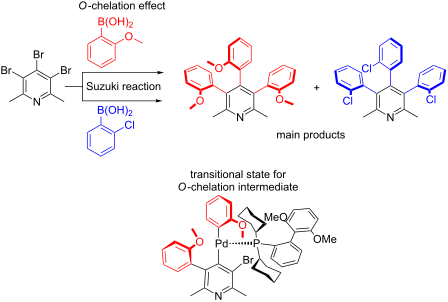
Some mechanistic aspects regarding the Suzuki–Miyaura reaction between selected ortho-substituted phenylboronic acids and 3,4,5-tribromo-2,6-dimethylpyridine
Beilstein J. Org. Chem. 2018, 14, 2384–2393, doi:10.3762/bjoc.14.214
- demanding chiral biaryldiols with excellent enantioselectivities [23]. Recently, highly atropselective synthesis of arylpyrroles by the catalytic asymmetric Paal–Knorr reaction for the synthesis of enantiomerically pure arylpyrroles was presented by Tan [25]. Also as an alternative to palladium couplings


Practical tetrafluoroethylene fragment installation through a coupling reaction of (1,1,2,2-tetrafluorobut-3-en-1-yl)zinc bromide with various electrophiles
Beilstein J. Org. Chem. 2018, 14, 2375–2383, doi:10.3762/bjoc.14.213

- apparatus [24] or reductive couplings with various carbonyl compounds [25], leading to good yields of versatile CF2CF2-containing substances. However, many obstacles to practical synthesis remain, e.g., the use of 1,2-dibromotetrafluoroethane (Halon-2402) with ozone depletion and global warming potentials


Cobalt bis(acetylacetonate)–tert-butyl hydroperoxide–triethylsilane: a general reagent combination for the Markovnikov-selective hydrofunctionalization of alkenes by hydrogen atom transfer
Beilstein J. Org. Chem. 2018, 14, 2259–2265, doi:10.3762/bjoc.14.201

- transfer (HAT) to the alkene substrate, followed by interception of the resulting alkyl radical intermediate with a SOMOphile. In addition, we report the first reductive couplings of unactivated alkenes and aryldiazonium salts by an HAT pathway. The simplicity and generality of the Co(acac)2–TBHP–Et3SiH


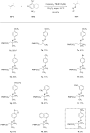
Cobalt-catalyzed peri-selective alkoxylation of 1-naphthylamine derivatives
Beilstein J. Org. Chem. 2018, 14, 2090–2097, doi:10.3762/bjoc.14.183
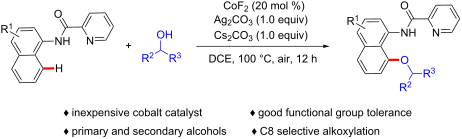
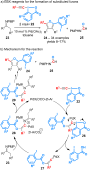
- structural units present in many natural products, functional materials, and pharmaceuticals [1]. Consequently, a variety of strategies have emerged to access them, including Pd-catalyzed and Cu-catalyzed coupling reactions (Buchwald–Harting couplings and Ullmann reactions) [2][3][4]. However, these classic


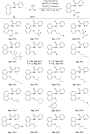


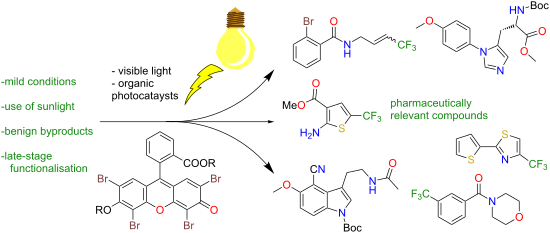
Applications of organocatalysed visible-light photoredox reactions for medicinal chemistry
Beilstein J. Org. Chem. 2018, 14, 2035–2064, doi:10.3762/bjoc.14.179
- heterocycle, and the benzene moiety can tolerate all manner of substituents in all positions, however, only mono-substituted systems are explored. This is a powerful procedure, which allows for the circumvention of traditional Pd or Cu catalysed couplings of heteroarenes, which are notoriously difficult. A
- C–C coupling reactions, is to consider the ability of organocatalysed photoredox reactions to perform reactions which create C–X (X = N, O, S) bonds, in reactions analogous to Buchwald or Chan–Lam couplings. An example of the creation of C–S bonds is given by Wang and co-workers, who have reported




Artificial bioconjugates with naturally occurring linkages: the use of phosphodiester
Beilstein J. Org. Chem. 2018, 14, 1946–1955, doi:10.3762/bjoc.14.169
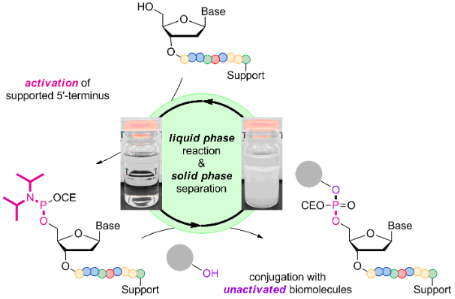
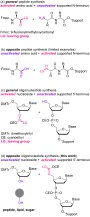
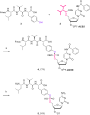
- -activated amino acids or 3’-terminal-activated nucleosides are coupled to the N- or 5’-terminus of the supported reactants via amide or phosphodiester linkages (Figure 1). Such couplings could also be possible in the opposite activating manner. Namely, the activation of the N- or 5’-terminus of the





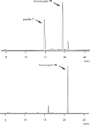
Lanyamycin, a macrolide antibiotic from Sorangium cellulosum, strain Soce 481 (Myxobacteria)
Beilstein J. Org. Chem. 2018, 14, 1554–1562, doi:10.3762/bjoc.14.132
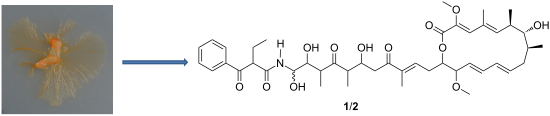
- and 8.75 ppm (J = 9.5 and 9.3 Hz) were identified as the NH and NH* signals of 1 and 2 from their correlation in the 15N,1H-HSQC NMR spectrum, respectively. They showed couplings to H-26 (4.96 ppm) and H-26* (4.91 ppm). The latter showed further 1H couplings to doublets of OH and OH* signals at 5.89


Hypervalent organoiodine compounds: from reagents to valuable building blocks in synthesis
Beilstein J. Org. Chem. 2018, 14, 1508–1528, doi:10.3762/bjoc.14.128
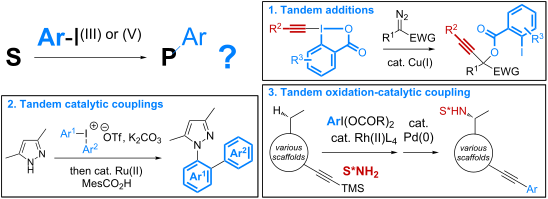
- achievements reported in this area. Keywords: atom-economy; couplings; hypervalent iodine; oxidation; tandem reactions; Introduction Synthetic applications of the hypervalent iodine chemistry have grown exponentially in the last four decades as highlighted by several books and comprehensive reviews dedicated
- , C–C, C–O, or C–N couplings, dearomatization of phenols, rearrangements, to name but a few, have been reported using these compounds thereby reflecting their versatility. A survey of the general structure of polyvalent organoiodine compounds reveals that they are prepared mostly from iodoarene
- reactions involving a step that enables the introduction of the iodoarene side-compound into the products. Various sequences combining oxidation reactions, nucleophilic additions, or aromatic couplings, thus, have been reported (Scheme 1b). In addition to address the issue of sustainability, this


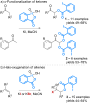




Metal-free formal synthesis of phenoxazine
Beilstein J. Org. Chem. 2018, 14, 1491–1497, doi:10.3762/bjoc.14.126
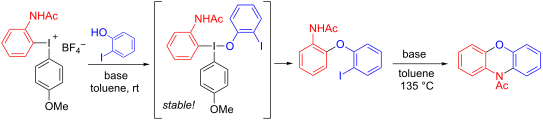
- recently, Bolm and co-workers reported a metal-free cyclization of iodo-substituted diaryl ethers with a broad scope (Scheme 1b) [18]. Transition metal-catalyzed cross couplings have also been employed to form the required C–O and C–N bonds, e.g., by Cu-catalyzed cyclization of 2-(2-bromophenoxy)anilines


Atom-economical group-transfer reactions with hypervalent iodine compounds
Beilstein J. Org. Chem. 2018, 14, 1263–1280, doi:10.3762/bjoc.14.108
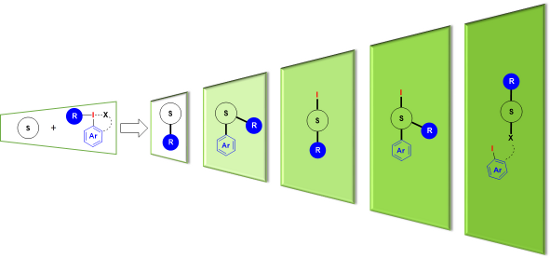
- ][40][41]. They have been widely applied in C–H oxygenations, nitrene generations, oxidative dearomatisations and dehydrogenative couplings by transferring one of their two carboxyl ligands or external oxygen nucleophiles to a substrate. In all these “classical” reactions aryl iodides are produced as
- iodoarenes 32. These species smoothly underwent subsequent Suzuki–Miyaura, Sonogashira and Mirozoki–Heck couplings. The respective arylated, alkynylated and alkenylated products 33a–d were obtained in high yields with excellent stereoselectivity. Due to the intramolecular pathway of the first step, high AE






A selective removal of the secondary hydroxy group from ortho-dithioacetal-substituted diarylmethanols
Beilstein J. Org. Chem. 2018, 14, 1229–1237, doi:10.3762/bjoc.14.105
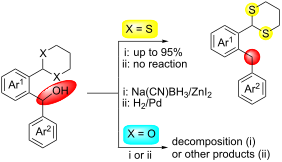
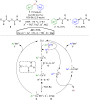
- reactions (e.g., Suzuki–Miyaura, Stille, Kumada, Hiyama or Negishi couplings) play a key role in the preparation of diarylmethanes. However, the reactions involving sulfur-containing moieties have not been reported yet (Scheme 1) [1]. It is noteworthy that under certain conditions, the Pd-catalyzed cross




One hundred years of benzotropone chemistry
Beilstein J. Org. Chem. 2018, 14, 1120–1180, doi:10.3762/bjoc.14.98
- benzotropylium ion 45. Secondly, 11 is obtained in 18% yield after benzylic bromination of 42 with NBS, followed by in situ elimination reaction of the labile bromide 43 mediated by t-BuOK (Scheme 9). Palladium-catalyzed C–C bond-formation reactions such as Heck and Sonogashira couplings are employed in a wide
- variety of areas in organic chemistry [56][57]. Recently, Shaabani’s group synthesized and characterized palladium nanoparticles supported on ethylenediamine-functionalized cellulose (PdNPs@EDACs) as a novel bio-supported catalyst for Heck and Sonogashira couplings in water [58]. Shaabani’s group reported








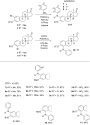
The first Pd-catalyzed Buchwald–Hartwig aminations at C-2 or C-4 in the estrone series
Beilstein J. Org. Chem. 2018, 14, 998–1003, doi:10.3762/bjoc.14.85

- desired products have been obtained in good to excellent yields. The nature and the position of the aniline substituent at the aromatic ring influenced the outcome of the couplings. 2-Amino-13α-estrone was also synthesized in a two-step protocol including an amination of 2-bromo-13α-estrone 3-benzyl ether
- in the amination step [9]. They also found that X-Phos is an outstanding ligand with increased activity and stability compared to those based on BINAP [10]. There are a number of literature methods with respect to microwave-assisted Buchwald–Hartwig couplings [11][12][13]. Many publications have
- (dba)3 as catalysts, X-Phos as a ligand, Cs2CO3 as a base in toluene or DMF solvent under thermal heating or microwave irradiation [18]. We recently described halogenations [19] and Sonogashira couplings on ring A of 13α-estrone and its 3-methyl ether [20]. The 13-epimer of natural estrone is a non


Cross-coupling of dissimilar ketone enolates via enolonium species to afford non-symmetrical 1,4-diketones
Beilstein J. Org. Chem. 2018, 14, 992–997, doi:10.3762/bjoc.14.84
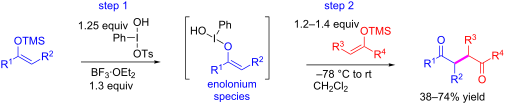
- intramolecular fashion has the double advantage of avoiding homocoupling as well as helping to overcome low reactivity in hindered systems such as cyclohexanone [12]. To the best of our knowledge there are only five examples of successful intermolecular couplings of dissimilar enolates. Two of these examples

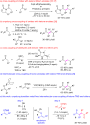


Bromide-assisted chemoselective Heck reaction of 3-bromoindazoles under high-speed ball-milling conditions: synthesis of axitinib
Beilstein J. Org. Chem. 2018, 14, 786–795, doi:10.3762/bjoc.14.66

- letermovir [8]. Hitherto, highly effective systems had been developed for the aryliodines that participated in Heck reactions with turn-over numbers of >1000 [9][10]. However, the couplings of bromo and chloro derivatives with unactivated alkenes still remain challenging. Though aryl bromides are always


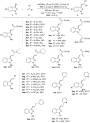

Nanoreactors for green catalysis
Beilstein J. Org. Chem. 2018, 14, 716–733, doi:10.3762/bjoc.14.61
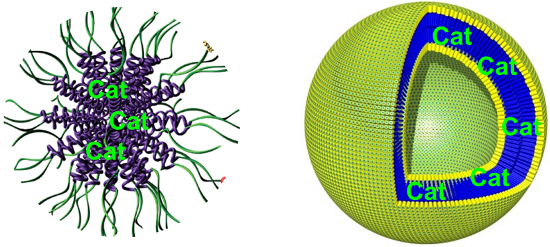
- reference [67]. Suzuki−Miyaura couplings with, or without, ppm Pd. Conditions: ArI 0.5 mmol 3a, Ar’B(OH)2 (0.75–1.00 mmol, 1.5–2.0 equiv) 3b, *with 200 ppm of Pd(OAc)2. Adapted from reference [70]. Copyright 2016 American Chemical Society. Cascade reaction with GOx and Myo. Adapted from reference [82


Heterogeneous Pd catalysts as emulsifiers in Pickering emulsions for integrated multistep synthesis in flow chemistry
Beilstein J. Org. Chem. 2018, 14, 648–658, doi:10.3762/bjoc.14.52
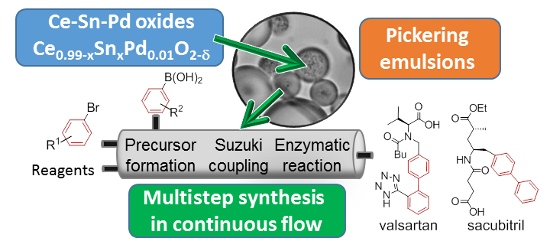
- oxide Ce0.99Pd0.01O2–δ showed to be least efficient for the explored Suzuki–Miyaura couplings. Regarding the selectivity of the catalysts in the selected cross-coupling reactions, no bromoarene-deriving side products (dehalogenation product Ar’ and bromoarene homocoupling product Ar’Ar’) could be
- of the catalytic active compounds. To assess the reusability of the heterogeneous catalysts, the Pd-substituted metal oxides were subjected to Suzuki–Miyaura couplings of 4-bromotoluene with phenylboronic acid in five subsequent reactions, i.e., after one reaction was finished, the particles were
- activities for Suzuki–Miyaura couplings in batch [37] and continuous flow [38]. After milling, the coarse and fine fractions of the particles were separated via sedimentation. For this purpose, 2 g of catalyst were suspended in 1 L water, the particles were de-aggregated by ultrasonic treatment and left to





Investigations towards the stereoselective organocatalyzed Michael addition of dimethyl malonate to a racemic nitroalkene: possible route to the 4-methylpregabalin core structure
Beilstein J. Org. Chem. 2018, 14, 553–559, doi:10.3762/bjoc.14.42
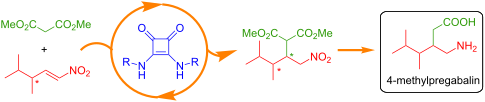
- amine 9 to compound 11 in two steps. However, under microwave heating conditions, both couplings of the amino group with squarate, as well as methoxymethyl (MOM) deprotection was observed. To the best of our knowledge, there is no report describing methanolysis of MOM-groups under microwave conditions


Preparation of trinucleotide phosphoramidites as synthons for the synthesis of gene libraries
Beilstein J. Org. Chem. 2018, 14, 397–406, doi:10.3762/bjoc.14.28
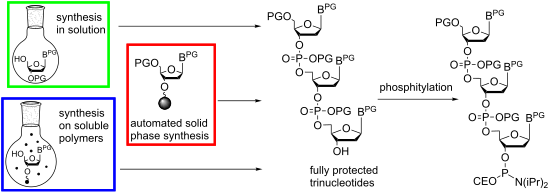
- –95%, preferentially with double or triple couplings, and a coupling time of 120 to 300 s [22][27][29]. Conclusion The synthesis of fully protected trimers can be achieved in solution, on a solid phase or on soluble supports. The key element is the choice of a suitable set of orthogonal protecting


Recent advances on organic blue thermally activated delayed fluorescence (TADF) emitters for organic light-emitting diodes (OLEDs)
Beilstein J. Org. Chem. 2018, 14, 282–308, doi:10.3762/bjoc.14.18




Fluorogenic PNA probes
Beilstein J. Org. Chem. 2018, 14, 253–281, doi:10.3762/bjoc.14.17
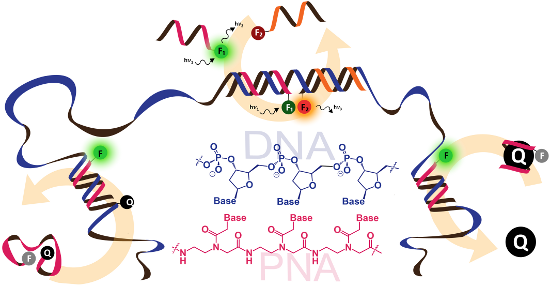
- uracils have also been extensively studied as fluorescent nucleobases in the context of aegPNA. Modifications have invariably been made at the 5-position of uracil, which could be functionalized by various aromatics or alkynes via palladium-catalyzed cross couplings of the corresponding iodouridine




Stereochemical outcomes of C–F activation reactions of benzyl fluoride
Beilstein J. Org. Chem. 2018, 14, 106–113, doi:10.3762/bjoc.14.6
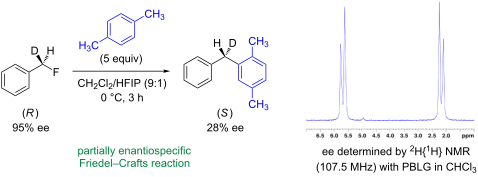
- with the electric field gradients associated with the orientated media, creating anisotropy and resolving into two sets of doublets. If there is sufficient resolution between these quadrupolar couplings, then the enantiomeric ratio can be recorded. We have used poly-γ-benzyl-L-glutamate (PBLG


Polarization spectroscopy methods in the determination of interactions of small molecules with nucleic acids – tutorial
Beilstein J. Org. Chem. 2018, 14, 84–105, doi:10.3762/bjoc.14.5
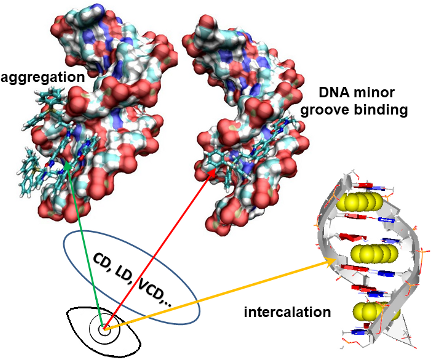
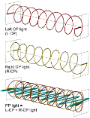
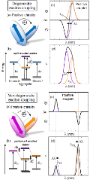
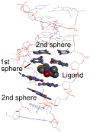
- affected by other contributions, e.g., the non-degenerate coupling between different guanosine transitions, long-range couplings between distant guanosines, etc. More interestingly for our purpose, ECD is a useful method for probing conformational changes of nucleic acid upon ligand binding. Moreover, as






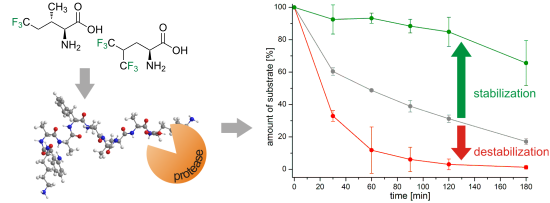
Position-dependent impact of hexafluoroleucine and trifluoroisoleucine on protease digestion
Beilstein J. Org. Chem. 2017, 13, 2869–2882, doi:10.3762/bjoc.13.279
- support by means of an Fmoc/tert-butyl protecting group strategy on a preloaded Fmoc-Lys(Boc)Wang resin (0.57 mmol/g loading) using 10 mL polypropylene reactors. HfLeu containing peptides were synthesized with an Activo-P11 automated peptide synthesizer (Activotec, Cambridge, United Kingdom). Couplings of
- non-fluorinated amino acids were performed in dimethylformamide (DMF) with the Fmoc-L-amino acid, 1-hydroxybenzotriazole (HOBt) and N,N’-diisocarbodiimide (DIC) in an eight-fold excess with respect to the resin amount. In order to ensure completion of the reaction the couplings were performed twice


Reactivity of bromoselenophenes in palladium-catalyzed direct arylations
Beilstein J. Org. Chem. 2017, 13, 2862–2868, doi:10.3762/bjoc.13.278

- ][5][6][7][8][9], Suzuki [10][11][12][13][14][15][16][17][18][19], or Kumada [20] couplings [21] (Scheme 1a and b). However, all these procedures require the preparation of an organometallic or a boron derivative of one of the coupling partners, and provide an organometallic salt (MX) as waste. In
- described. Therefore, the reactivity of 2-bromo- and 2,5-dibromoselenophenes in Pd-catalyzed direct couplings with heteroarenes needed to be investigated. Herein, we wish to report on the reactivity of 2-bromoselenophene, 2,5-dibromoselenophene and 2-aryl-5-bromoselenophenes in palladium-catalyzed direct