Search results
Search for "crystal structure" in Full Text gives 605 result(s) in Beilstein Journal of Organic Chemistry. Showing first 200.
Molecular diversity of the base-promoted reaction of phenacylmalononitriles with dialkyl but-2-ynedioates
Beilstein J. Org. Chem. 2022, 18, 991–998, doi:10.3762/bjoc.18.99

- displayed a singlet at 3.52 ppm for the hydroxy group and two singlets at 3.24, 3.96 ppm with J = 14.8 Hz for the two diastereotopic protons of the cyclic methylene unit. The single crystal structure of compound 3k was successfully determined by X-ray diffraction analysis (Figure 1). From Figure 1, it can
- the reaction was carried out in weak basic solution (Supporting Information File 1) and its single crystal structure was determined by X-ray diffraction (Figure 4). When DABCO was used as a base, the further addition of the alkoxide ion to the cyano group in cis-position of the cyclopentyl ring
- ]+ calcd for C39H39NaN3O12, 764.2431; found, 764.2413. Single crystal structure of compound 3k. Single crystal structure of compound 4a. Single crystal structure of compound 4c. Single crystal structure of compound 5. Representative cycloaddition reactions of phenacylmalononitriles. Proposed reaction


Synthesis of novel alkynyl imidazopyridinyl selenides: copper-catalyzed tandem selenation of selenium with 2-arylimidazo[1,2-a]pyridines and terminal alkynes
Beilstein J. Org. Chem. 2022, 18, 863–871, doi:10.3762/bjoc.18.87
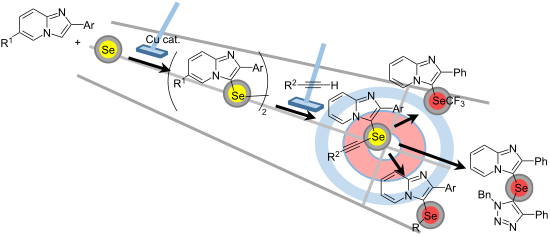
- . Figure 2a shows the crystal structure of 4aa, revealing that the ethynylselanyl group is located at the 3-position of the imidazo[1,2-a]pyridine core, and the bond angle of C1–Se–C2 was 100.45°. The imidazo[1,2-a]pyridine plane and the phenyl ring were observed to be slightly twisted, with a C2–C3–C4–C5
- crystallography details, and copies of spectra. Supporting Information File 77: X-ray crystal structure of 4aa. Supporting Information File 78: X-ray crystal structure of 8. Funding This research was supported by JSPS KAKENHI (Grant Number JP19K07005) (S. Y.). The authors also thank the research grant from



First series of N-alkylamino peptoid homooligomers: solution phase synthesis and conformational investigation
Beilstein J. Org. Chem. 2022, 18, 845–854, doi:10.3762/bjoc.18.85
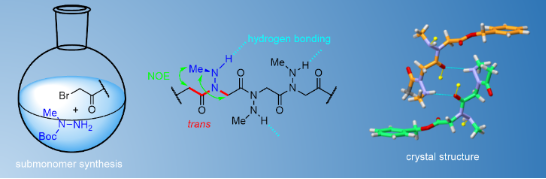
- crystal structure of dimer 2 confirms the trans geometry of the two amide bonds (Figure 3A). The unit cell contains eight molecules, including two groups of four identical molecules (Figure 3B), the conformation of the first group (conformation A, Table 2) being the mirror image of that observed for the
- –6 in various protic and aprotic solvents and of varying polarity indicates that the N-(methylamino)glycine units favor trans-amide bonds in proportions up to 90% in DMSO-d6. Adoption of trans-amide bonds was confirmed in the crystal structure of dimer 2. In addition to the control of the amide bond
- studied now in more detail. The crystal structure of dimer 2 also reveals the presence of intermolecular hydrogen bonding networks that could potentially be found in solution. It is also interesting to note that despite the lack of chirality, the two residues of peptoid 2 adopt the same conformation in


The stereochemical course of 2-methylisoborneol biosynthesis
Beilstein J. Org. Chem. 2022, 18, 818–824, doi:10.3762/bjoc.18.82
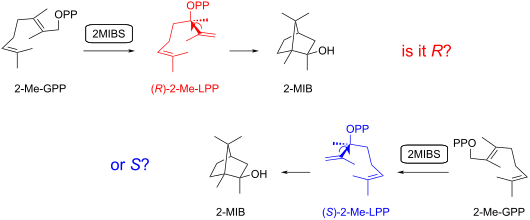
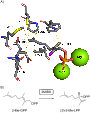
- isomerization to 2-Me-GPP and then to (R)-2-Me-LPP. Conclusively, these findings confirm Cane’s mechanistic proposal [23], while the observed conformation of 2FGPP in the crystal structure of 2MIBS may not represent the required conformation for 2-Me-GPP for the production of 1. A) Active site of 2MIBS with the
- bound substrate surrogate 2FGPP (generated with Pymol from the crystal structure, PDB code: 3V1X). B) Isomerization of 2-Me-GPP to (S)-2-Me-LPP, the hypothetical enantiomer expected for 2-Me-GPP in the same conformation as observed for 2FGPP. Structures of 2MIBS side products and spontaneous degradation




Thiophene/selenophene-based S-shaped double helicenes: regioselective synthesis and structures
Beilstein J. Org. Chem. 2022, 18, 809–817, doi:10.3762/bjoc.18.81
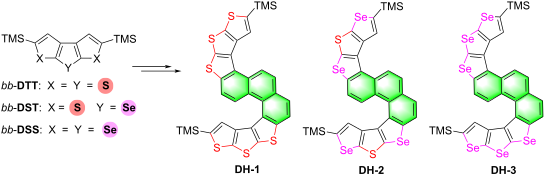
- packing structures of these compounds. Spectroscopic results and our previous work showed that the combination of molecular structure change and heteroatom replacement from S to Se could precisely modulate molecular energy levels. Keywords: crystal structure; double helicene; regioselective synthesis


Copper-catalyzed multicomponent reactions for the efficient synthesis of diverse spirotetrahydrocarbazoles
Beilstein J. Org. Chem. 2022, 18, 796–808, doi:10.3762/bjoc.18.80
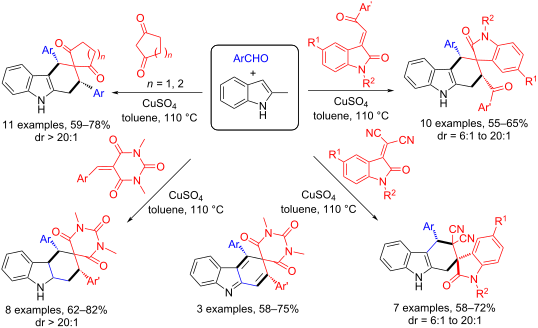
- smoothly to produce the corresponding products 5h–k in high yields with high diastereoselectivity. The single crystal structure of compound 5b (CCDC 2109580) clearly indicated that the two aryl groups are in cis-position. When we did not add the dienophiles to this system, 4-methylbenzaldehyde could react





Structural basis for endoperoxide-forming oxygenases
Beilstein J. Org. Chem. 2022, 18, 707–721, doi:10.3762/bjoc.18.71
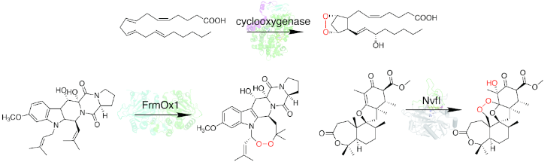
- role in the cyclooxygenase reaction. In the crystal structure, the catalytic Tyr385 residue is located at the interface between the active regions of the peroxidase-site and cyclooxygenase-site (Figure 2) [46][47][48][49][50][51]. Furthermore, the C13 of AA is located near the catalytic residue Tyr385
- in the crystal structure, indicating that a tyrosyl radical abstracts the pro-S hydrogen atom from C13 of AA (Figure 2B and 2C) [48][52][53]. Mechanism of the cyclooxygenase reaction The enzyme reaction is initiated upon Tyr385 activation by the oxyferryl heme cation radical, which is generated
- the partially closed conformation, the substrate binding mode in the crystal structure apparently shows a different stage of the reaction. The conformational changes of the loops, especially the flipping of Glu208, would contribute to alterations of the binding mode of the substrate and the long-lived


Tri(n-butyl)phosphine-promoted domino reaction for the efficient construction of spiro[cyclohexane-1,3'-indolines] and spiro[indoline-3,2'-furan-3',3''-indolines]
Beilstein J. Org. Chem. 2022, 18, 669–679, doi:10.3762/bjoc.18.68
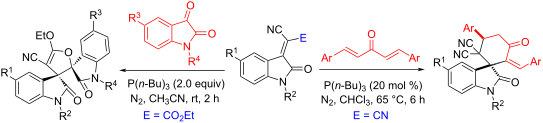
- are summarized in Table 3. Because there are three chiral carbon atoms in the molecule, several diastereoisomers can be formed in the reaction. The spiro[cyclohexane-1,3'-indolines] 5a–e were obtained in moderate to good yields. The single crystal structure of compound 5a was determined by X-ray
- of electron-donating methyl groups in the isatins gave higher yields than electron-withdrawing groups such as chloro and fluoro substituents. The structures of the spiro compounds 8a–m were fully characterized by their IR, HRMS, 1H and 13C NMR spectra. In addition, the single crystal structure of
- , 624.1666; found, 624.1660. Single crystal structure of compound 3l. Single crystal structure of compound 3s. Single crystal structure of compound 3f’. Single crystal structure of compound 5a. Single crystal struture of compound 8a. Proposed reaction mechanism for the compounds 3 and 5. Proposed mechanism


A study of the photochemical behavior of terarylenes containing allomaltol and pyrazole fragments
Beilstein J. Org. Chem. 2022, 18, 588–596, doi:10.3762/bjoc.18.61
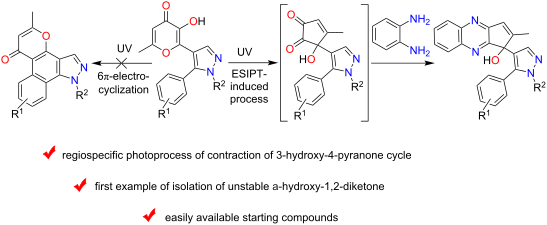
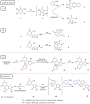
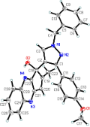
- synthesized products were confirmed by X-ray diffraction. 1H NMR monitoring of the photoreaction of compound 12a under UV irradiation (365 nm) in DMSO-d6 solution. The X-ray crystal structure of compound 15a. The X-ray crystal structure of compound 15m. The X-ray crystal structure of compound 18





Tosylhydrazine-promoted self-conjugate reduction–Michael/aldol reaction of 3-phenacylideneoxindoles towards dispirocyclopentanebisoxindole derivatives
Beilstein J. Org. Chem. 2022, 18, 469–478, doi:10.3762/bjoc.18.49
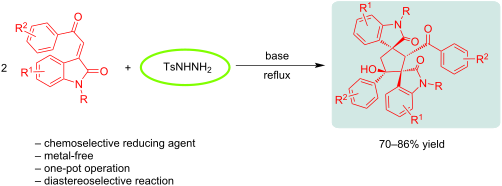
- (multiplet). HRMS with an ESI resource were acquired using a Waters XEVO-G2S Q TOF mass spectrometer. HPLC were recorded using an Agilent 1200 Series auto sampler HPLC system. Melting points were recorded with an open capillary on an electrical melting point apparatus and the single crystal structure of the


Organocatalytic asymmetric nitroso aldol reaction of α-substituted malonamates
Beilstein J. Org. Chem. 2022, 18, 217–224, doi:10.3762/bjoc.18.25

- /v, flow rate 1.0 mL/min, 254 nm, τminor = 13.0 min, τmajor = 13.9 min, 90% ee). HRMS (m/z): [M + Na]+ calcd for C17H17BrN2NaO4+, 415.0264; found, 415.0278. ORTEP diagram drawn with 30% ellipsoid probability for non-H atoms of the crystal structure of chiral compound 4a determined at 293 K. The




Anomeric 1,2,3-triazole-linked sialic acid derivatives show selective inhibition towards a bacterial neuraminidase over a trypanosome trans-sialidase
Beilstein J. Org. Chem. 2022, 18, 208–216, doi:10.3762/bjoc.18.24
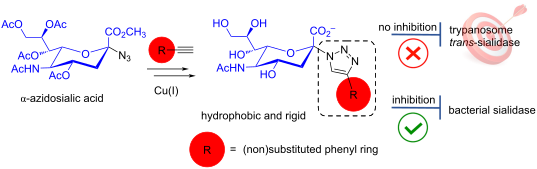
- derivatives 3a–h (1 mM) using a fluorimetric assay. DANA (2,3-dehydro-2-deoxy-N-acetylneuraminic acid) and PLP (pyridoxal phosphate) were used as positive controls at 1 mM. Crystal structure of TcTS (PDB code 1MS1 – coloured red) (A) and neuraminidase (PDB code 2VK6 – coloured green) (B) in complex with DANA



Efficient and regioselective synthesis of dihydroxy-substituted 2-aminocyclooctane-1-carboxylic acid and its bicyclic derivatives
Beilstein J. Org. Chem. 2022, 18, 77–85, doi:10.3762/bjoc.18.7
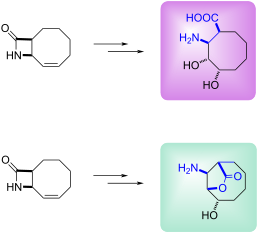
- , in contrast to the formation of the six-membered lactone 20. In addition, these novel compounds synthesized may be used as intermediates to design pharmacological tools. Examples of natural products containing β-amino acids. The X-ray crystal structure of 10. Solvent-corrected relative free energy


Bifunctional thiourea-catalyzed asymmetric [3 + 2] annulation reactions of 2-isothiocyanato-1-indanones with barbiturate-based olefins
Beilstein J. Org. Chem. 2022, 18, 25–36, doi:10.3762/bjoc.18.3
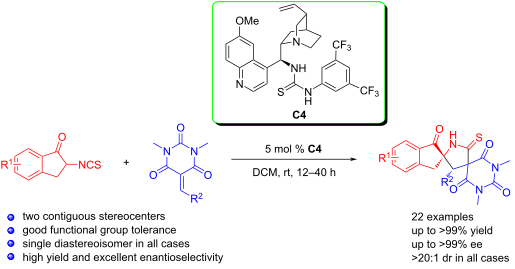
- scaffold. Selected examples of bioactive spirobarbiturates. The screened organocatalysts. X-ray crystal structure of 3ae (displacement ellipsoids are drawn at the 50% probability level). Known strategies and conceptual advance of this contribution. Substrate scope of 2-isothiocyanato-1-indanones. The




Host–guest interaction and properties of cucurbit[8]uril with chloramphenicol
Beilstein J. Org. Chem. 2021, 17, 2832–2839, doi:10.3762/bjoc.17.194
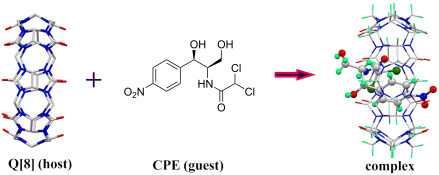
- ] and CPE was studied using single-crystal X-ray diffraction, UV–vis and 1H NMR spectroscopy, and the effects of Q[8] on the stability, in vitro release rate and antibacterial activity of CPE were investigated. Results and Discussion The host–guest interaction between Q[8] and CPE Single-crystal
- structure analysis of CPE@Q[8] The clathrate mode and crystal parameters of CPE and Q[8] were determined on a Bruker D8 Venture single-crystal diffractometer and shown in Figure 2 and Supporting Information File 1, Table S1, respectively. Figure 2A shows the interaction of CPE and Q[8] results in an
- formation of a O–H···O hydrogen bond, in which the bond distance between O20 and O5 was 2.921 Å. It can be seen that the CPE molecule is distorted at the C51 atom and the bond angle between C53–C51–N34 was 103.30°, which makes the CPE molecule fixed and enter the cavity of Q[8]. Figure 2C shows the crystal


Selective sulfonylation and isonitrilation of para-quinone methides employing TosMIC as a source of sulfonyl group or isonitrile group
Beilstein J. Org. Chem. 2021, 17, 2822–2831, doi:10.3762/bjoc.17.193
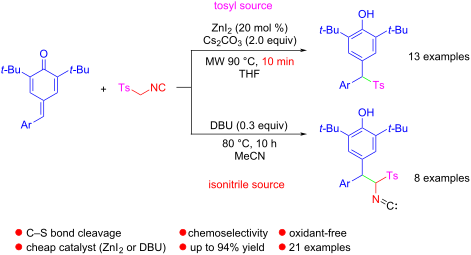
- mixture was stirred at 80 °C for 10 h and monitored by TLC. Then, the reaction mixture was concentrated under reduced pressure followed by column chromatography over silica gel using petroleum/EtOAc 10:1 to ≈5:1 as eluent to afford the desired product 4. Selected bioactive compounds. Crystal structure of


Photophysical, photostability, and ROS generation properties of new trifluoromethylated quinoline-phenol Schiff bases
Beilstein J. Org. Chem. 2021, 17, 2799–2811, doi:10.3762/bjoc.17.191
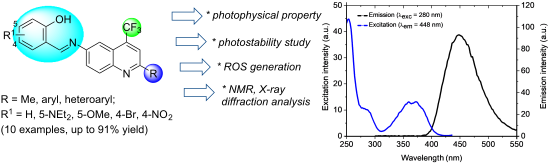
- the present study. ORTEP diagram of the crystal structure of (E)-2-(((2-phenyl-4-(trifluoromethyl)quinolin-6-yl)imino)methyl)phenol (3ba, CCDC 2036933). (a) Displacement ellipsoids are drawn at the 50% probability level, and circles with arbitrary radius represent the hydrogen atoms; (b) side view




The PIFA-initiated oxidative cyclization of 2-(3-butenyl)quinazolin-4(3H)-ones – an efficient approach to 1-(hydroxymethyl)-2,3-dihydropyrrolo[1,2-a]quinazolin-5(1H)-ones
Beilstein J. Org. Chem. 2021, 17, 2787–2794, doi:10.3762/bjoc.17.189
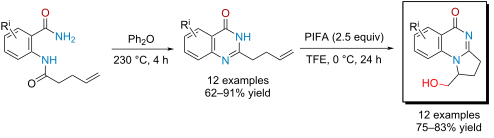
- +, 217.0972; found, 217.0973. Pyrrolo[1,2-a]quinazoline derivatives – analogs of vasicinone alkaloids and their biological activity. X-ray crystal structure of compound 6f. Synthetic approaches to 2,3-dihydropyrrolo[1,2-a]quinazolin-5(1H)-one derivatives. Plausible mechanism for the formation of 6. Synthesis


Targeting active site residues and structural anchoring positions in terpene synthases
Beilstein J. Org. Chem. 2021, 17, 2441–2449, doi:10.3762/bjoc.17.161
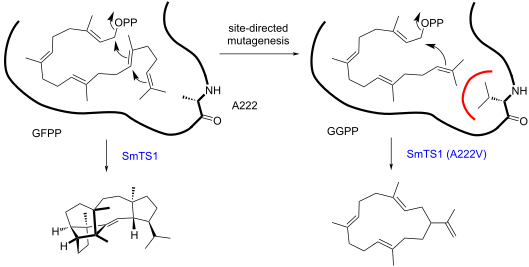
- functions as STPS and StTPS, the crystal structure of SdS [11] can be used as a template for SmTS1 to generate a Swiss homology model [20] (template pdb code 4OKM, Figure 3A). The active site residues of SdS make up a hydrophobic cavity (Figure 3B), that is structurally reflected in the SmTS1 model (Figure
- are also observed without enzyme. Swiss homology modelling of SmTS1. A) Superimposition of the SdS crystal structure (green) with the SmTS1 model (cyan). B) Active site residues of SdS. C) Active site residues of SmTS1. Active site residues that are smaller than in SdS are labelled in red. Green


Enantioselective PCCP Brønsted acid-catalyzed aminalization of aldehydes
Beilstein J. Org. Chem. 2021, 17, 2433–2440, doi:10.3762/bjoc.17.160
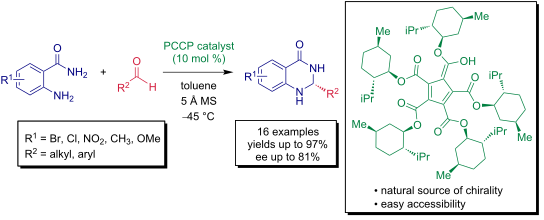
- strategies employing chiral Brønsted acid catalysis. X-ray single-crystal structure of aminal 3l with the displacement ellipsoids drawn at the 30% probability level. The substrate scope of the aminalization reaction for different aldehydes. aAfter recrystallization; breaction run at 1 mmol scale. The


Efficient synthesis of polyfunctionalized carbazoles and pyrrolo[3,4-c]carbazoles via domino Diels–Alder reaction
Beilstein J. Org. Chem. 2021, 17, 2425–2432, doi:10.3762/bjoc.17.159
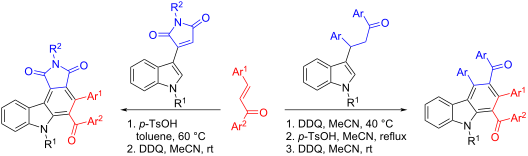
- crystal structure of compound 4g was determined by X-ray diffraction (Figure 4). It can be seen that the ring of pyrrolo[3,4-c]carbazole exists in a slightly twisted plane. The dihedral angles of the phenyl and the benzoyl group to the central benzene ring are 72.018° and 88.402°. To further expand the
- (CCDC 2099074), 3b (CCDC 2099075), and 4g (CCDC 2099076) have been deposited at the Cambridge Crystallographic Database Centre (http://www.ccdc.cam.ac.uk). Representative bioactive carbazole derivatives. Single crystal structure of the isomer 3a. Single crystal structure of the isomer 3b. Single crystal
- structure of the isomer 4g. Synthesis of tetrahydropyrrolo[3,4-c]carbazoles 3a and 3b. Proposed domino reaction mechanism for the formation of carbazoles 6. Synthesis of pyrrolo[3,4-c]carbazoles 4a–l.a Synthesis of the polysubstituted carbazoles 6a–n.a Supporting Information Supporting Information File 344


Synthesis and antimicrobial activity of 1H-1,2,3-triazole and carboxylate analogues of metronidazole
Beilstein J. Org. Chem. 2021, 17, 2377–2384, doi:10.3762/bjoc.17.154
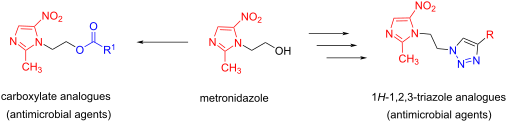
- . Crystal structure of compound 3. Colour codes: carbon = grey, mitrogen = blue, oxygen = red, hydrogen = white. Crystal structure of 1H-1,2,3-triazole compound 5c: Colour codes: carbon = grey, nitrogen = blue, oxygen = red, fluorine = yellow, hydrogen = white. Crystal structures of compound 7b. Colour


Constrained thermoresponsive polymers – new insights into fundamentals and applications
Beilstein J. Org. Chem. 2021, 17, 2123–2163, doi:10.3762/bjoc.17.138


Development of N-F fluorinating agents and their fluorinations: Historical perspective
Beilstein J. Org. Chem. 2021, 17, 1752–1813, doi:10.3762/bjoc.17.123
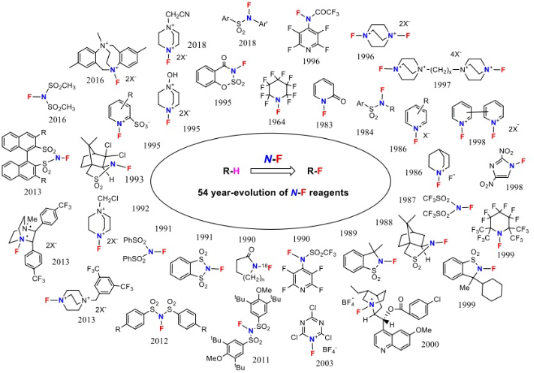










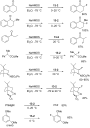

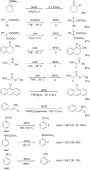


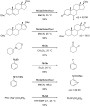


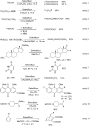


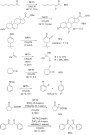


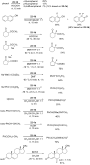

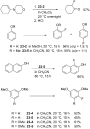


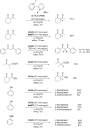








Chemical approaches to discover the full potential of peptide nucleic acids in biomedical applications
Beilstein J. Org. Chem. 2021, 17, 1641–1688, doi:10.3762/bjoc.17.116
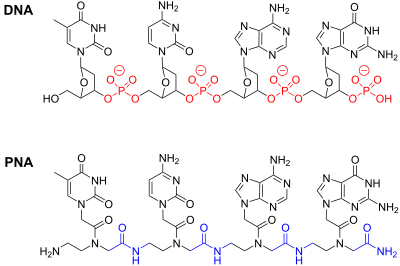
- conformation (C2′-endo), base pair inclination, and helical rise resembled B-DNA [39]. The first X-ray crystal structure of a PNA–DNA–PNA triplex revealed a previously unknown helix with a wide diameter of ≈26 Å (compared to 20 Å for A-form duplex) and a wide and deep major groove (Figure 3), given the name "P
- stabilizing interactions are better aligned. The crystal structure of a self-complementary PNA–PNA duplex was very similar to the P-form helix showing a wide helix (28 Å diameter) with a very large pitch of ≈18 base pairs per turn, compared to 10 and 11 base pairs per turn for DNA and RNA, respectively, and a
- nucleobase stacking pattern similar to that of the A-form RNA [43]. Another crystal structure of a partially self-complementary PNA–PNA duplex revealed PNA’s ability to combine the P-form Watson–Crick duplex with higher order structural features, such as reversed Hoogsteen base pairing, interstrand