


Search results
Search for "multicomponent reaction" in Full Text gives 140 result(s) in Beilstein Journal of Organic Chemistry.
Synthesis of spiro[dihydropyridine-oxindoles] via three-component reaction of arylamine, isatin and cyclopentane-1,3-dione
Beilstein J. Org. Chem. 2013, 9, 8–14, doi:10.3762/bjoc.9.2
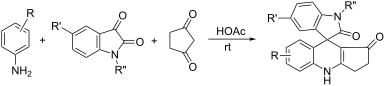
- scope of this novel reaction is briefly discussed. Keywords: arylamine; cyclopentanedione; isatin; multicomponent reaction; spiro compound; Introduction The spirooxindole is among the most important class of naturally occurring substances, characterized by highly pronounced biological properties, and
- [3][4][5][6]. Isatin and its derivatives may be the most useful starting materials or precursors in the synthesis of a wide number of spirocyclic oxindoles [7][8]. Due to its simple process, easy operation, efficiency and high atomic economy, the multicomponent reaction based on isatin and its


Dipyrazolo[1,5-a:4',3'-c]pyridines – a new heterocyclic system accessed via multicomponent reaction
Beilstein J. Org. Chem. 2012, 8, 2223–2229, doi:10.3762/bjoc.8.251
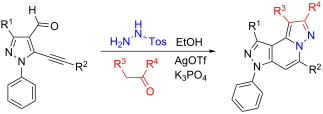
- multicomponent reaction affording new tricyclic compounds with a dipyrazolo[1,5-a:4',3'-c]pyridine core. Detailed NMR spectroscopic investigations (1H, 13C and 15N) were undertaken with all obtained compounds. Keywords: cyclization; nitrogen heterocycles; NMR spectroscopy; multicomponent reaction; pyrazole
- to the latter was achieved by a multicomponent reaction (MCR) starting from 5-alkynylpyrazole-4-carbaldehydes. Such MCRs, although being present since the early days of organic chemistry, nowadays attract an increasing interest because of their unmatched synthetic efficiency, which permits the
- conditions, firstly each step of the multicomponent reaction was carried out separately. According to the strategy, pyrazole-4-carbaldehyde 1a was primarily condensed with p-toluenesulfonyl hydrazide affording hydrazide 2a in 97% yield (Scheme 1). Secondly, two steps of the applied strategy were performed at


Features of the behavior of 4-amino-5-carboxamido-1,2,3-triazole in multicomponent heterocyclizations with carbonyl compounds
Beilstein J. Org. Chem. 2012, 8, 2100–2105, doi:10.3762/bjoc.8.236
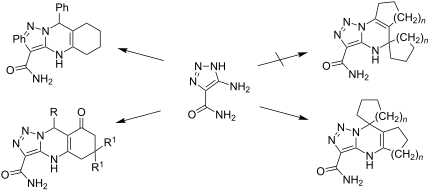
- ; heterocycle; microwave-assisted synthesis; multicomponent reaction; ultrasound-assisted synthesis; Introduction Multicomponent reactions (MCRs) [1][2][3][4] involving polyfunctional aminazoles as a key reagent are challenging objectives in the modern chemistry of heterocyclic compounds dealing with the



Regioselectivity in the multicomponent reaction of 5-aminopyrazoles, cyclic 1,3-diketones and dimethylformamide dimethylacetal under controlled microwave heating
Beilstein J. Org. Chem. 2012, 8, 18–24, doi:10.3762/bjoc.8.3
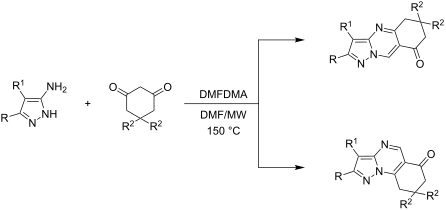
- 50918, Jeddah 21533, Kingdom of Saudi Arabia Chemistry Department, Faculty of Science, Kuwait University, PO Box 5969, Safat, 13060 Kuwait 10.3762/bjoc.8.3 Abstract The multicomponent reaction of 5-aminopyrazole derivatives with cyclic 1,3-dicarbonyl compounds and dimethylformamide dimethylacetal
- ., either kinetic or thermodynamic [11][12][13]. It has been reported that the use of microwave or ultrasound irradiation provides an additional parameter for synthetic selectivity [14][15][16][17]. Results and Discussion The multicomponent reaction of 5-aminopyrazoles, dimedone and aromatic aldehydes was
- one proton, which was assigned to the pyrazoloquinazolone C3 proton, and which indicates the lack of involvement of such a proton in the condensation leading to the tricyclic system. Although, it was previously reported [20] that, due to reduced steric hindrance, the multicomponent reaction of 5-amino



Synthesis of (−)-julocrotine and a diversity oriented Ugi-approach to analogues and probes
Beilstein J. Org. Chem. 2011, 7, 1504–1507, doi:10.3762/bjoc.7.175
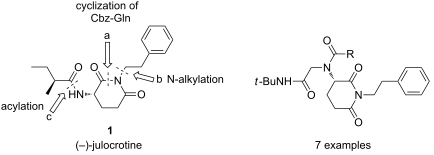
- analogues possess a protease-resistant peptoid scaffold and this might lead to an enhanced activity [19][20]. In this endeavor, all Ugi reactions were initiated by pre-imine formation of 5 and reaction with formaldehyde as the oxo-component, after which the multicomponent reaction was completed by the


Amines as key building blocks in Pd-assisted multicomponent processes
Beilstein J. Org. Chem. 2011, 7, 1387–1406, doi:10.3762/bjoc.7.163
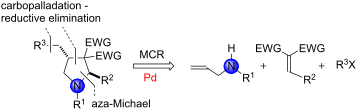
- advantage of this multicomponent reaction is to suppress the isolation of the pure form of the arylalkyne derivatives, which often represents a problem due to their ability to dimerize. This one-pot four-step reaction proceeded well with a series of electron-rich and electron-poor aryl iodide derivatives


Synthesis of diverse dihydropyrimidine-related scaffolds by fluorous benzaldehyde-based Biginelli reaction and post-condensation modifications
Beilstein J. Org. Chem. 2011, 7, 1294–1298, doi:10.3762/bjoc.7.150
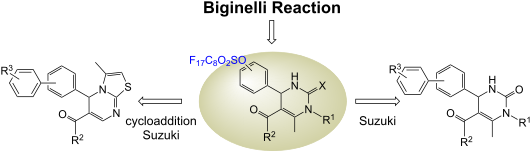
- achieved by conducting a multicomponent reaction for improved atom economy, under microwave heating for fast reaction, and with fluorous solid-phase extractions (F-SPE) for ease of purification. Keywords: Biginelli reaction; dihydropyrimidine; diversity-oriented synthesis; fluorous; Suzuki coupling


Multicomponent synthesis of artificial nucleases and their RNase and DNase activity
Beilstein J. Org. Chem. 2011, 7, 1135–1140, doi:10.3762/bjoc.7.131

- activity of the new compounds towards single-stranded RNA and double-stranded circular DNA. Keywords: DNA; isocyanide; multicomponent reaction; organocatalysis; peptidomimetic; RNA; Introduction RNA cleavage can serve as a molecular tool for biological research [1], as well as for development of


Multicomponent reaction access to complex quinolines via oxidation of the Povarov adducts
Beilstein J. Org. Chem. 2011, 7, 980–987, doi:10.3762/bjoc.7.110
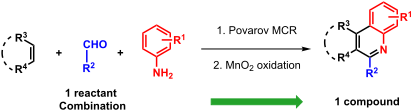
- tetrahydroquinolines obtained through the Povarov multicomponent reaction have been oxidized to the corresponding quinoline, giving access to a single product through a two-step sequence. Several oxidizing agents were studied and manganese dioxide proved to be the reagent of choice, affording higher yields, cleaner


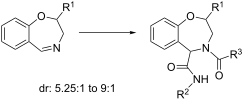
Long-range diastereoselectivity in Ugi reactions of 2-substituted dihydrobenzoxazepines
Beilstein J. Org. Chem. 2011, 7, 976–979, doi:10.3762/bjoc.7.109
- multicomponent reaction. Its great utility in the highly convergent and diversity-oriented synthesis of libraries of heterocyclic compounds, stemming from the possibility to introduce up to four diversity inputs in a single step, has been fully demonstrated [1][2][3][4][5]. However, a main drawback of this
- reaction, despite the fact that the stereogenic centre is only γ to the imine carbon (1,4 relative induction). This is, to our knowledge, the first example of 1,4 asymmetric induction in an isocyanide based multicomponent reaction of chiral carbonyl compounds or imines, and the first example of
- diastereoselectivity (from 5.25:1 up to 9:1) is completely unprecedented for an isocyanide based multicomponent reaction. A slight increase in the dr was observed on passing from R1 = Me to bulkier R1 = iBu. On the other hand the structure and the nature of both isocyanides and carboxylic acids seem to have little


A practical two-step procedure for the preparation of enantiopure pyridines: Multicomponent reactions of alkoxyallenes, nitriles and carboxylic acids followed by a cyclocondensation reaction
Beilstein J. Org. Chem. 2011, 7, 962–975, doi:10.3762/bjoc.7.108

- chains in the 2- and 6-positions is described. The presented two-step process utilizes a multicomponent reaction of alkoxyallenes, nitriles and carboxylic acids to provide β-methoxy-β-ketoenamides which are transformed into 4-hydroxypyridines in a subsequent cyclocondensation. The process shows broad
- substrate scope and leads to differentially substituted enantiopure pyridines in good to moderate yields. The preparation of diverse substituted lactic acid derived pyrid-4-yl nonaflates is described. Additional evidence for the postulated mechanism of the multicomponent reaction is presented. Keywords
- provide dihydropyridine 6. Elimination of trimethylsilanol and subsequent O-desilylation affords the 4-hydroxypyridine 7 (Scheme 1). The desired β-ketoenamides 4 are either accessible by acylation of enaminoketones or by a multicomponent reaction of lithiated alkoxyallenes, nitriles and carboxylic acids


Multicomponent reactions
Beilstein J. Org. Chem. 2011, 7, 960–961, doi:10.3762/bjoc.7.107
- and depsi-peptidic to heterocyclic structures; from reactivity-based to property-based concepts. The sympathetic reader, expert or newcomer, will find a tremendous degree of dynamic and exciting new results in this compilation of multicomponent reaction chemistry. As the guest editor of this Thematic
Palladium- and copper-mediated N-aryl bond formation reactions for the synthesis of biological active compounds
Beilstein J. Org. Chem. 2011, 7, 59–74, doi:10.3762/bjoc.7.10

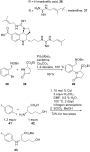
- contributing to the synthesis of murrazoline. Synthesis of vitamin E amines. Improved synthesis of martinellic acid. New tariquidar-derived ABCB1 inhibitors. β-Carbolin-1-ones as inhibitors of tumour cell proliferation. Copper-catalysed synthesis of promazine drugs. Palladium-catalysed multicomponent reaction




One-pot three-component synthesis of quinoxaline and phenazine ring systems using Fischer carbene complexes
Beilstein J. Org. Chem. 2010, 6, No. 52, doi:10.3762/bjoc.6.52
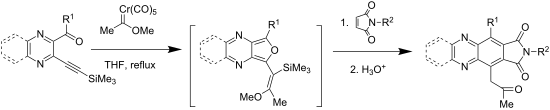
- approach to these ring systems is the annulation of benzene rings onto pre-existing heterocyclic rings [22]. This manuscript focuses on the successful execution of the latter transformation through a multicomponent reaction process to access these ring systems (Scheme 1). The synthetic approach involves a


Zeolite catalyzed solvent- free one-pot synthesis of dihydropyrimidin- 2(1H)-ones – A practical synthesis of monastrol
Beilstein J. Org. Chem. 2009, 5, No. 4, doi:10.3762/bjoc.5.4
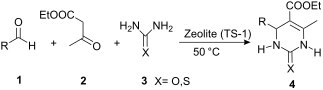
- monastrol, a potent inhibitor of kinesin Eg5. Keywords: Biginelli reaction; DHPMs; neat; MCR; zeolite; Introduction The Biginelli reaction is a well-known multicomponent reaction involving a one-pot cyclocondensation of an aldehyde, β-ketoester and urea/thiourea [1][2][3]. Multicomponent reactions (MCRs





