


Search results
Search for "asymmetric synthesis" in Full Text gives 234 result(s) in Beilstein Journal of Organic Chemistry. Showing first 200.
Stereoselective synthesis of perillaldehyde-based chiral β-amino acid derivatives through conjugate addition of lithium amides
Beilstein J. Org. Chem. 2014, 10, 2738–2742, doi:10.3762/bjoc.10.289

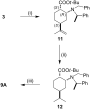
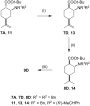
- addition was observed. Amino ester 11 was obtained as a single product and transformed to the corresponding amino acids 10A and 10D in good yields on the gram scale. Keywords: asymmetric synthesis; β-amino acid; chiral; Michael addition; monoterpene; Introduction In the past decade, cyclic β-amino acids


Selenium halide-induced bridge formation in [2.2]paracyclophanes
Beilstein J. Org. Chem. 2014, 10, 2550–2555, doi:10.3762/bjoc.10.266
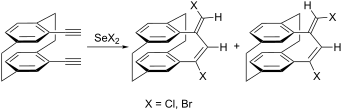
- systems and their ability to form charge-transfer complexes [4][5][6][7]. Much attention is also being paid to the development of new functionalized [2.2]paracyclophanes that can be used in asymmetric synthesis [8], while the formation of new bridges, particularly functionalized ones, has been somewhat


Application of cyclic phosphonamide reagents in the total synthesis of natural products and biologically active molecules
Beilstein J. Org. Chem. 2014, 10, 1848–1877, doi:10.3762/bjoc.10.195
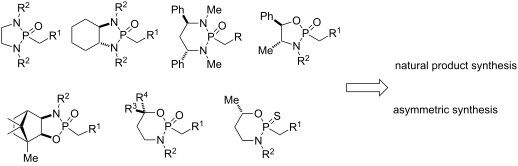
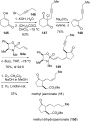
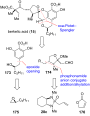
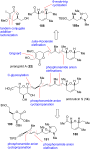
- products or bioactive molecules will be discussed [10]. Similar technologies to the ones discussed here without such applications and other uses of chiral phosphonamide reagents in asymmetric synthesis such as Denmark’s carbanion-accelerated Claisen rearrangements [11][12] have been reviewed elsewhere [13
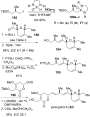
- mGluR agonist DCG-IV (162) (Figure 9) as a potent anticonvulsant and neuroprotective agent [123] had sparked interest in more efficient routes for its synthesis. Pellicciari and Marinozzi developed an asymmetric synthesis of DCG-IV (162) based on Hanessian’s cyclopropanation protocol (Scheme 20) [57












Proton transfers in the Strecker reaction revealed by DFT calculations
Beilstein J. Org. Chem. 2014, 10, 1765–1774, doi:10.3762/bjoc.10.184

- first asymmetric Strecker reaction [4]. The first asymmetric synthesis of α-aminonitirles via a chiral catalyst [5]. A reaction model composed of Me-CH=O, HCN, NH3 and (H2O)10 for geometry optimizations to trace elementary processes. Broken lines stand for hydrogen bonds. Possible pathways for the


Concise total synthesis of two marine natural nucleosides: trachycladines A and B
Beilstein J. Org. Chem. 2014, 10, 1681–1685, doi:10.3762/bjoc.10.176

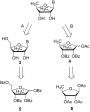
- chemical structure for the first time. Results and Discussion Until now, there is only one publication about the total synthesis of analogues of trachycladines A and B. In 2005, Enders et al. reported the first asymmetric synthesis of 4′-epi-trachycladines A and B in 14 steps. They used 2,2-dimethyl-1,3





Stereoselective synthesis of carbocyclic analogues of the nucleoside Q precursor (PreQ0)
Beilstein J. Org. Chem. 2014, 10, 1333–1338, doi:10.3762/bjoc.10.135

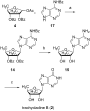
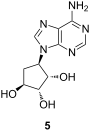
- triol 16. To extend into hydrophobic chemical space around our PreQ0 analogues, we prepared two novel derivatives containing the unusual 3-arylcyclohexylamine chiral motif present in 21 and 22. Zhou et al. had reported an asymmetric synthesis leading to the cis-3-arylcyclohexanamines with reasonable




Heronapyrrole D: A case of co-inspiration of natural product biosynthesis, total synthesis and biodiscovery
Beilstein J. Org. Chem. 2014, 10, 1228–1232, doi:10.3762/bjoc.10.121
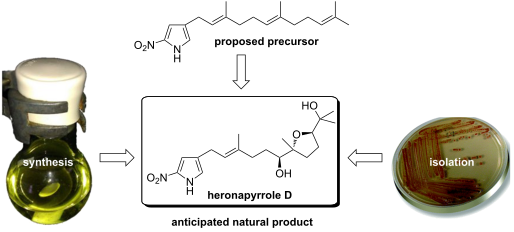
- sesquiterpenyl subunit in heronapyrroles A–C provoked the hypothesis that there might exist other hitherto unidentified metabolites. On biosynthetic grounds a mono-tetrahydrofuran-diol named heronapyrrole D appeared a possible candidate. We here describe a short asymmetric synthesis of heronapyrrole D, its
- produce an alternative bis-epoxy intermediate 3 that can deliver a hitherto undetected mono-tetrahydrofuran heronapyrrole (e.g., heronapyrrole D, Scheme 1). To test this hypothesis we completed an asymmetric synthesis of the putative natural product heronapyrrole D, and used this material to probe
- Streptomyces sp. (CMB-M0423) cultivations to test whether heronapyrrole D is indeed a natural product. The asymmetric synthesis of heronapyrrole D commenced with enantiomerically pure diol 8 (Scheme 2) synthesized in five steps from commercially available TIPS-protected 3-bromopyrrole 7 [3]. This reaction


Atherton–Todd reaction: mechanism, scope and applications
Beilstein J. Org. Chem. 2014, 10, 1166–1196, doi:10.3762/bjoc.10.117

- reduction of a prochiral ketone. The phosphoramidate (Scheme 32-iii) was the most efficient catalyst for these two reactions (ee: 95–98%, conversion 87–98%). In relation with asymmetric synthesis, the determination of the enantiomeric excess (ee) is usually achieved by different methodologies including




Preparation of phosphines through C–P bond formation
Beilstein J. Org. Chem. 2014, 10, 1064–1096, doi:10.3762/bjoc.10.106
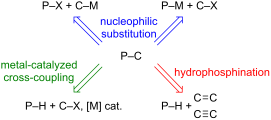
- asymmetric synthesis [5][6]. Only a minor part of the chiral phosphines are chiral at the phosphorus atom (P-stereogenic) [7][8][9]. A major drawback of phosphines is their highly oxidizable nature. They are easily converted to the corresponding phosphine oxide which makes the isolation difficult. To prevent
- phosphine–borane complex 13b (Scheme 23) [165]. Chiral phosphines with a C-stereogenic center have been studied but this was the first attempt for the asymmetric synthesis of a P-stereogenic compound. After evaluating several conditions the best catalyst was (S,S)-Me-DuPhos (46). An enantioenriched


Group-assisted purification (GAP) chemistry for the synthesis of Velcade via asymmetric borylation of N-phosphinylimines
Beilstein J. Org. Chem. 2014, 10, 746–751, doi:10.3762/bjoc.10.69
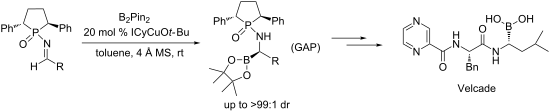
- biological research [1][2][3][4][5][6][7][8]. In the past several years, asymmetric catalysis and auxiliary-directed asymmetric synthesis has been conducted for assembling adjacent chiral centers of boronic aicds [9][10][11][12][13], but only a few methods for generating chiral α-aminoboronic acids have been


Synthesis of (2S,3R)-3-amino-2-hydroxydecanoic acid and its enantiomer: a non-proteinogenic amino acid segment of the linear pentapeptide microginin
Beilstein J. Org. Chem. 2014, 10, 667–671, doi:10.3762/bjoc.10.59
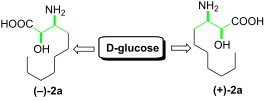
- -groups to olefinic acid by either asymmetric epoxidation, dihydroxylation or aminohydroxylation [10][11][12][13][14][15], (ii) the asymmetric synthesis of β-lactams by a Staudinger reaction between ketene and imine to give the corresponding amino acids [16], and (iii) the Lewis acid catalyzed


Synthesis of chiral N-phosphinyl α-imino esters and their application in asymmetric synthesis of α-amino esters by reduction
Beilstein J. Org. Chem. 2014, 10, 653–659, doi:10.3762/bjoc.10.57
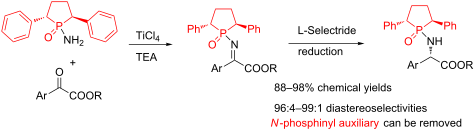
- them for the asymmetric synthesis of α-amino esters. Herein, we report for the first time the synthesis of N-phosphinyl-protected α-imino esters (Figure 1c), followed by the reduction of these α-imino esters by L-selectride, to give the corresponding α-amino esters with excellent yields (88–98%) and
- used for the asymmetric synthesis of α-amino esters through reduction. The reduction condition scan was firstly focused on the examination of reductants. A number of reductants, including Hantzsch ester, silanes, organoaluminum and boranes were tested in the system. Unfortunately, silanes failed to


Silver and gold-catalyzed multicomponent reactions
Beilstein J. Org. Chem. 2014, 10, 481–513, doi:10.3762/bjoc.10.46
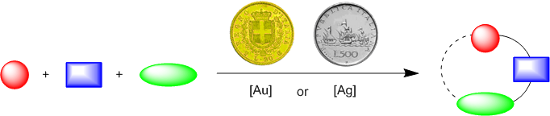


Synthesis and stereochemical assignments of diastereomeric Ni(II) complexes of glycine Schiff base with (R)-2-(N-{2-[N-alkyl-N-(1-phenylethyl)amino]acetyl}amino)benzophenone; a case of configurationally stable stereogenic nitrogen
Beilstein J. Org. Chem. 2014, 10, 442–448, doi:10.3762/bjoc.10.41

- observed depending on the substituent R introduced in the starting ligand, and stereochemical assignments were based on X-ray analysis, along with NMR studies and optical rotation measurements. Keywords: amino acids; asymmetric synthesis; Ni(II) complexes; Schiff bases; stereogenic nitrogen; Introduction


Concise, stereodivergent and highly stereoselective synthesis of cis- and trans-2-substituted 3-hydroxypiperidines – development of a phosphite-driven cyclodehydration
Beilstein J. Org. Chem. 2014, 10, 369–383, doi:10.3762/bjoc.10.35
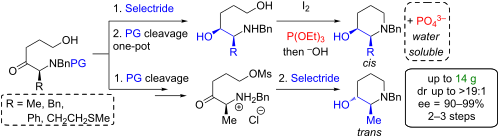
- overcoming separation difficulties usually associated to triphenylphosphine oxide. Keywords: amino acids; asymmetric synthesis; cyclodehydration; hydroxypiperidines; natural products; one-pot; Introduction 1,2-Amino alcohols of the type A (Figure 1) represent a frequent core motif of many pharmacologically
- active natural products [1][2][3][4][5][6][7][8][9], chiral auxiliaries [10][11] and catalysts for asymmetric synthesis [12][13][14]. Especially the 2-substituted 3-hydroxypiperidine scaffold of the general structure B (as one type of an 1,2-amino alcohol) can be found in numerous natural products and


Boron-substituted 1,3-dienes and heterodienes as key elements in multicomponent processes
Beilstein J. Org. Chem. 2014, 10, 237–250, doi:10.3762/bjoc.10.19

- -phenylmaleimide and 4-phenyltriazoline-3,5-dione. Asymmetric synthesis of a α-hydroxyalkylcyclohexane. Tandem [4 + 2]-cycloaddition/allylboration of 3-silyloxy- and 4-alkoxy-dienyl boronates. Metal-mediated cycloisomerization/Diels–Alder reaction/allylboration sequence. Cobalt-catalyzed Diels–Alder/allylboration


Total synthesis of (+)-grandiamide D, dasyclamide and gigantamide A from a Baylis–Hillman adduct: A unified biomimetic approach
Beilstein J. Org. Chem. 2014, 10, 127–133, doi:10.3762/bjoc.10.9
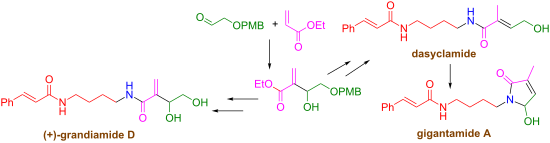
- , (+)-grandiamide D, dasyclamide and gigantamide A, isolated from leaves of Aglaia gigantea, by making use of a common synthetic intermediate prepared by the Baylis–Hillman reaction. Asymmetric synthesis of the natural (+)-grandiamide D was accomplished from camphor sultam. Keywords: Baylis–Hillman reaction
- 16.6% overall yield. The spectral data obtained for synthetic compound (±)-5 matches in all respect with the data reported for the natural product [7]. Asymmetric synthesis of (+)-grandiamide D (5) In continuation, we moved on with an asymmetric approach towards the synthesis of natural product
- to get (−)-gigantamide by lipase catalyzed kinetic resolution in line with the reported method for R-jatropham [23] was not successful. Conclusion In conclusion, a facile synthesis of (±)-grandiamide D (5), dasyclamide (6) and gigantamide A (7) and asymmetric synthesis of natural (+)-grandiamide D (5


Garner’s aldehyde as a versatile intermediate in the synthesis of enantiopure natural products
Beilstein J. Org. Chem. 2013, 9, 2641–2659, doi:10.3762/bjoc.9.300
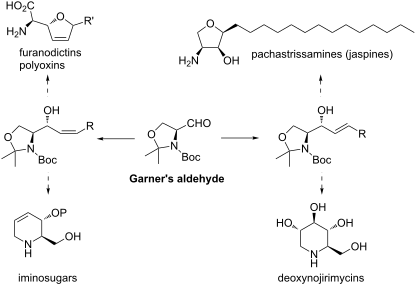
- deleterious epimerization of the existing stereocenter in Garner’s aldehyde. Keywords: asymmetric synthesis; Garner’s aldehyde; natural product synthesis; L-serine; Introduction “The universe is a dissymmetrical whole. I am inclined to think that life, as manifested to us, must be a function of the
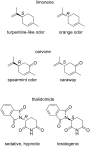
- antiemetic in the 1960s. The (S)-enantiomer turned out to be teratogenic. The crucial role of chirality presents a great challenge for synthetic chemists. Asymmetric synthetic methods have emerged and after the development of ample analytical methods over the last few decades, asymmetric synthesis has seen
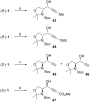
- formed the nucleophile reductively from pentadecyne with iBu2AlH in THF [44]. This vinylalane provided the syn-adduct 16 in modest stereoselectivity (1:2 anti/syn). For the addition reaction to be feasible for asymmetric synthesis, the configurational integrity during this step is important. Garner and





Bidirectional cross metathesis and ring-closing metathesis/ring opening of a C2-symmetric building block: a strategy for the synthesis of decanolide natural products
Beilstein J. Org. Chem. 2013, 9, 2544–2555, doi:10.3762/bjoc.9.289
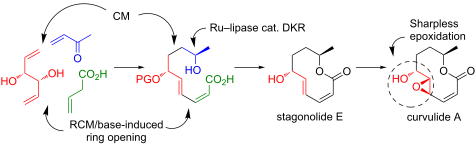
- at C6 could not be clarified. For the epoxide moiety of curvulide A, only the relative configurations at C4 and C5 were elucidated based on H,H-coupling constants (Figure 1) [30]. So far, two syntheses of stagonolide E have been published, which both rely on asymmetric synthesis for establishing both


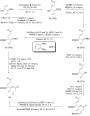


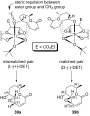


An overview of the synthetic routes to the best selling drugs containing 6-membered heterocycles
Beilstein J. Org. Chem. 2013, 9, 2265–2319, doi:10.3762/bjoc.9.265
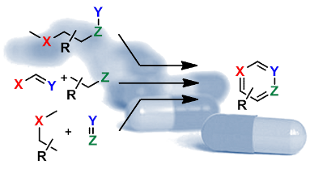


Non-cross-linked polystyrene-supported 2-imidazolidinone chiral auxiliary: synthesis and application in asymmetric alkylation reactions
Beilstein J. Org. Chem. 2013, 9, 2113–2119, doi:10.3762/bjoc.9.248

- auxiliaries; chiral carboxylic acids; 2-imidazolidinone; non-cross-linked polystyrene; Introduction Chiral auxiliaries have been proven as a powerful tool for the asymmetric synthesis of highly optical pure compounds used in pharmaceuticals or agrochemicals [1][2]. The recycling and reuse of expensive chiral
- for asymmetric synthesis, into the solid support [18][19]. As a part of our ongoing research, we herein report a novel NCPS-supported 2-imidazolidinone chiral auxiliary that exhibited excellent diastereocontrol. Its recycling and reuse for the synthesis of several chiral carboxylic acids are addressed


A concise enantioselective synthesis of the guaiane sesquiterpene (−)-oxyphyllol
Beilstein J. Org. Chem. 2013, 9, 2028–2032, doi:10.3762/bjoc.9.239
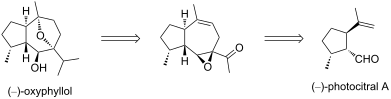
- the total synthesis of the anticancer guaiane (−)-englerin A. A regio- and diastereoselective Co(II)-catalyzed hydration of the olefin and a transannular epoxide opening were used as the key reactions. Keywords: asymmetric synthesis; hydration; natural products; terpenes; transannular epoxide opening


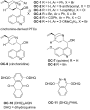
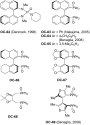
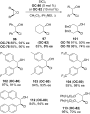
Organocatalyzed enantioselective desymmetrization of aziridines and epoxides
Beilstein J. Org. Chem. 2013, 9, 1677–1695, doi:10.3762/bjoc.9.192
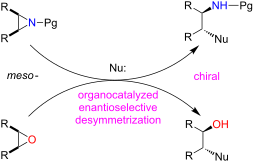
- ; Introduction The high demand of enantiopure organic compounds in the fine chemical industry gives impetus to the development of chiral technologies. Among them, the catalytic asymmetric synthesis represents the state of the art in organic chemistry [1]. Over the past four decades, the asymmetric synthesis








Asymmetric synthesis of a highly functionalized bicyclo[3.2.2]nonene derivative
Beilstein J. Org. Chem. 2013, 9, 655–663, doi:10.3762/bjoc.9.74
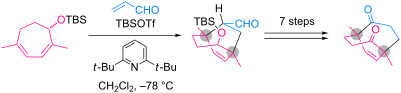
- ; m.p. 55 °C; [α]D20 +260 (c 0.37, CHCl3). Other analytical data of 1 were identical to those reported by our group previously [11]. Structure of ryanodine and the Diels–Alder reactions for construction of the potential intermediates of ryanodine. Asymmetric synthesis of 7 and determination of the
- effectively promoted by TBSOTf to produce a bicyclo[3.2.2]nonene derivative bearing two quaternary carbons. Seven additional transformations from the obtained bicycle delivered the C2-symmetric bicyclo[3.3.2]decene derivative, a key intermediate in our synthetic study of ryanodine. Keywords: asymmetric
- synthesis; C2-symmetry; catalysis; Diels–Alder reaction; Lewis acid; natural product; quaternary carbon; Introduction Ryanodine (Scheme 1) [1][2][3] is a potent modulator of the intracellular calcium release channels, known as ryanodine receptors [4][5]. Its complex architecture, including eight contiguous


Efficient synthesis of β’-amino-α,β-unsaturated ketones
Beilstein J. Org. Chem. 2013, 9, 486–495, doi:10.3762/bjoc.9.52

- reaction of chiral imines with enolates derived from Weinreb amides [13][14]. In previous work on the asymmetric synthesis of 2,6-disubstituted piperidines by C–N bond formation, we demonstrated that intramolecular aza-Michael ”type” cyclisation [15] using a β'-carbamate-α,β-unsaturated ketone
- devised for the asymmetric synthesis of β’-amino-protected-α,β enones, a valuable intermediate for the synthesis of trans 2,6-disubstituted piperidines. The scope and limitation of the aza-Michael reaction were studied with a range of substrates. We are currently working on the application of this
- = 15.9, 4.2 Hz, 1H), 2.71 (dd, J = 15.9, 6.5 Hz, 1H), 1.19 (d, J = 6.8 Hz, 3H), 1.14 (t, J = 6.9 Hz, 3H); 13C NMR (101 MHz, CDCl3) δ 198.8, 155.9, 143.4, 134.3, 130.6, 128.9, 128.4, 126.3, 60.6, 46.3, 44.1, 20.5, 14.6; HRMS-ESI (M + Na): calcd. for C15H19NO3Na 284.1263, found 284.1275. Asymmetric





