Search results
Search for "switching" in Full Text gives 332 result(s) in Beilstein Journal of Organic Chemistry. Showing first 200.
Multicomponent reactions (MCRs): a useful access to the synthesis of benzo-fused γ-lactams
Beilstein J. Org. Chem. 2019, 15, 1065–1085, doi:10.3762/bjoc.15.104
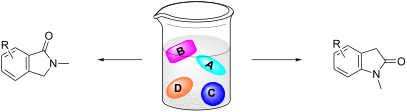
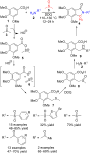
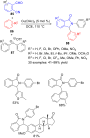
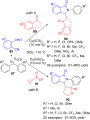
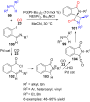
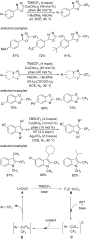
- no reaction in some cases. In addition to above mentioned benzene derivatives, heteroaromatic boronic acids also worked well under the reaction conditions and provided high yields of the corresponding oxindoles 131. Finally, switching the N-substituent in the starting propiolamide 128 by a H or a Bn


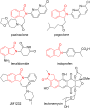
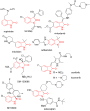








Azologization of serotonin 5-HT3 receptor antagonists
Beilstein J. Org. Chem. 2019, 15, 780–788, doi:10.3762/bjoc.15.74
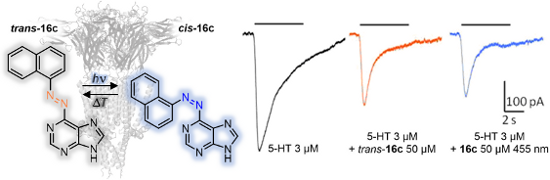
- photo-induced trans–cis isomerization representing the time of birth of the azobenzene photoswitch. Benefiting of their accessible synthesis, large change in polarity and geometry upon switching, excellent photochromic properties and tuneability, azobenzenes are amongst the most widely used photochromic
- absorption spectrum upon switching (= isosbestic points) indicate a clear two-component switching between trans and cis-species without any degradation or formation of a side-product (Figure 1, dotted black arrows). The UV–vis absorption spectra of all compounds are depicted in Supporting Information File 1
- switching is required. In case of thermally stable cis-isomers constant irradiation to maintain a substantial amount of the cis-isomer can be avoided. Patch-clamp studies The synthesized azo antagonist derivatives 5a, 5b, 12a, 16a–d, 23, and 28 were tested for their inhibitory activity using the patch-clamp


Synthesis of functionalized diazocines for application as building blocks in photo- and mechanoresponsive materials
Beilstein J. Org. Chem. 2019, 15, 727–732, doi:10.3762/bjoc.15.68
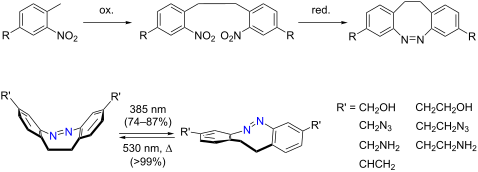
- , amine and vinyl groups, which are suitable for polymer synthesis. Upon irradiation at 385 and 530 nm the diazocines perform a reversible, pincer-type movement switching the 3,3’-distance between 6.1 Å (cis, stable isomer) and 8.2 Å (trans, metastable isomer). Key reactions in the synthesis are an
- to 3,3’- and 4,4’-diaminodiazocine, which have been implemented in macromolecules for conformation switching, our compounds exhibit improved photophysical properties (photostationary states, separation of absorption bands in the cis and trans configuration). Hence they are promising candidates as
- functionalized compounds are rare [19][20][21][22][23]. In contrary to azobenzenes, diazocines 1 are stable in their cis configuration. The bent cis isomer is less prone to π–π stacking which is known to reduce the switching efficiency (Figure 1a) [19][24]. The reverse stability of the cis and trans isomers in


Synthesis and fluorescent properties of N(9)-alkylated 2-amino-6-triazolylpurines and 7-deazapurines
Beilstein J. Org. Chem. 2019, 15, 474–489, doi:10.3762/bjoc.15.41
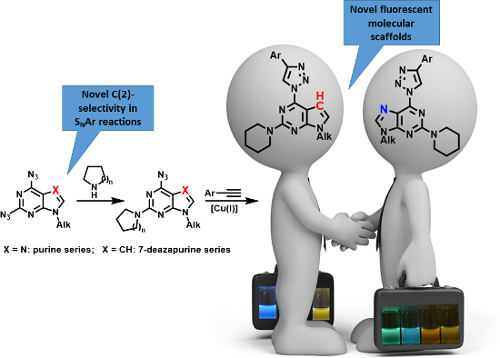
- Dimroth–Reichardt polarity parameter (ET(30)) [54] was observed (Figure 6) for both classes of compounds. For example, the fluorescence QY of 7-deazapurine 11c in THF were determined to be 0.76 and non-detectable in methanol. Similarly, QY of purine 8c dropped from 0.56 to <0.01 by switching between the




6’-Fluoro[4.3.0]bicyclo nucleic acid: synthesis, biophysical properties and molecular dynamics simulations
Beilstein J. Org. Chem. 2018, 14, 3088–3097, doi:10.3762/bjoc.14.288
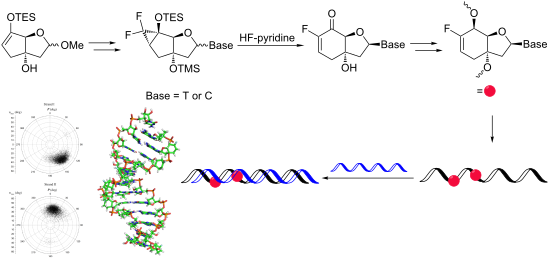
- characteristic parameters of a B- or A-type helix, respectively (Figures S5–S7, Supporting Information File 1) [69]. Furthermore, the examination of the minor groove distances [70] disclosed for the 6’F-bc4,3-DNA/RNA duplex a flexibility switching between values of an A- and B-helix (Figure S8, Supporting


1,8-Bis(dimethylamino)naphthyl-2-ketimines: Inside vs outside protonation
Beilstein J. Org. Chem. 2018, 14, 2940–2948, doi:10.3762/bjoc.14.273

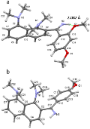
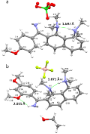
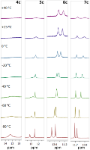
- (Figure S13 in Supporting Information File 1). The addition of a second OMe group in the case of 6 leads to the formation of 25% 6b’. Upon the insertion of a third OMe group in 7, the amount of 7b’ expectedly increases to 33%. Switching of the solvent to acetone-d6 facilitates the proton transfer away
- . Switching of protonation sites in imines 4b–7b. Protonation of the out-inverted dialkylamino group. Examples of proton sponges with stabilised in,out-conformation. Influence of the solvent on the proton transfer to imino nitrogen in 4b–7b solutions at 25 °C. Supporting Information Supporting Information







Unnatural α-amino ethyl esters from diethyl malonate or ethyl β-bromo-α-hydroxyiminocarboxylate
Beilstein J. Org. Chem. 2018, 14, 2853–2860, doi:10.3762/bjoc.14.264
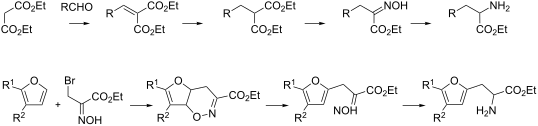
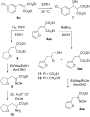
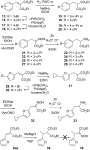
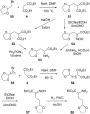
- ensuing reduction of 6u using sodium borohydride led to a somewhat better yield of compound 3u (as estimated by 1H NMR), side products resulting from over-reductions of the ester moieties were still observed. It is only when switching to tetramethylammonium borohydride that this was alleviated and the
- ester 2af were of (only) 56% and 54%, respectively. Later on, when using a 1:1 proportion of compounds 47 and 48af, a slightly improved yield of 50% was achieved when switching from ammonium bicarbonate to lithium carbonate (note d in Table 2) or in the case of the preparation of compound 2ag switching



Oxidative and reductive cyclization in stiff dithienylethenes
Beilstein J. Org. Chem. 2018, 14, 2812–2821, doi:10.3762/bjoc.14.259
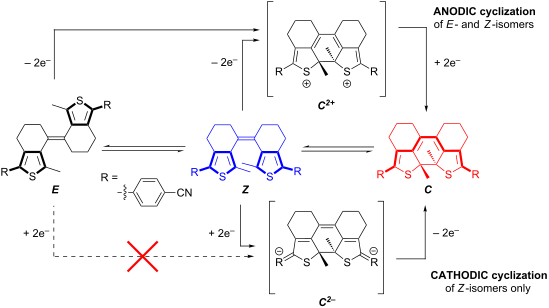
- methylpyridinium group as a substituent on the photochromic unit [27][28][29]. However, by a combination of suitable substituents, a bidirectional system able to operate in both switching directions either electrochemically or photochemically has been reported [28]. We have recently developed a new subclass of
- family of photoswitches possessing three switching states (E/Z/C). The oxidation potentials of a series of compounds with either 5-, 6-, or 7-membered rings attached to the central exocyclic double bond as well as the electronic influence of substituents were compared. We found that in particular the
- irradiation. Experiments in MeCN with 0.1 M Bu4NPF6, c = 1∙10−3 M, dE/dt = 1 V s−1. Combining double bond isomerization (E/Z) and cyclization/cycloreversion (Z/C) in three-state switching sDTEs. Photochemically, both ring-open isomers are converted to the closed isomer C in high yield when irradiated with


Synthesis of mono-functionalized S-diazocines via intramolecular Baeyer–Mills reactions
Beilstein J. Org. Chem. 2018, 14, 2799–2804, doi:10.3762/bjoc.14.257

- , spectral data and crystallographic data. Acknowledgements The authors gratefully acknowledge financial support by the Deutsche Forschungsgesellschaft (DFG) within the Sonderforschungsbereich 677, “Function by Switching”.


Gold-catalyzed post-Ugi alkyne hydroarylation for the synthesis of 2-quinolones
Beilstein J. Org. Chem. 2018, 14, 2572–2579, doi:10.3762/bjoc.14.234
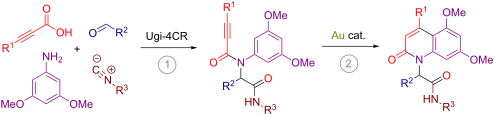
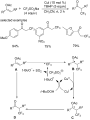
- concomitantly promoted the competing alkoxylation reaction (Table 3, entries 1 and 2). Consequently, we were able to isolate and characterize the corresponding TFE-adduct 9c (Table 3, entry 2). Switching to HFIP as the solvent prevented the alkoxylation but led to an even slower reaction rate (Table 3, entries
- in TFE did not lead to a full conversion within 12 h at rt (Table 4, entry 1). Switching to branched fluorinated solvents led to a faster conversion of 7r simultaneously suppressing the competing alkoxylation (Table 4, entries 2–4). Nonetheless, the transformation of 7r was further complicated by the


Tetrathiafulvalene – a redox-switchable building block to control motion in mechanically interlocked molecules
Beilstein J. Org. Chem. 2018, 14, 2163–2185, doi:10.3762/bjoc.14.190
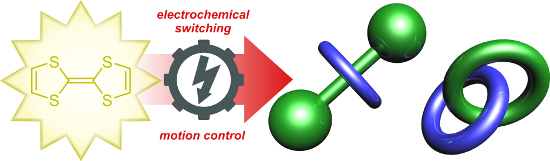
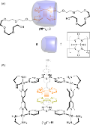
- implement a switching unit into the molecular framework, which is reversibly addressable by external stimuli [12][13]. A variety of different stimuli to control MIMs has been reported ranging, for example, from physical stimuli such as electrons, light, temperature, pressure, or magnetism to chemical
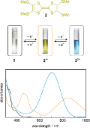
- fully reversible and have surprisingly low oxidation potentials (0.37 and 0.74 V vs Ag/AgCl in CH3CN) [24], which enable an easily achievable electrochemical switching under ambient conditions. The stability of all oxidation states – even in the presence of air and moisture – is crucial for the
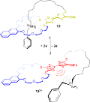
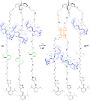
- -electron-poor molecule. The electrochemical switching of a TTF unit and the change of electronic or conformational properties not necessarily results in a mechanical motion of a MIM. A prerequisite is that at least one of the above-mentioned properties of TTF is interacting with other parts of the MIM. If









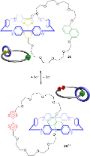


A pyridinium/anilinium [2]catenane that operates as an acid–base driven optical switch
Beilstein J. Org. Chem. 2018, 14, 1908–1916, doi:10.3762/bjoc.14.165
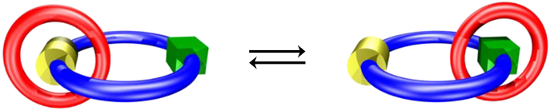
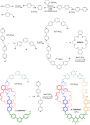
- measurements (<5 ppm) confirming the catenated nature of the structure. Table 2 summarizes the observed values. Acid–base driven switching The analysis of the 1H NMR spectrum (CD3CN, 298 K) of [8DB24C8]6+ indicates that the DB24C8 ring resides exclusively at the bis(pyridinium)ethane recognition site. This is
- molecular switching previously observed for analogous [2]rotaxanes. Experimental General comments 4-Bromobenzyl bromide, 4-bromoaniline, 4-pyridylboronic acid, 1,3-dichlorobenzene, p-tolylmagnesium bromide, n-butyllithium and N-bromosuccinimide were purchased from Aldrich and used as received. Benzoyl


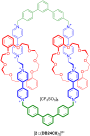
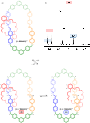
![[Graphic 3]](/bjoc/content/inline/1860-5397-14-165-i4.svg?max-width=637&scale=0.827274) DB24C8]6+ containing benzylanilinium and bis(pyridinium)ethane...
DB24C8]6+ containing benzylanilinium and bis(pyridinium)ethane...


Glycosylation reactions mediated by hypervalent iodine: application to the synthesis of nucleosides and carbohydrates
Beilstein J. Org. Chem. 2018, 14, 1595–1618, doi:10.3762/bjoc.14.137
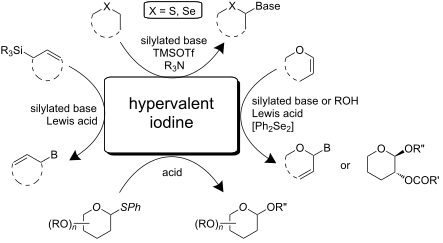
- coupling reaction of 42 occurred at the 4-position, as in the case mentioned above, to give 46 in 44% yield along with the desired product and its N7 isomer. In contrast, switching the protecting group of 27 at the 5-position to TBS resulted in the exclusive formation of 45 reacted at the 1-position (28


Recent advances in phosphorescent platinum complexes for organic light-emitting diodes
Beilstein J. Org. Chem. 2018, 14, 1459–1481, doi:10.3762/bjoc.14.124
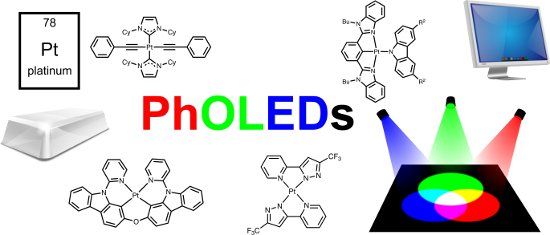
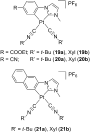
- solution. On the contrary, they became strong emitters in the solid state owing to the switching of the nature of the excited state that becomes 3MMLCT in nature. Their EL properties were evaluated by fabrication of non-doped OLEDs. Compound 10 was embedded into an OLED device with the following






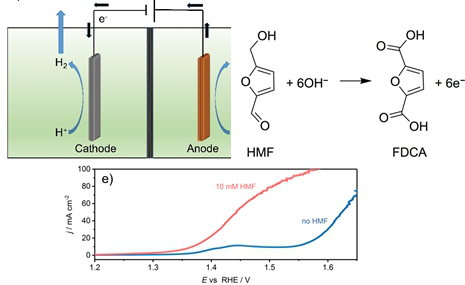
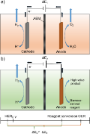
Cobalt–metalloid alloys for electrochemical oxidation of 5-hydroxymethylfurfural as an alternative anode reaction in lieu of oxygen evolution during water splitting
Beilstein J. Org. Chem. 2018, 14, 1436–1445, doi:10.3762/bjoc.14.121
- for 2 h. The mixture was then heated to 1100 °C and hold for 15 h. Subsequently, the bulk material was cooled down by switching off the furnace. The product was obtained in form of a purple metallic ingot. Electrochemical measurements Electrode preparation Nickel RDEs (Ø = 3 mm) were polished



Iodine(III)-mediated halogenations of acyclic monoterpenoids
Beilstein J. Org. Chem. 2018, 14, 1103–1111, doi:10.3762/bjoc.14.96
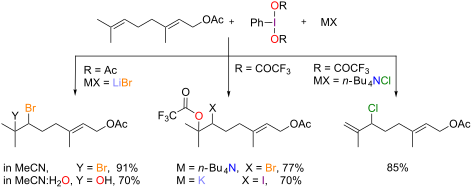
- our previous study on the bromination of enamides [11]. Thus, using a slight excess of DIB along with a two-fold amount of lithium bromide at 0 °C in dry acetonitrile rapidly yielded dibromo adduct 2a in 91% yield (Table 1, entry 1). Switching the reaction conditions to bromo(trifluoro)acetoxylation
- combination of DIB and iron(III) chloride in a 1.2:0.8 ratio (i.e., a 1:1 OAc/Cl ratio [12]) in acetonitrile, allylic chloride 6a [17] was obtained with a moderate 45% yield (Table 1, entry 11). Switching to a combination of PIFA and TBACl (Table 1, entry 12) did not change the course of the reaction towards


Fluorocyclisation via I(I)/I(III) catalysis: a concise route to fluorinated oxazolines
Beilstein J. Org. Chem. 2018, 14, 1021–1027, doi:10.3762/bjoc.14.88
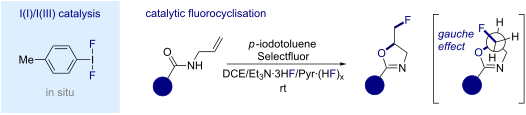
- less effective than DCE (Table 1, entries 7–9), switching to DCM led to full consumption of the starting material and a quantitative NMR yield (Table 1, entry 10). In a final optimisation round, the catalyst loading was reduced to 10 mol % with no discernable effect on performance (Table 1, entry 11




Correlation effects and many-body interactions in water clusters
Beilstein J. Org. Chem. 2018, 14, 979–991, doi:10.3762/bjoc.14.83
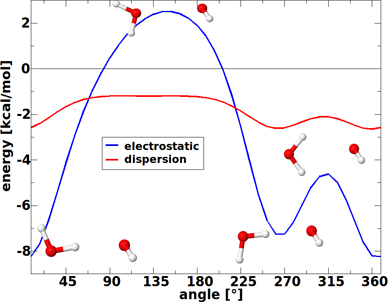
- ) method [72]). Thus, the decrease of the two-body interaction energy and the increase of the many-body interaction when switching from the cage/prism form to the ring form of (H2O)6 almost cancel. Apparently, the water hexamer is the first cluster where the two-body interactions start to dominate the


An efficient and facile access to highly functionalized pyrrole derivatives
Beilstein J. Org. Chem. 2018, 14, 884–890, doi:10.3762/bjoc.14.75
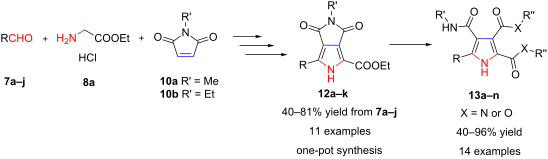
- choice even the reaction time was prolonged to 2 h (36% yield, Table 2, entry 3). Switching the base Et3N to DBU resulted in a significant decrease of product yield (Table 2, entry 4). Given that the crude azomethine ylide 9a was used without any purification, and 9a might be sensitive to other



A stereoselective and flexible synthesis to access both enantiomers of N-acetylgalactosamine and peracetylated N-acetylidosamine
Beilstein J. Org. Chem. 2018, 14, 856–860, doi:10.3762/bjoc.14.71

- stereocenter on C4, resulting in the desired cis-selective epoxide opening and therefore, galacto-configured azido alcohols 7a and 7b (≥95% de) [22]. Initial limitations in reaction size and yield could have been overcome by switching the solvent from THF, as described in the Miyashita protocol, to EtOH. This


Nanoreactors for green catalysis
Beilstein J. Org. Chem. 2018, 14, 716–733, doi:10.3762/bjoc.14.61
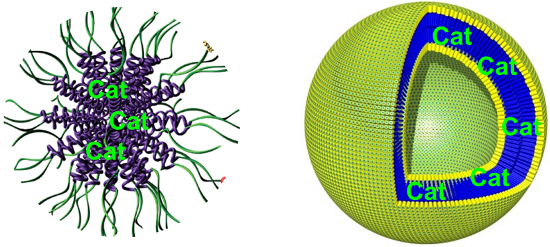
- switching procedures can be prevented. Although this requires still much development, it is to be expected that in the near future nanoreactors will be key to a more sustainable production of fine chemicals. Assembly of catalyst-functionalized amphiphilic block copolymers into polymer micelles and vesicles


Stimuli-responsive oligonucleotides in prodrug-based approaches for gene silencing
Beilstein J. Org. Chem. 2018, 14, 436–469, doi:10.3762/bjoc.14.32
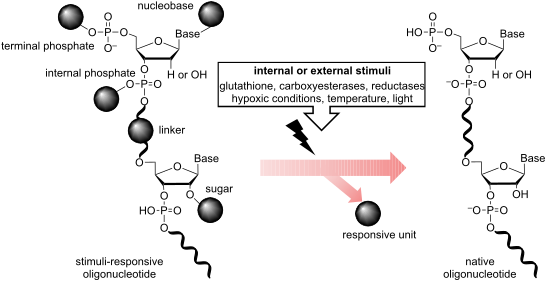
- this purpose various different approaches have been reported for the control of RNA translation (such as RNAi [81][82][83] and antisense [84][85], including splice switching of pre-mRNA [86] and DNAzymes [82][87]) and for the control of gene transcription (such as antigene strategy [88] and decoys [86


Fluorogenic PNA probes
Beilstein J. Org. Chem. 2018, 14, 253–281, doi:10.3762/bjoc.14.17
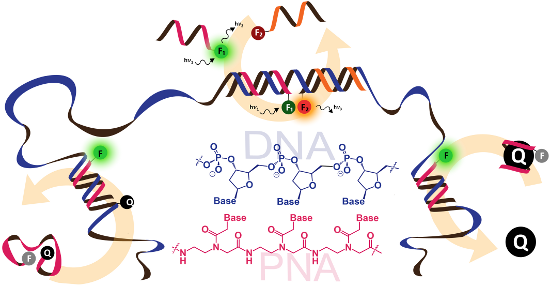
- background and good response with DNA, as well as offering an excellent specificity [65]. In addition to fluorophore-quencher interactions, FRET [66] and pyrene monomer–excimer switching [67][68] have been employed as alternative mechanisms for inducing fluorescence changes in the DNA probes. The FRET and
- monomer–excimer switching approaches have some advantages over fluorescence quenching because of the large Stokes shifts and the ability to measure the signals at two different wavelengths, thereby providing a means for self-referencing. Furthermore, unlike the fluorophore-quencher beacons, the FRET and
- monomer–excimer switching beacons are also fluorescent in the unbound state, and therefore it is possible to monitor the success of cellular delivery. In the case of pyrene monomer–excimer switching, the long fluorescence lifetime of the pyrene excimers allows facile elimination of background signals from




Progress in copper-catalyzed trifluoromethylation
Beilstein J. Org. Chem. 2018, 14, 155–181, doi:10.3762/bjoc.14.11
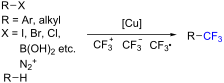
- para-benzylic position of the hydroxy group (Scheme 32). It is notable that the bulky tert-butyl group was introduced to suppress side reactions, which could be removed under acidic conditions. The solvent was critical in terms of product switching; the trifluoromethylation of aromatic C–H occurred in













Polarization spectroscopy methods in the determination of interactions of small molecules with nucleic acids – tutorial
Beilstein J. Org. Chem. 2018, 14, 84–105, doi:10.3762/bjoc.14.5
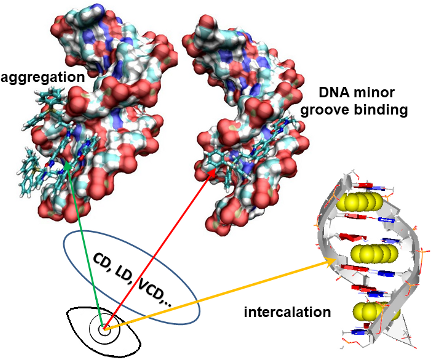
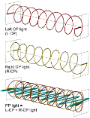
- ) into the cell. To mix the solution in the cell, spin it by switching on the motor for a few seconds. Turn off the spinning and record the spectrum. Then, turn on the spinning up to 5000 rpm and record another spectrum. Subtract the non-spinning spectrum from the spinning spectrum to get the LD spectrum