


Search results
Search for "thermal stability" in Full Text gives 253 result(s) in Beilstein Journal of Organic Chemistry. Showing first 200.
Experimental and theoretical investigations on the high-electron donor character of pyrido-annelated N-heterocyclic carbenes
Beilstein J. Org. Chem. 2016, 12, 1884–1896, doi:10.3762/bjoc.12.178
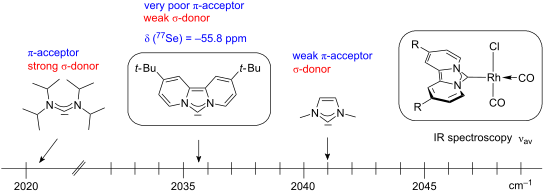
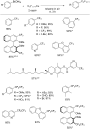
- prepared the respective selenourea, the 77Se NMR chemical shift was not reported [39][47][48]. We showed that the tert-butyl substituted dipyridocarbene dipiytBu exhibits an unusual high thermal stability and proofed the alternating bond lengths in the conjugated π-system of this carbene (similar to


On the cause of low thermal stability of ethyl halodiazoacetates
Beilstein J. Org. Chem. 2016, 12, 1590–1597, doi:10.3762/bjoc.12.155

- half-lives. The experimental results are supported by DFT calculations, and we provide a possible explanation for the reduced thermal stability of ethyl halodiazoacetates compared to ethyl diazoacetate and for the relative decomposition rates between the chloro, bromo and iodo analogs. We have also
- briefly studied the thermal, non-catalytic cyclopropanation of styrenes and compared the results to the analogous Rh(II)-catalyzed reactions. Keywords: carbenes; catalysis; cyclopropanation; halo diazoacetates; half-lives; thermal stability; Introduction The chemistry of diazo compounds has fascinated
- ]. The synthesis and properties of diazo compounds have been a topic of much interest, particularly relevant are their thermal stability and sensitivity towards Brønsted and Lewis acids. The monograph by Regitz and Maas gives an excellent overview on their preparation and properties [3]. The thermal




Star-shaped and linear π-conjugated oligomers consisting of a tetrathienoanthracene core and multiple diketopyrrolopyrrole arms for organic solar cells
Beilstein J. Org. Chem. 2016, 12, 1459–1466, doi:10.3762/bjoc.12.142
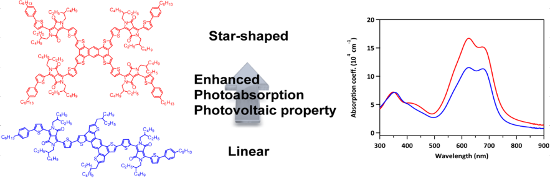
- cross-coupling reaction. Both TTA-DPP4 and TTA-DPP2 were soluble in common organic solvents, such as chloroform, toluene, and chlorobenzene. The thermal stability of these compounds was analyzed by thermogravimetric analysis (TGA). As shown in Figure 3, the 5% weight-loss temperature of TTA-DPP4 and TTA
- -DPP2, under N2 atmosphere, was determined to be 378 and 380 °C, respectively, suggesting the high thermal stability for these compounds as donor materials. Optical properties The UV–vis absorption spectra of TTA-DPP4 and TTA-DPP2 in chloroform solutions and as-spun thin films are depicted in Figure 4


Mutagenic activity of quaternary ammonium salt derivatives of carbohydrates
Beilstein J. Org. Chem. 2016, 12, 1434–1439, doi:10.3762/bjoc.12.138

- interesting group of QASs. These are extensively explored worldwide and find many applications. Because of their unique properties, including low melting point (by definition below 100 °C), high conductivity, high thermal stability, low flammability, and very low (if any) volatility [14], they are called


The role of alkyl substituents in deazaadenine-based diarylethene photoswitches
Beilstein J. Org. Chem. 2016, 12, 1103–1110, doi:10.3762/bjoc.12.106
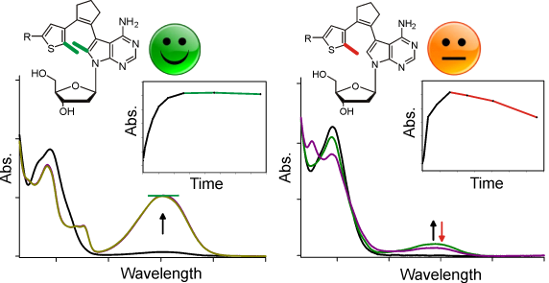
- substitution pattern, diarylethenes with one alkyl group can exhibit significant photochromism, but they generally show poor stability towards extended UV irradiation, low thermal stability, and decreased fatigue resistance. The results obtained provide an important direction for the design of new efficient
- cyclopentenyl bridge, which may also be perfluorinated. Substituents on the aryl rings tune the photophysical and chemical properties, such as absorption and isomerization wavelengths, thermal stability, and fatigue resistance. In 2010 our group reported the first diarylethene-based photoswitchable nucleosides
- hybridization upon switching [43][44]. This new class of diarylethenes showed promising photophysical and photochemical properties, such as the location of the photostationary states, reversibility of switching, thermal stability, and fatigue resistance. In 2013 we developed a 2nd generation of diarylethene



Synthesis of 2,1-benzisoxazole-3(1H)-ones by base-mediated photochemical N–O bond-forming cyclization of 2-azidobenzoic acids
Beilstein J. Org. Chem. 2016, 12, 874–881, doi:10.3762/bjoc.12.86

- -position of the benzisoxazole dramatically reduces the thermal stability of these compounds. Indeed, these compounds are the most labile representatives of several isomeric oxazoles [32], and they begin to decompose at temperatures slightly above 30 °C, which limits the number of methods for their
- (Table 2). The desired products 2b–f were isolated in moderate to high yields (Table 2). Both electron-withdrawing groups (Cl, Br, I) and the electron-donating group (triphenylmethyl) were well-tolerated. The thermal stability of the products of 2 decreases in the series: 2f > 2a > 2e > 2d > 2c > 2b


Syntheses of dibenzo[d,d']benzo[2,1-b:3,4-b']difuran derivatives and their application to organic field-effect transistors
Beilstein J. Org. Chem. 2016, 12, 805–812, doi:10.3762/bjoc.12.79
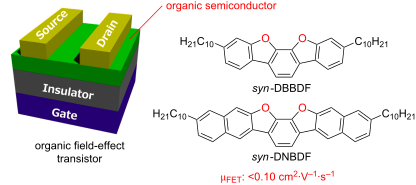
- organic solvents and can be purified by column chromatography. In contrast, because of low solubility in common organic solvents, the crude product of syn-DNBDF 6 was purified by washing several times with water and the subsequent sublimation. Thermal properties The phase-transition properties and thermal
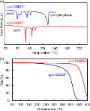
- stability of syn-DBBDF 5 and syn-DNBDF 6 were evaluated by differential scanning calorimetry (DSC) and thermogravimetric analysis (TGA), respectively. The DSC scans of syn-DBBDF 5 and syn-DNBDF 6 showed some transition peaks with the first phase-transition temperature at 20 °C and 45 °C, respectively, in




Highly stable and reusable immobilized formate dehydrogenases: Promising biocatalysts for in situ regeneration of NADH
Beilstein J. Org. Chem. 2016, 12, 271–277, doi:10.3762/bjoc.12.29
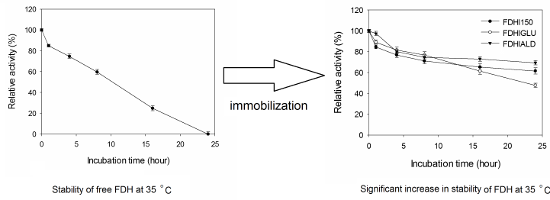
- methanol or formate from CO2 [10][11]. It was reported that FDH is a promising enzyme for the regeneration of NADH since the reaction product of FDH-catalyzed formate oxidation is CO2 which does not interfere with the purification of the final product [12][13]. However, free FDHs have low thermal stability
- boidinii as cross-linked enzyme aggregate (CLEA) and demonstrated that the residual activity and thermal stability of CLEA were strictly dependent on the type of cross-linker. Epoxy group containing supports are widely used in enzyme immobilization studies to obtain highly stable enzyme preparations by
- ethylenediamine and then activated with glutaraldehyde, and Immobead 150 support functionalized with aldehyde groups. The optimum conditions of free and immobilized FDH preparations were determined for formate oxidation. The thermal stability of free and immobilized FDH preparations was tested at 35 and 50 °C


Interactions of cyclodextrins and their derivatives with toxic organophosphorus compounds
Beilstein J. Org. Chem. 2016, 12, 204–228, doi:10.3762/bjoc.12.23
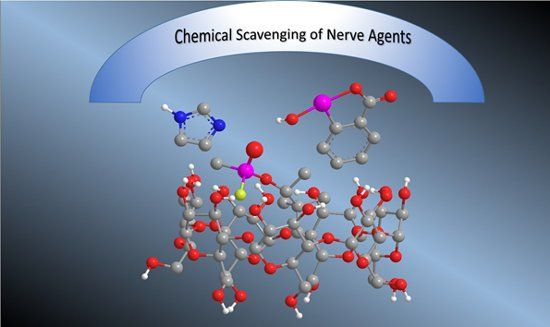
- energy barrier for complex dissociation revealed the thermal stability conferred upon guest encapsulation within the CD molecules. NMR experiments allow the enantiomers discrimination in presence of a chiral additive to create visible diastereomeric species. 31P NMR spectroscopy in presence of CDs as





Thermal and oxidative stability of Atlantic salmon oil (Salmo salar L.) and complexation with β-cyclodextrin
Beilstein J. Org. Chem. 2016, 12, 179–191, doi:10.3762/bjoc.12.20
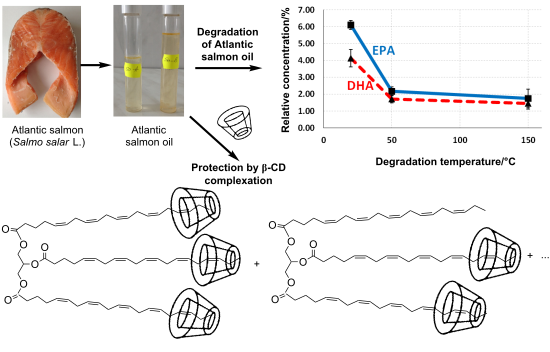
- [13][14]. One of the main disadvantages of PUFAs is their low oxidative and thermal stability. The rate of oxidation of such FAs (especially at higher temperatures) drastically increases with the increasing number of double bonds present, even by few thousand times. For example, the relative oxidation



Synthesis and photophysical characteristics of polyfluorene polyrotaxanes
Beilstein J. Org. Chem. 2015, 11, 2677–2688, doi:10.3762/bjoc.11.288
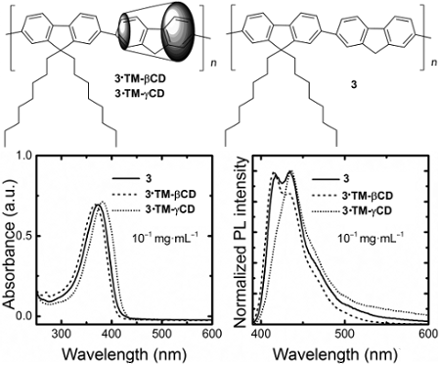
- evaluated and compared to those of the non-rotaxane counterpart 3. The influence of TM-βCD or TM-γCD encapsulation on the thermal stability, solubility in common organic solvents, film forming ability was also investigated. Polyrotaxane 3·TM-βCD exhibits a hypsochromic shift, while 3·TM-γCD displays a
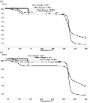
- 3·TM-βCD polyrotaxane. The thermal stability of the copolymers was also investigated by TGA (not shown) and the TGA data revealed that all polymers were stable up to about 300 °C. The absorption spectra of 3·TM-βCD and 3·TM-γCD polyrotaxanes and the unthreaded 3 counterpart at a concentration of 10


Carbon–carbon bond cleavage for Cu-mediated aromatic trifluoromethylations and pentafluoroethylations
Beilstein J. Org. Chem. 2015, 11, 2661–2670, doi:10.3762/bjoc.11.286
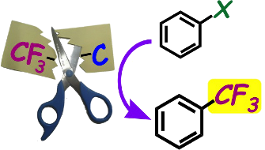
- reaction temperature from 160 °C to 200 °C accelerated the decarboxylation of CF3CO2K [36] (Scheme 3). The trifluoromethylation using a microreactor resulted in a good yield within a short reaction time by virtue of the thermal stability of CF3Cu and control of mixing. Taking advantage of the flow




Photoinduced 1,2,3,4-tetrahydropyridine ring conversions
Beilstein J. Org. Chem. 2015, 11, 2166–2170, doi:10.3762/bjoc.11.234
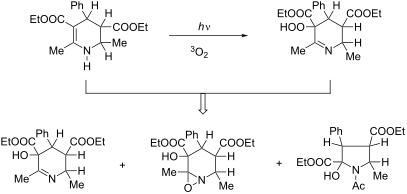
- attention has been paid to organic aromatic or heterocyclic hydroperoxides, probably due to their low thermal stability and high reactivity. Stable organic hydroperoxides were isolated in the early 1950s as products of autoxidation as well as catalytic oxygenation of indoles and tetrahydrocarbazoles [3][4


Olefin metathesis in air
Beilstein J. Org. Chem. 2015, 11, 2038–2056, doi:10.3762/bjoc.11.221
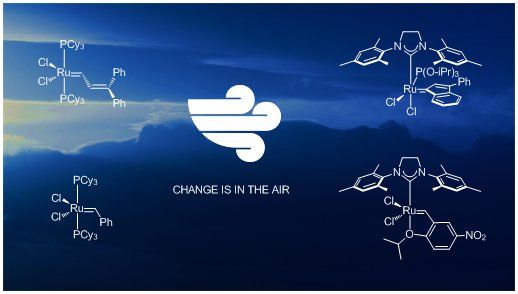
- has exhibited a rapid growth in use in recent years and is quickly becoming a mainstream catalyst in metathesis-type reactions (Figure 11). These complexes have received significant attention due to their high activity in olefin metathesis [72][73][74][75][76][77][78], their thermal stability and
- increased activity and maintained the same thermal stability. Again, these complexes showed similar activity to the Grubbs 2nd generation catalysts [77][78], and are stable when stored under air. Nolan reported the synthesis of Grubbs’ 2nd generation catalyst (15) from indenylidene complexes 84, by simple
- 2009, surely inspired by the aforementioned work, the Verpoort group reported a family of indenylidene Schiff base–ruthenium complexes (111a–f, Figure 17) for CM and RCM reactions in air [98]. They combined the higher thermal stability of indenylidene complexes and the tunability and stability of




Hexacoordinate Ru-based olefin metathesis catalysts with pH-responsive N-heterocyclic carbene (NHC) and N-donor ligands for ROMP reactions in non-aqueous, aqueous and emulsion conditions
Beilstein J. Org. Chem. 2015, 11, 1960–1972, doi:10.3762/bjoc.11.212
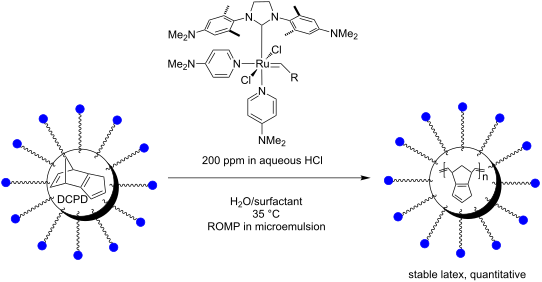
- determined solid contents often times exceeded the theoretical value derived from the amounts of monomer and surfactant added. This indicates that the catalysts have sufficient activity and thermal stability under the chosen conditions to promote complete ROMP of DCPD and the DCPD/COE monomer mixture. After
- –alkylidene complexes 14 and 15, they should exhibit much lower thermal stability due to high initiation rates [57]. However, the ability to quantitatively convert the monomers indicates that species 14 and 15 either are stabilized in the aqueous solvent, i.e., via H2O donation, or the species rapidly migrate


Nitro-Grela-type complexes containing iodides – robust and selective catalysts for olefin metathesis under challenging conditions
Beilstein J. Org. Chem. 2015, 11, 1823–1832, doi:10.3762/bjoc.11.198
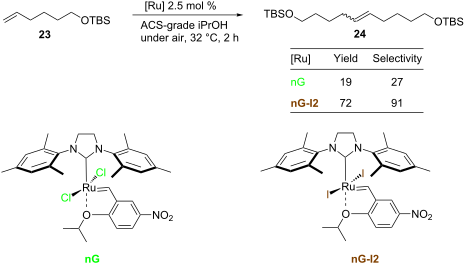
- anionic ligands were also reported very recently [22]. The former catalyst exhibited thermal stability and efficiency comparable with the original complex having two chlorides, while the difluoride catalyst showed low catalytic activity. Finally, alternative anionic ligands have been used in order to


Ruthenium indenylidene “1st generation” olefin metathesis catalysts containing triisopropyl phosphite
Beilstein J. Org. Chem. 2015, 11, 1520–1527, doi:10.3762/bjoc.11.166
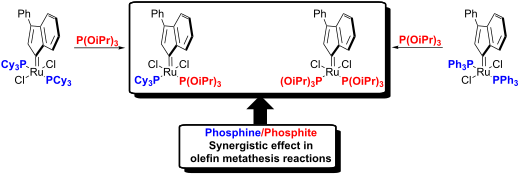
- ” cis-complexes. These have been used in olefin metathesis reactions. The cis-Ru species exhibit noticeable differences with the trans-Ru parent complexes in terms of structure, thermal stability and reactivity. Experimental data underline the importance of synergistic effects between phosphites and L
- synergistic effects in the case of the mixed phosphine/phosphite system. Complex 1 is a thermally-switchable, latent pre-catalyst displaying higher thermal stability compared to the phosphine-based Ind-I. Consequently, a brief study of the scope of the reaction was investigated employing “1st generation
- reaction showing similarities with cis-Caz-1 in terms of reactivity. Both pre-catalysts need thermal activation; they display an induction period in the reaction profiling and exhibit higher thermal stability compared to their phosphine-based analogues. In terms of catalytic efficiency, Ind-I was found


Thermal properties of ruthenium alkylidene-polymerized dicyclopentadiene
Beilstein J. Org. Chem. 2015, 11, 1469–1474, doi:10.3762/bjoc.11.159
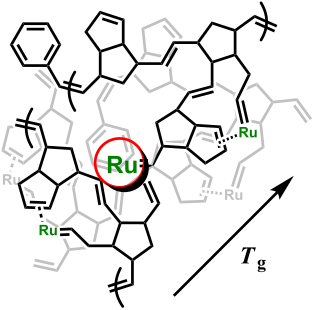
- initiators where only cross-linked polymers are obtained. This polyolefinic cross-linked thermoset material exhibits outstanding thermal stability [22], mechanical strength [23], fracture toughness [24] and dielectric characteristics [25]. Thanks to these properties PDCPD has become a very attractive polymer


Consequences of the electronic tuning of latent ruthenium-based olefin metathesis catalysts on their reactivity
Beilstein J. Org. Chem. 2015, 11, 1458–1468, doi:10.3762/bjoc.11.158
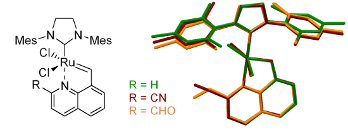
- -position changes the thermodynamic equilibrium favoring the trans- over the cis-isomers. In any case, a remarkable thermal stability of all studied compounds was found. Intrigued by the observed phenomenon, we turned to structural studies. Structures of 14 and 15 have been determined using single-crystal X
- thermal stability of the precatalyst becomes irrelevant once it is in the presence of the substrate [33], because it is the thermal stability of the actual active species in the reaction mixture that governs the reaction outcome. In the present case, the methylidene complex formed during metathesis with
- educt as well as that of the product is observed. However, the results for 5a as the precatalyst make clear that the thermal stability of the methylidene is not the only factor governing the outcome of the studied reactions. If the stability of the methylidene were the only crucial factor in all cases




Synthesis and spectroscopic properties of β-triazoloporphyrin–xanthone dyads
Beilstein J. Org. Chem. 2015, 11, 1434–1440, doi:10.3762/bjoc.11.155
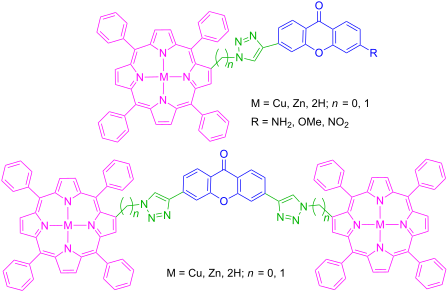
- porphyrins can be modulated by introducing diverse functionalities on their periphery or changing the metal ions in the porphyrin core [3][4]. Due to the high thermal stability and extended π-electron system, porphyrins are very useful for the construction of molecular switches [5][6] and other organic


Carboxylated dithiafulvenes and tetrathiafulvalene vinylogues: synthesis, electronic properties, and complexation with zinc ions
Beilstein J. Org. Chem. 2015, 11, 957–965, doi:10.3762/bjoc.11.107
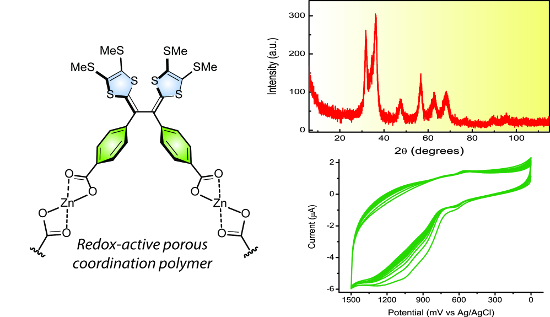
- of 9). It is therefore reasonable to propose that the microporosity in 8 is directly related to the coordination polymer structure. Finally, the thermal stability of coordination polymer 8 and Zn-DTF 9 were evaluated by differential scanning calorimetric (DSC) analysis, and detailed DSC traces are
- illustrated in Figure 6. The DSC data of Zn-TTFV 8 (Figure 6A) manifested very good thermal stability up to 400 °C, without any significant melting or decomposition except a slight phase transition at 272 °C. Comparatively, the DSC trace of carboxyl-TTFV ligand 6 showed a distinctive melting process at 317 °C
- considerably improved thermal stability, a property particularly beneficial for practical device and material applications. Conclusion In summary, we have synthesized carboxylated diphenyl-TTFV 6 and phenyl-DTF 7 as redox-active ligands to complex with Zn(II) ions. The electronic and electrochemical properties


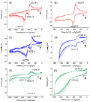


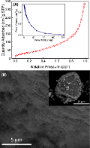

Mechanical stability of bivalent transition metal complexes analyzed by single-molecule force spectroscopy
Beilstein J. Org. Chem. 2015, 11, 817–827, doi:10.3762/bjoc.11.91
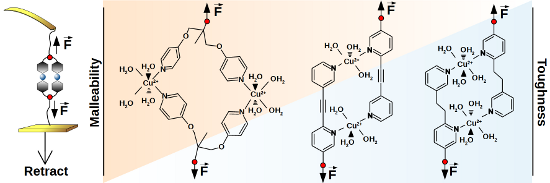
- 10.3762/bjoc.11.91 Abstract Multivalent biomolecular interactions allow for a balanced interplay of mechanical stability and malleability, and nature makes widely use of it. For instance, systems of similar thermal stability may have very different rupture forces. Thus it is of paramount interest to study
- latent catalysts for self-healing, mechanochroism or mechanoluminescence [14]. The thermal stability of a molecular system is inversely proportional to the thermal off-rate. However, this alone gives an incomplete image of bond rupture under physiological conditions. For example, depending on the
- ) model, finally giving the rupture length rb and the thermal off-rate koff (a measure of the inverse thermal stability) [20][21][22]. This method is especially useful in the case of interactions with low affinity of low yield that are inaccessible for ensemble measurements. For example in 2009


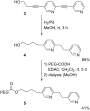


DNA display of glycoconjugates to emulate oligomeric interactions of glycans
Beilstein J. Org. Chem. 2015, 11, 707–719, doi:10.3762/bjoc.11.81
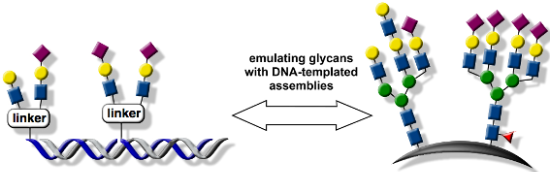
- helical structure and thermal stability. Surface plasmon resonance (SPR) affinity measurements with murine C-type lectin receptor (mMGL) showed specific binding only for duplexes containing two or four Lewis-X units. Alternatively, Ebara and co-workers have shown that glycan–DNA conjugates can be accessed


Azirinium ylides from α-diazoketones and 2H-azirines on the route to 2H-1,4-oxazines: three-membered ring opening vs 1,5-cyclization
Beilstein J. Org. Chem. 2015, 11, 302–312, doi:10.3762/bjoc.11.35

- across the single С–N bond (the С2–N1–С3–C4 dihedral angle is 4.3°, Figure 1), unlike its C4-aryl-substituted analogs with the angle of 73–75° [26]. The Е-configuration of the С=N bond, unfavorable for cyclization into 1,4-oxazine, explains the enhanced thermal stability of compound 3e. Heating azadiene


Properties of cationic monosubstituted tetraalkylammonium cyclodextrin derivatives – their stability, complexation ability in solution or when deposited on solid anionic surface
Beilstein J. Org. Chem. 2015, 11, 192–199, doi:10.3762/bjoc.11.20
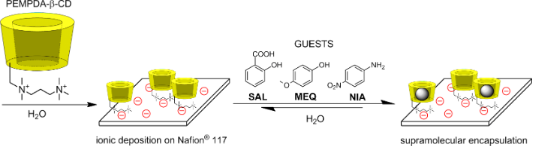
- , Czech Republic Department of Chemical Physics and Optics, Faculty of Mathematics and Physics, Charles University in Prague, Ke Karlovu 3, 121 16, Prague 2, Czech Republic 10.3762/bjoc.11.20 Abstract The thermal stability of the monosubstituted cationic cyclodextrin (CD) derivatives PEMEDA-β-CD and
- , yet robust and a straightforward process as well. Keywords: cyclodextrins; inclusion properties; solid surface; tetraalkylammonium derivatives; thermal stability; Introduction Cyclodextrins (CDs) are a very interesting group of natural macrocyclic carbohydrates, which were first described by
- transport of aromatic compounds [30]. In this paper we report on a comprehensive study of the properties of the novel monosubstituted cationic CD derivative PEMPDA-β-CD (PErMethylated PropyleneDiAmine substituted). Its thermal stability is compared to the previously reported analogue PEMEDA-β-CD





