Search results
Search for "chromatography" in Full Text gives 1991 result(s) in Beilstein Journal of Organic Chemistry. Showing first 200.
A fiber-optic spectroscopic setup for isomerization quantum yield determination
Beilstein J. Org. Chem. 2024, 20, 1684–1692, doi:10.3762/bjoc.20.150
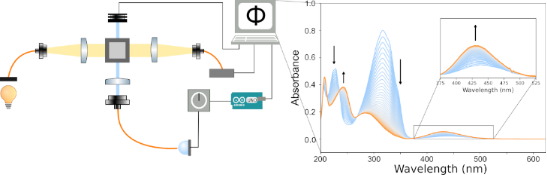
- showed that the cis-azobenzene previously isolated by extensive irradiation [2], liquid chromatography [22], or preparative TLC [21][33] contained some of the trans-isomer. Their work highlights the care that needs to be taken to obtain correct values for the molar absorptivities of cis-azobenzene. This


Oxidation of benzylic alcohols to carbonyls using N-heterocyclic stabilized λ3-iodanes
Beilstein J. Org. Chem. 2024, 20, 1677–1683, doi:10.3762/bjoc.20.149
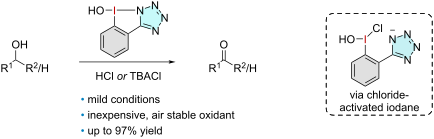
- equiv) and method A: aqueous HCl (37%, 500 µmol, 41.6 µL, 1.00 equiv) in EtOAc (2.5 mL) or method B: TBACl (500 µmol, 137 mg, 1.00 equiv) in MeCN (2.5 mL), respectively, were stirred at 60 °C for 2.5 h, quenched with Me2S (2.00 equiv) and the reaction mixture was purified via flash column chromatography




New triazinephosphonate dopants for Nafion proton exchange membranes (PEM)
Beilstein J. Org. Chem. 2024, 20, 1623–1634, doi:10.3762/bjoc.20.145
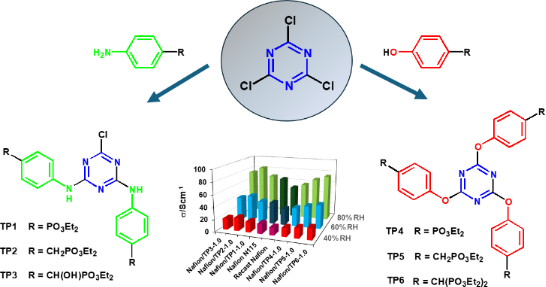
- phosphite in the presence of zinc(II) bromide allowed the formation of diethyl [hydroxy(4-hydroxyphenyl)methyl]phosphonate (11) and tetraethyl [(4-hydroxyphenyl)methylene]bis(phosphonate) (13), which were separated by column chromatography (Scheme 3). The synthesis of pure tetraethyl [(4-hydroxyphenyl
- -hydroxyphenylphosphonate (2) in THF, with DIPEA as base, gave a mixture of products which was purified by column chromatography to afford the desired trisubstituted compound TP4 (Scheme 6). Since this reaction had a very low yield (17%), another base, Na2CO3, was used and compound TP4 was obtained in a good yield (76
- , purification of the crude product by column chromatography led to the decomposition of compound TP7. Another strategy was devised to obtain the desired triazinephosphonate TP7: The first step was the nucleophilic substitution of the chlorine atoms of triazine 1 by 4-hydroxybenzaldehyde (12), followed by the




Supramolecular assemblies of amphiphilic donor–acceptor Stenhouse adducts as macroscopic soft scaffolds
Beilstein J. Org. Chem. 2024, 20, 1590–1603, doi:10.3762/bjoc.20.142
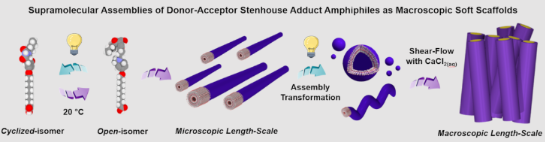
- specified. All reactions were performed under nitrogen unless otherwise specified. Analytical thin-layer chromatography (TLC) was performed with Macherey-Nagel silica gel 60 UV254 aluminum plates, and visualization was accomplished by UV light (254 nm or 365 nm) or by staining with phosphomolybdic acid and
- heating. Flash column chromatography was performed using Macherey-Nagel silica gel 60 (230–400 mesh). Deuterated solvents were purchased from Cambridge Isotope Laboratories. UV–vis spectroscopy UV–vis measurements were performed on an Agilent Cary 60 UV–vis spectrophotometer with a quartz cuvette of 1 cm




Primary amine-catalyzed enantioselective 1,4-Michael addition reaction of pyrazolin-5-ones to α,β-unsaturated ketones
Beilstein J. Org. Chem. 2024, 20, 1518–1526, doi:10.3762/bjoc.20.136
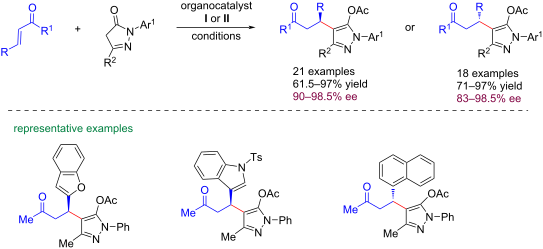
- temperature. The crude reaction mixture was purified by silica gel (230–400 mesh) column chromatography (petroleum ether/EtOAc as the eluent) to give the product 3 or ent-3. Selected examples of drugs and bioactive molecules bearing a pyrazole core. Single crystal X-ray structure of ent-3ba (CCDC 2234286
- CHCl3 for 4–14 h. Next, Ac2O (0.52 mmol, 50 µL) was added followed by DABCO (0.1 mmol, 11 mg) and the reaction mixture was further stirred for 2 h at 30–32 °C. aIsolated yield of 3 or ent-3 after column chromatography. bEnantiomeric excess (ee) was measured by HPLC analysis using a stationary phase
- mol % catalyst II, 30 mol % A5 (for ent-3) in 1.0 mL CHCl3 for 14 h. Next, Ac2O (0.52 mmol, 50 µL) was added followed by DABCO (0.1 mmol, 11 mg) and the reaction mixture was further stirred for 2 h at 30–32°C. aIsolated yield of 3 or ent-3 after column chromatography. bEnantiomeric excess (ee) was




Tetrabutylammonium iodide-catalyzed oxidative α-azidation of β-ketocarbonyl compounds using sodium azide
Beilstein J. Org. Chem. 2024, 20, 1510–1517, doi:10.3762/bjoc.20.135
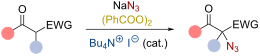
- decomposition and also some decarboxylation during column chromatography or upon prolonged reaction times. Also, tests with analogous β-ketoketones and β-ketoamides (compare with azidation products 5 and 6, Scheme 3) did not give any products but resulted in the formation of a variety of unidentified side
- were recorded on an Agilent QTOF 6520 spectrometer with an ESI source. Melting points are recorded using a Büchi M-560 apparatus and are reported uncorrected. TLC was performed on Macherey-Nagel pre-coated TLC plates (silica gel, 60 F254, 0.20 mm, ALUGRAM® Xtra SIL). Preparative column chromatography
- vacuo. In most cases the products were already obtained in sufficiently high purity (>95%) after this work up. If necessary, further purification by silica gel column chromatography can be carried out. Safety considerations: It is known that the combination of inorganic azides and halogenated compounds


Towards an asymmetric β-selective addition of azlactones to allenoates
Beilstein J. Org. Chem. 2024, 20, 1504–1509, doi:10.3762/bjoc.20.134
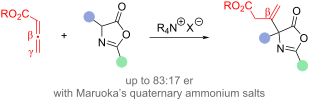
- residual water during column chromatography. Unfortunately, attempts to assign the absolute configuration of products 5 failed, as we have not been able to obtain any crystals suited for single crystal X-ray diffraction analysis. Finally, we also tested the suitability of products 5 to access acyclic α-AA


Photoswitchable glycoligands targeting Pseudomonas aeruginosa LecA
Beilstein J. Org. Chem. 2024, 20, 1486–1496, doi:10.3762/bjoc.20.132
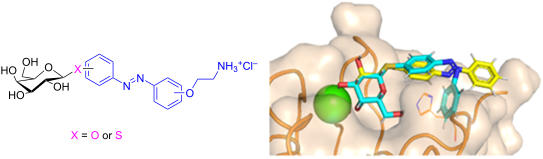
- equivalents of dihydroxyazobenzene 6 were used for the selective monoglycosylation step, with the excess of azobenene being recovered after column chromatography. Under these conditions, no bisglycosylated azobenzene was observed [28]. The observed 1,2-trans glycosylation could be explained either by the
- with 10% H2SO4 in EtOH and heating about 30 s at 400–600 °C. Column chromatography purification was performed on CombiFlash® Rf+ and RediSep® RF or RF Gold normal phase silica columns (with UV detection at 254 and 350 nm for all azobenzene derivatives), or by flash column chromatography employing
- concentrated under reduced pressure and purified by flash chromatography (cyclohexane/EtOAc 7:3) to give the thioglycoside. General procedure IV for the Zemplén deacetylation: To a seal tube containing the galactose derivatives in dry MeOH (0.15 M), NaOMe (30 mol %, 0.5 M sol. in MeOH) was added. The mixture


Synthesis of 2-benzyl N-substituted anilines via imine condensation–isoaromatization of (E)-2-arylidene-3-cyclohexenones and primary amines
Beilstein J. Org. Chem. 2024, 20, 1468–1475, doi:10.3762/bjoc.20.130
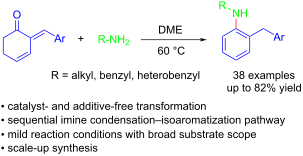
- purified by column chromatography on silica gel to give product 4. In the case of reacting with 3-NO2 bearing 2f, 2-benzylphenol 5f was partially obtained together with normal product 4fa. 4-CN substituted 2o generated 2-benzylphenol 5o exclusively. Synthesis of aniline derivatives from 2-cyclohexenones or



Rapid construction of tricyclic tetrahydrocyclopenta[4,5]pyrrolo[2,3-b]pyridine via isocyanide-based multicomponent reaction
Beilstein J. Org. Chem. 2024, 20, 1436–1443, doi:10.3762/bjoc.20.126
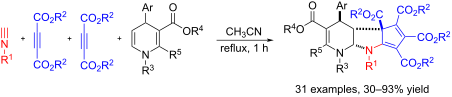
- one hour. After removing the solvent by rotatory evaporation at reduced pressure, the residue was subjected to column chromatography with a mixture of ethyl acetate and petroleum ether (v/v = 1:4) as eluent to give the pure product for analysis. Pentamethyl rel-(4R,4aR,4bS,8aS)-1-benzyl-8-cyclohexyl-4


Synthesis of cyclic β-1,6-oligosaccharides from glucosamine monomers by electrochemical polyglycosylation
Beilstein J. Org. Chem. 2024, 20, 1421–1427, doi:10.3762/bjoc.20.124
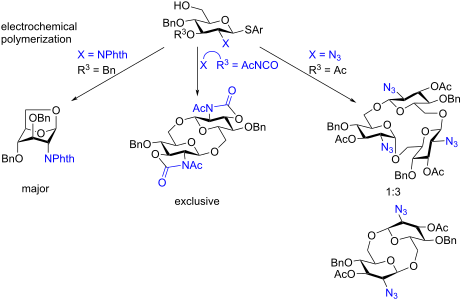
- was further washed with aqueous 1 M HCl solution and dried over Na2SO4. Then, the solvent was removed under reduced pressure, and the crude product (220 mg) was purified with recycling preparative gel permeation chromatography equipped with two series-connected JAIGEL-2HH columns (eluent: CHCl3, flow


Challenge N- versus O-six-membered annulation: FeCl3-catalyzed synthesis of heterocyclic N,O-aminals
Beilstein J. Org. Chem. 2024, 20, 1412–1420, doi:10.3762/bjoc.20.123
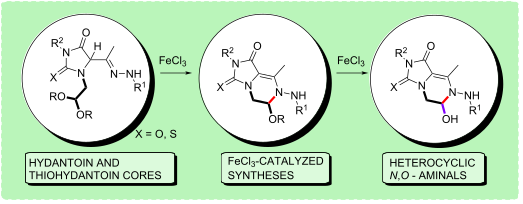
- dissolved in DCM (10 mL), FeCl3 (30 mol %) added and magnetically stirred at room temperature. Within 2–30 h, the reactions went to completion (TLC monitoring), affording, at last, N,O-aminals 5a–r (42–82%) and the corresponding hemiaminals 6a–p (4–35%) after column chromatography (Scheme 3). An increased




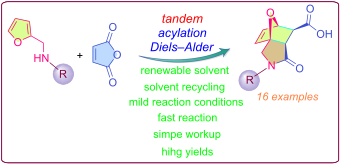
Sustainable tandem acylation/Diels–Alder reaction toward versatile tricyclic epoxyisoindole-7-carboxylic acids in renewable green solvents
Beilstein J. Org. Chem. 2024, 20, 1308–1319, doi:10.3762/bjoc.20.114
- . Louis, MO), or Acros Organics (Thermo Fisher Scientific, Geel, Belgium) and used without further purification. Thin-layer chromatography was performed using silica gel (60 F254, Merck, Darmstadt, Germany) plates. Melting points were recorded by Büchi melting point B-540 apparatus (Büchi Labortechnik AG


Diameter-selective extraction of single-walled carbon nanotubes by interlocking with Cu-tethered square nanobrackets
Beilstein J. Org. Chem. 2024, 20, 1298–1307, doi:10.3762/bjoc.20.113
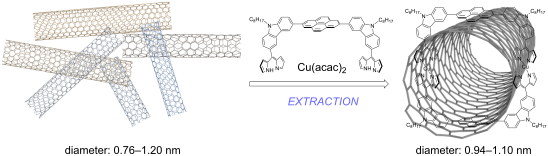
- depend on their structures [1]. To obtain specific structures, remarkable progress has been made in separation of SWNTs by various methods such as gel column chromatography [2][3], aqueous two-phase extraction (ATPE) [4][5], and polymer wrapping [6][7]. As compared with these methods, our separation by




Synthesis of indano[60]fullerene thioketone and its application in organic solar cells
Beilstein J. Org. Chem. 2024, 20, 1270–1277, doi:10.3762/bjoc.20.109
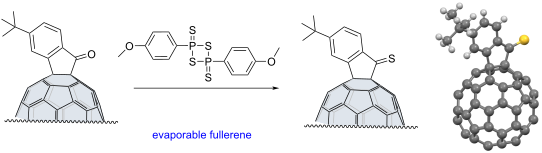
- amount of Lawesson's reagent was increased to 3 equiv (Table 1, entry 5), the signal of thioketone was observed for the first time by high-performance liquid chromatography (HPLC) and MALDI time-of-flight mass spectrometry. Subsequently, a conversion of 99% was achieved by further increasing the amount


Domino reactions of chromones with activated carbonyl compounds
Beilstein J. Org. Chem. 2024, 20, 1256–1269, doi:10.3762/bjoc.20.108
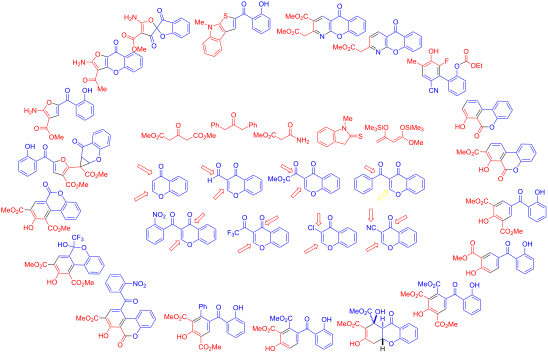
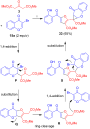
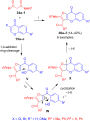
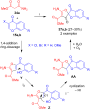
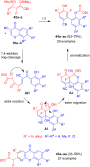
- dienes has to proceed with full conversion and in high yield as the they cannot be purified by chromatography. Distillation is also problematic, as dienes containing substituents located at carbon atom C-2 readily undergo isomerization reactions. The reactions of 1,3-bis(silyloxy)-1,3-butadienes with









Competing electrophilic substitution and oxidative polymerization of arylamines with selenium dioxide
Beilstein J. Org. Chem. 2024, 20, 1221–1235, doi:10.3762/bjoc.20.105
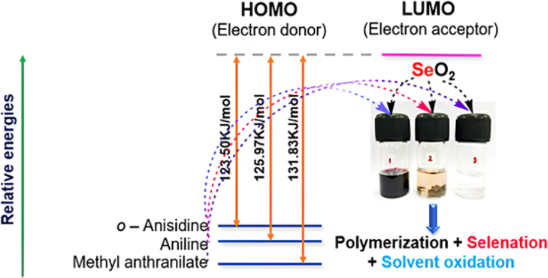
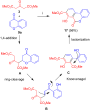
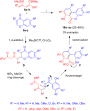
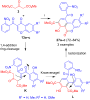
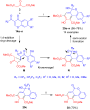
- oxidative polymerization in the presence of SeO2. After recognizing the polymeric nature of the solid, we analyzed the small molecular species present in the supernatant. Thin-layer chromatography (TLC) of the supernatant revealed that it contained a mixture of compounds. We could not isolate monoselenide 1
- as a pure compound through column chromatography. The obtained fraction was a black solid as reported by Bhat et al., and HRMS analysis revealed a peak at m/z 265.0229, corresponding to [M + H]+ (Figure S4, Supporting Information File 1). However, we could not ascertain the identity of the compound
- methyl anthranilate with SeO2 (vide infra), which was also supported by single-crystal X-ray analysis. However, for aniline, in addition to the major polymerization and poor selenation process, solvent oxidation was also noted. Importantly, through column chromatography, the oxamide derivative 3 formed


Cofactor-independent C–C bond cleavage reactions catalyzed by the AlpJ family of oxygenases in atypical angucycline biosynthesis
Beilstein J. Org. Chem. 2024, 20, 1198–1206, doi:10.3762/bjoc.20.102
- -morpholino)propanesulfonic acid (MOPS) buffer (pH 7.5), and the cells were disrupted by ultrasonication to obtain the cell extract. Cell debris was removed by centrifugation (14,000g, 15 min). The proteins were purified by Ni-NTA agarose chromatography, desalted, and concentrated by centrifugation (8,000g
- , 30 min) in 10 kDa ultrafiltration tubes (Centriplus YM series, Merck Millipore). Protein concentration was quantified by the Bradford method. AlpJ, JadG, JadH, and E. coli flavin reductase (Fre) were overproduced and purified by Ni-NTA agarose chromatography as described previously [10][11][43][44




Two-fold addition reaction of silylene to C60: structural and electronic properties of a bis-adduct
Beilstein J. Org. Chem. 2024, 20, 1179–1188, doi:10.3762/bjoc.20.100
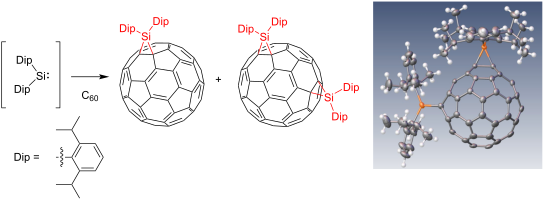
- accompanied by mono-adduct 2 (22% yield) by silica gel flash column chromatography using mixed solvents of hexane/CH2Cl2 by changing the ratios of volumes from 10:1 to 3:1. In thin-layer chromatography (TLC) analysis using silica gel, the Rf values are 0.55 for 2 and 0.33 for 3, respectively, with hexane
- column chromatography (SiO2) using mixed solvents of hexane/CH2Cl2 by changing the ratios of volumes from 10:1 to 3:1. TLC analysis (SiO2, hexane/CH2Cl2 5:1) afforded Rf = 0.55 for 2 and Rf = 0.33 for 3, respectively. Data for compound 3: 1H NMR (CDCl3/CS2 3:1) δ 7.61 (t, J = 7.5 Hz, 1H), 7.56 (t, J


Bismuth(III) triflate: an economical and environmentally friendly catalyst for the Nazarov reaction
Beilstein J. Org. Chem. 2024, 20, 1167–1178, doi:10.3762/bjoc.20.99
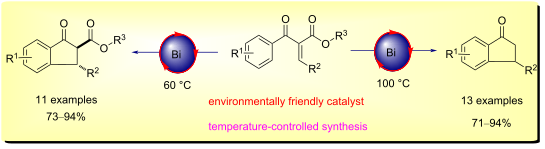
- yields. For derivatives 9af,ag,bq, we observed the formation of an E/Z mixture of products that was inseparable by column chromatography. Synthesis of 3-aryl-2-ethoxycarbonyl-1-indanones and 3-aryl-1-indanones With the starting materials prepared, we began evaluating the use of bismuth salts to promote
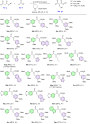
- different compounds containing the indanone moiety. Synthesis of unsaturated β-ketoesters (Knoevenagel derivatives). aIsolated yield after purification using silica gel column chromatography. Synthesis of 3-aryl-2-ethoxycarbonyl-1-indanones mediated by bismuth triflate. aIsolated yield after purification
- using silica gel column chromatography. bExtensive degradation. cRecovery of starting material. Basic protocol: The Knoevenagel product 9 (0.5 mmol), dry acetonitrile (2 mL), and Bi(OTf)3 (0.05 mmol) were added to a sealed tube. The reaction mixture was stirred at 60 °C and monitored by TLC. Controlled


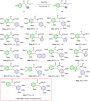
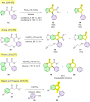


Kinetically stabilized 1,3-diarylisobenzofurans and the possibility of preparing large, persistent isoacenofurans with unusually small HOMO–LUMO gaps
Beilstein J. Org. Chem. 2024, 20, 1099–1110, doi:10.3762/bjoc.20.97
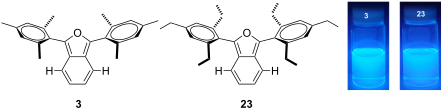
- obtained using a solvent purification system (Innovative Technologies, Inc.) and handled under a nitrogen atmosphere, unless otherwise noted. Flash chromatography was performed using SiliaFlash® F60 40–63 µm (230–400 mesh) 60 Å silica from Silicycle Inc. and RediSep® Rf Silica Flash Columns (12 g, 24 g or
- 40 g) on a CombiFlash® Rf 200 instrument (Teledyne Isco, Inc.). Evaporation of solvents was accomplished using an IKA® RV 10 digital rotary evaporator. Baker-flex® silica gel IB2-F thin-layer chromatography (TLC) plates were purchased from J.T. Baker. A 4 watt 254 nm lamp (Analtytik Jena Co.) and a
- gel CombiFlash chromatography (hexane/EtOAc 9:1) to obtain 22 as a yellow solid (0.44 g, 35%, Scheme 5). Mp 59–60 °C; 1H NMR (500 MHz, CDCl3) δ 7.43 (s, 4H), 6.93 (s, 4H), 2.64 (q, J = 7.6 Hz, 4H), 2.53 (q, J = 7.5 Hz, 8H), 1.25 (t, J = 7.6 Hz, 6H), 1.08 (t, J = 7.5 Hz, 12H); 13C NMR (126 MHz, CDCl3


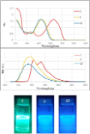




Synthesis of 1,4-azaphosphinine nucleosides and evaluation as inhibitors of human cytidine deaminase and APOBEC3A
Beilstein J. Org. Chem. 2024, 20, 1088–1098, doi:10.3762/bjoc.20.96
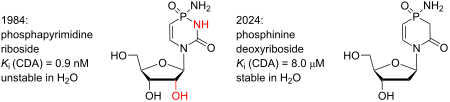
- /Et3N, followed by silica gel column chromatography, led to the triethylammonium salt of 2-N-Boc-aminoethylphosphinic acid 5 in 50 % yield. Alkylation of acid 5 with methyl chloroacetate in the presence of TMSCl and Et3N took five days at room temperature, and compound 6 as triethylammonium salt was
- phosphinic acid 7 was further protected with benzyl alcohol by a procedure adopted from reference [67] using TBTU and Et3N in refluxing dichloroethane. Compound 8 was obtained in 65% yield after silica gel column chromatography. To synthesise a nucleobase for nucleosides Va and Vb, we first obtained


Light on the sustainable preparation of aryl-cored dibromides
Beilstein J. Org. Chem. 2024, 20, 1076–1087, doi:10.3762/bjoc.20.95
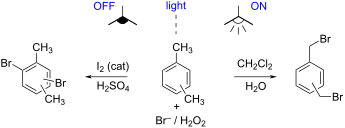
- the addition was complete, the mixture was left under stirring for 1 h and 30 min. After the workup, operated as described previously, a brown slurry was obtained. Yield: 42%. The crude product was purified via column chromatography on silica gel 60, eluting with petroleum ether. The pure product


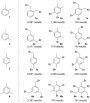

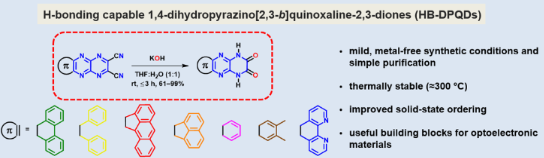
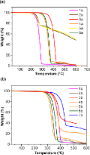
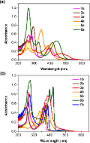
Structure–property relationships in dicyanopyrazinoquinoxalines and their hydrogen-bonding-capable dihydropyrazinoquinoxalinedione derivatives
Beilstein J. Org. Chem. 2024, 20, 1037–1052, doi:10.3762/bjoc.20.92
- . Palladium(II) acetate and anhydrous 1,4-dioxane were purchased from Strem Chemicals or Sigma-Aldrich and used as received. Thin-layer chromatography (TLC) was performed on SiO2-60 F254 aluminum plates with visualization by UV light or staining. Flash column chromatography was performed using Purasil SiO2-60




A Diels–Alder probe for discovery of natural products containing furan moieties
Beilstein J. Org. Chem. 2024, 20, 1001–1010, doi:10.3762/bjoc.20.88
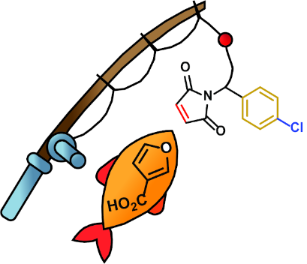
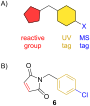
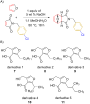
- easily identifiable on liquid chromatography–mass spectrometry (LC–MS). The molecular probe, which undergoes this reaction with a variety of furans, was designed with both a UV-tag and a mass tag to enable easy identification. The probe has been tested with a variety of purified furans, including natural