


Search results
Search for "activation barrier" in Full Text gives 71 result(s) in Beilstein Journal of Organic Chemistry.
Rongalite addition to dienones: diastereoselectivity in cyclic sulfone synthesis; stereochemical rationalization and prospects as a general conjugate nucleophile
Beilstein J. Org. Chem. 2026, 22, 742–752, doi:10.3762/bjoc.22.56

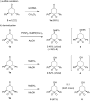
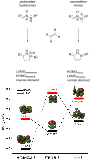
- Information File 1 for a graphical representation of this and TS images directly generated from the computational data). The analogous calculations for 1a and 1b showed a much smaller difference in activation barrier, 1.0 kcal/mol, which is consistent with the lower selectivity observed for that substrate
- bonds in TS-trans, there is a significant distortion in the chair shape in TS-cis: the two highlighted CH bonds are not parallel – they are converging and this 1,3-diaxial interaction may be a contributing factor in increasing the activation barrier relative to TS-trans. Further technical discussion of




Configuration–packing synergy enabling integrated crystalline-state RTP and amorphous-state TADF
Beilstein J. Org. Chem. 2026, 22, 224–236, doi:10.3762/bjoc.22.16
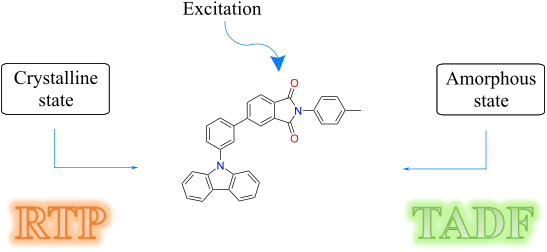
- intermolecular coupling to enhance SOC and suppress non-radiative decay channels, while TADF relies more on donor–acceptor decoupling and smaller ΔEST to lower the thermal activation barrier for RISC. Thus, a key challenge in the field is how to establish adjustable synergy between the molecular-scale
- . On the other hand, the small ΔEST plays a critical role in facilitating the RISC process, as it lowers the thermal activation barrier between the S1 and T1 states. This small energy gap makes it easier for the T1 to upconvert to the S1 through the RISC process, resulting in the release of energy in


Advances in Zr-mediated radical transformations and applications to total synthesis
Beilstein J. Org. Chem. 2026, 22, 71–87, doi:10.3762/bjoc.22.3
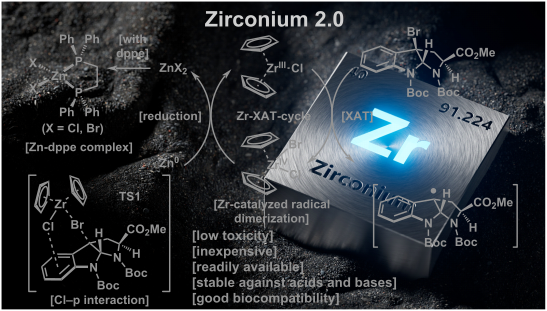
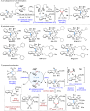
- potential and stabilizing the radical pathway. The DFT calculations are shown in Scheme 13A. The activation barrier for the XAT process was calculated to be ΔG‡ = 8.0 kcal/mol, indicating that this process can proceed spontaneously around room temperature. Moreover, the transition state (TS1) suggested the








Transition-state aromaticity and its relationship with reactivity in pericyclic reactions
Beilstein J. Org. Chem. 2025, 21, 1613–1626, doi:10.3762/bjoc.21.125

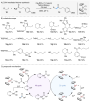
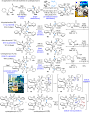
- other than aromaticity govern the barrier heights of these pericyclic reactions. Keywords: activation barrier; activation strain model; aromaticity; computational chemistry; transition state; Introduction Aromaticity is arguably one of the most fundamental and extensively studied concepts in chemistry
- destabilizing 4-electron interaction with the diene and ultimately, in a lower activation barrier. The term “Pauli-repulsion lowering in catalysis” [51] was coined to describe this effect, which has been proven to be general and applicable not only to related LA-catalyzed pericyclic reactions (as shown in the
- LAs [66] (Table 2). As expected, we found that the reduction of the activation barrier (up to ca. 25 kcal/mol) directly correlates with the relative Lewis acidity of the catalyst. In addition, the process becomes more and more asynchronous as the acidity of the catalyst increases, which strongly


Wittig reaction of cyclobisbiphenylenecarbonyl
Beilstein J. Org. Chem. 2025, 21, 1454–1461, doi:10.3762/bjoc.21.107
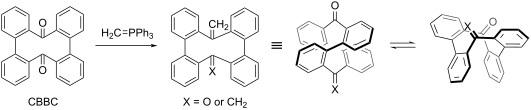
- conformation (Sa,Sa)-A is feasible with a small activation barrier of 9.9 kcal mol−1. The figure-eight conformer (M,M)-B untwists to adopt an achiral conformation C with the exo-alkene units rotated inwards in opposite directions. These conformational changes are almost identical to those of CBBC 1. However



Enhancing chemical synthesis planning: automated quantum mechanics-based regioselectivity prediction for C–H activation with directing groups
Beilstein J. Org. Chem. 2025, 21, 1171–1182, doi:10.3762/bjoc.21.94
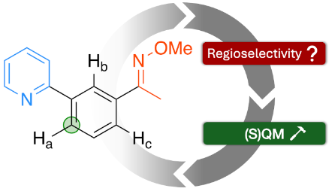
- could be correctly predicted by calculation and comparison of the activation barrier of this step by Davies and colleagues [8]. Hence, the reaction site for which the activation barrier is the lowest is predicted to be the most probable one. Tomberg et al. [9] established that the regioselectivity could


Development and mechanistic studies of calcium–BINOL phosphate-catalyzed hydrocyanation of hydrazones
Beilstein J. Org. Chem. 2025, 21, 755–765, doi:10.3762/bjoc.21.59
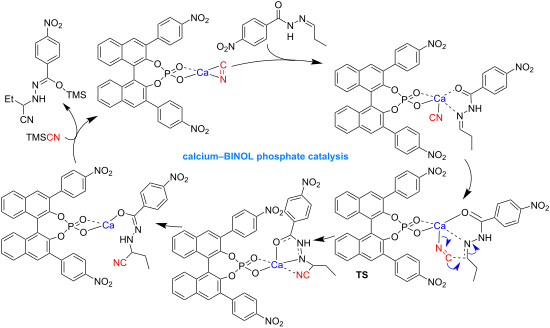
- the R-product from E-hydrazone is slightly lower in energy (Table 3). However, the activation barrier for the rate-limiting step is 0.4 kcal·mol−1 lower for the pathway shown in Figure 2 and that yields the S-product from the Z-hydrazone. As the activation barrier to thermal E/Z-isomerization is more


Advances in the use of metal-free tetrapyrrolic macrocycles as catalysts
Beilstein J. Org. Chem. 2024, 20, 3085–3112, doi:10.3762/bjoc.20.257
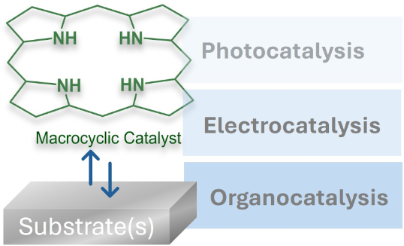
- nitrogen atoms that can form nitrogen–hydrogen (N–H) bonds. Therefore, the general mechanism for HER using a metal-free porphyrin involves inner core nitrogen atoms, which keep protons in proximity and lowers the activation barrier. Dihydrogen is then produced by prearranging the transition state of


Computational design for enantioselective CO2 capture: asymmetric frustrated Lewis pairs in epoxide transformations
Beilstein J. Org. Chem. 2024, 20, 2668–2681, doi:10.3762/bjoc.20.224
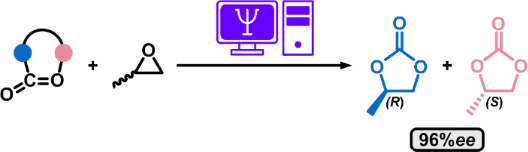
- ), S1 is the substituent on the LB, and S2 is the substituent on the LA. Capture of CO2 and PO by an FLP Chemoselectivity Our investigations began by examining the uncatalysed coupling reaction between CO2 and PO (Scheme 1), which exhibits a calculated activation barrier (ΔG‡) greater than 55 kcal·mol−1
- chosen to avoid addressing asymmetry concerns at this stage. The capture exhibiting the lowest activation barrier was considered the first step of the coupling reaction for the remainder of the study. The free-energy profiles of both capture processes are depicted in Figure S1 (Supporting Information
- File 1). Notably, the CO2 capture exhibits a lower activation barrier compared to the capture of epoxide (+10.0 kcal·mol−1 vs +30.0 kcal·mol−1). Using transition state theory [40] as expressed in Equation 1, the rate constants were calculated for binding to either molecule at 273.0 K, resulting in k1


Efficient modification of peroxydisulfate oxidation reactions of nitrogen-containing heterocycles 6-methyluracil and pyridine
Beilstein J. Org. Chem. 2024, 20, 2599–2607, doi:10.3762/bjoc.20.219
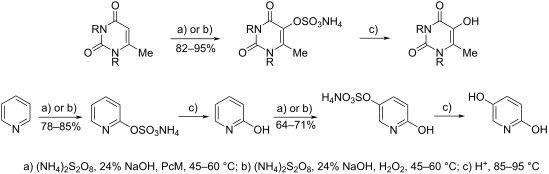
- . Additionally, the π-conjugation system facilitates the redistribution of electron density within the reaction complex, thereby lowering the activation barrier of the reaction [21]. The study employed the following oxidation catalysts for phthalocyanines – PcCo, PcFe(II), PcFe(III), PcMn, PcNi, and PcZn. The


Synthesis and reactivity of the di(9-anthryl)methyl radical
Beilstein J. Org. Chem. 2024, 20, 2254–2260, doi:10.3762/bjoc.20.193
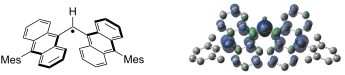
- small about 1.18 kcal mol−1 (Supporting Information File 1, Figure S2). To investigate the activation barrier of this equilibrium, potential energy curve by changing the dihedral angle θ of one anthryl group was calculated. The transition state was calculated with the dihedral angle θ = 30.6° and the
- activation barrier is only 2.94 kcal mol−1 (Supporting Information File 1, Figure S3). Thus, these two structures are likely in equilibrium and rapidly exchange with each other in solution. The energy difference between DAntM dimer (head-to-head σ-dimer) and DAntM radical monomer was also evaluated, showing


Divergent role of PIDA and PIFA in the AlX3 (X = Cl, Br) halogenation of 2-naphthol: a mechanistic study
Beilstein J. Org. Chem. 2024, 20, 1580–1589, doi:10.3762/bjoc.20.141
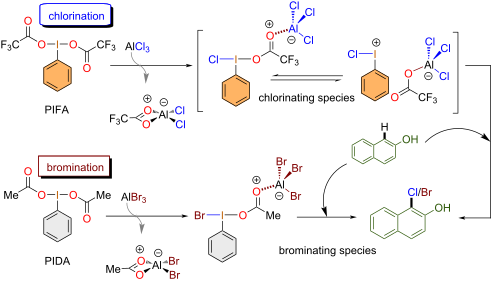
- states, significant energy differences exist concerning the PIDA/AlBr3 system. For example, the activation barrier of TS2 was 41.6 kcal/mol higher in energy than that in the mechanism in Figure 2. A similar energy profile was obtained for the bromination of 2-naphthol in the presence of PIFA (and 2


Computation-guided scaffold exploration of 2E,6E-1,10-trans/cis-eunicellanes
Beilstein J. Org. Chem. 2024, 20, 1320–1326, doi:10.3762/bjoc.20.115

- prior chair-to-boat conformational change of 9.7 kcal mol−1, providing a similar activation barrier for the Cope rearrangement step itself (27.2 kcal mol−1). For 1, a potential Cope rearrangement was predicted to be 32.5 kcal mol−1, an overall higher energetic barrier compared to 2 (Figure S11


Possible bi-stable structures of pyrenebutanoic acid-linked protein molecules adsorbed on graphene: theoretical study
Beilstein J. Org. Chem. 2024, 20, 570–577, doi:10.3762/bjoc.20.49
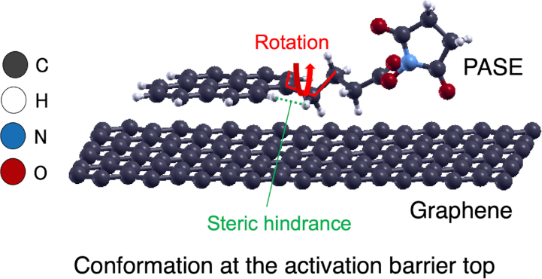
- ) linkers on graphene. The activation barrier between two bi-stable conformations exhibited by PASE is confirmed to be based on the steric hindrance effect between a hydrogen on the pyrene group and a hydrogen on the alkyl group of this molecule. Even after the protein is supplemented, this steric hindrance
- effect remains if the local structure of the linker consisting of an alkyl group and a pyrene group is maintained. Therefore, it is likely that the kinetic behavior of a protein immobilized with a single PASE linker exhibits an activation barrier-type energy surface between the bi-stable conformations on
- pathway on the adiabatic potential energy surface that connects these conformations caused by the deformation of the PASE linker. The reaction pathway for the conformational change of the PASE itself was found to have a reaction activation barrier [9]. First, we identify that the origin of the barrier is


Synthesis of photo- and ionochromic N-acylated 2-(aminomethylene)benzo[b]thiophene-3(2Н)-ones with a terminal phenanthroline group
Beilstein J. Org. Chem. 2024, 20, 552–560, doi:10.3762/bjoc.20.47
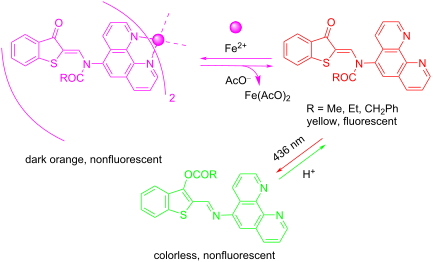
- . The reverse reaction 3a–c→2a–c with full restoration of the initial absorption and fluorescence properties was characterized by a high activation barrier and could be accomplished by heating a solution of 3a–c in o-dichlorobenzene at 423 K or by passing dry hydrogen chloride through a solution of 3a–c


Synthesis of π-conjugated polycyclic compounds by late-stage extrusion of chalcogen fragments
Beilstein J. Org. Chem. 2024, 20, 287–305, doi:10.3762/bjoc.20.30
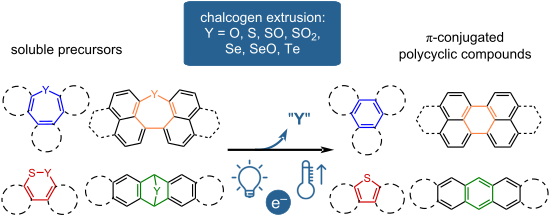
- room temperature, other group-16 heteropines suffer from thermal instability. Indeed, the low activation barrier for S, Se or Te cheletropic extrusion from the norcaradiene valence isomer, combined with the irreversibility of this process, shifts the tautomerization equilibrium and delivers benzene as




Electron-beam-promoted fullerene dimerization in nanotubes: insights from DFT computations
Beilstein J. Org. Chem. 2024, 20, 92–100, doi:10.3762/bjoc.20.10
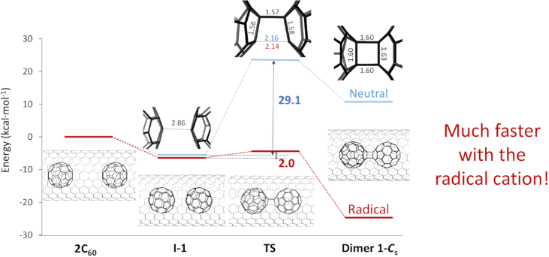
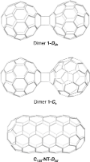
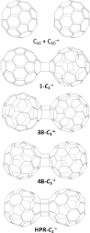
- the reaction either via singlet excitation or via radical cation formation (Scheme 1). Estimation of the activation barrier for the [2 + 2] cycloaddition when the nanotube acts as a sensitizer is 33.5 ± 6.8 kJ mol−1. This value agrees with computational predictions for the reaction via an excited




Cyclization of 1-aryl-4,4,4-trichlorobut-2-en-1-ones into 3-trichloromethylindan-1-ones in triflic acid
Beilstein J. Org. Chem. 2023, 19, 1460–1470, doi:10.3762/bjoc.19.105
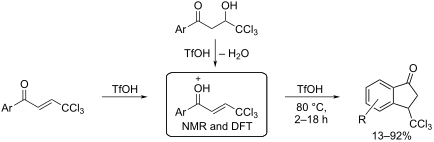
- , which then cyclize into the target indanones 3. Despite thermodynamic gain in energy, the cyclization of dications Aa in compounds 3 may have a high activation barrier. The calculations showed that the largest part of the positive charge in the key reactive species Ba is localized on the carbonyl carbon


Pyridine C(sp2)–H bond functionalization under transition-metal and rare earth metal catalysis
Beilstein J. Org. Chem. 2023, 19, 820–863, doi:10.3762/bjoc.19.62
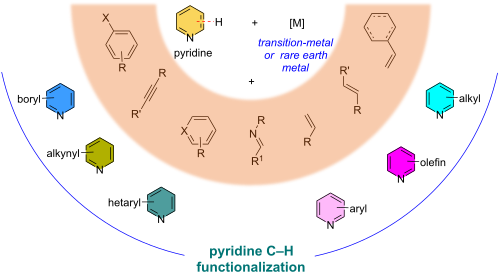
- , coordination chemistry including materials science [109][110]. The challenge associated with the C–H functionalization of bidentate molecules is the finding strategy in the subduing the high activation barrier of rollover cyclometallation pathway. In this section we discuss the C(sp2)–H functionalization of
















Access to cyclopropanes with geminal trifluoromethyl and difluoromethylphosphonate groups
Beilstein J. Org. Chem. 2023, 19, 541–549, doi:10.3762/bjoc.19.39
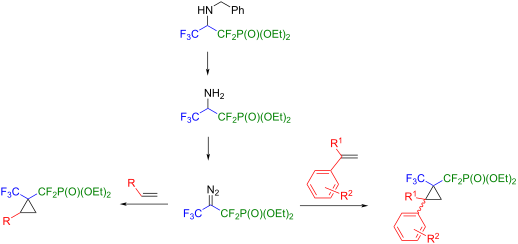
- adds to styrene to the carbon atom in 2-position of the ethenyl group. At this point, four different orientations of the phenyl group are conceivable (Scheme 6 and Scheme 7, TS2_1 to TS2_4). After an early transition state with hardly any activation barrier, the addition of styrene to Int2 proceeds in



Computational studies of Brønsted acid-catalyzed transannular cycloadditions of cycloalkenone hydrazones
Beilstein J. Org. Chem. 2023, 19, 477–486, doi:10.3762/bjoc.19.37
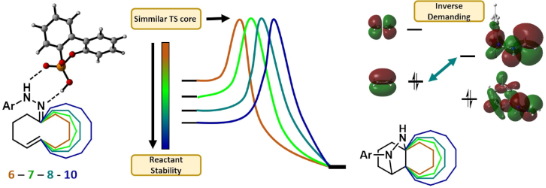
- yields. Similarly, data of Table 1 predict that the reaction of 1g and 1h leading to 5-5 and 5-6 systems (not tested experimentally, yet), respectively could also be observed experimentally. On the other hand, the higher activation barrier of compounds 1c, 1d, and 1k makes the cyclization way more energy




Naphthalimide-phenothiazine dyads: effect of conformational flexibility and matching of the energy of the charge-transfer state and the localized triplet excited state on the thermally activated delayed fluorescence
Beilstein J. Org. Chem. 2022, 18, 1435–1453, doi:10.3762/bjoc.18.149
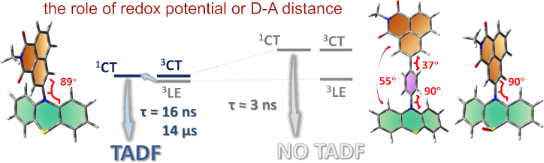
- difference and an even larger reorganization energy (0.75 and 1.92 eV, respectively), which lead to an activation barrier of ca. 3.42 eV (see details in Supporting Information File 1). Conversely, the sizable value of the RISC rate for the for the 3LE→1CT process in NI-PTZ roots on a small adiabatic energy
- difference and a similar value for the reorganization energy (0.23 vs 0.53 eV, respectively). This results in an activation barrier for the RISC process of ca. 0.076 eV, which is small enough to enable the RISC process at room temperature. In Scheme 2, a summary of the photodeactivation pathways for NI-PTZ
Heteroleptic metallosupramolecular aggregates/complexation for supramolecular catalysis
Beilstein J. Org. Chem. 2022, 18, 597–630, doi:10.3762/bjoc.18.62
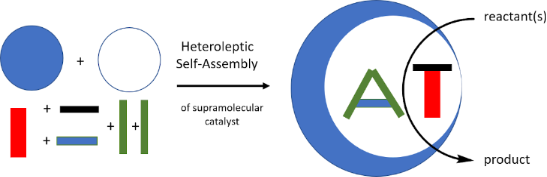
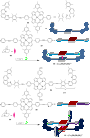
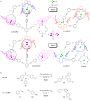
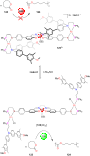
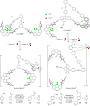
- ], Fujita [56], and others [57] have reported several template-free assemblies giving access to novel structures. The primary objective of these nanovessels as supramolecular catalysts is to encapsulate organic reactant/s to lower the activation barrier, thereby mimicking the functions of enzymes (without











Synthesis of highly substituted fluorenones via metal-free TBHP-promoted oxidative cyclization of 2-(aminomethyl)biphenyls. Application to the total synthesis of nobilone
Beilstein J. Org. Chem. 2021, 17, 2668–2679, doi:10.3762/bjoc.17.181
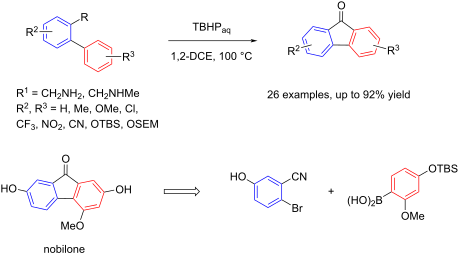
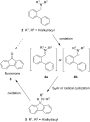
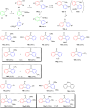
- gives only a low cyclization yield (Table 1, entry 12). It is unclear, if water is directly involved with this mechanism, but studies indicate that water may lower the activation barrier for the radical cyclization owing to its solvent effect, as has been previously reported for the radical synthesis of





Substituted nitrogen-bridged diazocines
Beilstein J. Org. Chem. 2021, 17, 1503–1508, doi:10.3762/bjoc.17.107
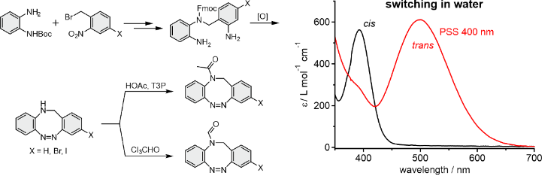
- to unsubstituted diazocines 10c and 11c. The activation barrier (EA) of the E→Z isomerization (obtained by an Arrhenius plot) is higher in formylated compounds 11 compared to acetylated compounds 10 and is further increased by halogenation. The unsubstituted N-formyl diazocine 11c and brominated NAc





