


Search results
Search for "insertion reactions" in Full Text gives 26 result(s) in Beilstein Journal of Organic Chemistry.
The trans-influence in gold chemistry from a catalytic perspective
Beilstein J. Org. Chem. 2026, 22, 838–856, doi:10.3762/bjoc.22.66
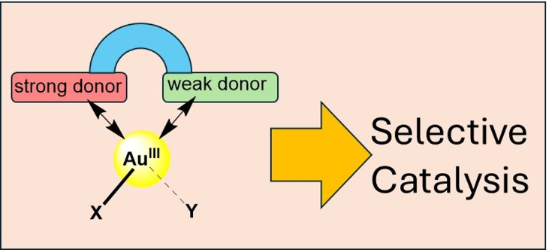
- electronic aspects such as photoluminescence and the spectroscopic and reactivity properties of gold(III) hydrides, before moving on to trans-influence enabled insertion reactions and catalytic applications. Perspective General considerations “Trans-influence” is a term applied to the weakening or
- of increasing cis influence, but generally the above series applies [50]. Au–H insertion reactions The different nature of the Au–H bond as a function of the trans-ligand has consequences in terms of chemical reactivity. Experiments have shown that gold hydrides can be grouped into two classes: those
- weakens Au–C bonds in trans position to a sufficient extent to make alkene insertion reactions energetically competitive. This is exemplified by the alkene insertions into an Au–aryl bond to give 30 and 31 (Scheme 17) [88], and by the double norbornene insertion into Au–Me to give 32 [89]. Further, the


Computational prediction of C–H hydricities and their use in predicting the regioselectivity of electron-rich C–H functionalisation reactions
Beilstein J. Org. Chem. 2026, 22, 603–610, doi:10.3762/bjoc.22.46
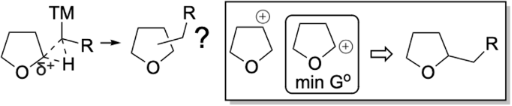
- predictive accuracy for sterically demanding carbene insertion reactions, where all current methods underperform. While the ten literature examples discussed here provide promising proof-of-concept evidence, establishing the general utility of hydricity for regioselectivity prediction will require validation


![[Graphic 6]](/bjoc/content/inline/1860-5397-22-46-i8.svg?max-width=637&scale=1.18182)


Catalytic asymmetric reactions of isocyanides for constructing non-central chirality
Beilstein J. Org. Chem. 2025, 21, 1648–1660, doi:10.3762/bjoc.21.129

- ], insertion reactions [16][17][18], cycloaddition reactions (e.g., [4 + 1], [3 + 2]) [19][20], and others [21][22][23]. Particularly, isocyanides have been widely exploited toward the preparation of centrally chiral structures through transition-metal-catalyzed or organocatalytic asymmetric reactions [24][25
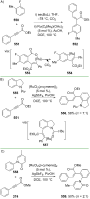
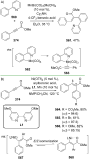
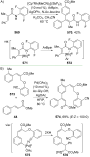
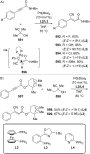
- reaction type and the chirality type of resulting products. Perspective Isocyanide-based transformations Palladium-catalyzed isocyanide insertion reactions In 2018, Luo, Zhu, and co-workers developed a palladium-catalyzed enantioselective reaction between ferrocene-derived vinyl isocyanides 1 and aryl
- for Pd-catalyzed isocyanide insertion reactions, organocatalytic isocyanide-based multicomponent reactions have been explored for the synthesis of axially chiral compounds. In 2024, Yang and co-workers reported a catalytic asymmetric version of the Groebke–Blackburn–Bienaymé reaction [32][33][34





Ambident reactivity of enolizable 5-mercapto-1H-tetrazoles in trapping reactions with in situ-generated thiocarbonyl S-methanides derived from sterically crowded cycloaliphatic thioketones
Beilstein J. Org. Chem. 2025, 21, 1508–1519, doi:10.3762/bjoc.21.113
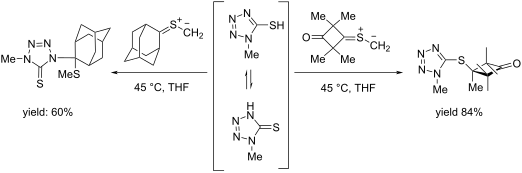
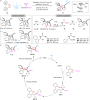
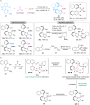
- derived from 5-mercapto-1H-tetrazoles was also examined. Keywords: 2,5-dihydro-1,3,4-thiadiazoles; enolizable 5-mercapto-1H-tetrazoles; insertion reactions; thiiranes; thiocarbonyl ylides; X-ray analysis; Introduction Cycloaddition reactions, including 1,3-dipolar cycloadditions, are considered as one
- products formed via S–H and N–H insertion reactions should also be tested. This method of modification of the structure of enolizable 5-mercapto-1H-tetrazole has not yet been described. Results and Discussion New precursors 2c,d of sterically crowded thiocarbonyl S-methanides 1c,d Based on the well
- substantial differences in reactivity of thiocarbonyl S-methanides 1a and 1b reported in earlier studies on their [3 + 2]-cycloadditions [6][10][11] or insertion reactions [12][13][14]. Therefore, a likely interpretation for the observed difference in the present study can be based on the assumption that the


Recent advances in synthetic approaches for bioactive cinnamic acid derivatives
Beilstein J. Org. Chem. 2025, 21, 1031–1086, doi:10.3762/bjoc.21.85
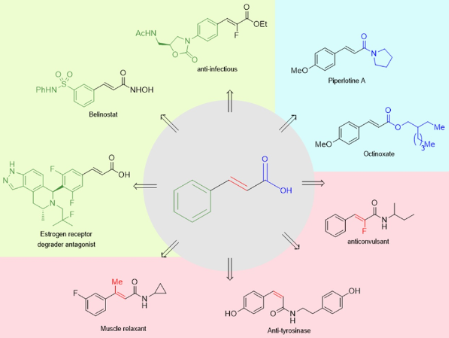
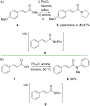
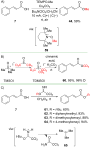
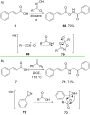
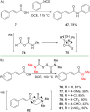
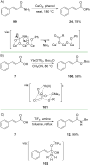
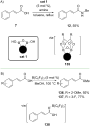
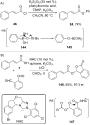
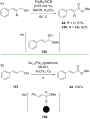
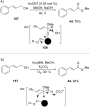
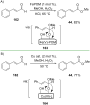
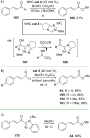
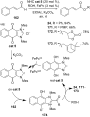
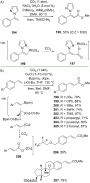
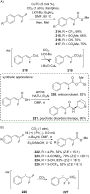
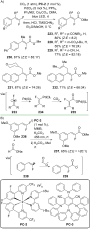
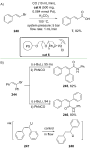
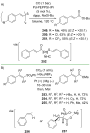
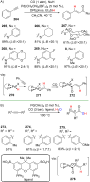
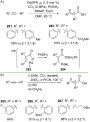
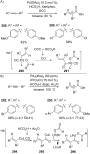
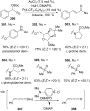
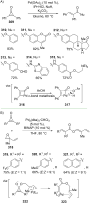
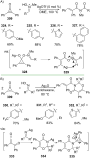
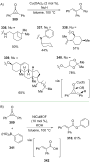
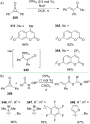
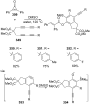
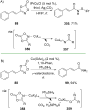
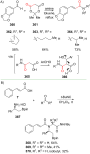
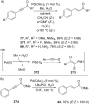
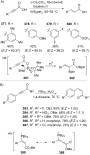
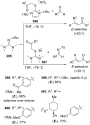
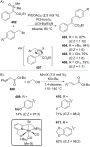
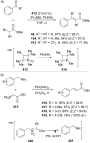
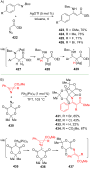
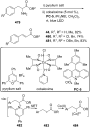
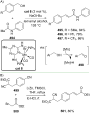
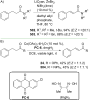
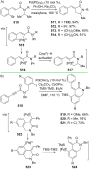
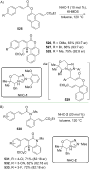
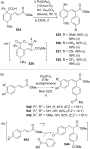
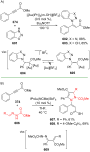
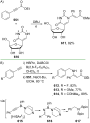
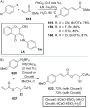
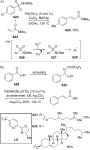
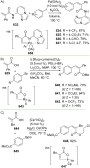
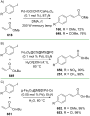
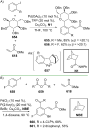
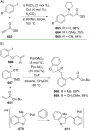
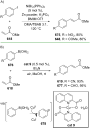
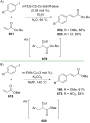
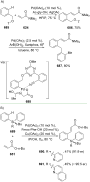
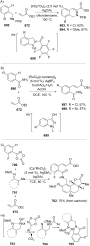
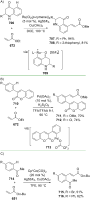
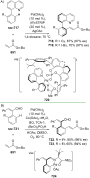
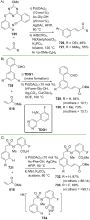
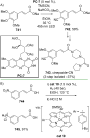
- -branched (L/B) selectivity of >20:1. The reaction involves the formation of palladium hydride (Pd–H) 270 as the key species followed by alkyne and CO insertion reactions via 271 and 272 (Scheme 68A) [116]. On the one hand, Jia and co-workers (2021) utilized environmentally benign water as the hydrogen










































Efficacy of radical reactions of isocyanides with heteroatom radicals in organic synthesis
Beilstein J. Org. Chem. 2024, 20, 2114–2128, doi:10.3762/bjoc.20.182
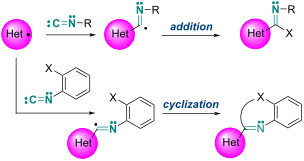
- hindrance. However, several examples of isocyanide insertion reactions into B–H and B–B bonds are known. For example, isocyanides coordinate to diborane (B2H6) or trialkylboranes (BR'3) to form Lewis acid–base complexes (RNC→BH3 or RNC→BR'3), but these complexes are thermally labile, and hydrogen or alkyl


N-Boc-α-diazo glutarimide as efficient reagent for assembling N-heterocycle-glutarimide diads via Rh(II)-catalyzed N–H insertion reaction
Beilstein J. Org. Chem. 2023, 19, 1841–1848, doi:10.3762/bjoc.19.136
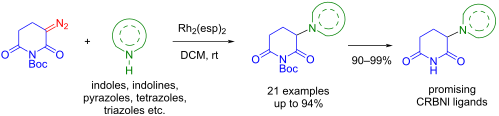
- )-catalyzed N–H insertion reactions involving NH-heterocycles. The proposed method enables the synthesis of multigram quantities of diazo compound 5 rapidly. Furthermore, it can be stored up to several weeks in the refrigerator (5 °C) without any observable alterations. A diverse array of NH-heterocycles with
- and efficiency in various XH insertion reactions [27][28][29]. In many cases (e.g., indoles, indazoles, benzotriazoles, tetrazoles, Scheme 3) the reaction progressed expeditiously (as indicated by gas evolution upon adding diazo reagent to the mixture of NH-substrate and catalyst) and was completed in
- suppressed the targeted reaction. Merely traces of the N–H insertion product were detectable in NMR data, with insignificant conversion of the initial heterocycle. Examples of N–H insertion reactions with azoles containing non-equivalent nitrogen atoms deserve separate discussion. As the only product of the




Exploring the role of halogen bonding in iodonium ylides: insights into unexpected reactivity and reaction control
Beilstein J. Org. Chem. 2023, 19, 1171–1190, doi:10.3762/bjoc.19.86
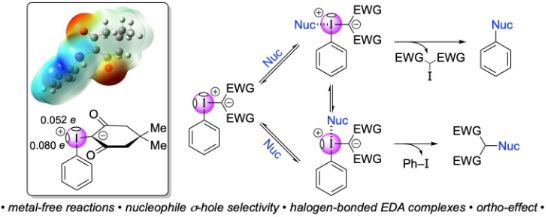
- insertion reactions could occur (Scheme 10) [100]. Systematic evaluation of acidic compounds showed that carboxylic acids (pKa ≈ 5; 85–99% yield) and thiophenols (pKa ≈ 7; 50f, 59%) were especially viable, whereas electron-rich phenols (pKa ≈ 10; 50d, <15% yield) were not. Though electron-poor phenols (pKa
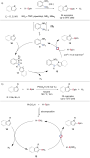
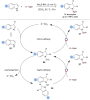
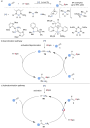
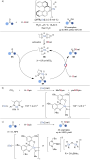
- . Proposed mechanism of the formal C–H insertion of pyrrole under blue LED irradiation. Mechanistic proposal for the X–H insertion reactions of iodonium ylides. Calculated reaction coordinate for the radiofluorination of iodonium ylide 60. Difference in Gibbs activation energy for ortho- or para-anisyl








Group 13 exchange and transborylation in catalysis
Beilstein J. Org. Chem. 2023, 19, 325–348, doi:10.3762/bjoc.19.28
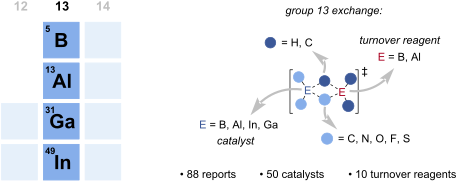
- functionalisation of unsaturated bonds [1][2][3][4][5], and, more recently, frustrated Lewis pair (FLP) chemistries including small molecule activations and C–H insertion reactions [6][7][8][9][10]. Group 13 exchange is the transfer of one or more substituents from one group 13 element to another group 13 element










A novel spirocyclic scaffold accessed via tandem Claisen rearrangement/intramolecular oxa-Michael addition
Beilstein J. Org. Chem. 2022, 18, 1649–1655, doi:10.3762/bjoc.18.177
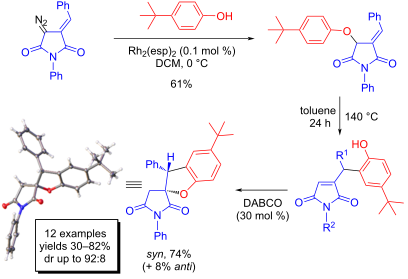
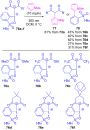
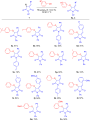
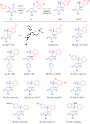
- spirocyclization of DAS with the formation of minor enol ether product 3a and its Claisen rearrangement. (b) Synthetic strategy investigated in this work. Initial attempt at Rh(II)-catalyzed O–H insertion/Claisen rearrangement. Rh2(esp)2-catalyzed O–H insertion reactions between various DAS 1 and phenols. Two-step



Unusual highly diastereoselective Rh(II)-catalyzed dimerization of 3-diazo-2-arylidenesuccinimides provides access to a new dibenzazulene scaffold
Beilstein J. Org. Chem. 2022, 18, 533–538, doi:10.3762/bjoc.18.55
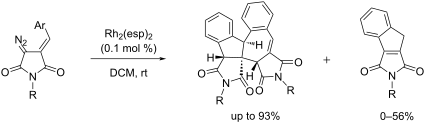
- method for the preparation of this class of compounds [2] and showed that DAS can undergo Rh(II)-catalyzed insertion reactions into the heteroatom–H bonds [3]. In 2020, it was shown that under Rh(II) catalysis, DAS can enter insertion reactions into the C–O bond of ethers [4], a rare transformation for


Selective sulfonylation and isonitrilation of para-quinone methides employing TosMIC as a source of sulfonyl group or isonitrile group
Beilstein J. Org. Chem. 2021, 17, 2822–2831, doi:10.3762/bjoc.17.193
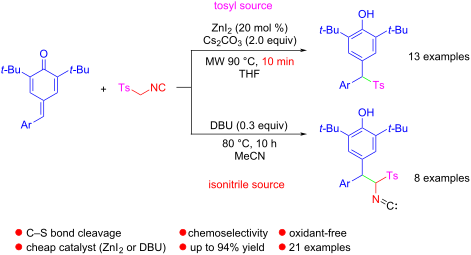
- important C1 synthon. Its special reactivity, such as the ability to react with electrophilic, nucleophilic, and radical reagents [25][26][27][28], determines that it can participate in many types of reactions such as multicomponent reactions [29][30][31][32], tandem reactions [33][34], and insertion
- reactions [35][36][37][38][39], etc. In this context, the electron-rich aryl(phenol)methane isonitrile may be a new active unit, which can be seen from the previous case of p-QMs type reaction [40][41][42][43][44][45][46][47][48][49][50][51] and the above-mentioned properties of isocyanide. Herein, we


Synthetic strategies of phosphonodepsipeptides
Beilstein J. Org. Chem. 2021, 17, 461–484, doi:10.3762/bjoc.17.41
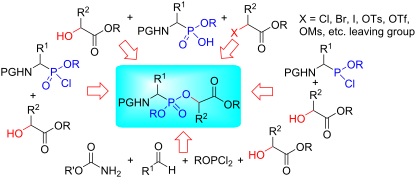
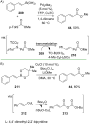
- insertion reactions. The reaction of the N-protected amino acids 209 and 210 with diethyl 1-diazo-2,2,2-trifluoroethylphosphonate (211) gave rise to the trifluoromethyl-containing phosphonodepsipeptides 212 and 213 with C-1-hydroxyalkylphosphonic acids in good yields under the catalysis of dirhodium




Preparation and in situ use of unstable N-alkyl α-diazo-γ-butyrolactams in RhII-catalyzed X–H insertion reactions
Beilstein J. Org. Chem. 2020, 16, 607–610, doi:10.3762/bjoc.16.55

- , the reactions tended to yield enamine adducts. Keywords: in situ reactions; N-alkyl 2-pyrrolidones; RhII-catalyzed insertion reactions; stability of diazo compounds; Introduction Recently, we described the first synthesis and subsequent transformations of a rare type of cyclic α-diazocarbonyl
- compounds, namely, α-diazo-γ-butyrolactams [1]. In particular, N-aryl-α-diazo-γ-butyrolactams 1 were efficiently transformed into pyrrolinones 2 upon the treatment with AgOTf (1 mol %) and into α-alkoxy derivatives 3 via Rh2(OAc)4-catalyzed O–H insertion reactions with various alcohols. In contrast, N-alkyl
- formation, in various RhII-catalyzed X–H insertion reactions, particularly the recently described rhodium carbene insertion into O–H [1], N–H [2] and S–H [3] bonds of alcohols, aromatic amines, and thiols, respectively. Herein, we report the results of these studies. Results and Discussion Three N-alkyl-α



Cyclopropanation–ring expansion of 3-chloroindoles with α-halodiazoacetates: novel synthesis of 4-quinolone-3-carboxylic acid and norfloxacin
Beilstein J. Org. Chem. 2019, 15, 2156–2160, doi:10.3762/bjoc.15.212
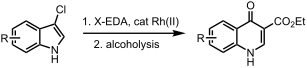
- decomposition of diazo compounds, are particularly versatile intermediates in organic synthesis, as they partake in cyclopropanation and C–H insertion reactions with high levels of selectivity [2]. This transition-metal-catalyzed carbene transfer has emerged as a mild and attractive route to indole


Synthesis of non-racemic 4-nitro-2-sulfonylbutan-1-ones via Ni(II)-catalyzed asymmetric Michael reaction of β-ketosulfones
Beilstein J. Org. Chem. 2019, 15, 1289–1297, doi:10.3762/bjoc.15.127
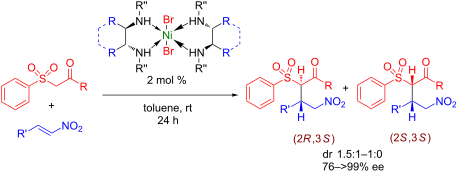
- , which allows to obtain chiral cyclic sulfones with high enantioselectivity [10][11][12]. Also non-racemic cyclic sulfones can be obtained by the Diels–Alder reaction, catalyzed by chiral Lewis acids or organocatalysts. Rh- and Cu-catalyzed CH-insertion reactions occurring at moderate or high




Diazirine-functionalized mannosides for photoaffinity labeling: trouble with FimH
Beilstein J. Org. Chem. 2018, 14, 1890–1900, doi:10.3762/bjoc.14.163

- insert into OH, NH, or CH groups of a protein in a fast reaction [5][6]. Further advantages of the diazirine group are its robustness at different pH values and its stability against nucleophiles. However, besides desired insertion reactions, carbenes can undergo unwanted side reactions, in particular




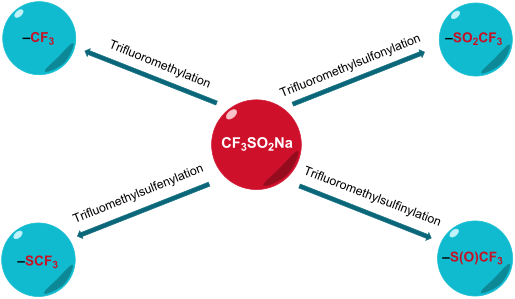
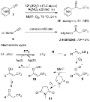
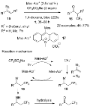
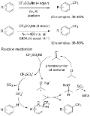
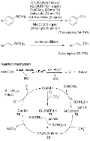
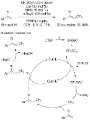
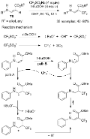
CF3SO2X (X = Na, Cl) as reagents for trifluoromethylation, trifluoromethylsulfenyl-, -sulfinyl- and -sulfonylation. Part 1: Use of CF3SO2Na
Beilstein J. Org. Chem. 2017, 13, 2764–2799, doi:10.3762/bjoc.13.272






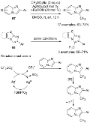

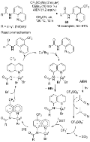


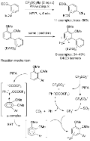


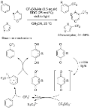











On the cause of low thermal stability of ethyl halodiazoacetates
Beilstein J. Org. Chem. 2016, 12, 1590–1597, doi:10.3762/bjoc.12.155

- expansion [12], and C–H insertion and Si–H insertion reactions [13]. Under Rh(II)-catalysis conditions, 2b extrudes N2 much faster than 1 (15 s vs 8 min to 50% conversion) [14]. The higher reaction rate implies a lower turnover limiting barrier in the catalytic cycle with 2b compared to 1. This example made




Enantioselective carbenoid insertion into C(sp3)–H bonds
Beilstein J. Org. Chem. 2016, 12, 882–902, doi:10.3762/bjoc.12.87
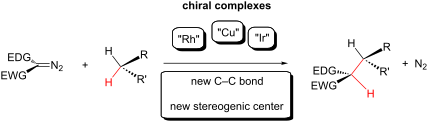
- chemical properties of the ligands around the metal center also determine significantly the type of insertion performed by the carbenoid intermediate. The complexes used for the formation of carbenoids in enantioselective insertion reactions must present a balance between steric and electronic factors, to
- rhodium have been the most frequently used ones in carbenoid insertion reactions. Copper carbenoids having a higher electrophilic character display a great reactivity, but little selectivity in insertion reactions. Despite these features, only recently the insertion of chiral copper carbenoids into a C
- carbenoid intermediates are prferably used in enantioselective insertion reactions. They are more often found as dirhodium(II) complexes. Only one of the two metal atoms present in the chemical structure effectively participates in the insertion reaction. The other rhodium atom withdraws electron density


Gold-catalyzed direct alkynylation of tryptophan in peptides using TIPS-EBX
Beilstein J. Org. Chem. 2016, 12, 745–749, doi:10.3762/bjoc.12.74
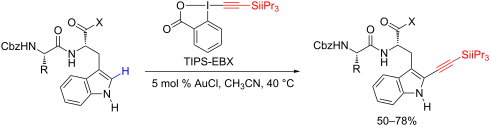
- . It has been achieved in the past for example by Francis and co-workers and Ball and co-workers using rhodium-catalyzed carbene-insertion reactions [21][22][23] or via direct C–H arylation [24][25][26][27][28][29]. If the installation of alkynes on peptides or proteins is desired, an indirect method



Copper-mediated synthesis of N-alkenyl-α,β-unsaturated nitrones and their conversion to tri- and tetrasubstituted pyridines
Beilstein J. Org. Chem. 2015, 11, 2097–2104, doi:10.3762/bjoc.11.226

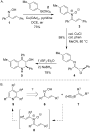
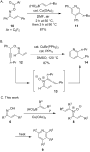
- substituents and regiospecificity of the transformation due to the use of the Chan–Lam reaction for the synthesis of the nitrone precursor are noteworthy and provide advantages over pyridine syntheses that require regioselective insertion reactions or nucleophilic additions. To better understand the conversion



Synthesis of quinoline-3-carboxylates by a Rh(II)-catalyzed cyclopropanation-ring expansion reaction of indoles with halodiazoacetates
Beilstein J. Org. Chem. 2015, 11, 1944–1949, doi:10.3762/bjoc.11.210

- many of the reactions between indoles and metal-bound carbenes are unclear [5][6][7][8]. We have for some time worked with halodiazoacetates and studied their reactivity in cyclopropanation reactions [17], C–H insertion and Si–H insertion reactions [18]. Halodiazoacetates can be made quantiatively and


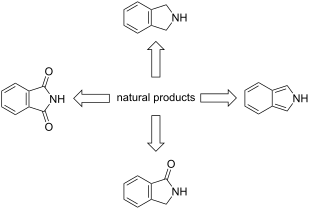
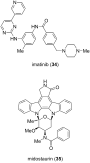
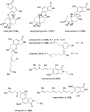
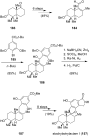
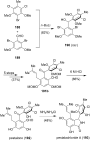
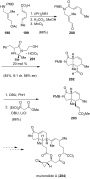
The chemistry of isoindole natural products
Beilstein J. Org. Chem. 2013, 9, 2048–2078, doi:10.3762/bjoc.9.243
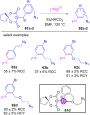
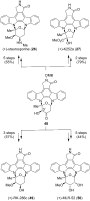
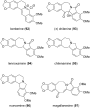
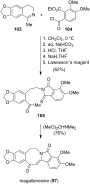
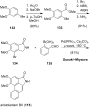
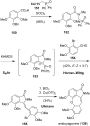
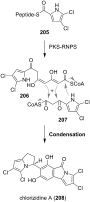
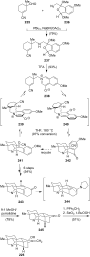
- Rh(II)-catalyzed C–H and OH insertion reactions (Scheme 4). The preparation of both enantiomeric furanose building blocks commenced with the Rh2(OAc)4-catalyzed OH insertion of 39, respectively 40 into the α-diazo-β-ketoester 40. A tandem [3,3]/[1,2]-rearrangement cascade, followed by reductive
















α-Bromodiazoacetamides – a new class of diazo compounds for catalyst-free, ambient temperature intramolecular C–H insertion reactions
Beilstein J. Org. Chem. 2013, 9, 1407–1413, doi:10.3762/bjoc.9.157

- cycloaddition, ylide formation, cyclopropanation and C–H insertion reactions [1][2][3]. A generally useful modification of diazo compounds is the substitution of the α-hydrogen for an electrophile. This substitution can be effected in the presence of a base or starting from the metalated diazo compound, and
- dirhodium(II)-catalysed cyclopropanation, and C–H and Si–H insertion reactions [37][38][39]. There are, to the best of our knowledge, no reports in the literature of α-halodiazoacetamides as a substance class. Thus, we wished to expand the substrate scope of one of our published methodologies to encompass
- , the dirhodium(II)-catalysed methylene C–H insertion reactions of the smaller cyclic derivatives 3a, 3b and 3e, were unsuccessful [61]. For comparison with the thermolytic reaction, we tested the performance of a small series of dirhodium(II)-catalysts in the intramolecular C–H insertion that forms 5b





