


Search results
Search for "numerical simulations" in Full Text gives 125 result(s) in Beilstein Journal of Nanotechnology.
Nonlinear features of the superconductor–ferromagnet–superconductor φ0 Josephson junction in the ferromagnetic resonance region
Beilstein J. Nanotechnol. 2022, 13, 1155–1166, doi:10.3762/bjnano.13.97
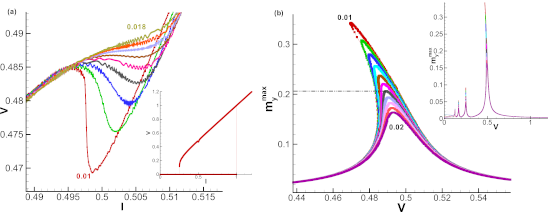
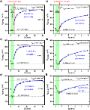
- numerical simulations of the dependence on α at different values of the SOC parameter r. It shows two specific features of ADD. First, with an increase in r, the critical value of Vpeak decreases (the curve moves away from ωF). The second important feature is an increase of αcrit, which is indicated by
- arrows in the figure. Another model parameter that affects the phenomenon discussed in the present paper is the ratio G between Josephson energy and magnetic energy. Figure 4b demonstrates the results of numerical simulations of the dependence on α at different values of G. Similar to the effect of r
- obtained from am approximated Duffing equation with numerical simulations of the total system in Equation 6. We show that in the limit of α ≪ G and r ≪ 1, we arrive at the Duffing oscillator. We start with the first three equations of Equation 6 for the magnetization components: Simplifying this system of


![[Graphic 14]](/bjnano/content/inline/2190-4286-13-97-i38.svg?max-width=637&scale=1.18182) at differ...
at differ...


![[Graphic 18]](/bjnano/content/inline/2190-4286-13-97-i42.svg?max-width=637&scale=1.18182) (V) on α in the damping parameter interval [0.001–0.12]....
(V) on α in the damping parameter interval [0.001–0.12]....

Micro-structures, nanomechanical properties and flight performance of three beetles with different folding ratios
Beilstein J. Nanotechnol. 2022, 13, 845–856, doi:10.3762/bjnano.13.75

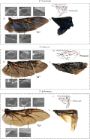
- through wind tunnel tests and numerical simulations, it was found that a higher aspect ratio of bionic wings leads to a higher lift-to-drag ratio [19]. The three-dimensional effect of flow is weakened with increasing aspect ratio, which increases the aerodynamic coefficient [47]. Based on beetle hind wing




A superconducting adiabatic neuron in a quantum regime
Beilstein J. Nanotechnol. 2022, 13, 653–665, doi:10.3762/bjnano.13.57

- and the formation of the sigmoidal activation function have also been studied. We start with the parameters of the input flux as presented in Figure 3. Numerical simulations demonstrate a distortion of the sigmoidal form of the activation function even when the SQ neuron is initialized in the ground
- instantaneous eigenbasis. Numerical simulations are performed for the temperature of the bosonic thermostat at T = 50 mK. We investigated the relaxation of the excited states for both the single-well (l < l*, Figure 10a,c) and double-well (l > l*, Figure 10b,d) potential shapes. The key result is the
- SQ neuron concept was developed with the support of the Russian Science Foundation (project no. 20-12-00130). The numerical simulations were supported by UNN within the framework of the strategic academic leadership program “Priority 2030” of the Ministry of Science and Higher Education of the


Approaching microwave photon sensitivity with Al Josephson junctions
Beilstein J. Nanotechnol. 2022, 13, 582–589, doi:10.3762/bjnano.13.50
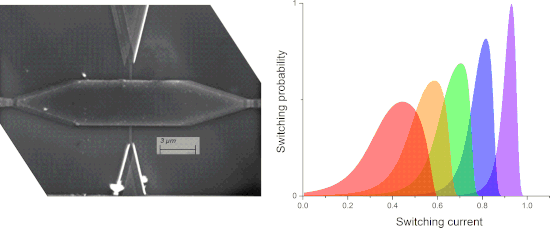
- achieve in real junctions. In our opinion, the most reliable way to determine the critical current is to compare the experimental lifetime as a function of the current with the lifetime calculated using numerical simulations [39][40][41] in the frame of the resistively–capacitively shunted junction (RCSJ
- need to use numerical simulations since, in the experiment, we are limited by the time constant of the filters that provide suppression of external interferences. As a result, we cannot measure switching times faster than the time constant, which in our case is about 1 ms. To obtain shorter times, we
- increases significantly. In Figure 5, one can see how the switching probability evolves with increasing temperature from 50 to 500 mK. The difference is not very large because at 50 mK the effective temperature was rather 265 mK, according to numerical simulations, and the thermal current at 500 mK is much


Tunable superconducting neurons for networks based on radial basis functions
Beilstein J. Nanotechnol. 2022, 13, 444–454, doi:10.3762/bjnano.13.37
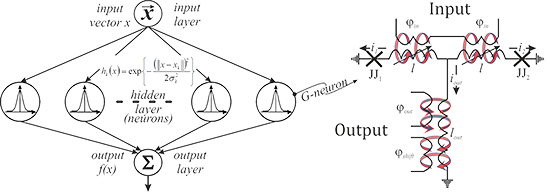
- implementation of the key elements of the discussed neural networks is the focus of this work. Results and Discussion Model of tunable Gauss-neuron: numerical simulations A common architecture of the considered RBFNs [49] is presented in Figure 1a. These networks have only one hidden layer of neurons on which
- dash–dot line) mutual orientations of magnetization between FM1 and FM2 layers as functions of the spacer thickness. Funding G-neuron and tunable inductance were developed with the support of the Russian Science Foundation (project no. 20-69-47013). The numerical simulations were supported within the


Theoretical understanding of electronic and mechanical properties of 1T′ transition metal dichalcogenide crystals
Beilstein J. Nanotechnol. 2022, 13, 160–171, doi:10.3762/bjnano.13.11

- to their composition and structural polytypes. However, experimental measurements of the electronic and mechanical properties of 2D materials face the challenge of synthesizing high-quality pristine crystals. Thus, numerical simulations have become a promising alternative due to the relatively good



Heating ability of elongated magnetic nanoparticles
Beilstein J. Nanotechnol. 2021, 12, 1404–1412, doi:10.3762/bjnano.12.104

- anisotropy constant was assumed [28][29] to be promising in magnetic hyperthermia. However, numerical simulations [30] showed that for spherical nanoparticles an increase of the uniaxial anisotropy constant leads to a decrease in SAR and a shift of the optimal particle diameters to smaller dimensions


Design aspects of Bi2Sr2CaCu2O8+δ THz sources: optimization of thermal and radiative properties
Beilstein J. Nanotechnol. 2021, 12, 1392–1403, doi:10.3762/bjnano.12.103
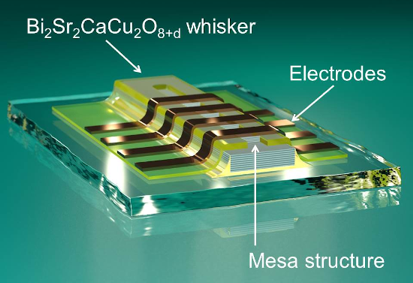
- sources. In this work we analyze thermal and radiative properties of such devices based on mesa structures of a layered high-temperature superconductor Bi2Sr2CaCu2O8+δ. Two types of devices are considered containing either a conventional large single crystal or a whisker. We perform numerical simulations
- needle-like whisker. We present numerical simulations for various geometrical configurations and parameters and make a comparison with experimental data. It is demonstrated that the structure and the geometry of both the superconductor and the electrodes play important roles. Electrodes provide an
- the substrate, see Figure 6c. Therefore, the substrate acts as a dielectric resonator and may strongly affect the radiation pattern of the device. The presented numerical simulations provide a qualitative explanation of the reported difference in radiative properties of whisker- and crystal-based


Cantilever signature of tip detachment during contact resonance AFM
Beilstein J. Nanotechnol. 2021, 12, 1286–1296, doi:10.3762/bjnano.12.96

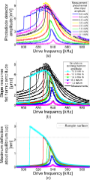
- to improve their measurements. We shed light on this issue by deliberately pushing both our experimental equipment and numerical simulations to the point of tip–sample detachment to explore cantilever dynamics during a useful and observable threshold feature in the measured response. Numerical
- nonlinear response feature to the onset of tip–sample detachment in our numerical simulations to confirm the conclusions from prior works [26][27][28]. The simulations allow for deeper insight into cantilever dynamics during the interaction between the AFM probe tip and the sample, which in turn allow us to
- measurements and numerical simulations of cantilever response amplitude as a function of drive frequency at different drive amplitudes are shown in Figure 1. Figure 1a shows the experimental photodiode amplitude signal as recorded with the lock-in amplifier of the AFM in units of volts. Figure 1b compares the


Nonmonotonous temperature dependence of Shapiro steps in YBCO grain boundary junctions
Beilstein J. Nanotechnol. 2021, 12, 1279–1285, doi:10.3762/bjnano.12.95
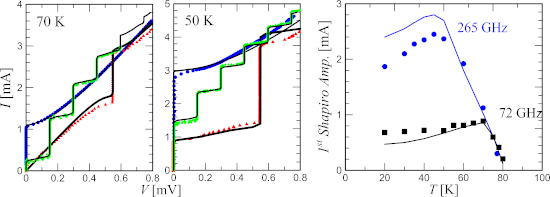
- shown in Figure 1. Figure 2 shows the IVCs for temperatures of 70 and 50 K in the absence of a high-frequency signal and in the regime of detecting external 72 or 265 GHz signals. The measurement results are in good agreement with the numerical simulations (the black curves). It should be noted that the


A review on slip boundary conditions at the nanoscale: recent development and applications
Beilstein J. Nanotechnol. 2021, 12, 1237–1251, doi:10.3762/bjnano.12.91

- conversion from 3 to 70% [23]. Generally, the methods to investigate slip boundary conditions for nanoconfined liquids include theoretical analysis, physical experiments, and numerical simulations [8][24][25][26][27][28][29][30][31][32][33][34]. In recent years, machine learning methods have also been
- force [39][40][41][42]. However, compared with experimental methods, numerical simulations, such as the lattice Boltzmann method and molecular dynamics (MD) simulation, are more attractive in many aspects. First, numerical simulations can readily reach the system sizes and timescales of practical
- nanoflows [43]. Additionally, numerical methods can provide a controllable way to change a certain property of liquid or solid walls while other properties remain unchanged [44]. In comparison with physical experiments, numerical simulations allow researchers to study the density, velocity profiles, and


Electromigration-induced formation of percolating adsorbate islands during condensation from the gaseous phase: a computational study
Beilstein J. Nanotechnol. 2021, 12, 694–703, doi:10.3762/bjnano.12.55

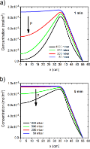
- islands during condensation from the gaseous phase. We will show that the elongated morphology of adsorbate islands remains stable if the electric field is turned off. Keywords: adsorptive systems; electromigration; numerical simulations; pattern formation; thin films; Introduction The processes of
- of adsorbate concentration on the substrate. After that, we discuss the results of numerical simulations. The main conclusions are collected in the last section. Model In order to describe the evolution of the adsorbate concentration on the first growing layer of the multilayer system during
- strength ε extends the domain of α and k∥ in which patterning is possible. Numerical simulations In order to perform numerical simulations of the process of pattern formation during deposition we will proceed in a manner closely related to [63][64]. We will solve numerically Equation 4 on a two-dimensional


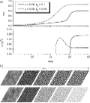


![[Graphic 29]](/bjnano/content/inline/2190-4286-12-55-i36.svg?max-width=637&scale=1.18182) on the adsorption coefficient α ...
on the adsorption coefficient α ...

Determination of elastic moduli of elastic–plastic microspherical materials using nanoindentation simulation without mechanical polishing
Beilstein J. Nanotechnol. 2021, 12, 213–221, doi:10.3762/bjnano.12.17

- cannot be controlled. There are no reliable theoretical or experimental methods to evaluate the mechanical behavior during nanoindentation of an elastic–plastic microsphere. Therefore, it is necessary to conduct reliable numerical simulations to evaluate this behavior. This article reports a systematic
- the mechanical behavior during nanoindentation of a curved specimen. Therefore, it is necessary to conduct reliable numerical simulations to evaluate the mechanical behavior of nanoindentation on an elastic–plastic microspherical material. The numerical simulations are usually carried out via the


Mapping of integrated PIN diodes with a 3D architecture by scanning microwave impedance microscopy and dynamic spectroscopy
Beilstein J. Nanotechnol. 2020, 11, 1764–1775, doi:10.3762/bjnano.11.159

- intrinsic layer allows one to meet the required electrical specifications for switches in power electronics. In order to analyse the profiles extracted from the sMIM measurements, the majority carrier concentration calculated by numerical simulations [31] for an abrupt PIN doping profile is compared with


Seebeck coefficient of silicon nanowire forests doped by thermal diffusion
Beilstein J. Nanotechnol. 2020, 11, 1707–1713, doi:10.3762/bjnano.11.153

- doping parameters. These results are in good agreement with numerical simulations of the doping process applied to silicon nanowires. These devices, based on doped nanowire forests, offer a possible route for the exploitation of the high power factor of silicon, which, combined with the very low thermal
- . Therefore, it is mandatory to perform a single-step diffusion process, which results in a nonuniform doping concentration in the nanowire. Here, we report the measurement of the Seebeck coefficient after different doping processes, and compare the measurements with numerical simulations that take into
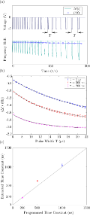
- several samples as a function of the nanowire length (doping at 800 °C for 10 min). Measured voltage drop (Seebeck voltage ΔVseebeck) as a function of the temperature difference between the ends of the nanowires, ΔTNW. The slope is the Seebeck coefficient of the nanowires. Numerical simulations of


On the frequency dependence of viscoelastic material characterization with intermittent-contact dynamic atomic force microscopy: avoiding mischaracterization across large frequency ranges
Beilstein J. Nanotechnol. 2020, 11, 1409–1418, doi:10.3762/bjnano.11.125

- approach can help to avoid some of the mischaracterization issues discussed above, especially in combination with numerical simulations of quasi-static [14][33][34] and dynamic AFM [35] measurements, which incorporate viscoelastic models such as those depicted in Figure 1. Conclusion We have presented an


Transition from freestanding SnO2 nanowires to laterally aligned nanowires with a simulation-based experimental design
Beilstein J. Nanotechnol. 2020, 11, 843–853, doi:10.3762/bjnano.11.69
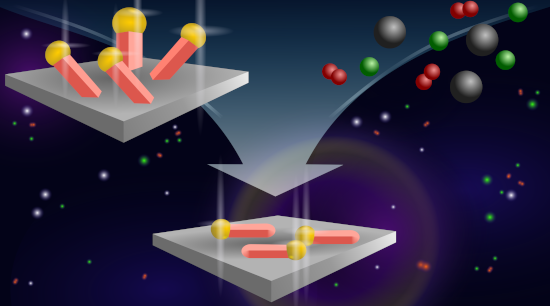
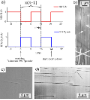
- can be changed to the growth of laterally aligned NWs. By comparison of numerical simulations with systematic experiments, we discuss how the process parameters for freestanding SnO2 NWs have to be modified to achieve a laterally aligned NW growth mode. Experimental Substrate preparation The





Current measurements in the intermittent-contact mode of atomic force microscopy using the Fourier method: a feasibility analysis
Beilstein J. Nanotechnol. 2020, 11, 453–465, doi:10.3762/bjnano.11.37

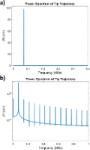
- contact-mode imaging. To explore its feasibility, we derive the analytical form of the tip–sample current that would be obtained for attractive (noncontact) and repulsive (intermittent-contact) dynamic AFM characterization, and compare it with results obtained from numerical simulations. Although
- torsional oscillations in a way that reduced cross-contamination of the signals used to reconstruct the tip–sample force. We have also reported numerical simulations of this method, providing analysis software that enables estimations of the accuracy of the method under different conditions [29]. Fourier
- the tunnelling current was neglected. In all cases we obtained good agreement between the analytical expressions derived and the numerical simulations conducted, which suggests that a Fourier-based reconstruction of the current may be feasible. Nevertheless, it is important to point out anticipated




Implementation of data-cube pump–probe KPFM on organic solar cells
Beilstein J. Nanotechnol. 2020, 11, 323–337, doi:10.3762/bjnano.11.24
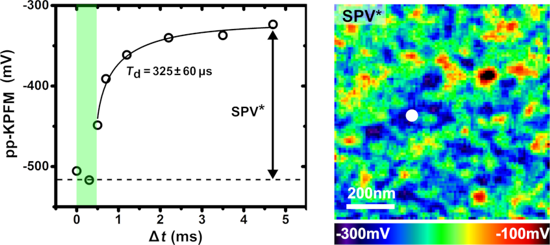
- the photocharging time is not negligible compared to the light pulse duration. In this case, numerical simulations are necessary to properly analyze the spectroscopic SP(fmod) curves [18]. When investigating organic donor–acceptor (D–A) blends, both capacitive effects and photocharging dynamics shall




An investigation on the drag reduction performance of bioinspired pipeline surfaces with transverse microgrooves
Beilstein J. Nanotechnol. 2020, 11, 24–40, doi:10.3762/bjnano.11.3

- microstructure, it can be divided into streamwise grooves and transverse grooves. With the development of numerical simulations and experimental techniques, the influence of microstructures on turbulent flow characteristics can be investigated accurately. Its drag reduction mechanism is owed to the two aspects
- measured average pressure difference was compared to the result of numerical simulations at the same flow rate. Figure 9 shows the comparison of the simulated and experimental results, and the maximum relative error was less than 2.0%, which was deemed acceptable. Therefore, it could be concluded from the
- %, which was lower than the maximum DRR of 3.84% obtained in the numerical simulations. Meanwhile, the experimental Reynolds number range associated with a drag reduction effect was smaller than that obtained in the numerical simulation (Table 4). The different results may have been caused by specimen


Plasmonic nanosensor based on multiple independently tunable Fano resonances
Beilstein J. Nanotechnol. 2019, 10, 2527–2537, doi:10.3762/bjnano.10.243
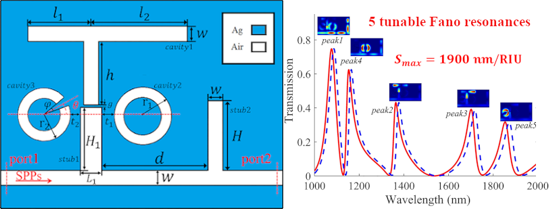
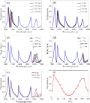
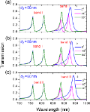
- the bright mode, and each of the three resonators (cavity1, cavity2, cavity3) can generate the different dark modes. To further reveal the resonance properties, like assembling as building blocks, we performed a series of numerical simulations to discuss the mechanism of our design. Firstly, a simple




Multiple Fano resonances with flexible tunablity based on symmetry-breaking resonators
Beilstein J. Nanotechnol. 2019, 10, 2459–2467, doi:10.3762/bjnano.10.236
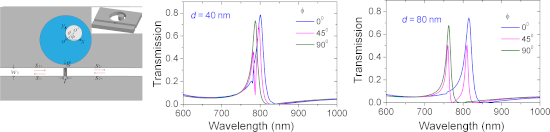
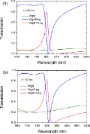
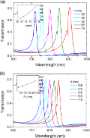
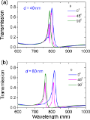
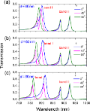
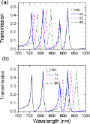
- , we have Tmax = 1. Results and Discussion Numerical simulations were performed by using COMSOL Multiphysics. The width of the waveguide is W0 = 50 nm, the gap between waveguide and resonator is g = 10 nm. The outer and inner radius of ring are R = 155 nm and r = 55 nm, respectively. The deviation




Dynamics of superparamagnetic nanoparticles in viscous liquids in rotating magnetic fields
Beilstein J. Nanotechnol. 2019, 10, 2294–2303, doi:10.3762/bjnano.10.221

- .10.221 Abstract The dynamics of magnetic nanoparticles in a viscous liquid in a rotating magnetic field has been studied by means of numerical simulations and analytical calculations. In the magneto-dynamics approximation three different modes of motion of the unit magnetization vector and particle
- , especially in the region of relatively large nanoparticle diameters. Results and Discussion The results of numerical simulations presented in Figure 4 and Figure 5 show that with an optimal choice of the particle diameters sufficiently large SAR values, of the order of 400–500 W/g can be obtained in RMFs at
- amplitudes used in the experiments [41][43]. Indeed, in [43] the SAR values of the assembly in RMFs were measured in a fairly wide frequency range, from 100 to 800 kHz. However, the RMF amplitudes were only 1 or 2 kA/m, that is, it did not exceed 25 Oe. As our numerical simulations show, it is impossible to


Review of time-resolved non-contact electrostatic force microscopy techniques with applications to ionic transport measurements
Beilstein J. Nanotechnol. 2019, 10, 617–633, doi:10.3762/bjnano.10.62
- frequency shift peak’ (tFP) by Giridharagopal and co-workers [22]. The authors demonstrated that simulated results (both numerical simulations of a damped-driven harmonic oscillator and finite element simulations) and their experimental results show excellent agreement given the same parameters and subject
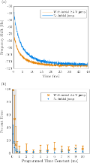
- FF-trEFM for these measurements, we performed numerical simulations (of a damped driven harmonic oscillator, see Supporting Information File 1 for MATLAB code) similar to those performed by Karatay and co-workers [51], using instead a resonance frequency varying in time as a stretched exponential and
- for excitations with time constants of 25 ns and 100 μs are shown).” Reproduced with permission from [51], copyright 2016 AIP Publishing. Extracted FF-trEFM signals from numerical simulations of tip–sample interactions with a stretched-exponential time response (Equation 1) with various relaxation





Heating ability of magnetic nanoparticles with cubic and combined anisotropy
Beilstein J. Nanotechnol. 2019, 10, 305–314, doi:10.3762/bjnano.10.29

- using numerical simulations. We take into account the influence of thermal agitation of particle magnetic moments at a room temperature and the effect of mutual magneto–dipole interaction between the nanoparticles on the assembly behavior. The aim of this paper is to estimate the SAR of magnetite
- ][19][20][21][22][24][25]. In addition, in the calculations performed, the fractal nature [24][25][26][27] of magnetic clusters in biological media is taken into account. The numerical simulations are carried out using the Landau–Lifshitz (LL) stochastic equation [22][28][29][30][31]. It is found that





