
Search results
Search for "electronic" in Full Text gives 1112 result(s) in Beilstein Journal of Nanotechnology. Showing first 200.
Characterization of ion track-etched conical nanopores in thermal and PECVD SiO2 using small angle X-ray scattering
Beilstein J. Nanotechnol. 2025, 16, 899–909, doi:10.3762/bjnano.16.68
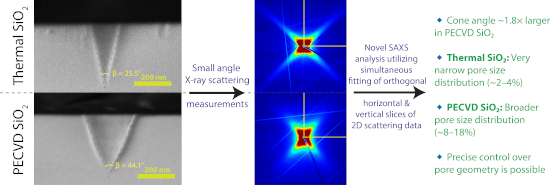
- typically differ in morphology, density, and stoichiometry compared to thermally grown SiO2. The electronic energy loss (Se) in the thermal and PECVD SiO2 layers was calculated using the SRIM2008 code [49]. The average Se values for thermal SiO2 for 1.6 GeV, 185 MeV, and 89 MeV Au irradiation are 21.1, 16.6


Heat-induced transformation of nickel-coated polycrystalline diamond film studied in situ by XPS and NEXAFS
Beilstein J. Nanotechnol. 2025, 16, 887–898, doi:10.3762/bjnano.16.67
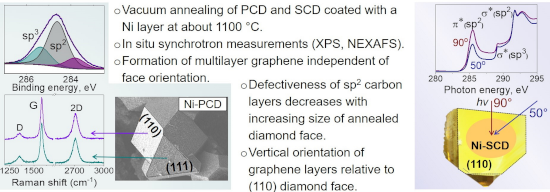
- coating on the electronic structure and chemical state of graphite layers formed on the surface of a polycrystalline diamond (PCD) film with mixed grain orientation was studied. A synthetic single-crystal diamond (SCD) with a polished (110) face was examined for comparison. The samples were coated with a


Ar+ implantation-induced tailoring of RF-sputtered ZnO films: structural, morphological, and optical properties
Beilstein J. Nanotechnol. 2025, 16, 872–886, doi:10.3762/bjnano.16.66
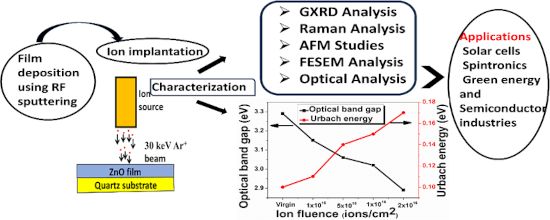
- implantation is carried out at normal incidence for all fluences. The electronic energy loss of 30 keV Ar+ ions in ZnO films is 18.73 eV·Å−1, while the nuclear energy loss is 9.610 × 10³ eV·Å−1, calculated using SRIM-2008 [19]. The projected range of 30 keV Ar+ ions in the ZnO lattice is 25.9 ± 13.7 nm. The
- fluences, the density of electronic excitation increases, and covalent bonds in the lattice are weakened. This leads to relaxation, which causes surface smoothening. The stoichiometry of pristine and implanted samples evaluated using EDS analysis are shown in Table 6. Because of the native oxide layer on






Insights into the electronic and atomic structures of cerium oxide-based ultrathin films and nanostructures using high-brilliance light sources
Beilstein J. Nanotechnol. 2025, 16, 860–871, doi:10.3762/bjnano.16.65
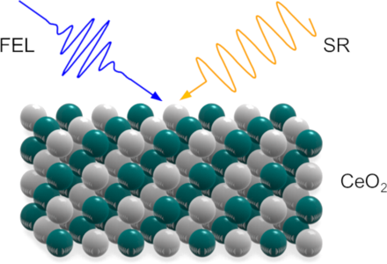
- light sources, such as synchrotrons and free-electron lasers, allow researchers to probe the structural, electronic, and dynamic properties of functional materials at an unprecedented level of detail. Techniques like X-ray photoelectron spectroscopy and X-ray absorption spectroscopy, can reveal atomic
- sensitivity, atomic selectivity, spatial and energy resolution, synchrotron radiation-based techniques, which utilize high-brilliance photon beams, have enabled refined characterization of the electronic, structural, and morphological properties of these materials, as well as the modifications they undergo
- understanding of cerium oxide-based systems was introduced by the application of resonant photoemission to selectively probe valence band features related to Ce4+ and Ce3+ ions. This can be done by tuning the photon energy at specific resonances related to Ce 4d→Ce 4f0 (Ce4+) and Ce 4d→Ce 4f1 (Ce3+) electronic


Facile one-step radio frequency magnetron sputtering of Ni/NiO on stainless steel for an efficient electrode for hydrogen evolution reaction
Beilstein J. Nanotechnol. 2025, 16, 837–846, doi:10.3762/bjnano.16.63
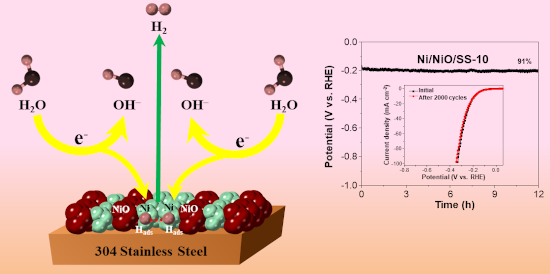
- operation. The high efficiency is attributed to the collaborative work of the NiO and Ni metal components and the good electrical conductivity of SS, which is advantageous for dissociative adsorption of water molecules, recombination of hydrogen atoms, and improvement of electronic/ionic motion. This work


Synthesis and magnetic transitions of rare-earth-free Fe–Mn–Ni–Si-based compositionally complex alloys at bulk and nanoscale
Beilstein J. Nanotechnol. 2025, 16, 823–836, doi:10.3762/bjnano.16.62
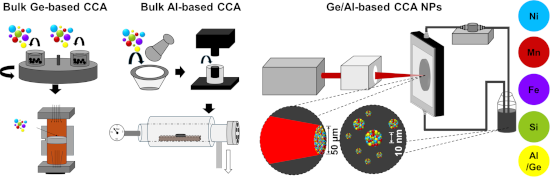
- -type structure [22]. For instance, a ternary MnNiSi alloy transitions from the hexagonal Ni2In structure to the orthorhombic TiNiSi structure at 1200 K [23], which is far from ideal for magnetocaloric, electronic, and spintronic-based applications. When these alloys are doped with elements such as Fe
- ], wear resistant coatings [29], environmental [30], biomedical [31], magnetic [32] and electronic [33] technologies. In magnetic NPs, a key feature is the superparamagnetic blocked-to-superparamagnetic fluctuating transition, which occurs at a characteristic blocking temperature (TB). Below TB, NPs
- weight ratio of 20:1 with a rotation speed of sun disk/jars 700 rpm/1400 rpm. In the second step, the HEBM powders were consolidated using SPS (Dr. Sinter Lab – Fuji Electronic Industrial Co. Ltd.) in a vacuum environment. The powder mixture was loaded into a cylindrical graphite die with an inner


Supramolecular hydration structure of graphene-based hydrogels: density functional theory, green chemistry and interface application
Beilstein J. Nanotechnol. 2025, 16, 806–822, doi:10.3762/bjnano.16.61
- implemented in electronic structure calculations. Generalized gradient approximation of Perdew–Burke–Ernzerhof (GGA-PBE) was used for describing exchange-correlation energy of electron–electron interactions. The correction of van der Waals dispersion energy was applied using the DFT-D3 method proposed by
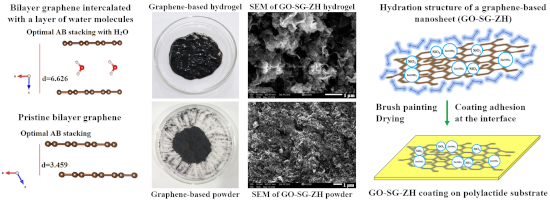
- graphene with the intersheet distance of 3.459 Å (a), and its valence–conduction band structure in hexagonal Brillouin zone (b). The AB bilayer graphene structure intercalated with a layer of water molecules and the intersheet distance of 6.626 Å (c), and its electronic band structure in hexagonal


Morphology and properties of pyrite nanoparticles obtained by pulsed laser ablation in liquid and thin films for photodetection
Beilstein J. Nanotechnol. 2025, 16, 785–805, doi:10.3762/bjnano.16.60
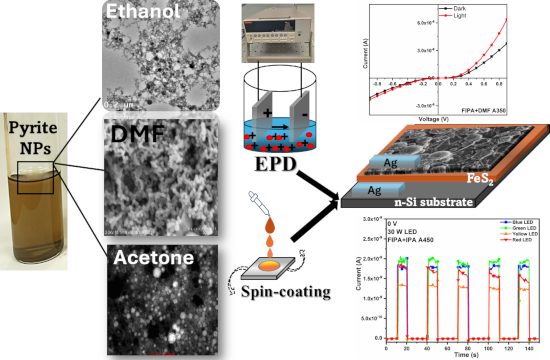
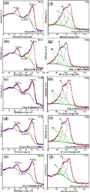
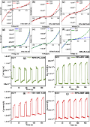
- spectral responsivity, S is the active area of illumination (0.7853 cm2), e is the electronic charge, Ilight and Idark are the current values under light and dark, and P is the optical power density. The optical power density values for 585 and 785 nm lasers, ranging from 20 mW to 100 mW, were between






Changes of structural, magnetic and spectroscopic properties of microencapsulated iron sucrose nanoparticles in saline
Beilstein J. Nanotechnol. 2025, 16, 762–784, doi:10.3762/bjnano.16.59





Thickness dependent oxidation in CrCl3: a scanning X-ray photoemission and Kelvin probe microscopies study
Beilstein J. Nanotechnol. 2025, 16, 749–761, doi:10.3762/bjnano.16.58
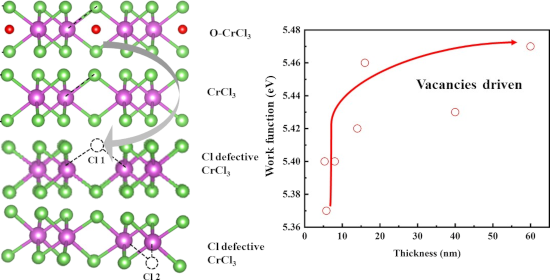
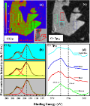
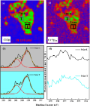
- , Faculty of Applied Physics and Mathematics, 80-233 Gdansk, Poland 10.3762/bjnano.16.58 Abstract The modifications in the electronic properties induced by the thickness and size of an individual flake of transition-metal halides on different substrates (silicon oxide or In-doped tin oxide) are of
- of CrCl3 [2], which can be easily exfoliated and exhibits a slower degradation rate compared to CrI3 or CrBr3[3]. To fully exploit the potential of any material, a detailed understanding of its electronic and structural changes arising from intrinsic and extrinsic defects is crucial [4]. Despite this
- importance, limited experimental research has been conducted on the electronic structure of CrX3 [5][6]. According to previously published photoelectron spectroscopy results, CrX3 belongs to metal compounds in which the 3d states are very close to the Fermi level, significantly above the 3p/4p/5p states of





Nanostructured materials characterized by scanning photoelectron spectromicroscopy
Beilstein J. Nanotechnol. 2025, 16, 700–710, doi:10.3762/bjnano.16.54
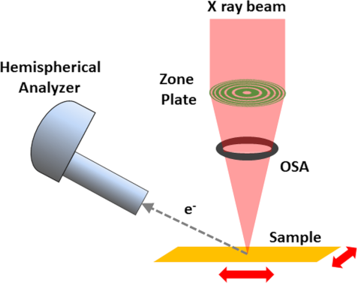
- current and future applications. Due to their nature resulting in diffused heterogeneous structures (chemical and electronic composition typically organized in phases or building blocks) characterizing these materials needs state of the art technologies which combine nanometer spatial resolution
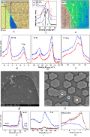
- decades, many characterization tools used to investigate chemical, electronic, or structural properties of materials have been developed or upgraded to match the requirements imposed by nanotechnology. Imaging capabilities covering from meso- to atomic scales, spatially resolved spectroscopies with
- enhanced sensitivities are examples of capabilities that modern techniques of characterization in nanotechnology must possess. X-ray photoelectron spectroscopy (XPS) is still one of the fundamental tools for chemical and electronic characterization of surfaces and subsurface layers. In the last three to


High-temperature epitaxial growth of tantalum nitride thin films on MgO: structural evolution and potential for SQUID applications
Beilstein J. Nanotechnol. 2025, 16, 690–699, doi:10.3762/bjnano.16.53
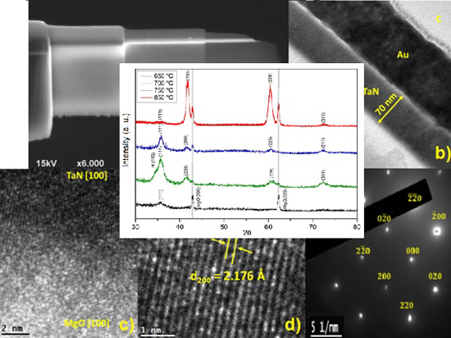
- as lossless power transmission, magnetic levitation in transportation systems, and the creation of powerful electromagnets. Furthermore, superconductivity plays a pivotal role in the development of advanced technologies, including quantum computing and nanometric electronic devices. Despite
- electronic devices operating in the gigahertz range. Transition-metal compounds, such as nitrides and carbides (e.g., NbN, TiN, TiC, and TaN), have demonstrated Tc values ranging from 2 to 10.4 K [3][4][5][6]. These compounds constitute a significant class of materials because of their exceptional physical
- has a superconductive energy gap lower than that of NbN [7], the most commonly used material for single-photon detectors in the gigahertz range; hence, this material can be a better candidate for superconductive electronic devices. Depending on the amount of incorporated nitrogen, x, the tantalum


The impact of tris(pentafluorophenyl)borane hole transport layer doping on interfacial charge extraction and recombination
Beilstein J. Nanotechnol. 2025, 16, 678–689, doi:10.3762/bjnano.16.52
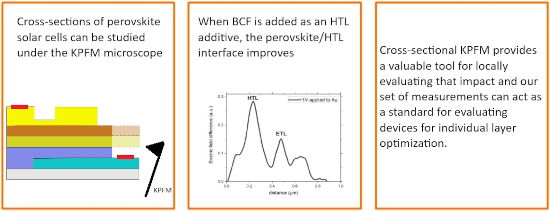
- about charge generation and transport within the absorber material, as well as charge extraction to the relevant interfaces [9][10][11][12]. The details of interfacial electronic carrier extraction at the junctions of the perovskite with the electron and hole transport layers (ETL, HTL) define the


Colloidal few layered graphene–tannic acid preserves the biocompatibility of periodontal ligament cells
Beilstein J. Nanotechnol. 2025, 16, 664–677, doi:10.3762/bjnano.16.51
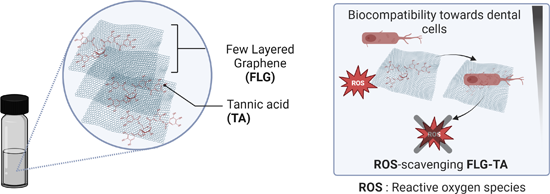
- multiple sources including metal impurities (such as Fe, Ni, or Cu) present in the graphene structure, as well as from the intrinsic electronic properties of graphene itself. Indeed, graphene’s sp2 hybridization and delocalized π electrons can participate in electron transfer reactions, potentially leading
- . The cellular response on different graphene surfaces was previously studied, and it was demonstrated that substrate characteristics such as surface roughness, surface chemistry, and electronic properties can influence cell response [38]. The implications of these results are particularly significant





Nanoscale capacitance spectroscopy based on multifrequency electrostatic force microscopy
Beilstein J. Nanotechnol. 2025, 16, 637–651, doi:10.3762/bjnano.16.49
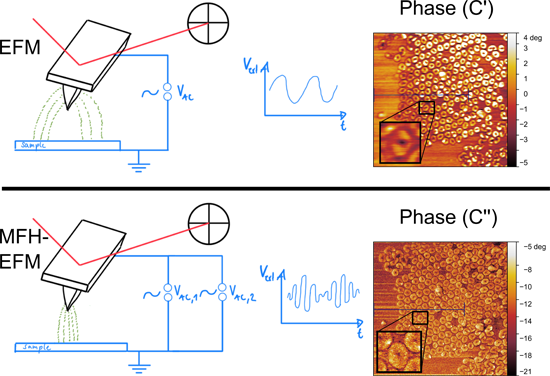
- study materials such as perovskite solar cells [18][19][20] and Li-ion batteries [21][22][23]. AFM enables simultaneous acquisition of topographic and electronic data by applying AC or DC voltages across the tip–sample gap, allowing for the detection of capacitive forces [24][25] or contact potential


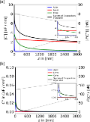


Retrieval of B1 phase from high-pressure B2 phase for CdO nanoparticles by electronic excitations in CdxZn1−xO composite thin films
Beilstein J. Nanotechnol. 2025, 16, 551–560, doi:10.3762/bjnano.16.43
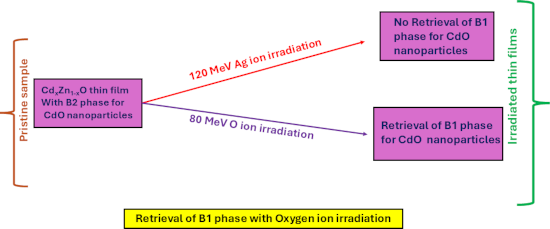
- Abstract This study investigates the recovery of the B1 phase from the high-pressure B2 phase, at atmospheric pressure, in cadmium oxide (CdO) nanoparticles incorporated within sol–gel synthesized CdxZn1−xO (x = 0.40) composite thin films. The recovery process is investigated using electronic excitations
- facilitates the reemergence of the B1 phase. The partial damage caused by electronic energy loss during oxygen ion irradiation in the willemite Zn2SiO4 phase is identified as a trigger for the B1 to B2 phase transformation in CdO nanoparticles, enabling the recovery of the B1 phase. The diminishing local
- -based optoelectronic applications [7]. High-energy ion irradiation can lead to latent track formation or phase transitions, either from crystalline to crystalline or crystalline to amorphous, depending on the threshold electronic energy loss (Seth) [8][9]. The formation of latent tracks has been


N2+-implantation-induced tailoring of structural, morphological, optical, and electrical characteristics of sputtered molybdenum thin films
Beilstein J. Nanotechnol. 2025, 16, 495–509, doi:10.3762/bjnano.16.38
- resistivity of Mo thin films makes them desirable for integrated circuits, where they contribute to the efficient flow of electrical current [3]. Furthermore, their optical properties make them well suited for a use as a protective coating in energy storage and electronic devices [4][5]. Mo films deposited on
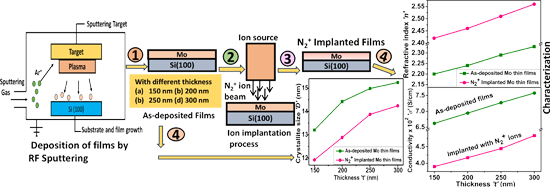
- for various applications in photovoltaics, sensors, optoelectronics, and electronic devices. In the present work, Mo thin films with varying thickness of 150, 200, 250, and 300 nm were deposited on Si(100) substrates using radio frequency (RF) sputtering in an argon environment at ambient temperature
- 1A,B. The values for electronic energy losses and nuclear energy losses have been determined to be 25.6 and 18.2 eV·Å−1, respectively. Both energy loss processes have values within a similar range, which suggests that contributions from both processes are approximately equivalent in their effect on


Performance optimization of a microwave-coupled plasma-based ultralow-energy ECR ion source for silicon nanostructuring
Beilstein J. Nanotechnol. 2025, 16, 484–494, doi:10.3762/bjnano.16.37
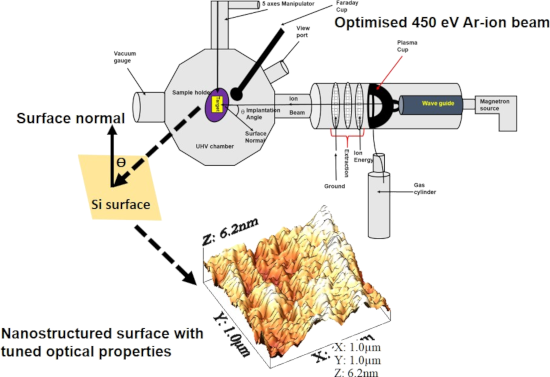
- irradiated for shorter periods of time. The change in reflectivity depends on the change in the electronic structure as well as surface topography of the material. A change in electronic structure can be related to changes in chemical nature, impurity incorporation on the surface, and amorphization of the
- the electronic density of the material, causing a lowering in reflectivity. The tailoring of the reflectivity by developing nanostructures is widely applicable for anti-reflective coatings and photovoltaic device applications [50][51]. The formation of nanostructures on the silicon surface by inert


Quantification of lead through rod-shaped silver-doped zinc oxide nanoparticles using an electrochemical approach
Beilstein J. Nanotechnol. 2025, 16, 422–434, doi:10.3762/bjnano.16.33
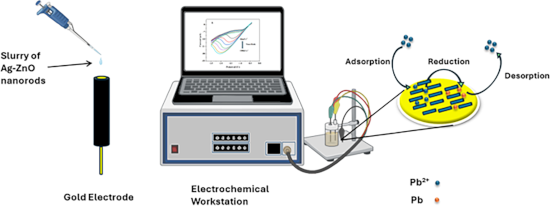
- activity, and semiconductor properties. By doping ZnO nanoparticles with transition metals, we can alter their electrical, optical, and magnetic properties by introducing new electronic states into the band structure. Herein, Ag is added to ZnO nanostructures to improve their optical properties to detect
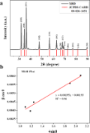
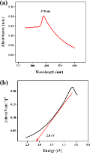
- vibrations, rotational energy, electronic energy levels, and scattering characteristics of Ag–ZnO nanorods. The Malvern Nano-ZS90 was utilized to determine the zeta potential of synthesized nanorods. Fabrication of the lead sensor / (Ag@ZnO nanorods/gold electrode) The obtained Ag@ZnO NRs served as an




ReactorAFM/STM – dynamic reactions on surfaces at elevated temperature and atmospheric pressure
Beilstein J. Nanotechnol. 2025, 16, 397–406, doi:10.3762/bjnano.16.30
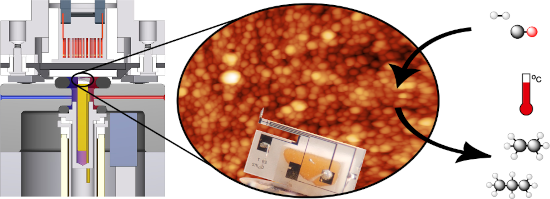
- , capable of studying materials under industrially relevant conditions. Here we show current developments of the ReactorAFM/STM, implementing a qPlus sensor to add the ability of combining atomic force microscopy (AFM) and scanning tunneling microscopy (STM) techniques to study the geometric and electronic
- insights of the electronic state and structure of the surface, AFM offers structural and electrostatic information. Therefore, combining AFM with STM brings the best of both techniques together and offers a more precise understanding of catalytic systems. In this paper, we present the design of a combined
- AFM/STM reactor is the possibility to observe the structural and electronic properties of the surface at high gas pressures and temperatures, independent of its conductivity. The extension from STM-only and AFM-only to the combined AFM/STM reactor is an ongoing development of the existing ReactorSTM


Engineered PEG–PCL nanoparticles enable sensitive and selective detection of sodium dodecyl sulfate: a qualitative and quantitative analysis
Beilstein J. Nanotechnol. 2025, 16, 385–396, doi:10.3762/bjnano.16.29
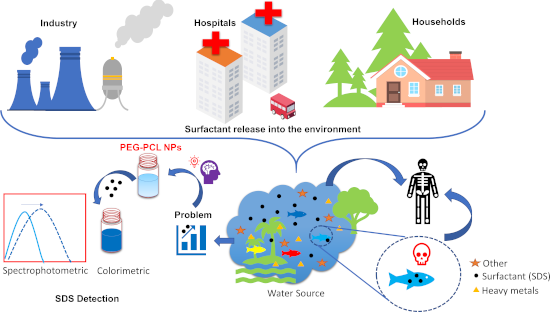
- information about the elemental composition, chemical states, and electronic states of the elements present in the nanoparticles. The XPS spectra of the PEG–PCL nanoparticles (Figure 2e) showed prominent peaks at binding energies of 284.8, 532.7, and 486.7 eV, corresponding to carbon, oxygen, and tin
- upon binding to the PEG–PCL NPs. As such, PEG–PCL NPs are colorless. Adding SDS further modifies this interaction, resulting in a red shift from blue to light blue. This color change is a direct consequence of the formation of the SDS–PEG–PCL NPs–dye complex, which alters the electronic structure of


Pulsed laser in liquid grafting of gold nanoparticle–carbon support composites
Beilstein J. Nanotechnol. 2025, 16, 349–361, doi:10.3762/bjnano.16.26
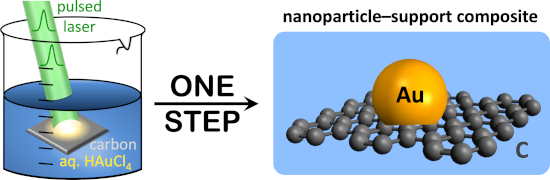
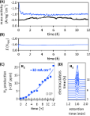
- , evident from electrochemical impedance spectroscopy (EIS) data (Figure 5B). Impedance, measured in an electrochemical setup, is the time-dependent opposition to alternating current stemming from the combined effect of ohmic resistance, capacitance, and phase elements in an electronic circuit. Impedance is
- a quantitative measure for electrical contact between nanoparticles and supports [64]. EIS data, visualized in a Nyquist plot, graph the negative imaginary impedance (Z) vs the real impedance [2]. Modeling the data with an electronic circuit that reflects the electrochemical system gives values for


Tailoring of physical properties of RF-sputtered ZnTe films: role of substrate temperature
Beilstein J. Nanotechnol. 2025, 16, 333–348, doi:10.3762/bjnano.16.25
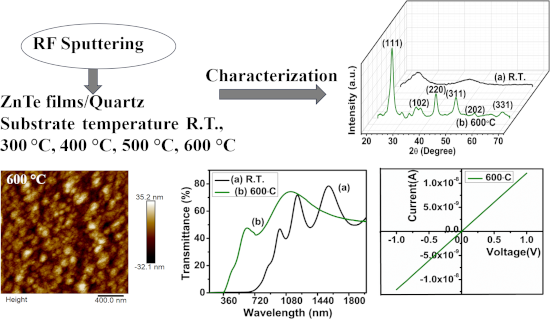
- substrate temperatures is presented in Figure 5B. It has been found that the films exhibit maximum absorbance in the visible region, which later decreases with the increase in wavelength. This decrease in absorbance with wavelength may be due to interband electronic transitions between the conduction band
- application of the fabricated ZnTe films in solar cells. Refractive index The refractive index is one of the important optical parameters as it is connected to the electronic polarizability, local fields in the semiconducting material, and transmission. The refractive index is related to the transmission of
- ]. The dielectric constant and the dielectric loss of the deposited ZnTe films exhibit a similar pattern and were also found to decrease with increasing substrate temperature (see below). Photoluminescence studies Photoluminescence (PL) studies were carried out to analyse the films’ electronic features




Graphene oxide–chloroquine conjugate induces DNA damage in A549 lung cancer cells through autophagy modulation
Beilstein J. Nanotechnol. 2025, 16, 316–332, doi:10.3762/bjnano.16.24
- ). Supporting Information File 1, Figure S1a, reveals the appearance of characteristic bands around 230 nm and 295 nm for GO which corresponds to π–π* and n–π* electronic transitions, respectively. The observed high intensity π–π* plasmon peak around 230 nm is attributed to well-defined nanoscale sp2 hybrid π
- -bonded networks and chromophore aggregation due to the presence of C=C, C=O, and C–O bonds [41]. The presence of a shoulder band around 295 nm corresponds to the well-defined n–π* electronic transitions due to the presence of C=O functional groups on the surface of GO. The appearance of the Chl
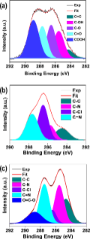
- , the decrease in ID/IG corroborates with the bathochromic shift of the π–π* electronic transition in GO–Chl due to the preservation of a sp2 carbon framework. Furthermore, the chemical states/structures of GO, Chl, and GO–Chl were investigated through X-ray photoelectron spectroscopy. Figure 2a–c



Emerging strategies in the sustainable removal of antibiotics using semiconductor-based photocatalysts
Beilstein J. Nanotechnol. 2025, 16, 264–285, doi:10.3762/bjnano.16.21
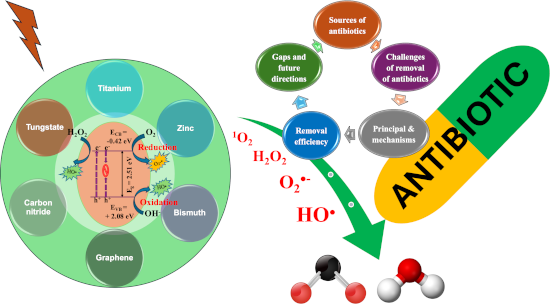
- wastewater treatment. Titanium dioxide-based materials TiO2 is the most commonly used photocatalyst for antibiotic removal owing to its unique features. In nanostructured forms, this substance exhibits outstanding physical and chemical durability, a high ratio of surface area to volume, adjustable electronic
- to degrade antibiotics under the illumination of UV and visible light [83][84]. They also possess a distinctive electronic structure with the VB containing Bi 6s and O 2p orbitals [54]. This distinctive configuration results in a more pronounced absorption edge in the visible light spectrum. The
- 7,7,8,8-tetracyanoquinodimethane (TCNQ) to enhance the energy band and electronic structure of g-C3N4. The pefloxacin degradation efficiency of the g-C3N4/TCNQ catalytic system was four times higher than that of pristine g-C3N4. By combining thiourea with 3-aminopyridine, researchers modified the