

Search results
Search for "films" in Full Text gives 996 result(s) in Beilstein Journal of Nanotechnology. Showing first 200.
Ultrasensitive and ultrastretchable metal crack strain sensor based on helical polydimethylsiloxane
Beilstein J. Nanotechnol. 2024, 15, 270–278, doi:10.3762/bjnano.15.25
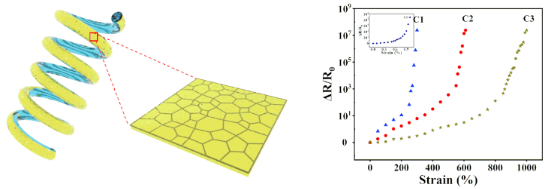
- and stretchable strain sensors with an impressive GF exceeding 42000 at a strain level of 150% [24]. These sensors were created by utilizing precisely controlled cracks in CNT films, which were formed through laser engraving of a CNT paper. In their study, Lee et al. have developed a strain sensor
- was exerted on the surface of the Au film at a rate of 10% strain per second, resulting in the initiation and propagation of cracks. Following the release of the pre-stretch, the Au thin films were affixed to silver wires using silver paste at both ends. Ultimately, the surface of the helix was coated


Design, fabrication, and characterization of kinetic-inductive force sensors for scanning probe applications
Beilstein J. Nanotechnol. 2024, 15, 242–255, doi:10.3762/bjnano.15.23
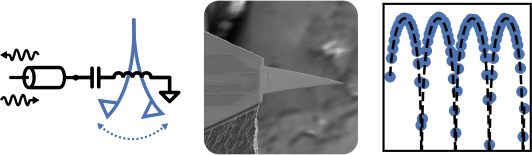
- larger than the geometric (electromagnetic) inductance in thin films and nanowires made of amorphous superconductors [16]. It is, therefore, useful in applications that require compact microwave resonators with low loss [17], including microwave filters [18] and resonant radiation detectors [19]. Large
- with 600 nm low-stress (<100 MPa) Si-N films. The sensor chips are 1.6 mm by 3.4 mm, about the size of a standard AFM cantilever chip. The steps are as follows: (a) Superconducting film. We first deposit a 15 nm thick thin film of superconducting Nb60Ti40N by reactive co-sputtering from separate



Ion beam processing of DNA origami nanostructures
Beilstein J. Nanotechnol. 2024, 15, 207–214, doi:10.3762/bjnano.15.20
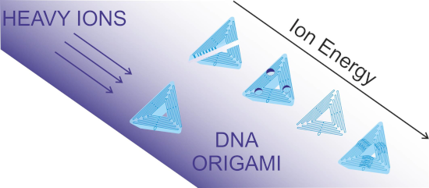
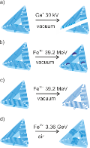
- the direction of the primary ion’s initial momentum. Hillock structures are usually formed upon such interaction with single-crystal materials [19], while craters and particle tracks form on polymeric thin films such as PMMA [20][21]. The dimensions of such features can be influenced by the interplay
- created by the 56Fe10+ ions. In experiments where the surface was fully covered, such as in the work of Thomaz et al. on 2 nm thick PMMA films on Si irradiated with 1.1 GeV Au atoms (∼5.6 MeV/u) [41], the number of incident ions to the number of craters is 1:1. We expect the same behavior in the present


Graphene removal by water-assisted focused electron-beam-induced etching – unveiling the dose and dwell time impact on the etch profile and topographical changes in SiO2 substrates
Beilstein J. Nanotechnol. 2024, 15, 190–198, doi:10.3762/bjnano.15.18
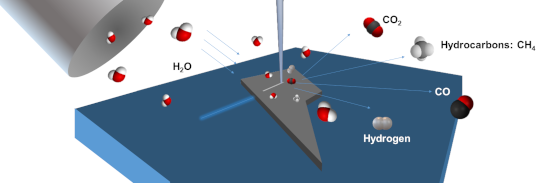
- graphene films, each with its own set of advantages and disadvantages. Most of the current techniques are based on multistep processing. For example, ultranarrow graphene nanoribbons can be formed with the so-called meniscus-mask lithography [7] or nanospheres lithography [8], although positioning and


Modification of graphene oxide and its effect on properties of natural rubber/graphene oxide nanocomposites
Beilstein J. Nanotechnol. 2024, 15, 168–179, doi:10.3762/bjnano.15.16
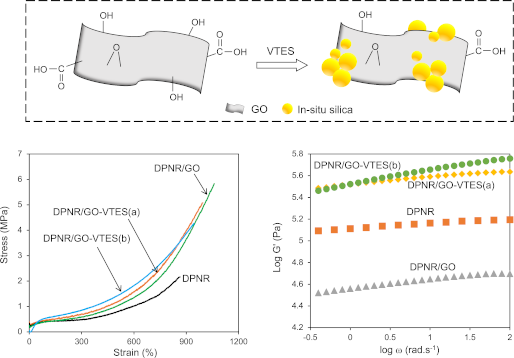
- with HITACHI S-4800. The measurement was performed at room temperature. The tensile properties of the composite samples were measured with a Tokyo Instron 5300 (Japan). The graft copolymer films (thickness of 1 mm) were cut in a dumbbell shape described in JIS K6251. Tensile measurements were done at






CdSe/ZnS quantum dots as a booster in the active layer of distributed ternary organic photovoltaics
Beilstein J. Nanotechnol. 2024, 15, 144–156, doi:10.3762/bjnano.15.14
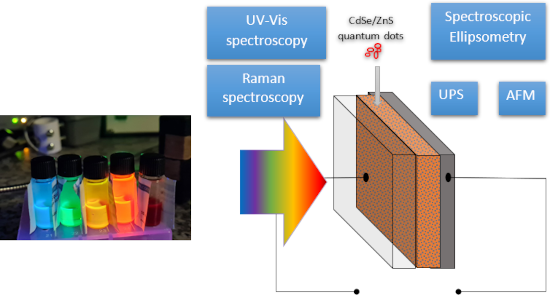
- relations of refractive indices and extinction coefficient were investigated. The morphologies of the thin films were studied with atomic force microscopy. The chemical boundaries of the ternary layers were determined by Raman spectroscopy. Based on UPS studies, the energy diagram of the potential devices
- –COOH groups, they can be easily labeled for chemical and biological applications. Low-molecular-weight organic molecules coat highly luminescent semiconductor nanocrystals. Materials and Methods Thin films, the intended active layers, were fabricated using the spin-coating method. The layers were a
- coefficient and shifts the maximum toward short wavelengths for the refractive index. Refractive indices and extinction coefficient parameters for investigated quantum dots thin films are summarized in Table 2. In ternary systems, a shift of the extinction coefficient maximum toward lower energies can be




In situ optical sub-wavelength thickness control of porous anodic aluminum oxide
Beilstein J. Nanotechnol. 2024, 15, 126–133, doi:10.3762/bjnano.15.12
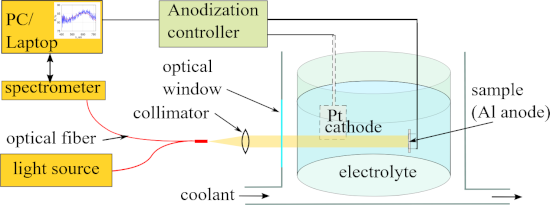
- microscopy and is particularly valuable for the small-scale production of PAAO-based functional optical coatings. Keywords: electrochemistry; ellipsometry; porous anodic alumina; spectroscopy; thin films; Introduction Porous anodic aluminum oxide (PAAO) is a versatile self-organized material with
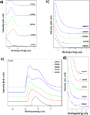
- works [21]. However, for short anodization times (thin PAAO films, hPAAO < 300 nm) the relationship may no longer be linear, and the current kinetic curves may exhibit variability among different samples [10]. To confirm the accuracy of the thickness measurements and assess the consistency of the PAAO
- refractive index. For instance, PAAO produced using phosphoric acid electrolyte at 120 V [40] can have 193 nm mean spacing for hexagonal pore arrangement and 14.4% pore volume. In comparison to oxalic or sulfuric alumina films [40] (with significantly smaller pore spacing and absolute volume) the phosphoric


Influence of conductive carbon and MnCo2O4 on morphological and electrical properties of hydrogels for electrochemical energy conversion
Beilstein J. Nanotechnol. 2024, 15, 57–70, doi:10.3762/bjnano.15.6
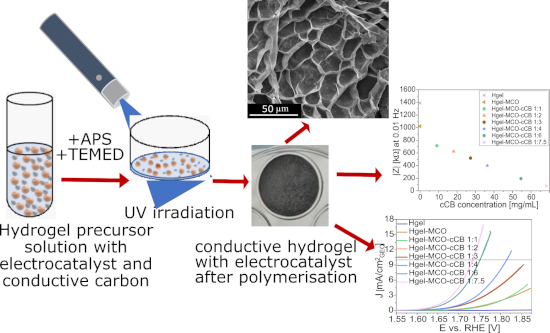
- cCB in the hydrogel-MCO structure. For the studied materials, CPE can be linked to a surface distribution of properties, related to the material roughness and the porosity of the films. In general, α values correlate with the observed behaviour of the corresponding Q parameters (Table 1). Therefore


Measurements of dichroic bow-tie antenna arrays with integrated cold-electron bolometers using YBCO oscillators
Beilstein J. Nanotechnol. 2024, 15, 26–36, doi:10.3762/bjnano.15.3
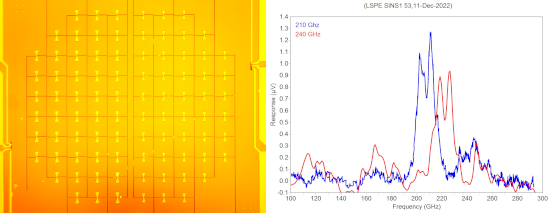
- based on high-temperature YBCO Josephson junctions [27][28][29]. Long junctions based on YBCO thin films were fabricated by the preliminary topology mask method [30][31]. Specifically, YBCO film was deposited on a 24° [001]-tilt Zr1−xYxO2 bicrystal substrate by magnetron sputtering with preliminary


TEM sample preparation of lithographically patterned permalloy nanostructures on silicon nitride membranes
Beilstein J. Nanotechnol. 2024, 15, 1–12, doi:10.3762/bjnano.15.1

- , we initially fabricated the nanostructures on a 200 µm thick Si substrate with 100 nm thick SiN buffer layers on both sides. The buffer layers were deposited with low-pressure CVD to ensure stress-free films. The fabrication process is shown in Figure 10. First, we made the nanostructure using lift
- development is to use a different membrane, for example SiC (lattice constant a = 0.435 nm), since it can grow as a single-crystalline layer and ensure epitaxial sample growth on top of it, for example, the growth of NbN (a = 0.439 nm) with a lattice mismatch of 1%. Epitaxial growth of Py films on single
- -crystal SiC membranes is also feasible. Py epitaxial films were obtained on single-crystal MgO substrates [36] that have a lattice constant of 0.42 nm. It was demonstrated that the epitaxial SiC layer can serve as an excellent mask material for KOH etching of Si [37]. However, etching to a crystalline


Spatial variations of conductivity of self-assembled monolayers of dodecanethiol on Au/mica and Au/Si substrates
Beilstein J. Nanotechnol. 2023, 14, 1169–1177, doi:10.3762/bjnano.14.97

- substrates consisting of thin Au layers of different surface roughness. We compare granular Au films deposited on Si wafers with epitaxial (flat) Au films on mica. Experimental Before the experimental results are presented, this section focuses on the preparation of the samples under study and the setup used
- S2a). In contrast to the Au/mica surface, the Au/Si substrate exhibits a rougher surface, as seen in Figure 2c, in agreement with the difference in growth mode of Au films on the two substrates. For mica, epitaxial growth is obtained [16][17], while Au on Si/SiO2 forms a granular film [18]. Although


Hierarchically patterned polyurethane microgrooves featuring nanopillars or nanoholes for neurite elongation and alignment
Beilstein J. Nanotechnol. 2023, 14, 1157–1168, doi:10.3762/bjnano.14.96
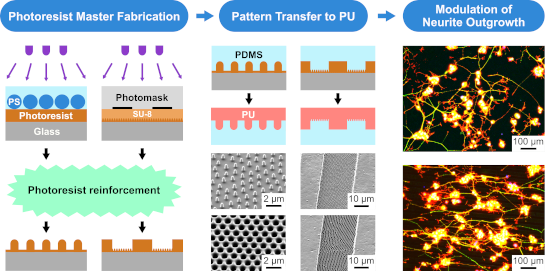
- approaches are quite limited. In this work, we show that nanopillars and nanoholes, and their combination with microgrooves, can be patterned on polyurethane (PU) films using a low-cost, reusable photoresist master mold prepared via nanosphere lens lithography and UV-LED photolithography, with specific
- patterned nano-/microstructured PU films enhance both PC12 neurite elongation and alignment, showing the potential use of our proposed method for the micro-/nanopatterning of polymers for nerve tissue engineering. Keywords: hierarchical; nanopatterning; neurite alignment; neurite outgrowth; topography
- Supporting Information File 1, Figure S2). Scanning electron microscopy (SEM) images (Figure 1C–E) confirm the featureless surface of flat PU and the ordered arrays of nanopillars and nanoholes on the nanopatterned films. For the PU nanopillar substrate, some short pillars occassionally appeared (Figure 1D


A multi-resistance wide-range calibration sample for conductive probe atomic force microscopy measurements
Beilstein J. Nanotechnol. 2023, 14, 1141–1148, doi:10.3762/bjnano.14.94

- versatility and high resolution in probing the local conductivity of materials, C-AFM has been extensively used in studying semiconductors [6][7], two-dimensional materials [8][9][10], memristive devices [11][12][13][14][15], photoelectric systems [16][17][18], dielectric films [19][20][21][22][23], molecular


Density functional theory study of Au-fcc/Ge and Au-hcp/Ge interfaces
Beilstein J. Nanotechnol. 2023, 14, 1093–1105, doi:10.3762/bjnano.14.90

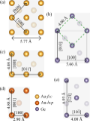
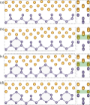
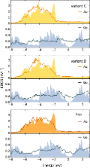
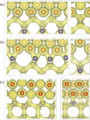
- interlayer distance compared to variant T2. The Ge–Au bond lengths obtained for the T1 structure, 2.50 Å, are in good agreement with the experimental values for amorphous GeAu alloys, 2.66 Å, [33] and thin films of Au covering a Ge(111) surface, 2.5 Å, [34]. In variant T2 the Au–Ge distance between Au atoms





Properties of tin oxide films grown by atomic layer deposition from tin tetraiodide and ozone
Beilstein J. Nanotechnol. 2023, 14, 1085–1092, doi:10.3762/bjnano.14.89
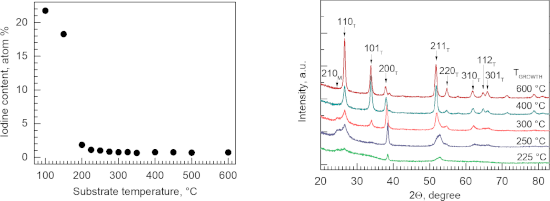
- Kristjan Kalam Peeter Ritslaid Tanel Kaambre Aile Tamm Kaupo Kukli Institute of Physics, University of Tartu, W. Ostwaldi 1, 50411 Tartu, Estonia 10.3762/bjnano.14.89 Abstract Polycrystalline SnO2 thin films were grown by atomic layer deposition (ALD) on SiO2/Si(100) substrates from SnI4 and O3
- . Suitable evaporation temperatures for the SnI4 precursor as well as the relationship between growth per cycle and substrate temperature were determined. Crystal growth in the films in the temperature range of 225–600 °C was identified. Spectroscopic analyses revealed low amounts of residual iodine and
- implied the formation of single-phase oxide in the films grown at temperatures above 300 °C. Appropriateness of the mentioned precursor system to the preparation of SnO2 films was established. Keywords: atomic layer deposition; tin oxide; tin tetraiodide; Introduction Atomic layer-deposited SnO2 films


Dual-heterodyne Kelvin probe force microscopy
Beilstein J. Nanotechnol. 2023, 14, 1068–1084, doi:10.3762/bjnano.14.88

- latter configuration is used in the case of organic BHJ thin films (processed on transparent substrates, i.e., glass coated with indium thin oxide). The light intensity is adjusted using the laser power control and optical density filters. In the following, for each measurement, the optical power Popt
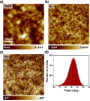
- again confirm the (positive) SPV polarity. To conclude this part of the work, it is important to check whether the data obtained for this PTB7:PC71BM sample are consistent with the results of our previous investigations on BHJ thin films based on the same donor–acceptor tandem. Considering only the SPV




Spatial mapping of photovoltage and light-induced displacement of on-chip coupled piezo/photodiodes by Kelvin probe force microscopy under modulated illumination
Beilstein J. Nanotechnol. 2023, 14, 1059–1067, doi:10.3762/bjnano.14.87

- effect of gravity on the displacement is taken into account. The voltage excitation signal is introduced to the LNO terminals as shown in the inset of Figure 2. The material properties of PZT and LNO thin films were derived from the literature and are summarized in Table 1. The strain-charge form is
- normalized to the corresponding voltage applied to each point. Properties of PZT [35][36] and LNO films [37]. Compliance matrix elements (elastic compliance constants, Sij) and coupling matrix elements (piezoelectric coefficients, dij) have the units of and , respectively. Supporting Information Supporting


Isolation of cubic Si3P4 in the form of nanocrystals
Beilstein J. Nanotechnol. 2023, 14, 971–979, doi:10.3762/bjnano.14.80

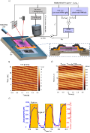
- sonication in an ultrasonic bath SW3H (Sono Swiss). Once the films were drop cast on aluminum mirrors, the IR spectra were recorded. The synthesized Si3P4 NPs were reactive and emanated phosphine upon contact with moisture. Once the ampoules were opened in an inert atmosphere, particles were allowed to
- the case of alcoholysis passivation, degassed 1-dodecanol was introduced to the Si3P4 product powder without air contact. Si3P4 NPs samples were examined on a diffractometer DRON-4-07 (Cu Kα radiation) in the form of films on a polished quartz substrate; phase analysis was performed using the program


Low temperature atomic layer deposition of cobalt using dicobalt hexacarbonyl-1-heptyne as precursor
Beilstein J. Nanotechnol. 2023, 14, 951–963, doi:10.3762/bjnano.14.78
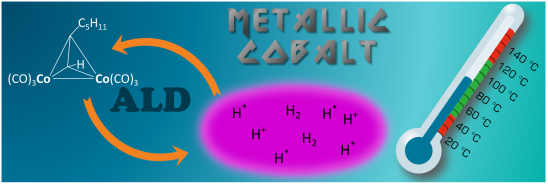
- -temperature ALD; PEALD; plasma-enhanced ALD; XPS; Introduction The atomic layer deposition (ALD) of cobalt films is an ongoing topic of interest [1]. Cobalt thin and ultrathin films play an important role in current generations of integrated circuits [2]. Compared to copper, the metal offers a greater
- . Typically, these systems require ultrathin layers within the nanometre scale [6]. The thickness and conformality criteria of future microelectronics devices require the development of cobalt metal films deposited by ALD. Because of the self-limiting growth process, ALD allows for the sub-nanometre control
- with a deposition rate of approximately 0.1 Å/cycle. The deposited films were analysed by X-ray photoelectron spectroscopy and are well in the metallic state. We also show the optimization of the overall process through varying the pulse times for precursor, purging, and the plasma pulse. Experimental


N-Heterocyclic carbene-based gold etchants
Beilstein J. Nanotechnol. 2023, 14, 865–871, doi:10.3762/bjnano.14.71
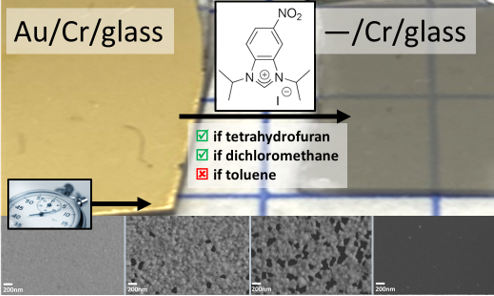
- but also the potential for deliberate etching, with the outcome determined by choice of chemically synthesized organic species and solvent. Keywords: gold etchant; microfabrication; N-heterocyclic carbenes; self-assembled monolayer (SAM); thin films; Introduction Self-assembled monolayers (SAMs) are
- resonance in solution-phase samples [15][18][19][20][21][22]. In these works, the NHC monolayer films were formed using several different approaches and preparations [16]. Indeed, a recent feature article highlights four methods to prepare NHC films [16]. For example, Crudden and co-workers have presented
- water and carbon dioxide so that there was no need for a strong base for deprotonation or for air-free conditions [13][14]. Camden and co-workers have used CO2 adducts of benzimidazolium to produce NHC films by melting the solid CO2 adduct directly onto a gold surface under vacuum. They have also



A wearable nanoscale heart sound sensor based on P(VDF-TrFE)/ZnO/GR and its application in cardiac disease detection
Beilstein J. Nanotechnol. 2023, 14, 819–833, doi:10.3762/bjnano.14.67

- . Composition and β-phase content of the piezoelectric composite films were analyzed using X-ray diffraction. The morphology of the composite film fibers was observed through scanning electron microscopy. Finally, the P(VDF-TrFE)/ZnO/graphene composite film was encapsulated in a sandwich-structure heart sound
- preprocessed heart sound signals using MATLAB scripts. Finally, a K-nearest neighbor (KNN) heart sound classification model was trained and used to predict whether a heart sound is normal or abnormal, with the prediction result displayed. Experimental Preparation of films by high-voltage electrospinning In
- of heart sound stethoscope. Results and Discussion Characterization of thin film samples In the study by Luo et al. [19], an investigation was carried out to explore the electrospinning of piezoelectric films using different composition ratios of P(VDF-TrFE), ZnO, and GR. The resulting films


Cross-sectional Kelvin probe force microscopy on III–V epitaxial multilayer stacks: challenges and perspectives
Beilstein J. Nanotechnol. 2023, 14, 725–737, doi:10.3762/bjnano.14.59
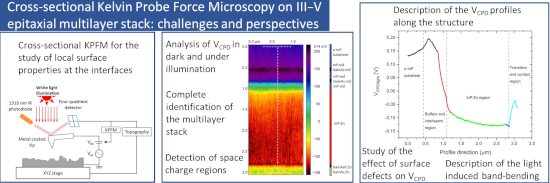
- hinder the extraction of the photogenerated charges. III–V-based solar devices belong to the PV technology of thin and ultrathin films in which layers with widths of the order of a few nanometres are often integrated for an optimal surface passivation or for better carrier extraction, considerably


The microstrain-accompanied structural phase transition from h-MoO3 to α-MoO3 investigated by in situ X-ray diffraction
Beilstein J. Nanotechnol. 2023, 14, 692–700, doi:10.3762/bjnano.14.55
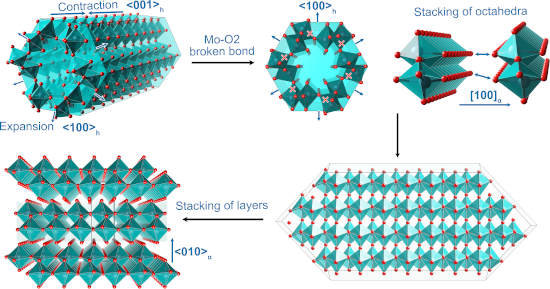
- some question regarding the h-MoO3 phase: (1) The location of the intercalated molecules inside the h-MoO3 structure is unknown. (2) The reason of the mismatch in h-MoO3 thin films and the failure of microdevices is not understood. (3) The structural phase transition at the atomic scale from h-MoO3 to
- transition from h-MoO3 to α-MoO3 Anisotropic thermal expansion and first-order phase transition The coefficient of thermal expansion (CTE) is an important mechanical parameter for the application of MoO3 thin films, as it can increase the mismatch between thin films and the substrate, causing microdevices to


SERS performance of GaN/Ag substrates fabricated by Ag coating of GaN platforms
Beilstein J. Nanotechnol. 2023, 14, 552–564, doi:10.3762/bjnano.14.46

- reliable SERS substrates, which often must be tailored toward specific applications [15][17][18]. The SERS substrates described in the literature include nanoparticles, core–shell nanoparticles, semicontinuous metal films, and many other nanostructures most commonly made of gold or silver [18][19][20][21
- relative to the axis of the pillars. The observed effect can be associated with the initial orientation of GaN pillars to the plasma plume (Figure 1); pillars are under some angle to the plasma plume. This effect is similar to the one observed during the growth of thin metal films in oblique angle


Carbon nanotube-cellulose ink for rapid solvent identification
Beilstein J. Nanotechnol. 2023, 14, 535–543, doi:10.3762/bjnano.14.44
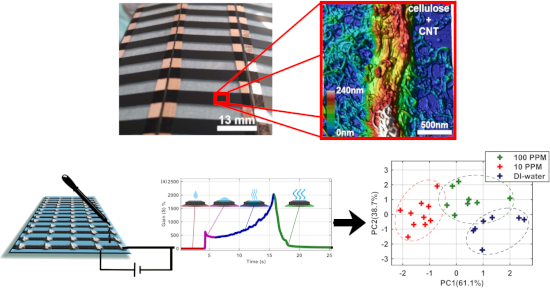
- sensing, as electromagnetic shielding, and as thermoelectric material [32][33][34][35][36][37][38]. Also, Qi et al. reported a liquid-water sensor based on carbon nanotube–cellulose composite films, and, more recently, Goodman et al. reported the scalable manufacturing of nanocomposites for liquid sensing
- [39][40]. Besides, graphene films deposited on cellulose paper and a graphene/cellulose composite were also reported as a solvent sensor material [30][33]. However, most of these works rely on cellulose as a paper substrate or as a thick composite film that cannot be readily employed for large-scale
- and other 1D/2D materials have been employed as ink components with great potential for a broad range of applications, for example, in flexible electronics, photoconductors, transparent conductors, and gas sensors [44][45][46][47]. Carbon nanotube ink films have been reported as field-effect