


Search results
Search for "quantum mechanical calculations" in Full Text gives 34 result(s) in Beilstein Journal of Organic Chemistry.
Synthesis and optical resolution of 4,5-diaminohomoadamantane: a promising scaffold for chiral ligands and bioactive compounds
Beilstein J. Org. Chem. 2026, 22, 1013–1022, doi:10.3762/bjoc.22.80
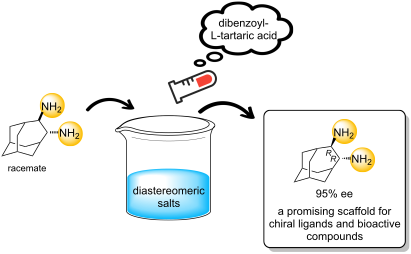
- -dihydropyrazine (4R,5R)-17 derived from diamine (4R,5R)-8a', the enantiomeric excess was determined to be 95%. Multiple attempts to grow a crystal suitable for X-ray analysis were unsuccessful; therefore, the absolute configuration of (4R,5R)-8a' was proposed on the basis of quantum mechanical calculations. To


Understanding the origin of stereoselectivity in the photochemical denitrogenation of 2,3-diazabicyclo[2.2.1]heptene and its derivatives with non-adiabatic molecular dynamics
Beilstein J. Org. Chem. 2025, 21, 2007–2020, doi:10.3762/bjoc.21.156
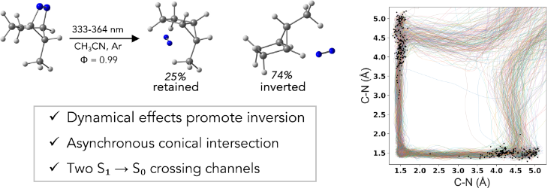
- combined with state-of-the-art multireference quantum mechanical calculations to understand the photophysical properties and mechanisms of these diazabicyclo[2.2.1]heptenes. The energetically accessible lowest excitations are nNN(σCN) → π* and range from 3.94–3.97 eV. From the >292 trajectories, the
- , thereby explaining the observed selectivities. A minority of trajectories undergo thermal conversion in the ground state, producing the minor retained housane product from inverted housane/diradical. Keywords: non-adiabatic molecular dynamics; photochemistry; quantum mechanical calculations
- preference for inversion across several derivatives of 1 [77][78]. These studies suggest that the thermal denitrogenation of diazabicyclo[2.1.1]hep-2-ene undergoes a concerted mechanism of elimination of nitrogen, while the photochemical reaction proceeds via a stepwise mechanism. Quantum mechanical


Quantifying the ability of the CF2H group as a hydrogen bond donor
Beilstein J. Org. Chem. 2025, 21, 189–199, doi:10.3762/bjoc.21.11
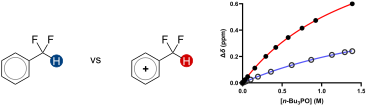
- . We expect this information to be useful for the rational application of the CF2H group in drug development and molecular design. Previous quantum mechanical calculations revealed that the CF2H···O binding energy (ΔE) ranges from 1.0 kcal/mol to 5.5 kcal/mol [14][15][18][21]. In addition, as measured




Catalysing (organo-)catalysis: Trends in the application of machine learning to enantioselective organocatalysis
Beilstein J. Org. Chem. 2024, 20, 2280–2304, doi:10.3762/bjoc.20.196
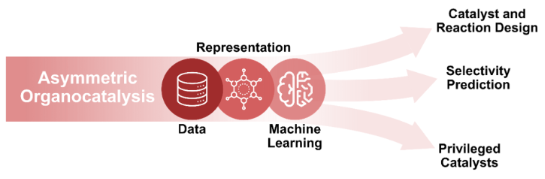
- mechanical calculations is also increasing, such as a data set that considers propargylation reactions catalysed by bipyridine N,N’-dioxide-derived scaffolds, created by Wheeler and co-workers using their AARON toolkit [21][114][115][116]. Similar to experimental data, computational data sets also lead to
- the change in predictive performance. Using this method, the authors observed that the main contribution towards enantioinduction by CPAs is through steric effects, in line with previous literature. Besides the establishment of experimental data sets, the number of ML data sets based on quantum




Mechanistic investigations of polyaza[7]helicene in photoredox and energy transfer catalysis
Beilstein J. Org. Chem. 2024, 20, 1236–1245, doi:10.3762/bjoc.20.106
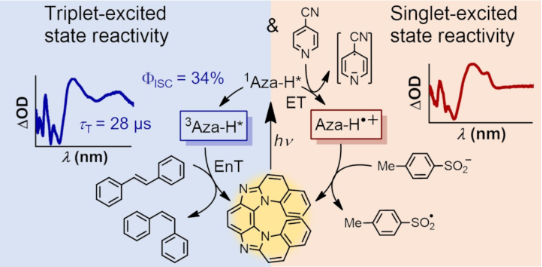
- Supporting Information File 72: General information, detailed experimental procedures, additional spectroscopic data, quantum-mechanical calculations, photostability and photoisomerization experiments. Funding We acknowledge generous financial support from the JGU Mainz and the German Federal Environmental




Access to cyclopropanes with geminal trifluoromethyl and difluoromethylphosphonate groups
Beilstein J. Org. Chem. 2023, 19, 541–549, doi:10.3762/bjoc.19.39
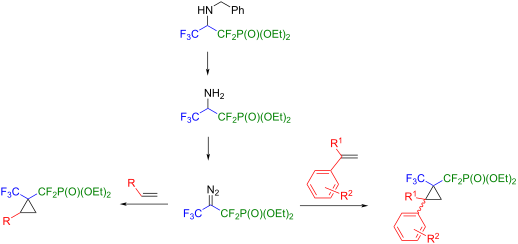
- difluoromethylphosphonate-containing cyclopropanes in reactions with selected olefins, carried out under mild conditions with good to very good yields, in the presence of CuI, an inexpensive catalyst. As confirmed by quantum mechanical calculations and experimental results, the cyclopropane formation occurs always with a



Strategies for the synthesis of brevipolides
Beilstein J. Org. Chem. 2021, 17, 2399–2416, doi:10.3762/bjoc.17.157
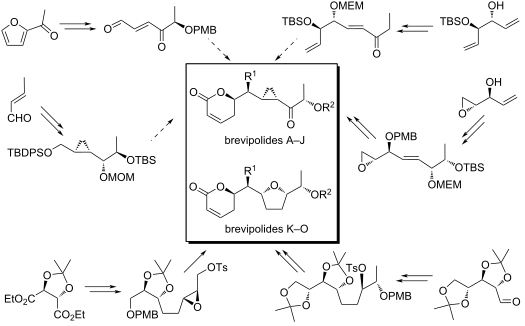
- comprehensive combination of quantum mechanical calculations and experimental spectroscopic analysis of their NMR and ECD data, to have a unique tetrahydrofuran ring instead of the cyclopropane functionality. The absolute configuration of these five compounds were evaluated and all conserved as C6R, C1’S, C2’R


Models of necessity
Beilstein J. Org. Chem. 2020, 16, 1649–1661, doi:10.3762/bjoc.16.137

- that this fundamental problem cannot be resolved because of the nature of the quantum mechanical wave function or electron density. All models that aim to derive Lewis-like concepts from quantum mechanical calculations are therefore arbitrary, however reasonable they may seem, and can only be judged on
- extracting Lewis structures and assigning bonding contributions from quantum mechanical calculations is actually a minority pursuit most often used to rationalize experimental results. Should the conversion between quantum mechanical calculations and Lewis structures be necessary, it is usually in the
- : Quantum mechanical calculations require 3D molecular structures, which each only represent one of sometimes very many energetically accessible conformations for flexible molecules. Thus, the calculations must be preceded by extensive conformational searches and many conformations must be stored for each


Understanding the role of active site residues in CotB2 catalysis using a cluster model
Beilstein J. Org. Chem. 2020, 16, 50–59, doi:10.3762/bjoc.16.7
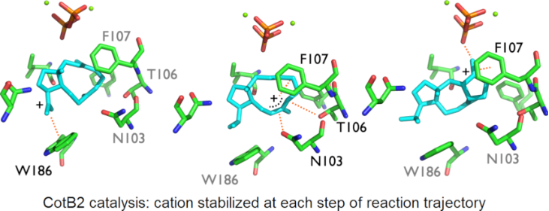
- melanosporofaciens, which catalyzes the formation of cycloocta-9-en-7-ol, a precursor to the next-generation anti-inflammatory drug cyclooctatin. In this work, we present evidence for the significant role of the active site's residues in CotB2 on the reaction energetics using quantum mechanical calculations in an


1,2,3,4-Tetrahydro-1,4,5,8-tetraazaanthracene revisited: properties and structural evidence of aromaticity loss
Beilstein J. Org. Chem. 2019, 15, 2059–2068, doi:10.3762/bjoc.15.203
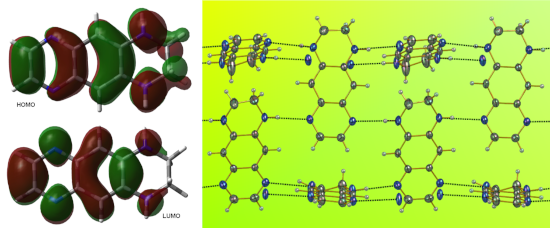
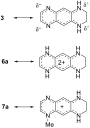
- the synthesis and purification of THTAA (3), and report on the results of our investigation based on the quantum mechanical calculations, X-ray structures and electronic absorption spectra of 3 and a number of its derivatives. Results and Discussion Synthesis, purification and chemical modification of
- structures in this paper have been deposited with the Cambridge Crystallographic Data Centre as supplementary publication: 3 CCDC 1912951, 6a CCDC 1912953, 7a CCDC 1912952. Quantum mechanical calculations were done with Gaussian 09 software [22] using B3LYP/6-311+G(2d,p) model chemistry. All energies include




Fluorinated azobenzenes as supramolecular halogen-bonding building blocks
Beilstein J. Org. Chem. 2019, 15, 2013–2019, doi:10.3762/bjoc.15.197
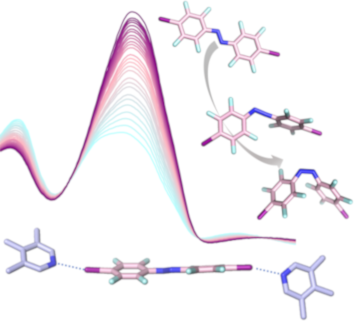
- help of quantum mechanical calculations involving a combination of low-cost implicit solvation models and hybrid density functionals when including dispersion corrections. Electrostatic potential map at different isodensity values (B3LYP/ def2/TZVP/DGZVP optimized geometries) with a) ρ = 0.0001, and b


Influence of per-O-sulfation upon the conformational behaviour of common furanosides
Beilstein J. Org. Chem. 2019, 15, 685–694, doi:10.3762/bjoc.15.63

- gauche-orientation upon sulfation. The effect is less pronounced in the galactosides. For all the studied structures changes in the conformational distribution were revealed by quantum mechanical calculations, that explained the observed changes in intraring coupling constants occurring upon introduction
- mechanical calculations. All the mentioned changes certainly affect the values of the intraring 1H–1H coupling constants. To study this influence in detail, DFT/B3LYP/pcJ-1 calculation of the constants for low-energy conformers (A–M) denoted in Table 4 was performed (Table 6). The first thing to note is that
- . S. Hendrickx and J. C. Martins [28]. The results are shown in Table 5. Comparison of the ring puckering parameters obtained from this analysis with those for the lowest energy conformers in Table 4 shows that they are of the same range and demonstrate the same tendencies as found from quantum





Mechanistic studies of an L-proline-catalyzed pyridazine formation involving a Diels–Alder reaction with inverse electron demand
Beilstein J. Org. Chem. 2019, 15, 30–43, doi:10.3762/bjoc.15.3
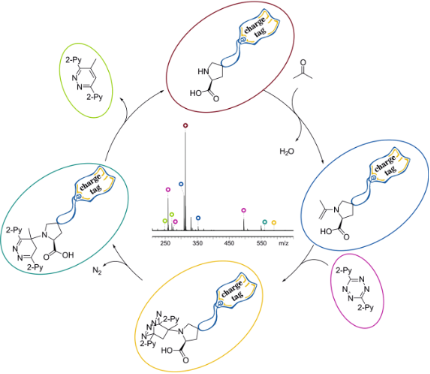
- -proline and the carbonyl substrate acetone [40]. Houk and co-worker [41] verified the mechanism with quantum mechanical calculations, thus giving rise to the “List–Houk” mechanism. A discussion about the role of oxazolidinones as isomeric species to enamines has been raised in the scientific community [42




Synthesis, effect of substituents on the regiochemistry and equilibrium studies of tetrazolo[1,5-a]pyrimidine/2-azidopyrimidines
Beilstein J. Org. Chem. 2017, 13, 2396–2407, doi:10.3762/bjoc.13.237

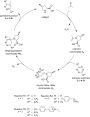
- predominant in the tetrazolo[1,5-a]pyrimidine2-azidopyrimidine equilibrium [1][21][22][23][24][26][27]. Additionally, from quantum mechanical calculations, it was possible to note that compound 3a (tetrazole form) is 1.54 kcal mol−1 more stable than 4a (azide form) in the solid state. To corroborate this
- energy data about the stabilization of the different forms, solvent effects, and shows that the azide–tetrazole transformation is initiated by a p–π atomic orbital overlap rather than an electrostatic attraction process [48]. To detect which form is more stable in the solid state, quantum mechanical
- calculations were performed using the Gaussian 09 software package [35] and B3LYP/cc-pVTZ level of theory for 6a and 6g. The results suggest that the 2-azidopyrimidine derivatives 7a–g are about 10 kcal mol−1 more stable than the tetrazolo[1,5-a]pyrimidine derivatives 6a–g. Figure 5 shows the


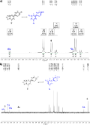
![[Graphic 9]](/bjoc/content/inline/1860-5397-13-237-i9.svg?max-width=637&scale=1.18182) 4d equilibrium in DMSO-d6 at 25 °C.
4d equilibrium in DMSO-d6 at 25 °C.


p-tert-Butylthiacalix[4]arenes functionalized by N-(4’-nitrophenyl)acetamide and N,N-diethylacetamide fragments: synthesis and binding of anionic guests
Beilstein J. Org. Chem. 2017, 13, 1940–1949, doi:10.3762/bjoc.13.188

- the association constants of the complexes of the studied thiacalix[4]arenes with a series of anions) and the results of quantum mechanical calculations (energy change in the formation of guest–host complexes calculated by the PM3 method) (HyperChem 7.0) was the final stage of the work (Table 4). The
- tetrahedral H2PO4−, Y-shaped CH3CO2− and NO3− ions. It is clearly seen from the Table 4 that all the studied thiacalix[4]arenes (2, 3, 5–9) bind F– ions. This agrees well with the quantum mechanical calculations. For all the complexes involving the macrocycles studied with F− ion, a significant energy gain
- within the range of 82–114 kcal/mol is observed. The quantum mechanical calculations of the complexes of the thiacalix[4]arenes 2, 3, 6, 7, 9 with CH3CO2− ion are in good agreement with the logarithms of the association constant (Table 4). An increase in the logarithm of the association constant


Experimental and theoretical investigations into the stability of cyclic aminals
Beilstein J. Org. Chem. 2016, 12, 2280–2292, doi:10.3762/bjoc.12.221
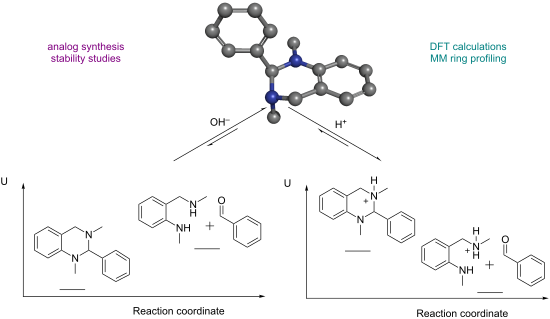
- reversed-phase HPLC. Based on these data, quantum mechanical calculations revealed that the hydrolysis of the test compounds is a thermodynamically driven process. Interestingly, we could show that this equilibrium is strongly dependent on the applied reaction conditions and that a change from an acidic to





Determination of the absolute stereostructure of a cyclic azobenzene from the crystal structure of the precursor containing a heavy element
Beilstein J. Org. Chem. 2016, 12, 2211–2215, doi:10.3762/bjoc.12.212
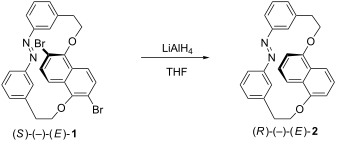
- chirality methods [28][29], NMR spectroscopy [30][31][32], X-ray diffraction [33][34][35], etc. In addition to these methods, many researchers explored a combination of vibrational circular dichroism and quantum mechanical calculations to determine the absolute stereostructures [36][37][38]. Among various


Ionic liquids as transesterification catalysts: applications for the synthesis of linear and cyclic organic carbonates
Beilstein J. Org. Chem. 2016, 12, 1911–1924, doi:10.3762/bjoc.12.181
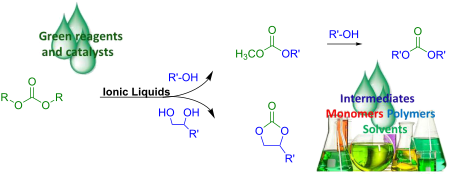
- -mechanical calculations indicated that the catalyst synergistically activated both BuOH and DMC. A wide variety of acyclic non-symmetrical organic carbonates of general formula ROC(O)OCH3 were prepared by Kumar et al. through the transesterification of DMC using the ionic liquid 1-(trimethoxysilyl)propyl-3
- of dimethyl carbonate with n-butanol has been accomplished using tetraethylammonium-based amino acid ionic liquids ([N2222][AA]) as homogeneous catalysts (Figure 3) [68]. [N2222][Pro] exhibited the best catalytic activity yielding an overall 72% yield of the dibutyl carbonate (DBC) product. Quantum


Visible light photoredox-catalyzed deoxygenation of alcohols
Beilstein J. Org. Chem. 2014, 10, 2157–2165, doi:10.3762/bjoc.10.223
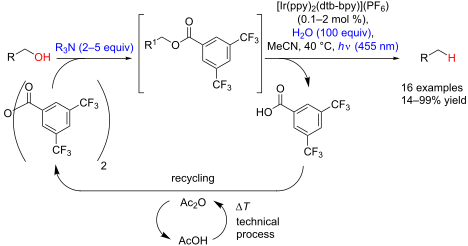
- reductively quenched photocatalyst followed by mesolysis and subsequent hydrogen abstraction (Scheme 4). Quantum mechanical calculations (B3LYP/6-31G*) for benzhydryl 3,5-bis(trifluoromethyl)benzoate (3) revealed that the electron density of the presumed transient radical anion is mainly located at the phenyl


Stereocontrolled synthesis of 5-azaspiro[2.3]hexane derivatives as conformationally “frozen” analogues of L-glutamic acid
Beilstein J. Org. Chem. 2014, 10, 1114–1120, doi:10.3762/bjoc.10.110
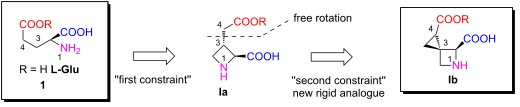
- Å, while an energy cutoff of 5 kcal/mol was applied to discard unreasonable conformations. Default values were used for all the remaining parameters. The lowest energy conformation of the four diastereoisomers 20a–d (Figure 3) was saved to perform the following quantum-mechanical calculations, which


cis–trans Isomerization of silybins A and B
Beilstein J. Org. Chem. 2014, 10, 1047–1063, doi:10.3762/bjoc.10.105
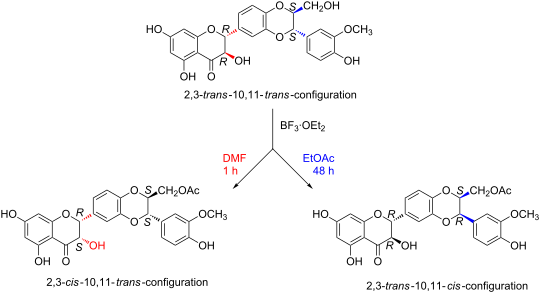
- optically pure compounds was determined by using NMR and comparing their electronic circular dichroism data with model compounds of known absolute configurations. Mechanisms for cis–trans-isomerization of silybin are proposed and supported by quantum mechanical calculations. Keywords: 2,3-cis-silybin


Staudinger ligation towards cyclodextrin dimers in aqueous/organic media. Synthesis, conformations and guest-encapsulation ability
Beilstein J. Org. Chem. 2014, 10, 774–783, doi:10.3762/bjoc.10.73
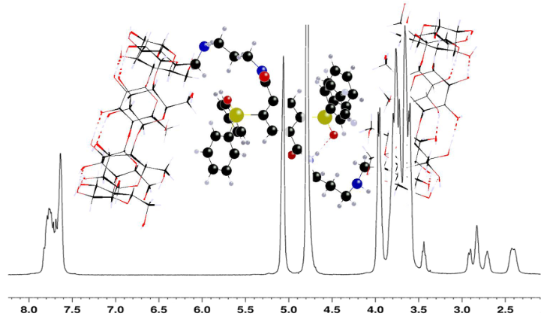
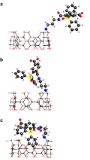
- over the cavity indicates that intermediate conformations, between extended and self-included may exist in water as well. Computational results Quantum mechanical calculations were carried out for monomer 4 and dimer 6 at the PM3 level of theory for isolated molecules, as well as in the presence of



Plakilactones G and H from a marine sponge. Stereochemical determination of highly flexible systems by quantitative NMR-derived interproton distances combined with quantum mechanical calculations of 13C chemical shifts
Beilstein J. Org. Chem. 2013, 9, 2940–2949, doi:10.3762/bjoc.9.331
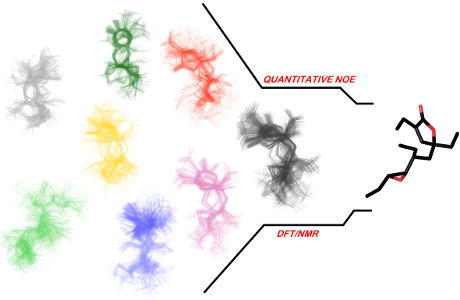
- sponge Plakinastrella mamillaris collected at Fiji Islands, is reported. The stereostructural studies began on plakilactone H by applying an integrated approach of the NOE-based protocol and quantum mechanical calculations of 13C chemical shifts. In particular, plakilactone H was used as a template to
- extend the application of NMR-derived interproton distances to a highly flexible molecular system with simultaneous assignment of four non-contiguous stereocenters. Chemical derivatization and quantum mechanical calculations of 13C on plakilactone G along with a plausible biogenetic interconversion


Cyclopamine analogs bearing exocyclic methylenes are highly potent and acid-stable inhibitors of hedgehog signaling
Beilstein J. Org. Chem. 2013, 9, 2328–2335, doi:10.3762/bjoc.9.267
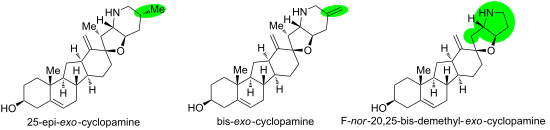
- [32][33]. Furthermore, quantum mechanical calculations guided our design and synthesis of exo-cyclopamine (2, see Figure 1), a ten-fold more potent and acid-stable analog with an exo-methylene unit at C13–C18 [34]. Herein, we describe a comprehensive study of cyclopamine analogs bearing exo-methylene



Cyclization of substitued 2-(2-fluorophenylazo)azines to azino[1,2-c]benzo[d][1,2,4]triazinium derivatives
Beilstein J. Org. Chem. 2013, 9, 1873–1880, doi:10.3762/bjoc.9.219
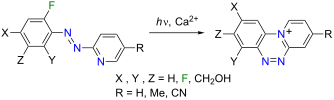
- structures. Computational Details The quantum-mechanical calculations were carried out at B3LYP/6-311G(2d,p) level of theory using the Gaussian 09 suite of programs [16]. The geometry optimizations were undertaken using tight convergence limits and with no symmetry constraints. Vibrational frequencies were





