


Search results
Search for "glycosyl donor" in Full Text gives 56 result(s) in Beilstein Journal of Organic Chemistry.
Enzymatic synthesis of glycosides: from natural O- and N-glycosides to rare C- and S-glycosides
Beilstein J. Org. Chem. 2017, 13, 1857–1865, doi:10.3762/bjoc.13.180
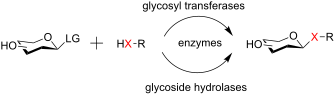
- are named thioligases [65]. Based on the mechanism, here the formation of the glycosyl–enzyme intermediate requires the use of an activated glycosyl donor, such as dinitrophenyl or azide glycosides, and the glycosylation step needs stronger nucleophiles such as thiol derivatives. The choice of the




Strategies toward protecting group-free glycosylation through selective activation of the anomeric center
Beilstein J. Org. Chem. 2017, 13, 1239–1279, doi:10.3762/bjoc.13.123

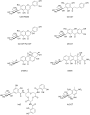
- review, we showcase the methods available for the selective activation of the anomeric center on the glycosyl donor and the mechanisms by which the glycosylation reactions take place to illustrate the power these techniques. Keywords: glycosides; glycosylation; oligosaccharides; protecting groups
- (III)-catalyzed strategy to access both simple aliphatic glycosides and disaccharides in good yields using either a propargyl or 2-butynyl glycosyl donor. They argued that since Au(III) is not too oxophilic and is also working in aprotic solvents, this metal would be suitable for anomeric activation of




Glycoscience@Synchrotron: Synchrotron radiation applied to structural glycoscience
Beilstein J. Org. Chem. 2017, 13, 1145–1167, doi:10.3762/bjoc.13.114
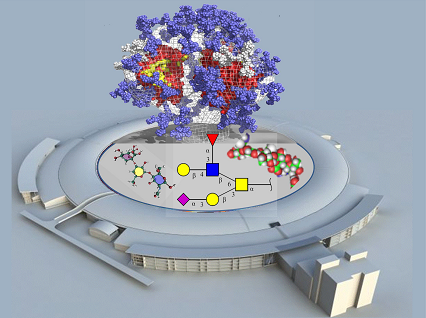
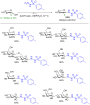
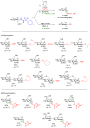
- the biosynthesis of glycosidic linkage requires the transfer of a sugar residue from a donor to an acceptor [35]. Acceptor substrates are carbohydrates, proteins, lipids, DNA, flavonol, antibiotics and steroids. In contrast, glycosyl donor substrates are mostly sugar nucleotides, such as UDP-GlcNAc






Total synthesis of TMG-chitotriomycin based on an automated electrochemical assembly of a disaccharide building block
Beilstein J. Org. Chem. 2017, 13, 919–924, doi:10.3762/bjoc.13.93
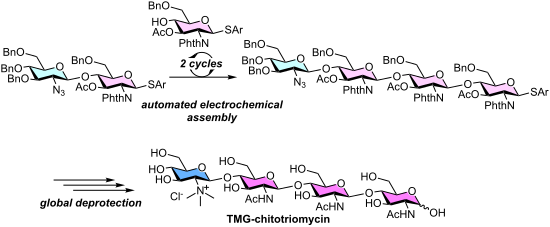
- ) stereoselectively, we initiated our study by optimization of the reaction conditions of the first glycosylation using 2-deoxy-2-azidothioglycoside 2 as a glycosyl donor. The azido group at the C2-position is a well-known substituent, which facilitates the formation of an α-glycosidic linkage selectively due to the


First total synthesis of kipukasin A
Beilstein J. Org. Chem. 2017, 13, 855–862, doi:10.3762/bjoc.13.86
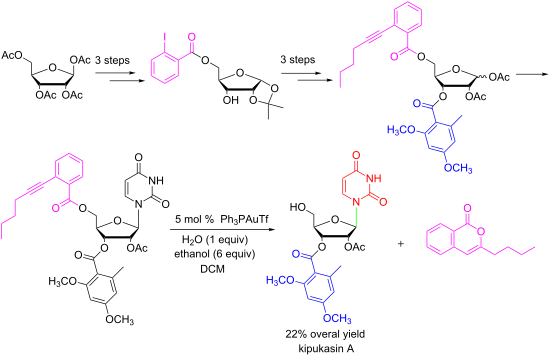
- ). Kipukasin A could be constructed by Vorbrüggen glycosylation [22][23] of a properly protected glycosyl donor 3 with uracil (4). Neighboring group participation of the 2’-O-acetyl group stereoselectively facilitate the β-glycosidic bond formation. Thus, the choice of a suitable protecting group at 5-OH


Silyl-protective groups influencing the reactivity and selectivity in glycosylations
Beilstein J. Org. Chem. 2017, 13, 93–105, doi:10.3762/bjoc.13.12

- . Review One of the earliest glycosylations with a persilylated glycosyl donor was carried out by Kihlberg and Broddefalk who needed an acid-labile protective group [5]. They protected a thiocresyl glucoside with TBS groups, oxidized the sulfur to sulfoxide 1 and used the latter to glucosylate the 2-OH of
- glycosylation with a TES-protected glycosyl donor has also been performed in a case where the target contained a 6-O-acylglucoside and hence protective groups that could be removed under mild acidic conditions were needed [9]. This was for example used for the synthesis of the serine protease inhibitor
- monosaccharide thioglycosides were subjected to linking the 3 and 6-OH group together with this silyl ether. This forces the glycosyl-donor conformation to change into an axial-rich conformation and hence into a superarmed donor (Table 2) making it possible to glycosylate an armed glycosyl donor selectively


Synthesis of the C8’-epimeric thymine pyranosyl amino acid core of amipurimycin
Beilstein J. Org. Chem. 2016, 12, 1765–1771, doi:10.3762/bjoc.12.165
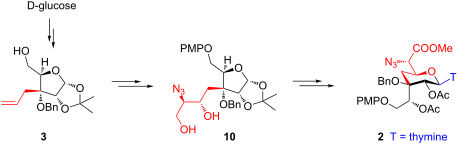
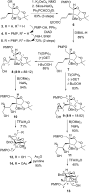
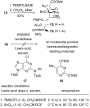
- ester 15. Acetylation of 15 with acetic anhydride in pyridine gave acetate derivative 16 in 95% yield. Having fully functionalized intermediate 16 in hand, we thought to incorporate the purine nucleobase using Vorbrüggen conditions. Thus, reaction of glycosyl donor 16 with bis(trimethylsilyl)-2-(N






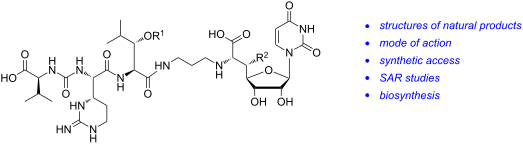
Muraymycin nucleoside-peptide antibiotics: uridine-derived natural products as lead structures for the development of novel antibacterial agents
Beilstein J. Org. Chem. 2016, 12, 769–795, doi:10.3762/bjoc.12.77
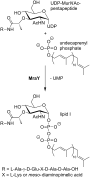
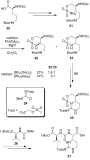
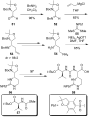
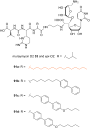
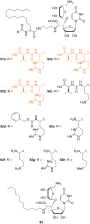
- -catalysed displacement of the uracil with a phosphate moiety to afford 5-amino-5-deoxyribose-1-phosphate (116). The LipM-mediated reaction of ribosyl phosphate 116 with a nucleoside triphosphate (NTP) then yields nucleoside diphosphate (NDP)-aminoribose 117. Finally, aminoribosylation of 101 with glycosyl
- donor 117, catalysed by glycosyltransferase LipN, furnishes the complete nucleoside core structure 118 (Scheme 11). The order of 6'-N-(3-aminopropyl) attachment and 5'-O-aminoribosylation is not fully clear yet, i.e., it is not elucidated if 101 or 6'-N-aminoalkyl intermediate 103 (see Scheme 10) act as













Synthesis, antimicrobial and cytotoxicity evaluation of new cholesterol congeners
Beilstein J. Org. Chem. 2015, 11, 1922–1932, doi:10.3762/bjoc.11.208

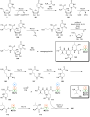
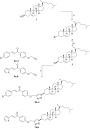
- pharmacological effects of the maltose tag compared with glucose as previously investigated in the case of VI [24]. Thus, coupling of glycosyl donor 21 [41] with acceptor 9a afforded maltoside 22 in low yield (Scheme 5). CuAAC of substrate 22 with 10 yielded derivative 23 in 62% yield. The 1H NMR showed that the




N-Alkyl derivatives of diosgenyl 2-amino-2-deoxy-β-D-glucopyranoside; synthesis and antimicrobial activity
Beilstein J. Org. Chem. 2015, 11, 869–874, doi:10.3762/bjoc.11.97
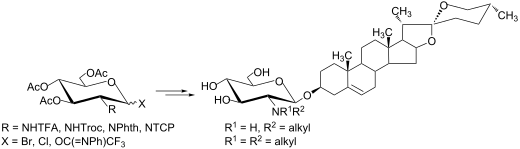
- triflate) was added to the solution of diosgenin and the respective glycosyl donor. In the “reverse” procedure, the respective glycosyl donor was added to the solution of diosgenin and the promoter. Diosgenin glycosylations were carried out in dichloromethane or/and in a mixture of dichloromethane and
- diethyl ether. The results summarized in Table 1 indicate that the “reverse” procedure is much more effective than the “normal” procedure. Running of the diosgenin glycosylation also depends on the kind of the solvent used. It is particularly important when bromide 2a is used as a glycosyl donor. Reaction
- least efficient is 4d with the tetrachlorophthaloyl protection of the amine group; the remaining (N-phenyl)trifluoroacetimidates react similarly. In the experimental section (see Supporting Information File 1), the best procedures for each glycosyl donor are presented. Finally, diosgenyl 2-amino-2-deoxy


Synthesis of a hexasaccharide partial sequence of hyaluronan for click chemistry and more
Beilstein J. Org. Chem. 2015, 11, 604–607, doi:10.3762/bjoc.11.67
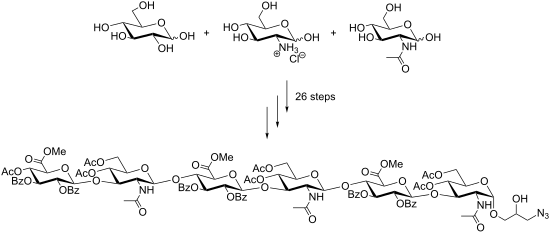
- ][23] was linked with glycosyl acceptor 2 [24][25] using TMSOTf as promoter to obtain disaccharide 4 in 90% yield. Likewise, reaction of glycosyl donor 1 with monosaccharide 3 [26] and subsequent O-TBS group cleavage with Olah's reagent [27], afforded disaccharide 5 in 86% yield. Thence, both

Synthesis of 1,2-cis-2-C-branched aryl-C-glucosides via desulfurization of carbohydrate based hemithioacetals
Beilstein J. Org. Chem. 2015, 11, 583–588, doi:10.3762/bjoc.11.64

- their profound biological importance, there are different routes reported for their synthesis but the common ones are: nucleophilic substitution of an activated glycosyl donor with organometallic aryl derivatives, cross-coupling of aryls with glycals, Friedel–Crafts arylation at the anomeric centre of
- an activated glycosyl donor, and rearrangement of aryl-O-glycosides to their corresponding aryl-C-glycosides [1][2][3][4][5][6]. Most of these methods provide 1,2-trans aryl C-glycosides and formation of 1,2-cis-aryl-C-glycosides, especially α-glucosides, still remains a challenge. Equally important


Synthesis and biological evaluation of a novel MUC1 glycopeptide conjugate vaccine candidate comprising a 4’-deoxy-4’-fluoro-Thomsen–Friedenreich epitope
Beilstein J. Org. Chem. 2015, 11, 155–161, doi:10.3762/bjoc.11.15
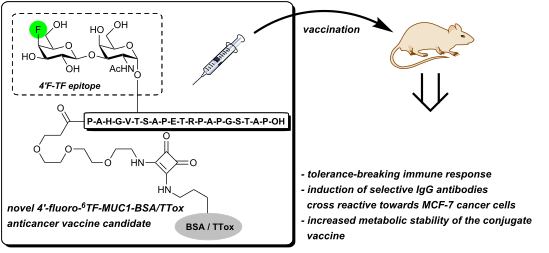
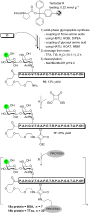
- 6 in 70% yield. A two-step protecting group manipulation ultimately afforded glycosyl donor 7 with 78% yield. The key step in the synthesis of the 4’-fluoro-TF-antigen glycosyl amino acid building block 10 is the stereoselective NIS/AgOTf-promoted coupling of 7 to the literature-known Tn antigen




Galactan synthesis in a single step via oligomerization of monosaccharides
Beilstein J. Org. Chem. 2014, 10, 2658–2663, doi:10.3762/bjoc.10.279
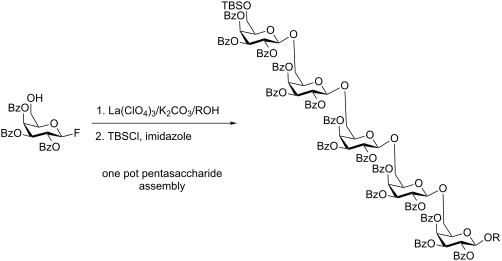
- Marius Drager Amit Basu Department of Chemistry, Box H, Brown University, Providence, RI 02912, USA 10.3762/bjoc.10.279 Abstract Galactans ranging in length from one to five residues were prepared in a single step by treatment of the glycosyl donor 2,3,4-tri-O-benzoyl-β-D-galactopyranosyl
- purification after the formation of each glycosidic bond, and have enabled the rapid preparation of complex glycans [1]. An alternative strategy for the efficient oligosaccharide formation involves the oligomerization of a single building block that functions both as a glycosyl donor and acceptor. This
- our surprise, the reaction provided both the desired monosaccharide 41a as well as significant amounts of the disaccharide 42a and trisaccharide 43a (entry 1, Table 1) [20]. We surmised that the fluoride ion derived from the activated glycosyl donor was responsible for desilylating 1 during the course


Efficient routes toward the synthesis of the D-rhamno-trisaccharide related to the A-band polysaccharide of Pseudomonas aeruginosa
Beilstein J. Org. Chem. 2014, 10, 1488–1494, doi:10.3762/bjoc.10.153
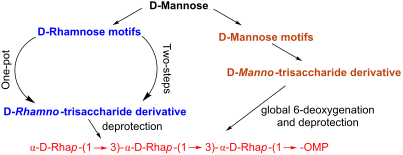
- subsequently serve as the glycosyl donor in the next step. Accordingly, 5 and 6 were coupled almost quantitatively to give 8. The disaccharide so obtained was then coupled with 7 to give the protected trisaccharide 9 in 90% yield using a N-iodosuccinimide-trimethylsilyl trifluoromethanesulfonate (NIS-TMSOTf


Synthesis of zearalenone-16-β,D-glucoside and zearalenone-16-sulfate: A tale of protecting resorcylic acid lactones for regiocontrolled conjugation
Beilstein J. Org. Chem. 2014, 10, 1129–1134, doi:10.3762/bjoc.10.112

- using acetyl-protected glucosyl donors since diastereoselective β-conjugation, which is needed for the preparation of glucosides formed during phase II metabolism, is commonly achieved applying the participation of acyl groups at O-2 of the glycosyl donor (anchimeric effect) [30]. Lewis acid-mediated


Convergent synthesis of a tetrasaccharide repeating unit of the O-specific polysaccharide from the cell wall lipopolysaccharide of Azospirillum brasilense strain Sp7
Beilstein J. Org. Chem. 2014, 10, 293–299, doi:10.3762/bjoc.10.26
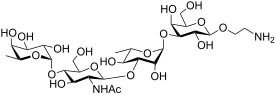
- use of Et2O in the reaction solvent facilitated the formation of 1,2-cis glycoside as the major product. The concept of the Fraser–Reid’s “armed–disarmed” effect was successfully exploited in this glycosylation reaction [34][35]. Compound 5 acted as an activated or armed glycosyl donor because of the
- summary, a straightforward and convergent synthesis of the tetrasaccharide 1 as its 2-aminoethyl glycoside corresponding to the O-specific polysaccharide of the LPS of A. brasilense strain Sp7 has been presented. The use of thioglycosides both as glycosyl donor and acceptor according to the concept of the


Gold-catalyzed glycosidation for the synthesis of trisaccharides by applying the armed–disarmed strategy
Beilstein J. Org. Chem. 2013, 9, 2147–2155, doi:10.3762/bjoc.9.252
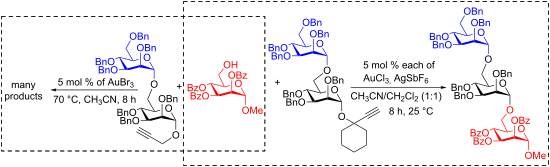
- Abhijeet K. Kayastha Srinivas Hotha Department of Chemistry, Indian Institute of Science Research and Education, Pune-411 008, India 10.3762/bjoc.9.252 Abstract The synthesis of oligosaccharides is still a challenging task as there is no universal glycosyl donor for the synthesis of all
- process, the saccharide unit that is donating its glycon is called a glycosyl donor, whereas the saccharide that is accepting the glycon is referred to as glycosyl acceptor or aglycon. The synthesis of oligosaccharides is still a formidable task in spite of the development of various methods. There is
- still no universal glycosyl donor [17][18], although the first glycoside was reported by Emil Fischer more than a century ago. A series of observations in our laboratory led to the identification of a gold(III)-catalyzed glycosidation reaction that uses alkynyl glycosides as glycosyl donors [19][20][21


Synthesis of mucin-type O-glycan probes as aminopropyl glycosides
Beilstein J. Org. Chem. 2013, 9, 1867–1872, doi:10.3762/bjoc.9.218

- peracetylated trichloroacetimidate donor 13 in the presence of catalytic TMSOTf. Disaccharide 24 was obtained in 62% yield and without any further protecting-group manipulations, the thioglycoside disaccharide was subsequently activated as a glycosyl donor using NIS/TMSOTf and coupled to 4,6-O-benzylidene


Straightforward synthesis of a tetrasaccharide repeating unit corresponding to the O-antigen of Escherichia coli O16
Beilstein J. Org. Chem. 2013, 9, 1757–1762, doi:10.3762/bjoc.9.203

- iodonium ion mediated glycosylation conditions; (c) the use of p-methoxybenzyl (PMB) ether protection as an in situ removable protecting group in a one-pot glycosylation reaction and its removal [17] and (d) the use of galactofuranosidic thioglycoside as a glycosyl donor. The iodonium ion promoted


Appel-reagent-mediated transformation of glycosyl hemiacetal derivatives into thioglycosides and glycosyl thiols
Beilstein J. Org. Chem. 2013, 9, 974–982, doi:10.3762/bjoc.9.112

- , fluoride, bromide, hemiacetal, etc.) and hence the thio functionality is often used as a temporary anomeric protecting group. Thioglycosides can act as a glycosyl donor as well as glycosyl acceptor depending on the reaction conditions (orthogonal glycosylations) [11][12]. Due to their stability towards


Convergent synthesis of the tetrasaccharide repeating unit of the cell wall lipopolysaccharide of Escherichia coli O40
Beilstein J. Org. Chem. 2012, 8, 2053–2059, doi:10.3762/bjoc.8.230

- ) in the 1H NMR and δ 97.4 (C-1D), 83.0 (C-1C) in the 13C NMR spectra, respectively]. During the synthesis of compound 9, thioglycoside 4 acted as glycosyl donor and thioglycoside 5 acted as orthogonal glycosyl acceptor because of the difference in their reactivity following the “armed–disarmed


Antifreeze glycopeptide diastereomers
Beilstein J. Org. Chem. 2012, 8, 1657–1667, doi:10.3762/bjoc.8.190

- -desoxygalactopyranosyl chloride serving as a glycosyl donor in a silver-mediated Koenigs–Knorr glycosylation of the particular Fmoc- and t-Bu-protected amino acids, i.e., the allo-L-configured (1A) and D-configured (1B) threonine derivatives. Both glycosylated amino acids (2) were obtained in good yields and very good


Synthesis of 4” manipulated Lewis X trisaccharide analogues
Beilstein J. Org. Chem. 2012, 8, 1134–1143, doi:10.3762/bjoc.8.126
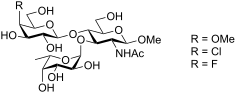
- degradation of the glycosyl donor at this higher temperature (Table 1, entry 5). Of the three glycosylations considered here, the coupling of acceptor 8 with the 4-fluoro donor 11 gave the highest yields (Table 1, entries 6 and 7). Indeed the desired disaccharide 22 was obtained in very good yields when the



2-Allylphenyl glycosides as complementary building blocks for oligosaccharide and glycoconjugate synthesis
Beilstein J. Org. Chem. 2012, 8, 597–605, doi:10.3762/bjoc.8.66
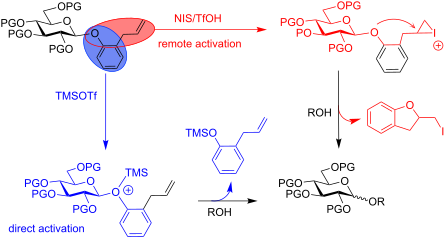
- range of standard glycosyl acceptors 2–5 [18]. Encouragingly, the reaction of glycosyl donor 1a with the primary glycosyl acceptor 2 in the presence of TMSOTf was completed within 15 min and provided the corresponding disaccharide 6a in 82% yield (Table 1, entry 1). As expected, when a control
- trend, namely no reaction with TMSOTf and smooth glycosylation with MeOTf [32]. NIS/TMSOTf is a powerful promoter for the activation of both O-pentenyl and thioglycosides. It was also found to be effective for the activation of AP glycosyl donor 1a, upon which disaccharide 6a was obtained in 80% yield
- -promoted glycosylations of 1b have proven to be of preparative value and the desired disaccharides 6b and 9b were isolated in 71–78% yield (Table 1, entries 10–12). In order to gain a more flexible activation profile for the synthesis of 1,2-trans glycosides, we also investigated AP glycosyl donor 1c





