


Search results
Search for "organocatalysis" in Full Text gives 205 result(s) in Beilstein Journal of Organic Chemistry. Showing first 200.
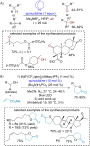
Stereoselective mechanochemical synthesis of thiomalonate Michael adducts via iminium catalysis by chiral primary amines
Beilstein J. Org. Chem. 2024, 20, 2313–2322, doi:10.3762/bjoc.20.198
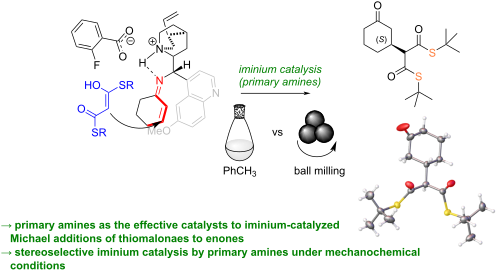
- nucleophiles in this transformation. Keywords: asymmetric catalysis; iminium catalysis; mechanochemistry; organocatalysis; thioesters; Introduction Mechanochemistry, particularly solventless processes under ball milling conditions, offers the opportunity to devise unconventional reaction pathways [1][2][3][4
- ][7][8]. Furthermore, the integration of mechanochemistry and organocatalysis leads to the development of more sustainable transformations, characterized by reduced reaction times, decreased catalyst loadings, and significantly diminished solvent usage and waste production [9][10][11]. The pioneering
- sustainable transformations characterized by reduced reaction times. An unprecedented combination of mechanochemistry with organocatalysis, notably chiral amine-catalyzed stereoselective reactions, has been extensively investigated. While primary amine-catalyzed reactions under ball milling conditions are


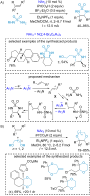
Catalysing (organo-)catalysis: Trends in the application of machine learning to enantioselective organocatalysis
Beilstein J. Org. Chem. 2024, 20, 2280–2304, doi:10.3762/bjoc.20.196
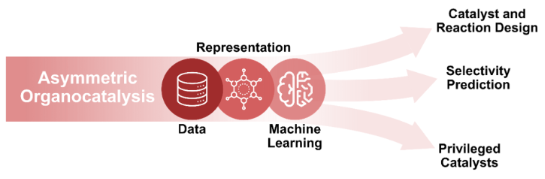
- Research (NCCR) Catalysis, ETH Zurich, Zurich CH-8093, Switzerland 10.3762/bjoc.20.196 Abstract Organocatalysis has established itself as a third pillar of homogeneous catalysis, besides transition metal catalysis and biocatalysis, as its use for enantioselective reactions has gathered significant
- interest over the last decades. Concurrent to this development, machine learning (ML) has been increasingly applied in the chemical domain to efficiently uncover hidden patterns in data and accelerate scientific discovery. While the uptake of ML in organocatalysis has been comparably slow, the last two
- decades have showed an increased interest from the community. This review gives an overview of the work in the field of ML in organocatalysis. The review starts by giving a short primer on ML for experimental chemists, before discussing its application for predicting the selectivity of organocatalytic




Factors influencing the performance of organocatalysts immobilised on solid supports: A review
Beilstein J. Org. Chem. 2024, 20, 2129–2142, doi:10.3762/bjoc.20.183
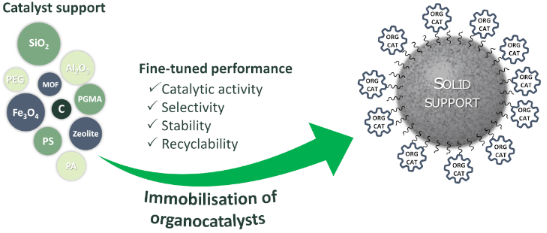
- Zsuzsanna Feher Dora Richter Gyula Dargo Jozsef Kupai Department of Organic Chemistry and Technology, Budapest University of Technology and Economics, Műegyetem rkp. 3., H-1111 Budapest, Hungary 10.3762/bjoc.20.183 Abstract Organocatalysis has become a powerful tool in synthetic chemistry
- applications in organic chemistry. Keywords: asymmetric synthesis; catalyst recycling; heterogenisation; organocatalysis; solid support; Introduction Organocatalysts are small molecules that do not contain a metal atom in the reaction centre and are able to increase the speed of reactions. They have proven
- their place among the efficient and robust catalysts on numerous occasions since the two seminal works [1][2] published in 2000. Since then, organocatalysis has been combined with many other areas of research, such as photocatalysis, electrochemistry and mechanochemistry [3][4][5], while List and


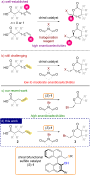
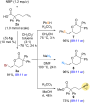
Chiral bifunctional sulfide-catalyzed enantioselective bromolactonizations of α- and β-substituted 5-hexenoic acids
Beilstein J. Org. Chem. 2024, 20, 1794–1799, doi:10.3762/bjoc.20.158
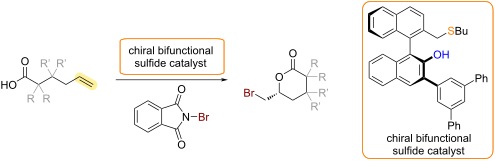
- ; enantioselectivity; halogenation; lactones; organocatalysis; Introduction Catalytic asymmetric halolactonizations of alkenoic acids are powerful methods for the preparation of important chiral lactones in enantioenriched forms [1][2][3][4][5][6][7][8][9][10][11]. A wide variety of chiral catalysts have been applied



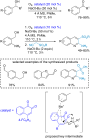
Primary amine-catalyzed enantioselective 1,4-Michael addition reaction of pyrazolin-5-ones to α,β-unsaturated ketones
Beilstein J. Org. Chem. 2024, 20, 1518–1526, doi:10.3762/bjoc.20.136
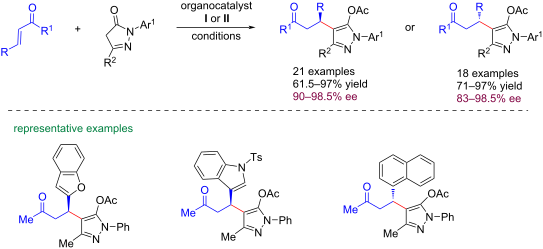
- ; organocatalysis; pyrazoles; Introduction N-Heterocycles are attractive molecules owing to their extensive applications in small-molecule drugs, natural products, and agrochemical products [1][2][3]. Among the N-heterocycles, pyrazole is an important structural scaffold, found in several marketed drugs and
- metal catalytic conditions. In continuation of our work in the field of organocatalysis [26][27][28][29], herein, we present the Michael addition reaction of 4-unsubstituted pyrazolin-5-ones with arylidene/heteroarylideneacetones using cinchona alkaloid-derived primary amine catalysts. The developed




Tetrabutylammonium iodide-catalyzed oxidative α-azidation of β-ketocarbonyl compounds using sodium azide
Beilstein J. Org. Chem. 2024, 20, 1510–1517, doi:10.3762/bjoc.20.135
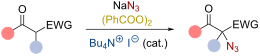
- . Keywords: azidation; nitration; organocatalysis; oxidation; quaternary ammonium iodides; Introduction Organic compounds containing an azide functionality are highly valuable synthesis targets that offer considerable potential for various applications and further manipulations [1][2][3][4][5][6][7][8][9


Towards an asymmetric β-selective addition of azlactones to allenoates
Beilstein J. Org. Chem. 2024, 20, 1504–1509, doi:10.3762/bjoc.20.134
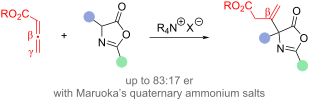
- -selective manner with moderate levels of enantioselectivities (up to 83:17 er). Furthermore, the obtained products can be successfully engaged in nucleophilic ring opening reactions, thus giving highly functionalized α-amino acid derivatives. Keywords: allenoates; amino acids; azlactones; organocatalysis


Evaluation of the enantioselectivity of new chiral ligands based on imidazolidin-4-one derivatives
Beilstein J. Org. Chem. 2024, 20, 684–691, doi:10.3762/bjoc.20.62
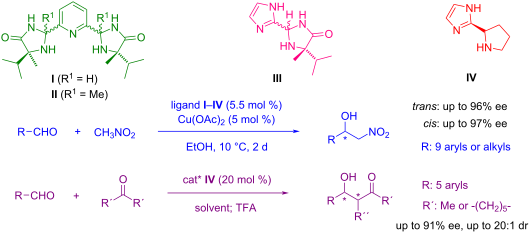
- chiral metal complex catalyst but also as an enantioselective organocatalyst [17]. Accordingly, its application in enantioselective organocatalysis, particularly in asymmetric reactions through “enamine activation”, warrants further investigation. Results and Discussion The corresponding copper(II


A laterally-fused N-heterocyclic carbene framework from polysubstituted aminoimidazo[5,1-b]oxazol-6-ium salts
Beilstein J. Org. Chem. 2024, 20, 621–627, doi:10.3762/bjoc.20.54
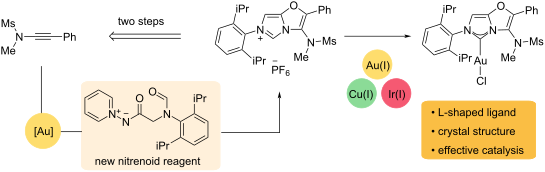
- ; imidazolium; NHC; Introduction Imidazolium-derived nucleophilic heterocyclic carbenes (NHCs) have had a sustained impact across the fields of organometallic and main group chemistry, transition-metal catalysis, materials synthesis and organocatalysis [1]. Laterally annellated polycyclic NHCs offer a useful


Green and sustainable approaches for the Friedel–Crafts reaction between aldehydes and indoles
Beilstein J. Org. Chem. 2024, 20, 379–426, doi:10.3762/bjoc.20.36
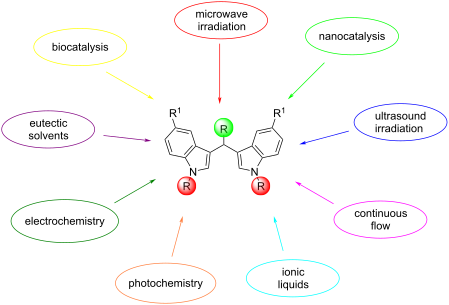
- development of greener synthetic technologies, like photocatalysis, organocatalysis, the use of nanocatalysts, microwave irradiation, ball milling, continuous flow, and many more. Thus, in this review, we summarize the medicinal properties of BIMs and the developed BIM synthetic protocols, utilizing the
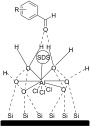
- of green chemistry. Organocatalysis is the acceleration of chemical reactions with the use of small organic compounds, which do not contain any amounts of enzyme or inorganic elements [37][38][39]. The benefits of solid acid catalysis render them as an appealing choice, compared to their liquid




Catalytic multi-step domino and one-pot reactions
Beilstein J. Org. Chem. 2024, 20, 254–256, doi:10.3762/bjoc.20.25
- ; multi-step reactions; multicomponent reactions; one-pot synthesis; organocatalysis; tandem reactions; transition-metal-catalysis; The synthesis of pharmaceutical ingredients, natural products, agrochemicals, ligand systems, and building blocks for materials science has reached a high level of

Chiral phosphoric acid-catalyzed transfer hydrogenation of 3,3-difluoro-3H-indoles
Beilstein J. Org. Chem. 2024, 20, 205–211, doi:10.3762/bjoc.20.20
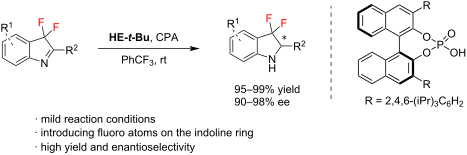
- excellent yield and enantioselectivity. Keywords: asymmetric organocatalysis; chiral Brønsted acid; 3,3-difluoroindoline; Hantzsch ester; transfer hydrogenation; Introduction The introduction of fluoro atoms into organic molecules can alter their lipophilicity, solubility, metabolic stability, and
- organocatalysis using chiral phosphoric acids has also been studied (Scheme 1b) [26][27][28]. In 2010, Magnus Rueping and his co-workers developped an enantioselective Brønsted acid-catalyzed transfer hydrogenation of 3H-indoles [29]. In 2020, Song and Yu successfully applied a new chiral Brønsted acid


Using the phospha-Michael reaction for making phosphonium phenolate zwitterions
Beilstein J. Org. Chem. 2024, 20, 41–51, doi:10.3762/bjoc.20.6
- Matthias R. Steiner Max Schmallegger Larissa Donner Johann A. Hlina Christoph Marschner Judith Baumgartner Christian Slugovc Institute for Chemistry and Technology of Materials, Graz University of Technology, Stremayrgasse 9, 8010 Graz, Austria Christian Doppler Laboratory for Organocatalysis in
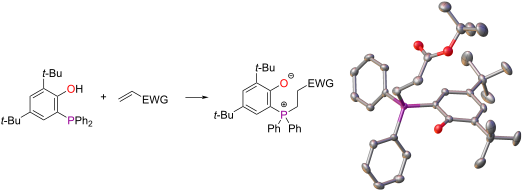
- reactive in chloroform solution, while in methanol the corresponding phosphonium phenolate is formed. Keywords: Lewis-base catalysis; Michael acceptor reactivity; phospha-Michael reaction; phosphonium phenolate zwitterion; Introduction Organocatalysis has emerged in recent years as a valuable and


Aldiminium and 1,2,3-triazolium dithiocarboxylate zwitterions derived from cyclic (alkyl)(amino) and mesoionic carbenes
Beilstein J. Org. Chem. 2023, 19, 1947–1956, doi:10.3762/bjoc.19.145
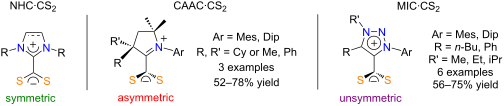
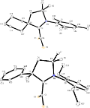
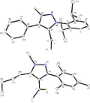
- weaker basicity and greater modularity, the related 1,2,4-triazol-5-ylidene derivatives D have been mainly employed in organocatalysis [6]. Besides these four types of N-heterocyclic carbenes (NHCs), other families of cyclic compounds have been actively pursued to further expand the diversity of singlet


A novel recyclable organocatalyst for the gram-scale enantioselective synthesis of (S)-baclofen
Beilstein J. Org. Chem. 2023, 19, 1811–1824, doi:10.3762/bjoc.19.133
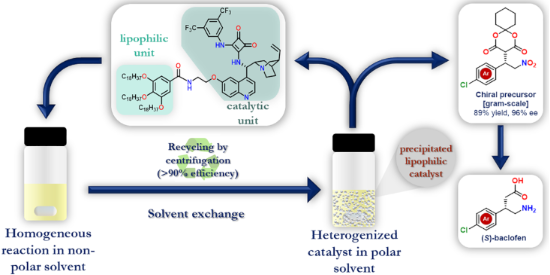
- , acetonitrile, with 91–100% efficiency, and the catalyst was reused in five reaction cycles without the loss of activity and selectivity. Keywords: baclofen; catalyst recovery; lipophilic cinchona squaramide; organocatalysis; stereoselective catalysis; Introduction In today’s chemical industry, catalytic
- processes are of paramount importance. In particular, the application of asymmetric organocatalysts is receiving increased attention [1][2][3][4]. This is illustrated by the fact that in 2021 the Nobel Prize in Chemistry was awarded for the discovery of asymmetric organocatalysis [5]. The use of


N-Sulfenylsuccinimide/phthalimide: an alternative sulfenylating reagent in organic transformations
Beilstein J. Org. Chem. 2023, 19, 1471–1502, doi:10.3762/bjoc.19.106
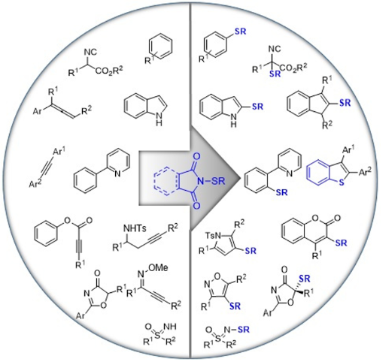
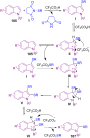
- synthesis of chiral sulfides up to 97% ee was achieved in this method. A wide range of cyclic alkenes 138 and acyclic alkenes 52 and 9 were smoothly tolerated in this organocatalysis strategy. According to the proposed mechanism, initially, the organocatalyst activated the electrophilic sulfur species to
- reduction of II by silane. On the other hand, most of II were converted to intermediate III, which underwent hydride reduction to render product 140 (Scheme 61). Another organocatalysis system was disclosed by Liu and co-workers for sulfenylation of α-fluoro-β-ketoamides 143 and azlactones 145 (Scheme 62




Acetaldehyde in the Enders triple cascade reaction via acetaldehyde dimethyl acetal
Beilstein J. Org. Chem. 2023, 19, 1243–1250, doi:10.3762/bjoc.19.92
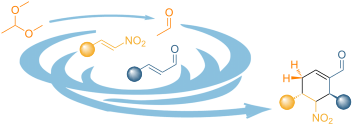
- enantioselectivity. Keywords: acetaldehyde; acetaldehyde dimethyl acetal; cascade reaction; multicomponent reaction; organocatalysis; Introduction Multicomponent reactions (MCRs) are chemical processes that involve three or more compounds, in which the product contains all the atoms of the reagents, except for


Exploring the role of halogen bonding in iodonium ylides: insights into unexpected reactivity and reaction control
Beilstein J. Org. Chem. 2023, 19, 1171–1190, doi:10.3762/bjoc.19.86
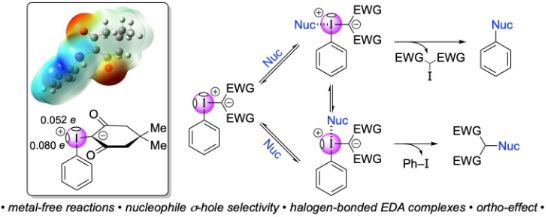
- ][78][79][80][81][82]. Organocatalysis is also a common point of intersection for halogen- and hydrogen bonding, and this has been thoroughly explored using monovalent iodine catalysts [83][84][85]. 1.3 Halogen bonding in hypervalent iodine complexes Similar to monovalent iodine compounds, a diverse
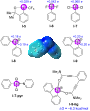
- compounds have also played an active role in halogen bond-based organocatalysis [91][92][93][94][95][96][97]. 2 Halogen bonding in iodonium ylides 2.1 Quantification of σ-holes in iodonium ylides Until recently, there were no quantitative evaluations of σ-holes in iodonium ylides [98][99], even though








Aromatic C–H bond functionalization through organocatalyzed asymmetric intermolecular aza-Friedel–Crafts reaction: a recent update
Beilstein J. Org. Chem. 2023, 19, 956–981, doi:10.3762/bjoc.19.72

- stereoselectivity is also explained. Keywords: asymmetric; aza-Friedel–Crafts reaction; H-bonding; organocatalysis; stereoselectivity; Introduction The ease of a chemical transformation depends on the thermodynamic instability of a chemical bond owing to its fast cleavage under mild reaction conditions. A C–H
- the tremendous progress in organic chemistry over the last few decades, metal catalysis has been increasingly and successfully replaced by organocatalysis, i.e., accelerating the rate of chemical transformations by using small organic molecules as catalysts. Although being discovered more than 100
- years ago, the concept became increasingly accepted and popular only by the last decade of the last century [2][3]. Nowadays, organocatalysis is especially applied to asymmetric synthesis and a huge number of organocatalysts has been introduced in last three decades for the asymmetric synthesis of




Total synthesis: an enabling science
Beilstein J. Org. Chem. 2023, 19, 474–476, doi:10.3762/bjoc.19.36
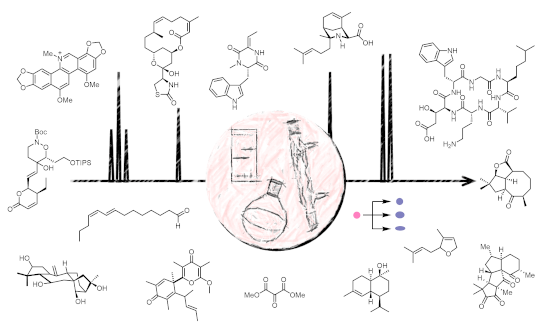
- synthetic methodology developments and to natural product isolation or biosynthesis. Thus, thematic issues dealing with total synthesis in the Beilstein Journal of Organic Chemistry have naturally been published in these fields, such as "Transition-metal and organocatalysis in natural product synthesis


NaI/PPh3-catalyzed visible-light-mediated decarboxylative radical cascade cyclization of N-arylacrylamides for the efficient synthesis of quaternary oxindoles
Beilstein J. Org. Chem. 2023, 19, 57–65, doi:10.3762/bjoc.19.5
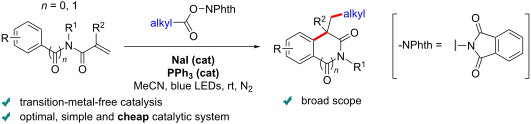
- advantage of circumventing the need for external redox additives and/or noble metals, using readily available and cost-effective NaI and PPh3 under mild reaction conditions. In a broader context, phosphine organocatalysis is probably still underappreciated in organic synthesis, and could lead to important




Two-step continuous-flow synthesis of 6-membered cyclic iodonium salts via anodic oxidation
Beilstein J. Org. Chem. 2023, 19, 27–32, doi:10.3762/bjoc.19.2
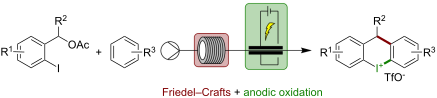
- -established reagents for synthetic chemists. They are portrayed as an alternative to otherwise hazardous transition metals. This is due to their great reactivity in electrophilic group transfers [1][2][3][4], photo- or organocatalysis [5][6][7][8][9][10][11][12][13][14][15], and their utility as building


Redox-active molecules as organocatalysts for selective oxidative transformations – an unperceived organocatalysis field
Beilstein J. Org. Chem. 2022, 18, 1672–1695, doi:10.3762/bjoc.18.179
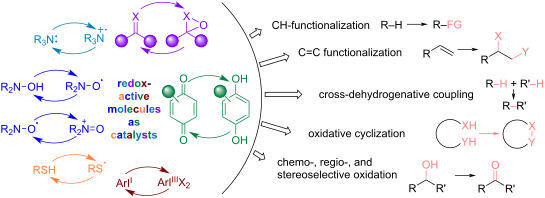
- Elena R. Lopat'eva Igor B. Krylov Dmitry A. Lapshin Alexander O. Terent'ev N. D. Zelinsky Institute of Organic Chemistry, Russian Academy of Sciences, Leninsky Prospect 47, Moscow, 119991, Russia 10.3762/bjoc.18.179 Abstract Organocatalysis is widely recognized as a key synthetic methodology in
- organic chemistry. It allows chemists to avoid the use of precious and (or) toxic metals by taking advantage of the catalytic activity of small and synthetically available molecules. Today, the term organocatalysis is mainly associated with redox-neutral asymmetric catalysis of C–C bond-forming processes
- oxidative, catalyzed by redox-active organic molecules in the ground state (without light excitation). Unfortunately, many of such processes are not associated in the literature with the organocatalysis field and thus many achievements are not fully consolidated and systematized. The present article is











Design, synthesis, and evaluation of chiral thiophosphorus acids as organocatalysts
Beilstein J. Org. Chem. 2022, 18, 1471–1478, doi:10.3762/bjoc.18.154
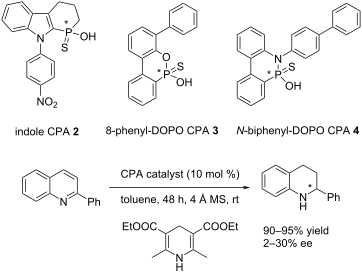
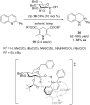
- asymmetric organocatalysis. In order to eliminate the need for C2-symmetry in common CPAs, various scaffolds containing C1-symmetrical thiophosphorus acids were chosen. These new compounds were synthesized and evaluated in the asymmetric transfer hydrogenation of 2-phenylquinoline. Although the efficacy of
- the thiophosphorus acids was disappointing for this reaction, the work should be useful for developing structural design elements. Keywords: asymmetric; heterocycles; organocatalysis; phosphorus; synthesis; Introduction The importance of asymmetric organocatalysis was demonstrated by the 2021 Nobel
- SPINOL [4][5] (Figure 1). The great success of these CPAs in asymmetric organocatalysis, is demonstrated by the publication of thousands of articles and reviews [6][7][8][9][10][11][12][13][14][15][16][17]. In all cases the C2-symmetry is required because of the prototropic tautomeric equilibrium in the


First example of organocatalysis by cathodic N-heterocyclic carbene generation and accumulation using a divided electrochemical flow cell
Beilstein J. Org. Chem. 2022, 18, 979–990, doi:10.3762/bjoc.18.98
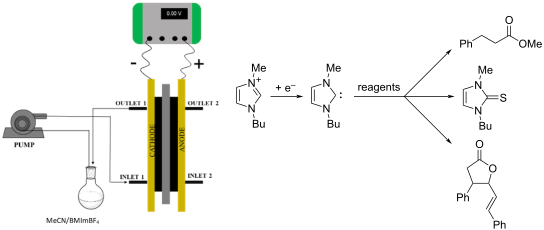
- at the cathode is usually H2 evolution [29]. The use of divided cells is less common in organic electrosynthesis, mainly due to complications inherent with membranes. Useful cathodic processes are less exploited in organic electrochemistry. In the context of NHC organocatalysis in flow
- ). Therefore, the 32% chemical yield (with respect to starting IL) is comparable with the yield of the batch process. Electrogenerated NHC organocatalysis. Dimerization of trans-cinnamaldehyde: synthesis of 4-phenyl-5-styryldihydrofuran-2(3H)-one Having demonstrated that NHCs could be generated and accumulated
- anolyte, a lower amount of both diastereoisomers was observed (Table 2, entries 5 and 6). Thus the best yield (79%, 67:33 cis/trans ratio) was obtained using a charge of 2.0 F and a solution of MeCN–MeOH (9.5:0.5)/Et4NBF4 (0.1 M) as anolyte (Table 2, entry 3). Electrogenerated NHC organocatalysis





