Search for "asymmetric synthesis" in Full Text gives 226 result(s) in Beilstein Journal of Organic Chemistry. Showing first 200.
Beilstein J. Org. Chem. 2019, 15, 1289–1297, doi:10.3762/bjoc.15.127
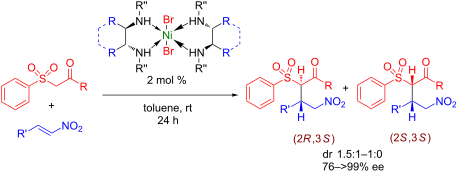
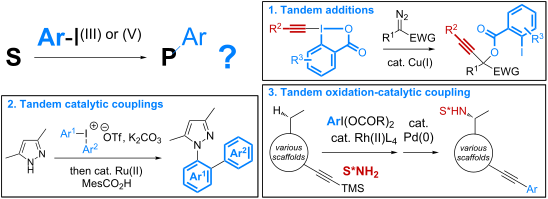
Graphical Abstract
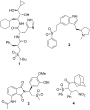
Figure 1: Рharmacologically active sulfones.
Figure 2: Structures of the ligands L1–L8.
Figure 3: Evolution of the conversion of 5 and diastereomeric composition of the products of reaction of 5a w...
Figure 4: Time profile of epimerization and retro-Michael reaction of (2R,3S)-8a in chloroform-d solution.
Figure 5: ORTEP diagram of (2R,3S)-8d.
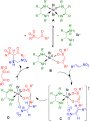
Scheme 1: The proposed mechanism of asymmetric addition of β-ketosulfones to nitroalkenes.
Scheme 2: Transition state models for asymmetric addition of β-ketosulfones to nitroalkenes.
Beilstein J. Org. Chem. 2019, 15, 1236–1256, doi:10.3762/bjoc.15.121
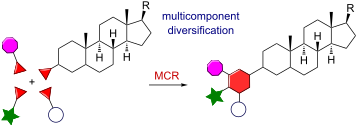
Graphical Abstract
Figure 1: Structures of natural steroids of A) animal and B) plant origin.
Scheme 1: Synthesis of a steroidal β-lactam by Ugi reaction of a cholanic aldehyde [14].
Scheme 2: Synthetic route to steroidal 2,5-diketopiperazines based on a diastereoselective Ugi-4CR with an an...
Scheme 3: Multicomponent synthesis of a heterocycle–steroid hybrid using a ketosteroid as carbonyl component [18]....
Scheme 4: Synthesis of peptidomimetic–steroid hybrids using the Ugi-4CR with spirostanic amines and carboxyli...
Scheme 5: Synthesis of azasteroids using the Ugi-4CR with androstanic and pregnanic carboxylic acids [22].
Figure 2: Ugi-4CR-derived library of androstanic azasteroids with diverse substitution patterns at the phenyl...
Scheme 6: Synthesis of 4-azacholestanes by an intramolecular Ugi-4C-3R [26].
Scheme 7: Synthesis of amino acid–steroid hybrid by multiple Ugi-4CR using steroidal isocyanides [29].
Scheme 8: Synthesis of ecdysteroid derivatives by Ugi-4CR using a steroidal isocyanide [30].
Scheme 9: Stereoselective multicomponent synthesis of a steroid–tetrahydropyridine hybrid using a chiral bifu...
Scheme 10: Pd(II)-catalyzed three-component reaction with an alkynyl seco-cholestane [34].
Scheme 11: Multicomponent synthesis of steroid–thiazole hybrids from a steroidal ketone [36].
Scheme 12: Synthesis of cholanic pseudo-peptide derivatives by novel MCRs based on the reactivity of ynamide [37,38].
Scheme 13: Synthesis of steroid-fused pyrimidines and pyrimidones using the Biginelli-3CR [39,42,43].
Scheme 14: Synthesis of steroidal pyridopyrimidines by a reaction sequence comprising a 4CR followed by a post...
Scheme 15: Synthesis of steroid-fused pyrimidines by MCR of 2-hydroxymethylene-3-ketosteroids [46].
Scheme 16: Synthesis of steroid-fused naphthoquinolines by the Kozlov–Wang MCR using ketosteroids [50,51].
Scheme 17: Conjugation of steroids to carbohydrates and peptides by the Ugi-4CR [62,63].
Scheme 18: Solid-phase multicomponent conjugation of peptides to steroids by the Ugi-4CR [64].
Scheme 19: Solid-phase multicomponent conjugation of peptides to steroids by the Petasis-3CR [68].
Scheme 20: Synthesis of steroidal macrobicycles (cages) by multiple multicomponent macrocyclizations based on ...
Scheme 21: One-pot synthesis of steroidal cages by double Ugi-4CR-based macrocyclizations [76].
Beilstein J. Org. Chem. 2019, 15, 1194–1202, doi:10.3762/bjoc.15.116
Graphical Abstract
Figure 1: Squalestatin S1/zaragozic acid A (1) and DDSQ (2).
Scheme 1: Carbonyl ylide cycloaddition–rearrangement to the squalestatin core [12,13].
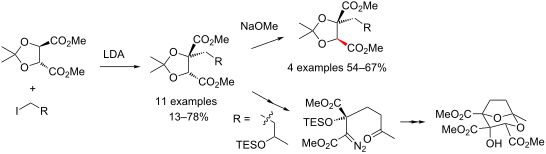
Scheme 2: Tartrate alkylation strategy to cycloaddition substrate.
Scheme 3: Conversion of α-ketoester to α-diazoester.
Scheme 4: Seebach’s tartrate alkylation and rationalisation of stereoselectivity [17-19].
Scheme 5: Tartrate alkylation with a non-activated alkyl iodide.
Scheme 6: Alkylated tartrate to diazoester sequence.
Scheme 7: TES protection approach to the squalestatin core.
Scheme 8: Tartrate acetonide methylation.
Scheme 9: Tartrate alkylation with various alkyl halides.
Scheme 10: Rationalisation of dialkylation observations.
Scheme 11: Tartrate alkylation chemistry with more complex alkyl iodides [12,13].
Figure 2: Natural product examples containing the monoalkylated tartaric acid motif.
Scheme 12: Epimerisation of monoalkylated tartrates.
Beilstein J. Org. Chem. 2019, 15, 542–550, doi:10.3762/bjoc.15.48
Graphical Abstract
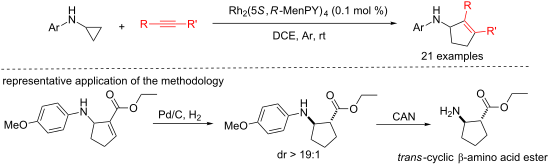
Scheme 1: Applications of N-arylaminocyclopropanes.
Scheme 2: Synthesis of trans-ethyl 2-aminocyclopentanecarboxylate.
Scheme 3: Proposed mechanism.
Beilstein J. Org. Chem. 2019, 15, 490–496, doi:10.3762/bjoc.15.42
Graphical Abstract
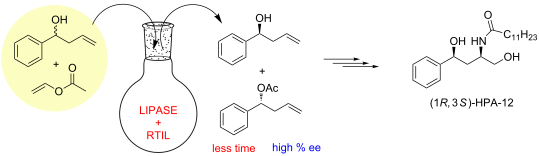
Figure 1: Structure of most active HPA-12 isomers, originally proposed (1) and revised (2).
Scheme 1: Lipase-catalyzed trans-acylation of (±)-4 and subsequent Mitsunobu inversion. Conditions: (i) Zn/TH...
Scheme 2: Synthesis of azide 9 from (S)-4. Conditions: (i) NaH/Bu4NI/BnBr/THF/25 °C/4 h; (ii) AD-mix-β/t-BuOH...
Scheme 3: Attempted synthesis of 2 from 9. Conditions: (i) (a) LiAlH4 (1 M in THF)/THF/25 °C/3 h, (b) DCC/DMA...
Scheme 4: Actual synthesis of 2 from 9. Conditions: (i) DDQ/CH2Cl2–H2O 4:1/3 h; (ii) a) LiAlH4/THF/25 °C/3 h,...
Beilstein J. Org. Chem. 2019, 15, 371–377, doi:10.3762/bjoc.15.33
Graphical Abstract
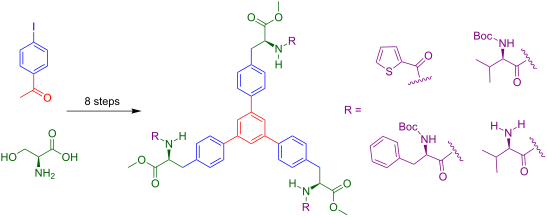
Figure 1: Exemplar C3-symmetric peptide scaffolds reported in the literature.
Scheme 1: Preparation of compound 7 from L-serine (3).
Scheme 2: Preparation of the trimerized product 9.
Scheme 3: Synthesis of compound 11 via Negishi cross-coupling reaction.
Scheme 4: Synthesis of C3-symmetric trimers 12, 13 and 14.
Beilstein J. Org. Chem. 2019, 15, 357–363, doi:10.3762/bjoc.15.31
Graphical Abstract
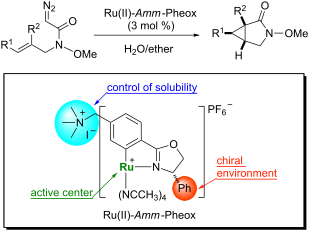
Figure 1: A comparison of the solubility of Ru(II)-Pheox (cat. 1) and Ru(II)-Amm-Pheox (cat. 2).
Scheme 1: Intramolecular cyclopropanation of various trans-allylic diazo Weinreb amide derivatives catalyzed....
Scheme 2: Synthetic transformation of cyclopropane products 2d and 2f.
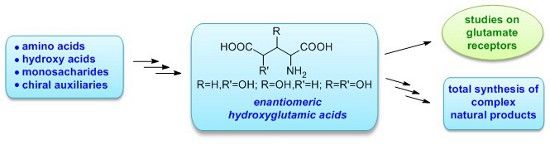
Beilstein J. Org. Chem. 2019, 15, 236–255, doi:10.3762/bjoc.15.22
Graphical Abstract
Figure 1: Structure of L-glutamic acid.
Figure 2: 3-Hydroxy- (2), 4-hydroxy- (3) and 3,4-dihydroxyglutamic acids (4).
Figure 3: Enantiomers of 3-hydroxyglutamic acid (2).
Scheme 1: Synthesis of (2S,3R)-2 from (R)-Garner's aldehyde. Reagents and conditions: a) MeOCH=CH–CH(OTMS)=CH2...
Scheme 2: Synthesis of (2S,3R)-2 and (2S,3S)-2 from (R)-Garner’s aldehyde. Reagents and conditions: a) H2C=CH...
Scheme 3: Two-carbon homologation of the protected L-serine. Reagents and conditions: a) Fmoc-succinimide, Na2...
Scheme 4: Synthesis of di-tert-butyl ester of (2R,3S)-2 from L-serine. Reagents and conditions: a) PhSO2Cl, K2...
Scheme 5: Synthesis of (2R,3S)-2 from O-benzyl-L-serine. Reagents and conditions: a) (CF3CH2O)2P(O)CH2COOMe, ...
Scheme 6: Synthesis of (2S,3R)-2 employing a one-pot cis-olefination–conjugate addition sequence. Reagents an...
Scheme 7: Synthesis of the orthogonally protected (2S,3R)-2 from a chiral aziridine. Reagents and conditions:...
Scheme 8: Synthesis of N-Boc-protected (2S,3R)-2 from D-phenylglycine. Reagents and conditions: a) BnMgCl, et...
Scheme 9: Synthesis of (2S,3R)-2 employing ketopinic acid as chiral auxiliary. Reagents and conditions: a) Br2...
Scheme 10: Synthesis of dimethyl ester of (2S,3R)-2 employing (1S)-2-exo-methoxyethoxyapocamphane-1-carboxylic...
Scheme 11: Synthesis of N-Boc-protected dimethyl ester of (2S,3R)-2 from (S)-N-(1-phenylethyl)thioacetamide. R...
Scheme 12: Synthesis of N-Boc-protected dimethyl ester of (2S,3R)-2 via Sharpless epoxidation. Reagents and co...
Scheme 13: Synthesis of (2S,3S)-2 from the imide 51. Reagents and conditions: a) NaBH4, MeOH/CH2Cl2; b) Ac2O, ...
Scheme 14: Synthesis of (2R,3S)-2 and (2S,3S)-2 from the acetolactam 55 (PMB = p-methoxybenzyl). Reagents and ...
Scheme 15: Synthesis of (2S,3R)-2 from D-glucose. Reagents and conditions: a) NaClO2, 30% H2O2, NaH2PO4, MeCN;...
Figure 4: Enantiomers of 3-hydroxyglutamic acid (3).
Scheme 16: Synthesis of (4S)-4-hydroxy-L-glutamic acid [(2S,4S)-3] by electrophilic hydroxylation. Reagents an...
Scheme 17: Synthesis of all stereoisomers of 4-hydroxyglutamic acid (3). Reagents and conditions: a) Br2, PBr5...
Scheme 18: Synthesis of the orthogonally protected 4-hydroxyglutamic acid (2S,4S)-73. Reagents and conditions:...
Scheme 19: Synthesis of (2S,4R)-4-acetyloxyglutamic acid as a component of a dipeptide. Reagents and condition...
Scheme 20: Synthesis of N-Boc-protected dimethyl esters of (2S,4R)- and (2S,4S)-3 from (2S,4R)-4-hydroxyprolin...
Scheme 21: Synthesis of orthogonally protected (2S,4S)-3 from (2S,4R)-4-hydroxyproline. Reagents and condition...
Scheme 22: Synthesis of the protected (4R)-4-hydroxy-L-pyroglutamic acid (2S,4R)-87 by electrophilic hydroxyla...
Figure 5: Enantiomers of 3,4-dihydroxy-L-glutamic acid (4).
Scheme 23: Synthesis of (2S,3S,4R)-4 from the epoxypyrrolidinone 88. Reagents and conditions: a) MeOH, THF, KC...
Scheme 24: Synthesis of (2S,3R,4R)-4 from the orthoester 92. Reagents and conditions: a) OsO4, NMO, acetone/wa...
Scheme 25: Synthesis of (2S,3S,4S)-4 from the aziridinolactone 95. Reagents and conditions: a) BnOH, BF3·OEt2,...
Scheme 26: Synthesis of (2S,3S,4R)-4 and (2R,3S,4R)-4 from cyclic imides 106. Reagents and conditions: a) NaBH4...
Scheme 27: Synthesis of (2R,3R,4R)-4 and (2S,3R,4R)-4 from the cyclic meso-imide 110. Reagents and conditions:...
Scheme 28: Synthesis of (2S,3S,4S)-4 from the protected serinal (R)-23. Reagents and conditions: a) Ph3P=CHCOO...
Scheme 29: Synthesis of (2S,3S,4S)-4 from O-benzyl-N-Boc-D-serine. Reagents and conditions: a) ClCOOiBu, TEA, ...
Scheme 30: Synthesis of (2S,3S,4R)-127 by enantioselective conjugate addition and asymmetric dihydroxylation. ...
Figure 6: Structures of selected compounds containing hydroxyglutamic motives (in blue).
Beilstein J. Org. Chem. 2019, 15, 60–66, doi:10.3762/bjoc.15.6
Graphical Abstract
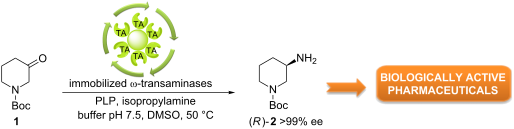
Scheme 1: Transamination reaction of 1-Boc-3-piperidone (1).
Figure 1: Reuse of ATA-025-IMB in five consecutive cycles in the transamination reaction of 1 in batch system...
Figure 2: Reuse of ATA-025-IMB IMB in five consecutive cycles in the transamination reaction of 1 in a flow s...
Beilstein J. Org. Chem. 2018, 14, 3122–3149, doi:10.3762/bjoc.14.292
Graphical Abstract
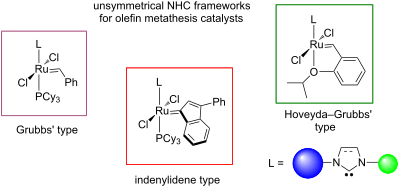
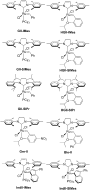
Figure 1: Second-generation Grubbs (GII), Hoveyda (HGII), Grela (Gre-II), Blechert (Ble-II) and indenylidene-...
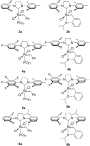
Figure 2: Grubbs (1a) and Hoveyda-type (1b) complexes with N-phenyl, N’-mesityl NHCs.
Figure 3: C–H insertion product 2.
Figure 4: Grubbs (3a–6a) and Hoveyda-type (3b–6b) complexes with N-fluorophenyl, N’-aryl NHCs.
Scheme 1: RCM of diethyl diallylmalonate (7).
Scheme 2: RCM of diethyl allylmethallylmalonate (9).
Scheme 3: RCM of diethyl dimethallylmalonate (11).
Scheme 4: CM of allylbenzene (13) with cis-1,4-diacetoxy-2-butene (14).
Scheme 5: ROMP of 1,5-cyclooctadiene (16).
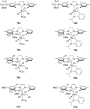
Figure 5: Grubbs (18a–21a) and Hoveyda-type (18b–21b) catalysts bearing uNHCs with a hexafluoroisopropylalkox...
Figure 6: A Grubbs-type complex with an N-adamantyl, N’-mesityl NHC 22 and the Hoveyda-type complex with a ch...
Figure 7: Grubbs (24a and 25a) and Hoveyda-type (24b and 25b) complexes with N-alkyl, N’-mesityl NHCs.
Figure 8: Grubbs-type complexes 31–34 with N-alkyl, N’-mesityl NHCs.
Figure 9: Grubbs-type complex 35 with an N-cyclohexyl, N’-2,6-diisopropylphenyl NHC.
Figure 10: Hoveyda-type complexes with an N-alkyl, N’-mesityl (36, 37) and an N-alkyl, N’-2,6-diisopropylpheny...
Figure 11: Indenylidene-type complexes 41–43 with N-alkyl, N’-mesityl NHCs.
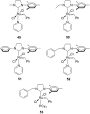
Figure 12: Grubbs-type complex 44 and its monopyridine derivative 45 containing a chiral uNHC.
Scheme 6: Alternating copolymerization of 46 with 47 and 48.
Figure 13: Pyridine-containing complexes 49–52 and Grubbs-type complex 53.
Figure 14: Hoveyda-type complexes 54–58 in the alternating ROMP of NBE (46) and COE (47).
Figure 15: Catalysts 59 and 60 in the tandem RO–RCM of 47.
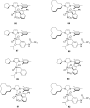
Figure 16: Hoveyda-type complexes 61–69 with N-alkyl, N’-aryl NHCs.
Scheme 7: Ethenolysis of methyl oleate (70).
Scheme 8: AROCM of cis-5-norbornene-endo-2,3-dicarboxylic anhydride (75) with styrene.
Figure 17: Hoveyda-type catalysts 79–82 with N-tert-butyl, N’-aryl NHCs.
Scheme 9: Latent ROMP of 83 with catalyst 82.
Figure 18: Indenylidene and Hoveyda-type complexes 85–92 with N-cycloalkyl, N’-mesityl NHCs.
Scheme 10: RCM of N,N-dimethallyl-N-tosylamide (93) with catalyst 85.
Scheme 11: Self metathesis of 13 with catalyst 85.
Figure 19: Grubbs-type complexes 98–104 with N-alkyl, N’-mesityl NHCs.
Figure 20: Grubbs-type complexes 105–115 with N-alkyl, N’-mesityl ligands.
Figure 21: Complexes 116 and 117 bearing a carbohydrate-based NHC.
Figure 22: Complexes 118 and 119 bearing a hemilabile amino-tethered NHC.
Figure 23: Indenylidene-type complexes 120–126 with N-benzyl, N’-mesityl NHCs.
Scheme 12: Diastereoselective ring-rearrangement metathesis (dRRM) of cyclopentene 131.
Figure 24: Indenylidene-type complexes 134 and 135 with N-nitrobenzyl, N’-mesityl NHCs.
Figure 25: Hoveyda-type complexes 136–138 with N-benzyl, N’-mesityl NHCs.
Figure 26: Hoveyda-type complexes 139–142 with N-benzyl, N’-Dipp NHC.
Figure 27: Indenylidene (143–146) and Hoveyda-type (147) complexes with N-heteroarylmethyl, N’-mesityl NHCs.
Figure 28: Hoveyda-type complexes 148 and 149 with N-phenylpyrrole, N’-mesityl NHCs.
Figure 29: Grubbs-type complexes with N-trifluoromethyl benzimidazolidene NHCs 150–153, 155 and N-isopropyl be...
Scheme 13: Ethenolysis of ethyl oleate 156.
Scheme 14: Ethenolysis of cis-cyclooctene (47).
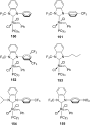
Figure 30: Grubbs-type C1-symmetric (164) and C2-symmetric (165) catalysts with a backbone-substituted NHC.
Figure 31: Possible syn and anti rotational isomers of catalyst 164.
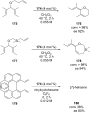
Scheme 15: ARCM of substrates 166, 168 and 170.
Figure 32: Hoveyda (172) and Grubbs-type (173,174) backbone-substituted C1-symmetric NHC complexes.
Scheme 16: ARCM of 175,177 and 179 with catalyst 174.
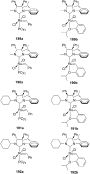
Figure 33: Grubbs-type C1-symmetric NHC catalysts bearing N-propyl (181, 182) or N-benzyl (183, 184) groups on...
Scheme 17: ARCM of 185 and 187 promoted by 184 to form the encumbered alkenes 186 and 188.
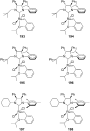
Figure 34: N-Alkyl, N’-isopropylphenyl NHC ruthenium complexes with syn (189, 191) and anti (190, 192) phenyl ...
Figure 35: Hoveyda-type complexes 193–198 bearing N-alkyl, N’-aryl backbone-substituted NHC ligands.
Scheme 18: ARCM of 166 and 199 promoted by 192b.
Figure 36: Enantiopure catalysts 201a and 201b with syn phenyl units on the NHC backbone.
Figure 37: Backbone-monosubstituted catalysts 202–204.
Figure 38: Grubbs (205a) and Hoveyda-type (205b) backbone-monosubstituted catalysts.
Scheme 19: AROCM of 206 with allyltrimethylsilane promoted by catalyst 205a.
Beilstein J. Org. Chem. 2018, 14, 2949–2955, doi:10.3762/bjoc.14.274
Graphical Abstract
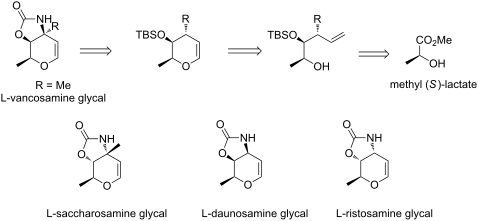
Figure 1: N,N-Dimethyl-L-vancosamine as substructure of kidamycin and pluramycin.
Figure 2: Glycals as relevant scaffolds for constructing aryl C-glycosidic linkage.
Figure 3: Strategy including a ring-closing metathesis of vinyl ethers as key step for the preparation of sev...
Scheme 1: Evans aldol reaction for the preparation of diastereomeric compounds 13a and 13b.
Scheme 2: Alternative preparation of 13b based on a diastereoselective allylboration.
Scheme 3: O-Vinylation-ring-closing metathesis sequence for access to 3-amino glycals.
Scheme 4: Synthesis of key intermediate 23 for the C-3 unbranched amino glycals preparation.
Scheme 5: Access to diastereoisomeric compounds 3 and 4 from 23.
Beilstein J. Org. Chem. 2018, 14, 2384–2393, doi:10.3762/bjoc.14.214
Graphical Abstract
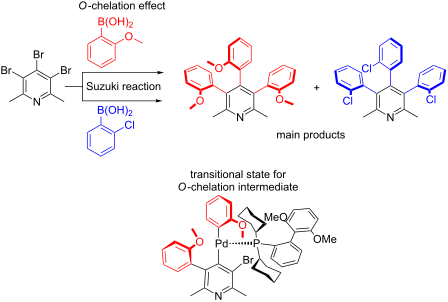
Figure 1: Structures of stereoisomers of 3,4,5-tris(2-methoxyphenyl)-2,6-dimethylpyridines determined by X-ra...
Figure 2: Graphical representation of kinetic, time-dependent 1H NMR analysis of (syn)-7 (100 °C).
Figure 3: Graphical representation of kinetic, time-dependent 1H NMR analysis of (syn)-10 (120 °C).
Figure 4: HT-NMR (300 MHz, DMSO-d6) spectra of A) (syn)-7. B) (syn)-10. Only the upfield (ca. 3.4–4 ppm) regi...
Figure 5: Summary of the results for coupling with ortho-substituted phenylboronic acid for triaryl products.
Figure 6: Summary of results for coupling with ortho-substituted phenylboronic acid for diaryl products.
Figure 7: Proposed intermediates for the 1,2-addition of 5 with methoxy group. A) Oxidative addition step. B)...
Figure 8: Proposed intermediates for the 1,3-addition with methoxy group. A) Oxidative addition step. B) Tran...
Figure 9: Proposed intermediates for the 1,2-addition with chlorine atom. A) Oxidative addition step. B) Tran...
Figure 10: Proposed intermediates for the 1,3-addition with chlorine atom. A) Oxidative addition step. B) Tran...
Beilstein J. Org. Chem. 2018, 14, 2340–2347, doi:10.3762/bjoc.14.209
Graphical Abstract
Scheme 1: Commercial process for the synthesis of 1.
Scheme 2: Previous work about asymmetric synthesis of I-13a.
Scheme 3: Asymmetric synthesis of 1.
Scheme 4: The second strategy for the asymmetric synthesis of 1.
Beilstein J. Org. Chem. 2018, 14, 2308–2312, doi:10.3762/bjoc.14.205
Graphical Abstract
Scheme 1: One-pot synthesis of epoxides from benzyl alcohols and aldehydes.
Figure 1: Scope of the one-pot synthesis of epoxides from benzyl alcohols and aldehydes.
Scheme 2: mCPBA epoxidation of electron-rich stilbene derivatives.
Figure 2: Scope of the reaction with electron-rich alcohols and aldehydes.
Beilstein J. Org. Chem. 2018, 14, 2082–2089, doi:10.3762/bjoc.14.182
Graphical Abstract
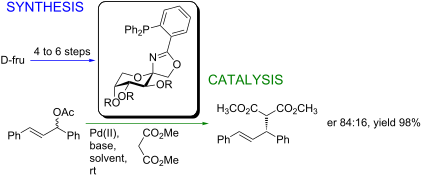
Figure 1: General structure of PHOX ligands 1 and structures of annulated glucosamine-based PHOX and PyOx lig...
Scheme 1: Preparation of 1,2-isopropylidene-protected D-fructose derivatives with different substitution patt...
Scheme 2: Activation of 7 to oxocarbenium ion 9 in the Ritter reaction.
Scheme 3: Zemplén deacetylation of 10i.
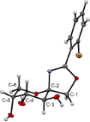
Figure 2: Molecular structure of 10j. Ellipsoids are given at the 50% probability level. Grey = carbon, red =...
Scheme 4: Benzylation of 10j to give 10b.
Scheme 5: Plausible mechanism of the Ritter reaction. For better clarity C-2 is not shown in conformers 9a an...
Scheme 6: Neighboring group participation of ester protective groups. For better clarity C-2 is not shown in ...
Scheme 7: Pd catalyzed Tsuji–Trost reation. BSA: N,O-bis(trimethylsilyl)acetamide, DMM: dimethyl malonate.
Beilstein J. Org. Chem. 2018, 14, 1668–1692, doi:10.3762/bjoc.14.143
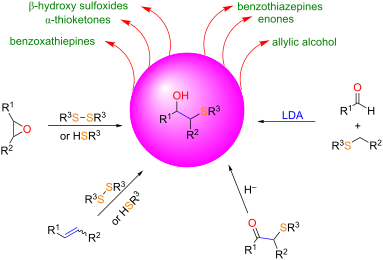
Graphical Abstract
Figure 1: Some sulfur-containing natural products.
Figure 2: Some natural products incorporating β-hydroxy sulfide moieties.
Figure 3: Some synthetic β-hydroxy sulfides of clinical value.
Scheme 1: Alumina-mediated synthesis of β-hydroxy sulfides, ethers, amines and selenides from epoxides.
Scheme 2: β-Hydroxy sulfide syntheses by ring opening of epoxides under different Lewis and Brønsted acid and...
Scheme 3: n-Bu3P-catalyzed thiolysis of epoxides and aziridines to provide the corresponding β-hydroxy and β-...
Scheme 4: Zinc(II) chloride-mediated thiolysis of epoxides.
Scheme 5: Thiolysis of epoxides and one-pot oxidation to β-hydroxy sulfoxides under microwave irradiation.
Scheme 6: Gallium triflate-catalyzed ring opening of epoxides and one-pot oxidation.
Scheme 7: Thiolysis of epoxides and one-pot oxidation to β-hydroxy sulfoxides using Ga(OTf)3 as a catalyst.
Scheme 8: Ring opening of epoxide using ionic liquids under solvent-free conditions.
Scheme 9: N-Bromosuccinimide-catalyzed ring opening of epoxides.
Scheme 10: LiNTf2-mediated epoxide opening by thiophenol.
Scheme 11: Asymmetric ring-opening of cyclohexene oxide with various thiols catalyzed by zinc L-tartrate.
Scheme 12: Catalytic asymmetric ring opening of symmetrical epoxides with t-BuSH catalyzed by (R)-GaLB (43) wi...
Scheme 13: Asymmetric ring opening of meso-epoxides by p-xylenedithiol catalyzed by a (S,S)-(salen)Cr complex.
Scheme 14: Desymmetrization of meso-epoxide with thiophenol derivatives.
Scheme 15: Enantioselective ring-opening reaction of meso-epoxides with ArSH catalyzed by a C2-symmetric chira...
Scheme 16: Enantioselective ring-opening reaction of stilbene oxides with ArSH catalyzed by a C2-symmetric chi...
Scheme 17: Asymmetric desymmetrization of meso-epoxides using BINOL-based Brønsted acid catalysts.
Scheme 18: Lithium-BINOL-phosphate-catalyzed desymmetrization of meso-epoxides with aromatic thiols.
Scheme 19: Ring-opening reactions of cyclohexene oxide with thiols by using CPs 1-Eu and 2-Tb.
Scheme 20: CBS-oxazaborolidine-catalyzed borane reduction of β-keto sulfides.
Scheme 21: Preparation of β-hydroxy sulfides via connectivity.
Scheme 22: Baker’s yeast-catalyzed reduction of sulfenylated β-ketoesters.
Scheme 23: Sodium-mediated ring opening of epoxides.
Scheme 24: Disulfide bond cleavage-epoxide opening assisted by tetrathiomolybdate.
Scheme 25: Proposed reaction mechanism of disulfide bond cleavage-epoxide opening assisted by tetrathiomolybda...
Scheme 26: Cyclodextrin-catalyzed difunctionalization of alkenes.
Scheme 27: Zinc-catalyzed synthesis of β-hydroxy sulfides from disulfides and alkenes.
Scheme 28: tert-Butyl hydroperoxide-catalyzed hydroxysulfurization of alkenes.
Scheme 29: Proposed mechanism of the radical hydroxysulfurization.
Scheme 30: Rongalite-mediated synthesis of β-hydroxy sulfides from styrenes and disulfides.
Scheme 31: Proposed mechanism of Rongalite-mediated synthesis of β-hydroxy sulfides from styrenes and disulfid...
Scheme 32: Copper(II)-catalyzed synthesis of β-hydroxy sulfides 15e,f from alkenes and basic disulfides.
Scheme 33: CuI-catalyzed acetoxysulfenylation of alkenes.
Scheme 34: CuI-catalyzed acetoxysulfenylation reaction mechanism.
Scheme 35: One-pot oxidative 1,2-acetoxysulfenylation of Baylis–Hillman products.
Scheme 36: Proposed mechanism for the oxidative 1,2-acetoxysulfination of Baylis–Hillman products.
Scheme 37: 1,2-Acetoxysulfenylation of alkenes using DIB/KI.
Scheme 38: Proposed reaction mechanism of the diacetoxyiodobenzene (DIB) and KI-mediated 1,2-acetoxysulfenylat...
Scheme 39: Catalytic asymmetric thiofunctionalization of unactivated alkenes.
Scheme 40: Proposed catalytic cycle for asymmetric sulfenofunctionalization.
Scheme 41: Synthesis of thiosugars using intramolecular thiol-ene reaction.
Scheme 42: Synthesis of leukotriene C-1 by Corey et al.: (a) N-(trifluoroacetyl)glutathione dimethyl ester (3 ...
Scheme 43: Synthesis of pteriatoxins with epoxide thiolysis to attain β-hydroxy sulfides. Reagents: (a) (1) K2...
Scheme 44: Synthesis of peptides containing a β-hydroxy sulfide moiety.
Scheme 45: Synthesis of diltiazem (12) using biocatalytic resolution of an epoxide followed by thiolysis.
Beilstein J. Org. Chem. 2018, 14, 1508–1528, doi:10.3762/bjoc.14.128
Graphical Abstract
Scheme 1: Strategies to address the issue of sustainability with polyvalent organoiodine reagents.
Scheme 2: Functionalization of ketones and alkenes with IBX.
Scheme 3: Functionalization of pyrroles with DMP.
Scheme 4: Catalytic benzoyloxy-trifluoromethylation reported by Szabó.
Scheme 5: Catalytic benzoyloxy-trifluoromethylation reported by Mideoka.
Scheme 6: Catalytic 1,4-benzoyloxy-trifluoromethylation of dienes.
Scheme 7: Catalytic benzoyloxy-trifluoromethylation of allylamines.
Scheme 8: Catalytic benzoyloxy-trifluoromethylation of enynes.
Scheme 9: Catalytic benzoyloxy-trifluoromethylation of allenes.
Scheme 10: Alkynylation of N-(aryl)imines with EBX for the formation of furans.
Scheme 11: Catalytic benzoyloxy-alkynylation of diazo compounds.
Scheme 12: Catalytic asymmetric benzoyloxy-alkynylation of diazo compounds.
Scheme 13: Catalytic 1,2-benzoyloxy-azidation of alkenes.
Scheme 14: Catalytic 1,2-benzoyloxy-azidation of enamides.
Scheme 15: Catalytic 1,2-benzoyloxy-iodination of alkenes.
Scheme 16: Seminal study with cyclic diaryl-λ3-iodane.
Scheme 17: Synthesis of alkylidenefluorenes from cyclic diaryl-λ3-iodanes.
Scheme 18: Synthesis of alkyne-substituted alkylidenefluorenes.
Scheme 19: Synthesis of phenanthrenes from cyclic diaryl-λ3-iodanes.
Scheme 20: Synthesis of dibenzocarbazoles from cyclic diaryl-λ3-iodanes.
Scheme 21: Synthesis of triazolophenantridines from cyclic diaryl-λ3-iodanes.
Scheme 22: Synthesis of functionalized benzoxazoles from cyclic diaryl-λ3-iodanes.
Scheme 23: Sequential difunctionalization of cyclic diaryl-λ3-iodanes.
Scheme 24: Double Suzuki–Miyaura coupling reaction of cyclic diaryl-λ3-iodanes.
Scheme 25: Synthesis of a δ-carboline from cyclic diaryl-λ3-iodane.
Scheme 26: Synthesis of N-(aryl)carbazoles from cyclic diaryl-λ3-iodanes.
Scheme 27: Synthesis of carbazoles from cyclic diaryl-λ3-iodanes.
Scheme 28: Synthesis of carbazoles and acridines from cyclic diaryl-λ3-iodanes.
Scheme 29: Synthesis of dibenzothiophenes from cyclic diaryl-λ3-iodanes.
Scheme 30: Synthesis of various sulfur heterocycles from cyclic diaryl-λ3-iodanes.
Scheme 31: Synthesis of dibenzothioheterocycles from cyclic diaryl-λ3-iodanes.
Scheme 32: Synthesis of dibenzosulfides and dibenzoselenides from cyclic diaryl-λ3-iodanes.
Scheme 33: Synthesis of dibenzosulfones from cyclic diaryl-λ3-iodanes.
Scheme 34: Seminal study with linear diaryl-λ3-iodanes.
Scheme 35: N-Arylation of benzotriazole with symmetrical diaryl-λ3-iodanes.
Scheme 36: Tandem catalytic C–H/N–H arylation of indoles with diaryl-λ3-iodanes.
Scheme 37: Tandem N-arylation/C(sp2)–H arylation with diaryl-λ3-iodanes.
Scheme 38: Catalytic intermolecular diarylation of anilines with diaryl-λ3-iodanes.
Scheme 39: Catalytic synthesis of diarylsulfides with diaryl-λ3-iodanes.
Scheme 40: α-Arylation of enolates using [bis(trifluoroacetoxy)iodo]arenes.
Scheme 41: Mechanism of the α-arylation using [bis(trifluoroacetoxy)iodo]arene.
Scheme 42: Catalytic nitrene additions mediated by [bis(acyloxy)iodo]arenes.
Scheme 43: Tandem of C(sp3)–H amination/sila-Sonogashira–Hagihara coupling.
Scheme 44: Tandem reaction using a λ3-iodane as an oxidant, a substrate and a coupling partner.
Scheme 45: Synthesis of 1,2-diarylated acrylamidines with ArI(OAc)2.
Beilstein J. Org. Chem. 2018, 14, 1389–1412, doi:10.3762/bjoc.14.117
Graphical Abstract
Figure 1: Inherently chiral calix[4]arene-based phase-transfer catalysts.
Scheme 1: Asymmetric alkylations of 3 catalyzed by (±)-1 and (±)-2 under phase-transfer conditions.
Scheme 2: Synthesis of chiral calix[4]arene-based phase-transfer catalyst 7 and structure of O’Donnell’s N-be...
Scheme 3: Asymmetric alkylation of glycine derivative 3 catalyzed by calixarene-based phase-transfer catalyst ...
Figure 2: Calix[4]arene-amides used as phase-transfer catalysts.
Scheme 4: Phase-transfer alkylation of 3 catalyzed by calixarene-triamide 12.
Scheme 5: Synthesis of inherently chiral calix[4]arenes 20a/20b substituted at the lower rim. Reaction condit...
Scheme 6: Asymmetric Henry reaction between 21 and 22 catalyzed by 20a/20b.
Figure 3: Proposed transition state model of asymmetric Henry reaction.
Scheme 7: Synthesis of enantiomerically pure phosphinoferrocenyl-substituted calixarene ligands 27–29.
Scheme 8: Asymmetric coupling reaction of aryl boronates and aryl halides in the presence of calixarene mono ...
Scheme 9: Asymmetric allylic alkylation in the presence of calix[4]arene ligand (S,S)-29.
Figure 4: Structure of inherently chiral oxazoline calix[4]arenes applied in the palladium-catalyzed Tsuji–Tr...
Scheme 10: Asymmetric Tsuji–Trost reaction in the presence of calix[4]arene ligands 36–39.
Figure 5: BINOL-derived calix[4]arene-diphosphite ligands.
Scheme 11: Asymmetric hydrogenation of 41a and 41b catalyzed by in situ-generated catalysts comprised of [Rh(C...
Figure 6: Inherently chiral calix[4]arene 43 containing a diarylmethanol structure.
Scheme 12: Asymmetric Michael addition reaction of 44 with 45 catalyzed by 43.
Figure 7: Calix[4]arene-based chiral primary amine–thiourea catalysts.
Scheme 13: Asymmetric Michael addition of 48 with 49 catalyzed by 47a and 47b.
Scheme 14: Enantioselective Michael addition of 51 to 52 catalyzed by calix[4]arene thioureas.
Scheme 15: Synthesis of calix[4]arene-based tertiary amine–thioureas 54–56.
Scheme 16: Asymmetric Michael addition of 34 and 57 to nitroalkenes 49 catalyzed by 54b.
Scheme 17: Synthesis of p-tert-butylcalix[4]arene bis-squaramide derivative 64.
Scheme 18: Asymmetric Michael addition catalyzed by 64.
Scheme 19: Synthesis of chiral p-tert-butylphenol analogue 68.
Figure 8: Novel prolinamide organocatalysts based on the calix[4]arene scaffold.
Scheme 20: Asymmetric aldol reactions of 72 with 70 and 71 catalyzed by 69b.
Scheme 21: Synthesis of p-tert-butylcalix[4]arene-based chiral organocatalysts 75 and 78 derived from L-prolin...
Scheme 22: Synthesis of upper rim-functionalized calix[4]arene-based L-proline derivative 83.
Scheme 23: Synthesis and proposed structure of Calix-Pro-MN (86).
Figure 9: Calix[4]arene-based L-proline catalysts containing ester, amide and acid units.
Scheme 24: Synthesis of calix[4]arene-based prolinamide 92.
Scheme 25: Calixarene-based catalysts for the aldol reaction of 21 with 70.
Scheme 26: Asymmetric aldol reactions of 72 with cyclic ketones catalyzed by calix[4]arene-based chiral organo...
Figure 10: A proposed structure for catalyst 92 in H2O.
Scheme 27: Synthetic route for organocatalyst 98.
Scheme 28: Asymmetric aldol reactions catalyzed by 99.
Figure 11: Proposed catalytic environment for catalyst 99 in the presence of water.
Scheme 29: Asymmetric aldol reactions between 94 and 72 catalyzed by 55a.
Scheme 30: Enantioselective Biginelli reactions catalyzed by 69f.
Scheme 31: Synthesis of calix[4]arene–(salen) complexes.
Scheme 32: Enantioselective epoxidation of 108 catalyzed by 107a/107b.
Scheme 33: Synthesis of inherently chiral calix[4]arene catalysts 111 and 112.
Scheme 34: Enantioselective MPV reduction.
Scheme 35: Synthesis of chiral calix[4]arene ligands 116a–c.
Scheme 36: Asymmetric MPV reduction with chiral calix[4]arene ligands.
Scheme 37: Chiral AlIII–calixarene complexes bearing distally positioned chiral substituents.
Scheme 38: Asymmetric MPV reduction in the presence of chiral calix[4]arene diphosphites.
Scheme 39: Synthesis of enantiomerically pure inherently chiral calix[4]arene phosphonic acid.
Scheme 40: Asymmetric aza-Diels–Alder reactions catalyzed by (cR,pR)-121.
Scheme 41: Asymmetric ring opening of epoxides catalyzed by (cR,pR)-121.
Beilstein J. Org. Chem. 2018, 14, 1349–1369, doi:10.3762/bjoc.14.114
Graphical Abstract
Scheme 1: Mannich reaction of N-Boc-isatin imines with ethyl nitroacetate (2) catalyzed by a cinchona alkaloi...
Scheme 2: Mannich reaction of N-Boc-isatin imines with 1,3-dicarbonyl compounds catalyzed by a cinchona alkal...
Scheme 3: Mannich reaction of N-alkoxycarbonylisatin imines with acetylacetone catalyzed by a cinchona alkalo...
Scheme 4: Mannich reaction of isatin-derived benzhydrylketimines with trimethylsiloxyfuran catalyzed by a pho...
Scheme 5: Mannich reaction of N-Boc-isatin imines with acetaldehyde catalyzed by a primary amine.
Scheme 6: Mannich reaction of N-Cbz-isatin imines with aldehydes catalyzed by L-diphenylprolinol trimethylsil...
Scheme 7: Addition of dimedone-derived enaminones to N-Boc-isatin imines catalyzed by a phosphoric acid.
Scheme 8: Addition of hydroxyfuran-2-one-derived enaminones to N-Boc-isatin imines catalyzed by a phosphoric ...
Scheme 9: Zinc-catalyzed Mannich reaction of N-Boc-isatin imines with silyl ketene imines.
Scheme 10: Tin-catalyzed Mannich reaction of N-arylisatin imines with an alkenyl trichloroacetate.
Scheme 11: Aza-Morita–Baylis–Hillman reaction of N-Boc-isatin imines with acrolein catalyzed by β-isocupreidin...
Scheme 12: Aza-Morita–Baylis–Hillman reaction of N-Boc-isatin imines with acrolein (35) catalyzed by α-isocupr...
Scheme 13: Aza-Morita–Baylis–Hillman reaction of N-Boc-isatin imines with maleimides catalyzed by β-isocupreid...
Scheme 14: Aza-Morita–Baylis–Hillman reaction of N-Boc-isatin imines with nitroolefins catalyzed by a cinchona...
Scheme 15: Friedel–Crafts reactions of N-Boc-isatin imines with 1 and 2-naphthols catalyzed by a cinchona alka...
Scheme 16: Friedel–Crafts reactions of N-alkoxycarbonyl-isatin imines with 1 and 2-naphthols catalyzed by a ci...
Scheme 17: Friedel–Crafts reaction of N-Boc-isatin imines with 6-hydroxyquinolines catalyzed by a cinchona alk...
Scheme 18: Aza-Henry reaction of N-Boc-isatin imines with nitromethane catalyzed by a bifunctional guanidine.
Scheme 19: Domino addition/cyclization reaction of N-Boc-isatin imines with 1,4-dithiane-2,5-diol (53) catalyz...
Scheme 20: Nickel-catalyzed additions of methanol and cumene hydroperoxide to N-Boc-isatin imines.
Scheme 21: Palladium-catalyzed addition of arylboronic acids to N-tert-butylsulfonylisatin imines.
Beilstein J. Org. Chem. 2018, 14, 1244–1262, doi:10.3762/bjoc.14.107
Graphical Abstract
Scheme 1: An overview of different chiral iodine reagents or precursors thereof.
Scheme 2: Asymmetric oxidation of sulfides by chiral hypervalent iodine reagents.
Scheme 3: Oxidative dearomatization of naphthol derivatives by Kita et al.
Scheme 4: [4 + 2] Diels–Alder dimerization reported by Birman et al.
Scheme 5: m-CPBA guided catalytic oxidative naphthol dearomatization.
Scheme 6: Oxidative dearomatization of phenolic derivatives by Ishihara et al.
Scheme 7: Oxidative spirocyclization applying precatalyst 11 developed by Ciufolini et al.
Scheme 8: Asymmetric hydroxylative dearomatization.
Scheme 9: Enantioselective oxylactonization reported by Fujita et al.
Scheme 10: Dioxytosylation of styrene (47) by Wirth et al.
Scheme 11: Oxyarylation and aminoarylation of alkenes.
Scheme 12: Asymmetric diamination of alkenes.
Scheme 13: Stereoselective oxyamination of alkenes reported by Wirth et al.
Scheme 14: Enantioselective and regioselective aminofluorination by Nevado et al.
Scheme 15: Fluorinated difunctionalization reported by Jacobsen et al.
Scheme 16: Aryl rearrangement reported by Wirth et al.
Scheme 17: α-Arylation of β-ketoesters.
Scheme 18: Asymmetric α-oxytosylation of carbonyls.
Scheme 19: Asymmetric α-oxygenation and α-amination of carbonyls reported by Wirth et al.
Scheme 20: Asymmetric α-functionalization of ketophenols using chiral quaternary ammonium (hypo)iodite salt re...
Scheme 21: Oxidative Intramolecular coupling by Gong et al.
Scheme 22: α-Sulfonyl and α-phosphoryl oxylation of ketones reported by Masson et al.
Scheme 23: α-Fluorination of β-keto esters.
Scheme 24: Alkynylation of β-ketoesters and amides catalyzed by phase-transfer catalyst.
Scheme 25: Alkynylation of β-ketoesters and dearomative alkynylation of phenols.
Beilstein J. Org. Chem. 2018, 14, 1120–1180, doi:10.3762/bjoc.14.98
Graphical Abstract
Scheme 1: Tropone (1), tropolone (2) and their resonance structures.
Figure 1: Natural products containing a tropone nucleus.
Figure 2: Possible isomers 11–13 of benzotropone.
Scheme 2: Synthesis of benzotropones 11 and 12.
Scheme 3: Oxidation products of benzotropylium fluoroborate (16).
Scheme 4: Oxidation of 7-bromo-5H-benzo[7]annulene (22).
Scheme 5: Synthesis of 4,5-benzotropone (11) using o-phthalaldehyde (27).
Scheme 6: Synthesis of 4,5-benzotropone (11) starting from oxobenzonorbornadiene 31.
Scheme 7: Acid-catalyzed cleavage of oxo-bridge of 34.
Scheme 8: Synthesis of 4,5-benzotropone (11) from o-xylylene dibromide (38).
Scheme 9: Synthesis of 4,5-benzotropone (11) via the carbene adduct 41.
Scheme 10: Heck coupling strategy for the synthesis of 11.
Scheme 11: Synthesis of benzofulvalenes via carbonyl group of 4,5-benzotropone (11).
Figure 3: Some cycloheptatrienylium cations.
Scheme 12: Synthesis of condensation product 63 and its subsequent oxidative cyclization products.
Figure 4: A novel series of benzo[7]annulenes prepared from 4,5-benzotropone (11).
Scheme 13: Preparation of substituted benzo[7]annulene 72 using the Mukaiyama-Michael reaction.
Figure 5: Possible benzo[7]annulenylidenes 73–75.
Scheme 14: Thermal and photochemical decomposition of 7-diazo-7H-benzo[7]annulene (76) and the trapping of int...
Scheme 15: Synthesis of benzoheptafulvalene 86.
Scheme 16: Synthesis of 7-(diphenylmethylene)-7H-benzo[7]annulene (89).
Scheme 17: Reaction of 4,5-benzotropone (11) with dimethyl diazomethane.
Scheme 18: Synthesis of dihydrobenzomethoxyazocine 103.
Scheme 19: Synthesis and reducibility of benzo-homo-2-methoxyazocines.
Scheme 20: Synthesis of 4,5-benzohomotropones 104 and 115 from 4,5-benzotropones 11 and 113.
Scheme 21: A catalytic deuterogenation of 4,5-benzotropone (11) and synthesis of 5-monosubstituted benzo[7]ann...
Scheme 22: Synthesis of methyl benzo[7]annulenes 131 and 132.
Scheme 23: Ambident reactivity of halobenzo[7]annulenylium cations 133a/b.
Scheme 24: Preparation of benzo[7]annulenylidene–iron complexes 147.
Scheme 25: Synthesis of 1-ethynylbenzotropone (150) and the etheric compound 152 from 4,5-benzotropone (11) wi...
Scheme 26: Thermal decomposition of 4,5-benzotropone (11).
Scheme 27: Reaction of 4,5-benzotropone (11) with 1,2-ethanediol and 1,2-ethanedithiol.
Scheme 28: Conversions of 1-benzosuberone (162) to 2,3-benzotropone (12).
Scheme 29: Synthesis strategies for 2,3-bezotropone (12) using 1-benzosuberones.
Scheme 30: Oxidation-based synthesis of 2,3-benzotropone (12) via 1-benzosuberone (162).
Scheme 31: Synthesis of 2,3-benzotropone (12) from α-tetralone (171) via ring-expansion.
Scheme 32: Preparation of 2,3-benzotropone (12) by using of benzotropolone 174.
Figure 6: Benzoheptafulvenes as condensation products of 2,3-benzotropone (12).
Scheme 33: Conversion of 2,3-benzotropone (12) to tosylhydrazone salt 182 and gem-dichloride 187.
Figure 7: Benzohomoazocines 191–193 and benzoazocines 194–197.
Scheme 34: From 2,3-benzotropone (12) to carbonium ions 198–201.
Scheme 35: Cycloaddition reactions of 2,3-benzotropone (12).
Scheme 36: Reaction of 2,3-benzotropone (12) with various reagents and compounds.
Figure 8: 3,4-Benzotropone (13) and its resonance structure.
Scheme 37: Synthesis of 6,7-benzobicyclo[3.2.0]hepta-3,6-dien-2-one (230).
Figure 9: Photolysis and thermolysis products of 230.
Figure 10: Benzotropolones and their tautomeric structures.
Scheme 38: Synthesis strategies of 4,5-benzotropolone (238).
Scheme 39: Synthesis protocol for 2-hydroxy-4,5-benzotropone (238) using oxazole-benzo[7]annulene 247.
Figure 11: Some quinoxaline and pyrazine derivatives 254–256 prepared from 4,5-benzotropolone (238).
Scheme 40: Nitration product of 4,5-benzotropolone (238) and its isomerization to 1-nitro-naphthoic acid (259)....
Scheme 41: Synthesis protocol for 6-hydroxy-2,3-benzotropone (239) from benzosuberone (162).
Scheme 42: Various reactions via 6-hydroxy-2,3-benzotropone (239).
Scheme 43: Photoreaction of 6-hydroxy-2,3-benzotropone (239).
Scheme 44: Synthesis of 7-hydroxy-2,3-benzotropone (241) from benzosuberone (162).
Scheme 45: Synthesis strategy for 7-hydroxy-2,3-benzotropone (241) from ketone 276.
Scheme 46: Synthesis of 7-hydroxy-2,3-benzotropone (241) from β-naphthoquinone (280).
Scheme 47: Synthesis of 7-hydroxy-2,3-benzotropone (241) from bicyclic endoperoxide 213.
Scheme 48: Synthesis of 7-hydroxy-2,3-benzotropone (241) by ring-closing metathesis.
Figure 12: Various monosubstitution products 289–291 of 7-hydroxy-2,3-benzotropone (241).
Scheme 49: Reaction of 7-hydroxy-2,3-benzotropone (241) with various reagents.
Scheme 50: Synthesis of 4-hydroxy-2,3-benzotropones 174 and 304 from diketones 300/301.
Scheme 51: Catalytic hydrogenation of diketones 300 and 174.
Scheme 52: Synthesis of halo-benzotropones from alkoxy-naphthalenes 306, 307 and 310.
Figure 13: Unexpected byproducts 313–315 during synthesis of chlorobenzotropone 309.
Figure 14: Some halobenzotropones and their cycloadducts.
Scheme 53: Multisep synthesis of 2-chlorobenzotropone 309.
Scheme 54: A multistep synthesis of 2-bromo-benzotropone 26.
Scheme 55: A multistep synthesis of bromo-2,3-benzotropones 311 and 316.
Scheme 56: Oxidation reactions of 8-bromo-5H-benzo[7]annulene (329) with some oxidants.
Scheme 57: Synthesis of 2-bromo-4,5-benzotropone (26).
Scheme 58: Synthesis of 6-chloro-2,3-benzotropone (335) using LiCl and proposed intermediate 336.
Scheme 59: Reaction of 7-bromo-2,3-benzotropone (316) with methylamine.
Scheme 60: Reactions of bromo-2,3-benzotropones 26 and 311 with dimethylamine.
Scheme 61: Reactions of bromobenzotropones 311 and 26 with NaOMe.
Scheme 62: Reactions of bromobenzotropones 26 and 312 with t-BuOK in the presence of DPIBF.
Scheme 63: Cobalt-catalyzed reductive cross-couplings of 7-bromo-2,3-benzotropone (316) with cyclic α-bromo en...
Figure 15: Cycloadduct 357 and its di-π-methane rearrangement product 358.
Scheme 64: Catalytic hydrogenation of 2-chloro-4,5-benzotropone (311).
Scheme 65: Synthesis of dibromo-benzotropones from benzotropones.
Scheme 66: Bromination/dehydrobromination of benzosuberone (162).
Scheme 67: Some transformations of isomeric dibromo-benzotropones 261A/B.
Scheme 68: Transformations of benzotropolone 239B to halobenzotropolones 369–371.
Figure 16: Bromobenzotropolones 372–376 and 290 prepared via bromination/dehydrobromination strategy.
Scheme 69: Synthesis of some halobenzotropolones 289, 377 and 378.
Figure 17: Bromo-chloro-derivatives 379–381 prepared via chlorination.
Scheme 70: Synthesis of 7-iodo-3,4-benzotropolone (382).
Scheme 71: Hydrogenation of bromobenzotropolones 369 and 370.
Scheme 72: Debromination reactions of mono- and dibromides 290 and 375.
Figure 18: Nitratation and oxidation products of some halobenzotropolenes.
Scheme 73: Azo-coupling reactions of some halobenzotropolones 294, 375 and 378.
Figure 19: Four possible isomers of dibenzotropones 396–399.
Figure 20: Resonance structures of tribenzotropone (400).
Scheme 74: Two synthetic pathways for tribenzotropone (400).
Scheme 75: Synthesis of tribenzotropone (400) from dibenzotropone 399.
Scheme 76: Synthesis of tribenzotropone (400) from 9,10-phenanthraquinone (406).
Scheme 77: Synthesis of tribenzotropone (400) from trifluoromethyl-substituted arene 411.
Figure 21: Dibenzosuberone (414).
Figure 22: Reduction products 415 and 416 of tribenzotropone (400).
Figure 23: Structures of tribenzotropone dimethyl ketal 417 and 4-phenylfluorenone (412) and proposed intermed...
Figure 24: Structures of benzylidene- and methylene-9H-tribenzo[a,c,e][7]annulenes 419 and 420 and chiral phos...
Figure 25: Structures of tetracyclic alcohol 422, p-quinone methide 423 and cation 424.
Figure 26: Structures of host molecules 425–427.
Scheme 78: Synthesis of non-helical overcrowded derivatives syn/anti-431.
Figure 27: Hexabenzooctalene 432.
Figure 28: Structures of possible eight isomers 433–440 of naphthotropone.
Scheme 79: Synthesis of naphthotropone 437 starting from 1-phenylcycloheptene (441).
Scheme 80: Synthesis of 10-hydroxy-11H-cyclohepta[a]naphthalen-11-one (448) from diester 445.
Scheme 81: Synthesis of naphthotropone 433.
Scheme 82: Synthesis of naphthotropones 433 and 434 via cycloaddition reaction.
Scheme 83: Synthesis of naphthotropone 434 starting from 452.
Figure 29: Structures of tricarbonyl(tropone)irons 458, and possible cycloadducts 459.
Scheme 84: Synthesis of naphthotropone 436.
Scheme 85: Synthesis of precursor 465 for naphthotropone 435.
Scheme 86: Generation of naphthotropone 435 from 465.
Figure 30: Structures of tropylium cations 469 and 470.
Figure 31: Structures of tropylium ions 471+.BF4−, 472+.BF4−, and 473+.BF4−.
Scheme 87: Synthesis of tropylium ions 471+.BF4− and 479+.ClO4−.
Scheme 88: Synthesis of 1- and 2-methylanthracene (481 and 482) via carbene–carbene rearrangement.
Figure 32: Trapping products 488–490.
Scheme 89: Generation and chemistry of a naphthoannelated cycloheptatrienylidene-cycloheptatetraene intermedia...
Scheme 90: Proposed intermediates and reaction pathways for adduct 498.
Scheme 91: Exited-state intramolecular proton transfer of 505.
Figure 33: Benzoditropones 506 and 507.
Scheme 92: Synthesis of benzoditropone 506e.
Scheme 93: Synthetic approaches for dibenzotropone 507 via tropone (1).
Scheme 94: Formation mechanisms of benzoditropone 507 and 516 via 515.
Scheme 95: Synthesis of benzoditropones 525 and 526 from pyromellitic dianhydride (527).
Figure 34: Possible three benzocyclobutatropones 534–536.
Scheme 96: Synthesis of benzocyclobutatropones 534 and 539.
Scheme 97: Synthesis attempts for benzocyclobutatropone 545.
Scheme 98: Generation and trapping of symmetric benzocyclobutatropone 536.
Scheme 99: Synthesis of chloro-benzocyclobutatropone 552 and proposed mechanism of fluorenone derivatives.
Scheme 100: Synthesis of tropolone analogue 559.
Scheme 101: Synthesis of tropolones 561 and 562.
Figure 35: o/p-Tropoquinone rings (563 and 564) and benzotropoquinones (565–567).
Scheme 102: Synthesis of benzotropoquinone 566.
Scheme 103: Synthesis of benzotropoquinone 567 via a Diels–Alder reaction.
Figure 36: Products 575–577 through 1,2,3-benzotropoquinone hydrate 569.
Scheme 104: Structures 578–582 prepared from tropoquinone 567.
Figure 37: Two possible structures 583 and 584 for dibenzotropoquinone, and precursor compound 585 for 583.
Scheme 105: Synthesis of saddle-shaped ketone 592 using dibenzotropoquinone 584.
Beilstein J. Org. Chem. 2018, 14, 856–860, doi:10.3762/bjoc.14.71
Graphical Abstract
Figure 1: Four possible isomers reachable through the presented approach.
Scheme 1: Sharpless epoxidation to gain D-galacto- 5a and L-galacto-configured epoxythreitol 5b.
Scheme 2: Reagents and conditions: a) i) (COCl)2, DMSO, Et3N, DCM, ii) triethyl phosphonoacetate, NaH, DCM; b...
Scheme 3: Proposed mechanism of the Pd-catalyzed azide substitution of 6a in protic solvent.
Scheme 4: Approach towards peracetylated D-IdoNAc 2c, reactions and conditions: a) Ti(OiPr)4, t-BuOOH, D-DET,...
Beilstein J. Org. Chem. 2018, 14, 593–602, doi:10.3762/bjoc.14.46
Graphical Abstract
Figure 1: Examples of synthetic pharmacologically active chiral 3-substituted isoindolinones.
Scheme 1: Retrosynthetic analysis of NH free chiral 3-substituted isoindolinones (3S)-1 and (3S)-2.
Scheme 2: Synthesis of parent benzamides 6–8.
Figure 2: Esters 12a–e, 13 prepared, isolated yield.
Figure 3: Benzamides 6a–d, 7a–e, 8 prepared, isolated yield.
Figure 4: Phase transfer catalysts (PTC) used in this study.
Scheme 3: Synthesis of isoindolinones 3a–d, 4a–e, 5; isolated yield, de by HPLC and 1H NMR. aAfter flash chro...
Scheme 4: Removal of the chiral auxiliary. Synthesis of isoindolinones 1a–c, 1e, 2; isolated yield, ee by HPL...
Figure 5: ORTEP plot of isoindolinone (2R,3S)-3a (CCDC 1590565) [68].
Scheme 5: Synthesis of pazinaclone analogue (3S)-27.
Beilstein J. Org. Chem. 2018, 14, 576–582, doi:10.3762/bjoc.14.44
Graphical Abstract
Scheme 1: Synthesis of chiral α-fluoroalkylated tertiary alcohols.
Scheme 2: Scope of fluoroalkylated pyruvates. Yields were determined by 19F NMR analysis using benzotrifluori...
Scheme 3: Catalytic asymmetric methylation of the simple perfluoroalkylated ketone 3a. Yields were determined...
Beilstein J. Org. Chem. 2018, 14, 325–344, doi:10.3762/bjoc.14.21
Graphical Abstract
Scheme 1: Reformatsky-type reaction.
Scheme 2: First total synthesis of prunustatin A based on a Zn-mediated Reformatsky reaction [17].
Scheme 3: Synthesis of a γ-hydroxylysine derivative through a Zn-mediated nitrile Reformatsky-type reaction [18].
Scheme 4: Synthesis of apratoxin E and its C30 epimer through a Zn-mediated Reformatsky reaction. Fmoc = 9-fl...
Scheme 5: Synthesis of the eastern fragment of jatrophane diterpene Pl-3 through a SmI2-mediated Reformatsky ...
Scheme 6: First total synthesis of prebiscibactin through a SmI2-mediated Reformatsky reaction. Boc = tert-bu...
Scheme 7: Synthesis of prostaglandin E2 methyl ester through a SmI2-mediated Reformatsky reaction [23].
Scheme 8: Synthesis of the C1–C11 fragment of tedanolide C through a SnCl2-mediated Reformatsky reaction. PMB...
Scheme 9: Synthesis of β-trifluoromethyl β-(N-tert-butylsulfinyl)amino esters exhibiting a quaternary stereoc...
Scheme 10: Synthesis of α,α-difluoro-β-(N-tert-butylsulfinyl)amino esters through Zn(II)-mediated aza-Reformat...
Scheme 11: Synthesis of a common fragment to anti-apoptotic protein inhibitors through a Zn-mediated aza-Refor...
Scheme 12: Synthesis of α,α-difluoro-β-(N-tert-butylsulfinyl)amino ketones through a Zn-mediated aza-Reformats...
Scheme 13: Synthesis of (2-oxoindolin-3-yl)amino esters through a Zn-mediated aza-Reformatsky reaction [30].
Scheme 14: Synthesis of a precursor of sacubitril through a Zn-mediated aza-Reformatsky reaction [31].
Scheme 15: Synthesis of epothilone D through a Cr(II)-mediated Reformatsky reaction. TFA = trifluoroacetic aci...
Scheme 16: Synthesis of β-hydroxy-α-methyl-δ-trichloromethyl-δ-valerolactone through a Sm(II)- or Yb(II)-media...
Scheme 17: Synthesis of cebulactam A1 through a Sm(II)-mediated Reformatsky reaction. MOM = methoxymethyl [34].
Scheme 18: Synthesis of ansamacrolactams (+)-Q-1047H-A-A and (+)-Q-1047H-R-A through a Sm(II)-mediated Reforma...
Scheme 19: Reformatsky reaction of aldehydes with ethyl iodoacetate in the presence of a chiral 1,2-amino alco...
Scheme 20: Reformatsky reaction of aldehydes with ethyl bromoacetate in the presence of a chiral amide ligand [44]....
Scheme 21: Reformatsky reaction of cinnamaldehyde with ethyl bromozinc-α,α-difluoroacetate in the presence of ...
Scheme 22: Reformatsky reaction of aldehydes with an enolate equivalent prepared from phenyl isocyanate and CH2...
Scheme 23: Domino aza-Reformatsky/cyclization reactions of imines with ethyl dibromofluoroacetate in the prese...
Scheme 24: Domino aza-Reformatsky/cyclization reactions of imines with ethyl bromodifluoroacetate in the prese...
Scheme 25: Aza-Reformatsky reactions of cyclic imines with ethyl iodoacetate in the presence of a chiral diary...
Scheme 26: Mechanism for aza-Reformatsky reaction of cyclic imines with ethyl iodoacetate in the presence of a...
Scheme 27: Aza-Reformatsky reaction of dibenzo[b,f][1,4]oxazepines and dibenzo[b,f][1,4]thiazepine with ethyl ...