


Search results
Search for "chiral HPLC" in Full Text gives 125 result(s) in Beilstein Journal of Organic Chemistry.
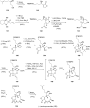
Synthesis of Xenia diterpenoids and related metabolites isolated from marine organisms
Beilstein J. Org. Chem. 2015, 11, 2521–2539, doi:10.3762/bjoc.11.273
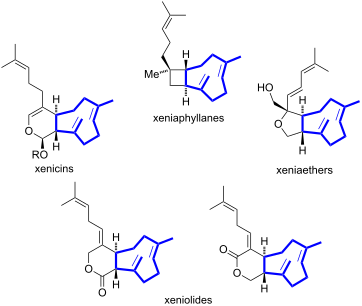
- acetylide to the carbonyl group of 69, followed by desilylation under basic conditions gave rise to (±)-ethynylcarbinol, which was separated by chiral HPLC. The desired diastereomer was then transformed to benzene sulfinate ester 70. A palladium-catalyzed [2,3]-sigmatropic rearrangement formed an isomeric







Synthesis of racemic and chiral BEDT-TTF derivatives possessing hydroxy groups and their achiral and chiral charge transfer complexes
Beilstein J. Org. Chem. 2015, 11, 1561–1569, doi:10.3762/bjoc.11.172
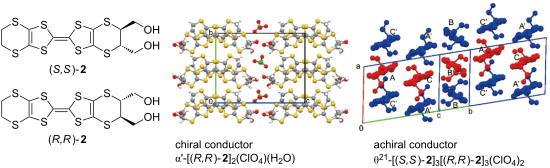
- of enatiopure donors 1 and the preparations of their charge transfer complexes are under way. Moreover, enantiopure (S,S)-2 and (R,R)-2 were also synthesized as shown in Scheme 2. Chiral HPLC was performed using a JAIGEL-OA7500 column on a JAI LC-908 recycling preparative system using the solvent


The enantioselective synthesis of (S)-(+)-mianserin and (S)-(+)-epinastine
Beilstein J. Org. Chem. 2015, 11, 1509–1513, doi:10.3762/bjoc.11.164

- , desmethylmianserin (10) was obtained in 81% yield by reduction of the carbonyl groups using a 1.0 M solution of lithium aluminum hydride in THF. Finally, the reaction between derivative 10 and methyl iodide led to optical pure (S)-(+)-mianserin (1) (as confirmed by chiral HPLC) in 67% yield. In order to obtain


Chiroptical properties of 1,3-diphenylallene-anchored tetrathiafulvalene and its polymer synthesis
Beilstein J. Org. Chem. 2015, 11, 972–979, doi:10.3762/bjoc.11.109
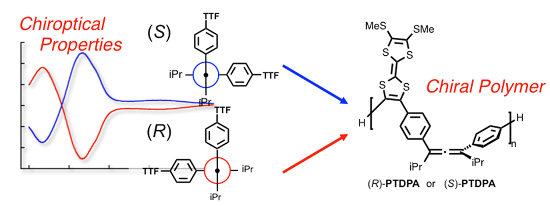
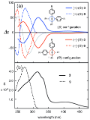
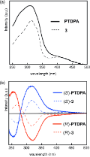
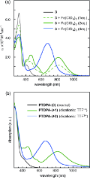
- of 3. Synthesis of chiral (R)-PTDPA and (S)-PTDPA. Redox potentials of 3 and PTDPA.a Absorption maxima of 3, 10 and PTDPA.a Supporting Information Supporting Information File 216: Experimental procedures, characterization data, copies of 1H and 13C NMR charts, recyclable chiral HPLC chart and DFT




First chemoenzymatic stereodivergent synthesis of both enantiomers of promethazine and ethopropazine
Beilstein J. Org. Chem. 2014, 10, 3038–3055, doi:10.3762/bjoc.10.322

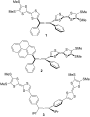
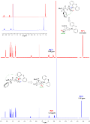
- subsequently followed by chiral HPLC. As a first attempt, Novozym 435-catalyzed KR of racemic alcohol (±)-3 was carried out (Table 1, entries 1–6). After series of experiments, the influence of various co-solvents could be summarized as the following row orders in terms of enzyme activity: pentane > n-hexane
- and the enantiomeric elution order from chiral HPLC, which were opposite to those corresponding to the appropriate products obtained when toluene was applied as a solvent (see Supporting Information File 1). This phenomenon was also confirmed by isolation of byproducts characteristic for this reaction




Preparation of neuroprotective condensed 1,4-benzoxazepines by regio- and diastereoselective domino Knoevenagel–[1,5]-hydride shift cyclization reaction
Beilstein J. Org. Chem. 2014, 10, 2594–2602, doi:10.3762/bjoc.10.272

- iminium carbon of intermediate A occurred with trans-diastereoselectivity to the C-2 phenyl group. The formation of the diastereomeric cis-7a,b could not be detected. The chiral HPLC analysis of the products 7a,b also confirmed that the reaction took place diastereoselectively and enantiomers of trans-7a
- uncorrected. The NMR spectra were recorded on Bruker-AMX 500 (1H: 500 MHz; 13C: 125 MHz) and Bruker Avance II 400 (1H: 400 MHz; 13C: 100 MHz) spectrometers using TMS as internal standard. Chemical shifts were reported as δ in ppm and 3JH,H coupling constants in Hz. Chiral HPLC separation of 7a,b were


Oligomerization of optically active N-(4-hydroxyphenyl)mandelamide in the presence of β-cyclodextrin and the minor role of chirality
Beilstein J. Org. Chem. 2014, 10, 2361–2366, doi:10.3762/bjoc.10.246

- conversion of the enantiomers of 1 during the enzymatic oligomerization has been studied using chiral HPLC. Accordingly, the racemate of 1 was oligomerized three times with each enzyme in the absence of RAMEB-CD or in the presence of RAMEB-CD, respectively to evaluate the reproducibility. The isolated


Atherton–Todd reaction: mechanism, scope and applications
Beilstein J. Org. Chem. 2014, 10, 1166–1196, doi:10.3762/bjoc.10.117

- chiral HPLC or CPG. In a recent study, Montchamp et al. used the AT reaction for the determination of the ee of P-chiral H-phosphinates by the formation of diastereoisomers (Scheme 33) [108]. The ee determined by this method, which can be achieved directly in the NMR tube before recording 31P NMR spectra
- , was consistent with those determined by other methods (e.g., chiral HPLC). 4.2 Flame retardants Since the early age of the development of synthetic fibers, the production of flame retardants became an industrial and academic challenge aiming to identify efficient compounds for this purpose but also to




Stereocontrolled synthesis of 5-azaspiro[2.3]hexane derivatives as conformationally “frozen” analogues of L-glutamic acid
Beilstein J. Org. Chem. 2014, 10, 1114–1120, doi:10.3762/bjoc.10.110
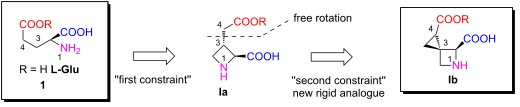
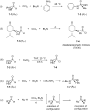
- intermediate 16. The two most abundant diastereoisomers were isolated in pure form by semi-preparative chiral HPLC and their stereochemistry was elucidated by NOE studies [40]. In principle, as shown in Figure 2, the attack of the carbene intermediate to the olefin moiety 18 can occur at both the re and si


Preparation of phosphines through C–P bond formation
Beilstein J. Org. Chem. 2014, 10, 1064–1096, doi:10.3762/bjoc.10.106
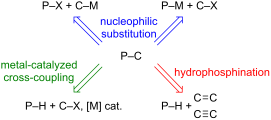
- alkenylphosphine 81c was formed. The highest enantiomeric excess measured by chiral HPLC was 56%. No reaction was observed without the palladium catalyst [165]. Gillaizeau and co-workers have demonstrated the use of α-amido enol phosphates 88 as vinylic coupling partners in the palladium-catalyzed C–P cross


Silver and gold-catalyzed multicomponent reactions
Beilstein J. Org. Chem. 2014, 10, 481–513, doi:10.3762/bjoc.10.46
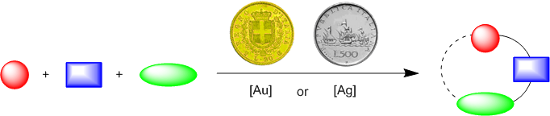
- nonsymmetric ketones. Moreover, an optical active compound could be generated during the reaction process since a chiral catalyst (proline) is used in the reactions. However, enantioselectivity was not observed by chiral HPLC analysis, and 3-pentanone gives rise to a mixture of diastereoisomers. Following this


Organocatalytic asymmetric fluorination of α-chloroaldehydes involving kinetic resolution
Beilstein J. Org. Chem. 2014, 10, 323–331, doi:10.3762/bjoc.10.30
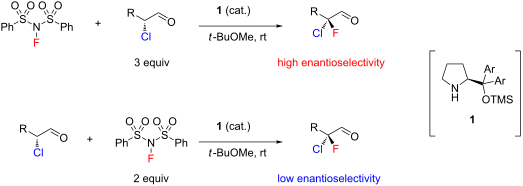
- was converted via the Barton–McCombie deoxygenation [13] into a simple ester 10, which was then reduced to the primary alcohol 4a by treatment with LiAlH4. Comparison of the optical rotations and retention times on chiral HPLC clearly showed that the asymmetric fluorination of 2a catalyzed by (S)-1


New hydrogen-bonding organocatalysts: Chiral cyclophosphazanes and phosphorus amides as catalysts for asymmetric Michael additions
Beilstein J. Org. Chem. 2014, 10, 224–236, doi:10.3762/bjoc.10.18
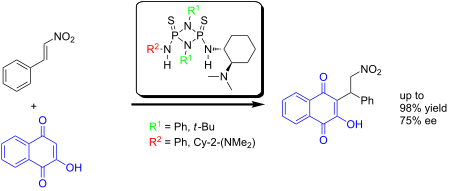
- recorded on Bruker Avance (300, 400, 500 and 600 MHz) instruments. High resolution mass spectra were conducted at the mass spectrometry facility of the Institute for Organic Chemistry of the University of Cologne. Enantiomeric excess was determined by chiral HPLC. We employed the LaChrom elite unit by


Total synthesis of (+)-grandiamide D, dasyclamide and gigantamide A from a Baylis–Hillman adduct: A unified biomimetic approach
Beilstein J. Org. Chem. 2014, 10, 127–133, doi:10.3762/bjoc.10.9
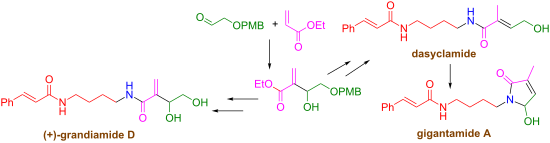
- enantiopure ester (+)-16 in 71% yield, after purification (Scheme 4). Chiral HPLC analysis of (+)-16 showed that the enantiomeric ratio is 99.7:0.3 in favour of the (+)-isomer. Further chemistry was carried out as described earlier in Scheme 3, to get (+)-grandiamide D (5) in almost the same yield. The
- enantiomeric purity of (+)-grandiamide D (5) was found to be 98.6%, as determined from chiral HPLC analysis. (observed [α]D25 = +4.7 (c 0.5, CHCl3); reported [7] [α]D20 = +2.0 (c 0.5, CHCl3). Synthesis of dasyclamide Since Baylis–Hillman adduct (±)-18 was considered as the common intermediate, we decided to
- synthetic product. The overall yield for the synthetic route was found to be 2.3%. Chiral HPLC analysis revealed that it is a racemic compound which was further confirmed by the optical rotation ([α]D23= 0 (c, 0.5, CHCl3); reported for the enatio-pure compound: [α]D20= −10 (c, 0.3, CHCl3)). Further attempt


Efficient synthesis of dihydropyrimidinones via a three-component Biginelli-type reaction of urea, alkylaldehyde and arylaldehyde
Beilstein J. Org. Chem. 2013, 9, 2846–2851, doi:10.3762/bjoc.9.320
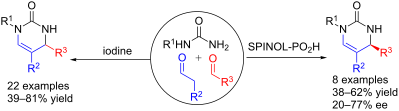
- crystal structure of 4a. Scope of the enantioselective reaction. Reaction conditions: 5a (10 mol %, 0.02 mmol), 1 (0.2 mmol), 2 (0.2 mmol), 3 (0.3 mmol), MS 4 Å (0.1 g), toluene (1 mL), rt, 2 days. Isolated Yields were given. The ee’s were determined by chiral HPLC. Possible mechanism. Optimization of


Multigramme synthesis and asymmetric dihydroxylation of a 4-fluorobut-2E-enoate
Beilstein J. Org. Chem. 2013, 9, 2660–2668, doi:10.3762/bjoc.9.301
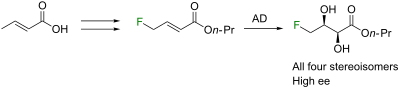
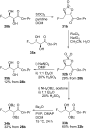
- oxidation (catalytic osmium tetroxide, NMO aqueous t-BuOH, 83%) of 25 to avoid ambiguity, and converted to the dibenzoate 29c (not shown, 80%) as described above. The dibenzoates were purified by flash chromatography then examined by chiral HPLC (Chiralcel OD, 2% iPrOH in hexane). The separation of the
- enantiomers 29a and 29b was excellent, with over 6 minutes separating the stereoisomers in the chromatograms. Due to the robust nature of the dibenzoylation chemistry and the excellent chromatograms produced, the derivatisation/chiral HPLC assay was used routinely. However, direct measurement of the ee's of
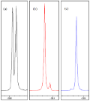
- 13C NMR spectra). Attempts to use RI detection in the chiral HPLC were no more successful. A new analytical method was therefore sought which would allow the ee’s of the diols to be measured quickly and directly using 19F{1H} NMR, avoiding the introduction of additional synthetic steps. The




An overview of the synthetic routes to the best selling drugs containing 6-membered heterocycles
Beilstein J. Org. Chem. 2013, 9, 2265–2319, doi:10.3762/bjoc.9.265
- (S)-enantiomer of compound 2.81 can be isolated in greater than 99% ee and 93% overall yield. This approach is certainly superior to the original separation of the two enantiomers (at the stage of the final product) by preparative chiral HPLC that was used in the discovery route (albeit it should be


Synthesis of axially chiral gold complexes and their applications in asymmetric catalyses
Beilstein J. Org. Chem. 2013, 9, 2224–2232, doi:10.3762/bjoc.9.261
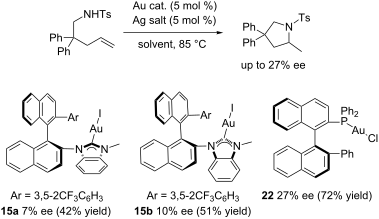
- stirred at 85 °C for 36 h. Column chromatography of the reaction mixture gave the desired product. The enantiomeric purity of the product was determined by chiral HPLC analysis. Compound 25: 1H NMR (400 MHz, CDCl3, TMS) δ 7.61 (d, J = 8.0 Hz, 2H, ArH), 7.27–7.09 (m, 12H, ArH), 4.17 (d, J = 10.4 Hz, 1H



Synthesis of enantiomerically pure N-(2,3-dihydroxypropyl)arylamides via oxidative esterification
Beilstein J. Org. Chem. 2013, 9, 2129–2136, doi:10.3762/bjoc.9.250

- purifications and showed a chiral HPLC purity of 100% with retention of configuration. Conclusion A highly enantioselective synthesis of (S) and (R)-isomers of N-(2,3-dihydroxypropyl)arylamides was developed with high overall yields. We report the nitrogen heterocyclic carbene catalyzed enantioselective ring


Synthesis of the calcilytic ligand NPS 2143
Beilstein J. Org. Chem. 2013, 9, 1383–1387, doi:10.3762/bjoc.9.154

- optical purity (er > 99:1) as demonstrated by chiral HPLC and the pharmacological profile for (R)-3 is in full accordance with that reported in the literature. Keywords: epoxides; GPCR; NPS 2143; nucleophilic aromatic substitution; pyrylium chemistry; Introduction The first G-protein-coupled receptors
- yield after aqueous work-up. With compounds 4 and 6 in hand we turned our attention to the synthesis of the remaining building block 5 (Scheme 4). In order to accurately determine the optical purity of the target molecule (R)-3 by chiral HPLC, we performed the synthesis of racemic rac-3 and optically
- . Fortunately, the side product could be removed by recrystallization of the hydrochloric salt of 3 to produce 3·HCl of excellent purity and in good overall yield. Analysis of optical purity by chiral HPLC showed that (R)-3 was of excellent purity with an er > 99:1 (Figure 2). Pharmacological testing of (R)-3


Preparation of optically active bicyclodihydrosiloles by a radical cascade reaction
Beilstein J. Org. Chem. 2013, 9, 1326–1332, doi:10.3762/bjoc.9.149
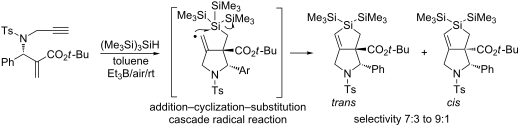
- . Dihydrosiloles 2c–2j were isolated in good yields from other precursors in a trans-selective manner (Table 2, entries 2–9). Their diastereomeric ratios ranged from 9/1 to 7/3. Although we could not determine the enantiomeric excesses for some compounds of 2 because of insufficient separation by chiral HPLC


Exploration of an epoxidation–ring-opening strategy for the synthesis of lyconadin A and discovery of an unexpected Payne rearrangement
Beilstein J. Org. Chem. 2013, 9, 1179–1184, doi:10.3762/bjoc.9.132
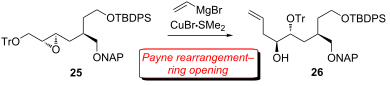
- % overall yield from 22. Notably, the high (94%) ee of 24 as established by chiral HPLC analysis demonstrated that the Myers alkylation of 20 had proceeded with excellent diastereoselectivity. Then, we were pleased to find that Shi epoxidation of 24 provided 25 in reasonable (72%) yield and high (>95:5) dr


Cascade radical reaction of substrates with a carbon–carbon triple bond as a radical acceptor
Beilstein J. Org. Chem. 2013, 9, 1148–1155, doi:10.3762/bjoc.9.128
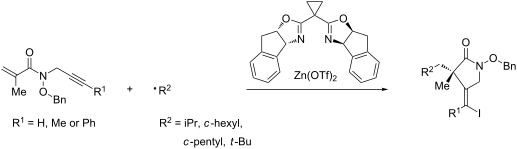
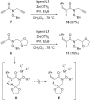
- –allylation of hydroxamate esters 3A–C having an acryloyl moiety (Scheme 1). The reactions were evaluated in CH2Cl2 at −78 °C by employing isopropyl iodide, allyltin reagent, and Et3B as a radical initiator. The enantiomeric purities of products were checked by chiral HPLC analysis. The effect of the




A versatile and efficient approach for the synthesis of chiral 1,3-nitroamines and 1,3-diamines via conjugate addition to new (S,E)-γ-aminated nitroalkenes derived from L-α-amino acids
Beilstein J. Org. Chem. 2013, 9, 832–837, doi:10.3762/bjoc.9.95

- freezer or even at room temperature for several months without decomposition occurring. In order to verify the enantiomeric purity of the new nitroalkenes 2a–c and to confirm their stereochemical stability, a chiral HPLC analysis was conducted. Racemic (+/−)-2b was synthesized from (D/L)-phenylalanine by
- reduced to the corresponding chiral 2-substituted-1,3-diamines 14a,b, the present route constitutes a versatile access to these important classes of substances in high yields. Chiral HPLC analysis: Chiralpak AD-H; n-hexane/2-propanol 99:1 (0.6 mL/min), T = 25 °C; UV–vis detection at λ = 254 nm; retention


Synthesis of skeletally diverse alkaloid-like molecules: exploitation of metathesis substrates assembled from triplets of building blocks
Beilstein J. Org. Chem. 2013, 9, 775–785, doi:10.3762/bjoc.9.88
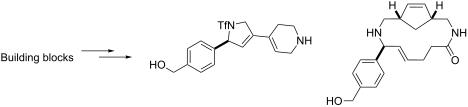
- enriched samples (prepared from the commercially available amino acid). Analysis by chiral HPLC indicated that the amino alcohol 23 had (R)-configuration. It was concluded that the sense of diastereoselectivity in the addition 21 → 22 contrasted with that reported by Ellman [21]. However, the sense of





