Search results
Search for "conjugation" in Full Text gives 446 result(s) in Beilstein Journal of Organic Chemistry. Showing first 200.
Synthesis, structure, and properties of switchable cross-conjugated 1,4-diaryl-1,3-butadiynes based on 1,8-bis(dimethylamino)naphthalene
Beilstein J. Org. Chem. 2023, 19, 674–686, doi:10.3762/bjoc.19.49
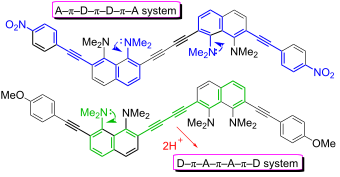
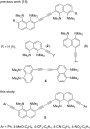
- two 7-(arylethynyl)-1,8-bis(dimethylamino)naphthalene fragments was prepared via the Glaser–Hay oxidative dimerization of 2-ethynyl-7-(arylethynyl)-1,8-bis(dimethylamino)naphthalenes. The oligomers synthesized in this way are cross-conjugated systems, in which two conjugation pathways are possible: π
- -conjugation of 1,8-bis(dimethylamino)naphthalene (DMAN) fragments through a butadiyne linker and a donor–acceptor aryl–C≡C–DMAN conjugation path. The conjugation path can be “switched” simply by protonation of DMAN fragments. X-ray diffraction, UV–vis spectroscopy and cyclic voltammetry are applied to analyze
- the extent of π-conjugation and the efficiency of particular donor–acceptor conjugation path in these new compounds. X-ray structures and absorption spectra of doubly protonated tetrafluoroborate salts of the oligomers are also discussed. Keywords: 1,8-bis(dimethylamino)naphthalene; cross-conjugated



Combretastatins D series and analogues: from isolation, synthetic challenges and biological activities
Beilstein J. Org. Chem. 2023, 19, 399–427, doi:10.3762/bjoc.19.31
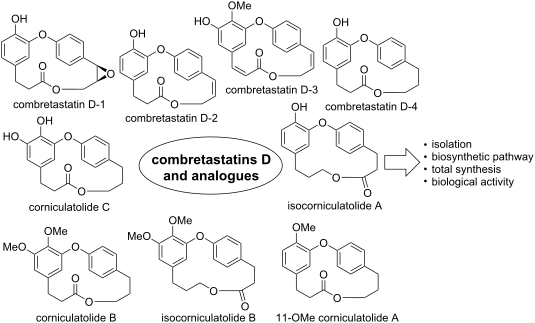
- Cham–Lam reactions [23][24][25][26]. However, it has been described that a Mitsunobu reaction of the seco-acid was particularly prone to an SN1 reaction, once the activated allylic alcohol yields an oxyphosphonium ion intermediate due to the conjugation to electron-rich aromatic ring, requiring some




CuAAC-inspired synthesis of 1,2,3-triazole-bridged porphyrin conjugates: an overview
Beilstein J. Org. Chem. 2023, 19, 349–379, doi:10.3762/bjoc.19.29
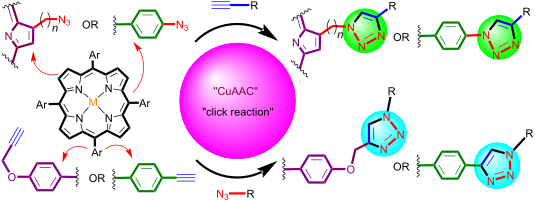
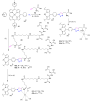
- -base analogues 41a,b were also obtained by the treatment with HCl in dioxane. The conjugation of carbohydrate with porphyrin improves the solubility of porphyrin in aqueous medium and also improves the optical and medicinal properties of porphyrins [30]. Considering these properties of glycoporphyrins




1,4-Dithianes: attractive C2-building blocks for the synthesis of complex molecular architectures
Beilstein J. Org. Chem. 2023, 19, 115–132, doi:10.3762/bjoc.19.12
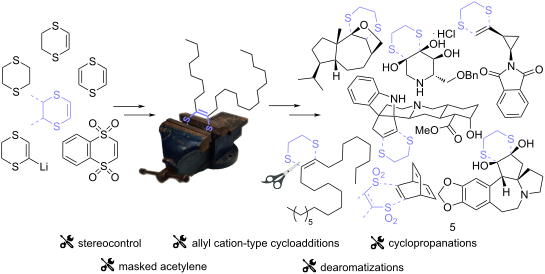
- 12 kJ/mol) [35]. Because of the extensive conjugation between two sulfurs and the vinyl bond, the resulting six-electron system (S–C=C–S) can be regarded as a pseudoaromatic core that tends to conserve itself in organic reactions just like an aromatic sextet would. Indeed, some classical











Naphthalimide-phenothiazine dyads: effect of conformational flexibility and matching of the energy of the charge-transfer state and the localized triplet excited state on the thermally activated delayed fluorescence
Beilstein J. Org. Chem. 2022, 18, 1435–1453, doi:10.3762/bjoc.18.149
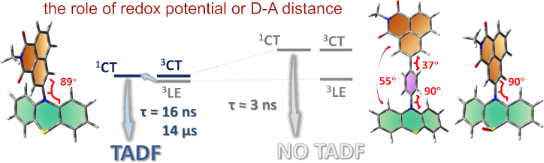
- ). For NI-Ph-PTZ, the NI•− absorption bands in the 350–600 nm range are less resolved than for NI-PTZ. This likely comes from the effect of the π-conjugation of the phenyl ring with the NI moiety in NI-Ph-PTZ. In contrast, the PTZ•+ absorption band of NI-Ph-PTZ resembles the one of NI-PTZ, indicating
Synthesis of C6-modified mannose 1-phosphates and evaluation of derived sugar nucleotides against GDP-mannose dehydrogenase
Beilstein J. Org. Chem. 2022, 18, 1379–1384, doi:10.3762/bjoc.18.142
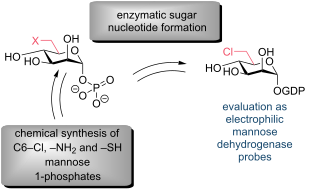
- the GMD-19 incubation time to overnight, followed by protein-MS analysis, but found no evidence of sugar nucleotide–protein conjugation; by contrast a positive control treating GMD with iodoacetamide showed multiple alkylation of the protein (see Figure S4 in Supporting Information Information File 1


Ionic multiresonant thermally activated delayed fluorescence emitters for light emitting electrochemical cells
Beilstein J. Org. Chem. 2022, 18, 1311–1321, doi:10.3762/bjoc.18.136
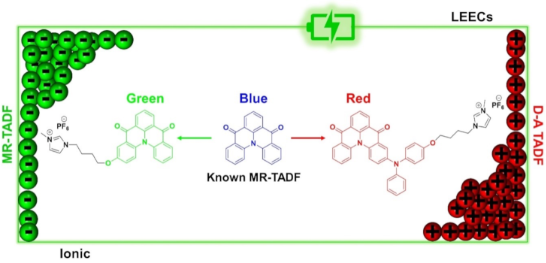
- intense than that of the parent DiKTa at 436 nm, (ε = 14 × 103 M−1 cm−1) [27] owing to the increased conjugation in DiKTa-OBuIm. For the emitter 7a (Figure 1b) [33] reported by Yan et al. the red-shift of the lowest energy absorption band was more pronounced than that in DiKTa-OBuIm. This band is assigned



Thermally activated delayed fluorescence (TADF) emitters: sensing and boosting spin-flipping by aggregation
Beilstein J. Org. Chem. 2022, 18, 1177–1187, doi:10.3762/bjoc.18.122
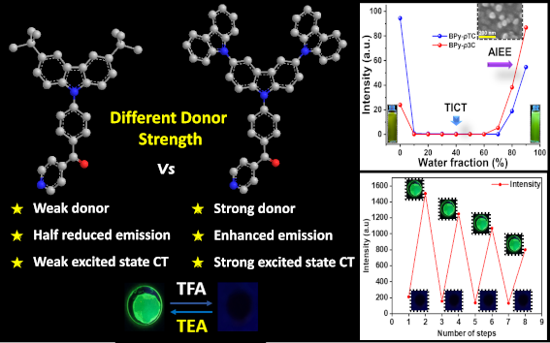
- disruption of the molecular conjugation or ICT interactions upon protonation or deprotonation would lead to switching of the optical properties. While there are many reports on acid–based sensors, TADF emitter-based sensors are rare in the literature. In this context, we chose the D–A molecular design to


Reductive opening of a cyclopropane ring in the Ni(II) coordination environment: a route to functionalized dehydroalanine and cysteine derivatives
Beilstein J. Org. Chem. 2022, 18, 1166–1176, doi:10.3762/bjoc.18.121
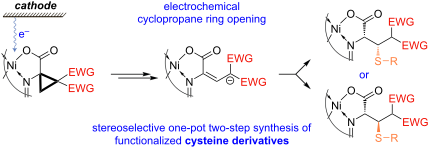
- significant bathochromic shift as compared to the deprotonated glycine complex (λmax = 458 nm [9]) indicates an elongation of the conjugation chain and formation of the anionic complex which can be considered as a vinylog of the parent glycine derivative (Scheme 2) The anionic species formed in the



A versatile way for the synthesis of monomethylamines by reduction of N-substituted carbonylimidazoles with the NaBH4/I2 system
Beilstein J. Org. Chem. 2022, 18, 1032–1039, doi:10.3762/bjoc.18.104

- ) than that for N-alkyl carbonylimidazoles (about 1 h) can be well explained by the two-step mechanism. In step I, the N-aryl carbonylimidazoles might react much faster than N-alkyl carbonylimidazoles, because the stronger conjugation system of the resulting N-aromatic formamides made them more stable
- had a large steric hindrance like 7b, but also had a strong conjugation system, took much longer time (6 h) to complete the reaction. As shown by the reaction mechanism, the methyl group was converted from the carbonylimidazole moiety by full reduction and therefore no competing overalkylation


Isolation and biosynthesis of daturamycins from Streptomyces sp. KIB-H1544
Beilstein J. Org. Chem. 2022, 18, 1009–1016, doi:10.3762/bjoc.18.101
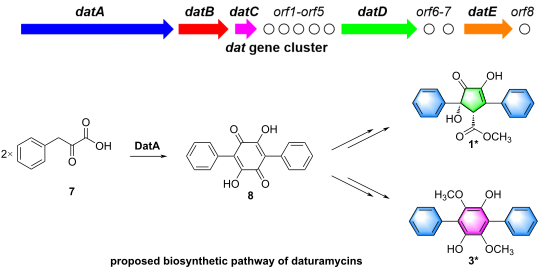
- the target gene datA would be replaced with the cassette. This recombinant cosmid was transformed into E. coli ET12567/pUZ8002, and suffered from intergeneric conjugation with S. sp. KIB-H1544 wild strain. E. coli-Streptomyces conjugation was performed on MS solid medium freshly supplemented with 10


Electrochemical and spectroscopic properties of twisted dibenzo[g,p]chrysene derivatives
Beilstein J. Org. Chem. 2022, 18, 963–971, doi:10.3762/bjoc.18.96
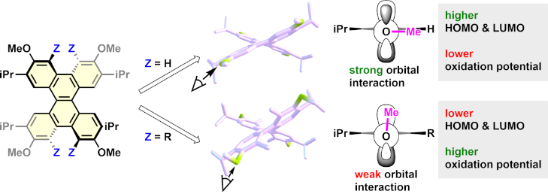
- higher oxidation potentials than that for DBC-H, even for compounds that contained an electron-donating group such as DBC-Me and DBC-SMe. DFT calculations clearly indicate that these higher oxidation potentials are due to the ineffective conjugation of the MeO group, which is oriented perpendicular to
- twisting results in a slight increase in the HOMO and a slight lowering of the LUMO. The twisting effect is much smaller than the conjugation effect of the MeO group. Absorption spectra of all the substituted DBC derivatives also showed a red-shift as compared to that for DBC-H. Concerning the luminescence
- acenes are an interesting class of compounds due to their characteristic structures and conjugation systems [23][24][25]. Dibenzo[g,p]chrysene (DBC), which consists of a twisted naphthalene core with four fused benzene rings (Figure 1a) [26], is a promising framework for serving as organic semiconductors


Introducing a new 7-ring fused diindenone-dithieno[3,2-b:2',3'-d]thiophene unit as a promising component for organic semiconductor materials
Beilstein J. Org. Chem. 2022, 18, 944–955, doi:10.3762/bjoc.18.94
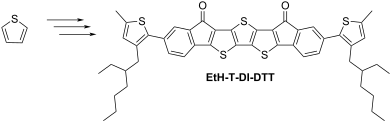
- , which extends the degree of π-conjugation [1]. In this way, the HOMO–LUMO gap can be narrowed [2]. Low HOMO–LUMO gaps are desirable for organic solar cells as the maximum photoflux density of the sun is at ca. 700 nm, corresponding to 1.77 eV [3]. However, fused systems have the drawback of being prone
- structure–property relationships. The basic structural reason for semiconductivity in an organic molecule is usually an extended conjugated π-electron system [14]. Depending on how extended the system is, the HOMO–LUMO gap can be small enough for semiconductivity. However, conjugation can be interrupted if


Thiophene/selenophene-based S-shaped double helicenes: regioselective synthesis and structures
Beilstein J. Org. Chem. 2022, 18, 809–817, doi:10.3762/bjoc.18.81
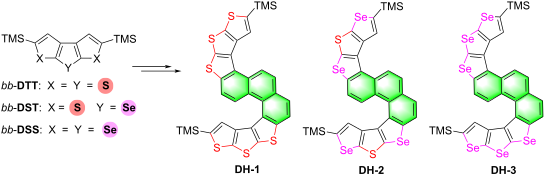
- ; selenophene; thiophene; Introduction Given their esthetically pleasing helical structures, inherent helical chirality, and extended π-conjugation, helicenes have attracted extensive research attention. Helicenes are generally divided into carbohelicenes and heterohelicenes. The rapid development of
- occur with increasing number of selenium atoms. In band-I, compounds DH-1–3 show a maximum absorption peak at 232, 240, and 242 nm, respectively. In band-II and band-III, helical distortion and possible conjugation through heteroatoms (e.g., sulfur and selenium atoms) in DH-1–3 may increase π-electron


Chemistry of polyhalogenated nitrobutadienes, 17: Efficient synthesis of persubstituted chloroquinolinyl-1H-pyrazoles and evaluation of their antimalarial, anti-SARS-CoV-2, antibacterial, and cytotoxic activities
Beilstein J. Org. Chem. 2022, 18, 524–532, doi:10.3762/bjoc.18.54
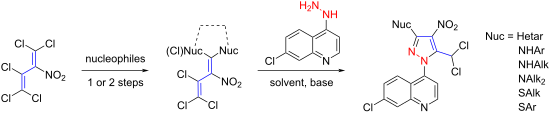
- , obtained from reaction of 2c and secondary amines, are obviously stabilized by the effective conjugation between the amino and nitro groups and react with 7-chloro-4-hydrazinylquinoline to give 3-aminopyrazoles 5b–k. In this case, the nucleophilic attack of the NH2 group of ArNHNH2 on the C1 position of


Substituent effect on TADF properties of 2-modified 4,6-bis(3,6-di-tert-butyl-9-carbazolyl)-5-methylpyrimidines
Beilstein J. Org. Chem. 2022, 18, 497–507, doi:10.3762/bjoc.18.52
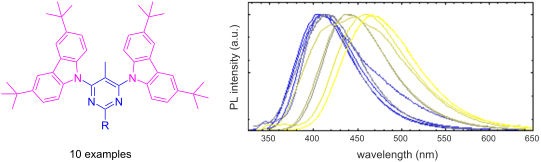
- the larger conjugation length of the acceptor unit (also evidenced by a deeper LUMO), followed by lower oscillator strengths of S0→S1 transition due to more evident HOMO–LUMO decoupling (≈0.04 vs ≈0.4). Lower singlet–triplet energy gaps were estimated for compounds with stronger acceptor units (down




Comparative study of thermally activated delayed fluorescent properties of donor–acceptor and donor–acceptor–donor architectures based on phenoxazine and dibenzo[a,j]phenazine
Beilstein J. Org. Chem. 2022, 18, 459–468, doi:10.3762/bjoc.18.48
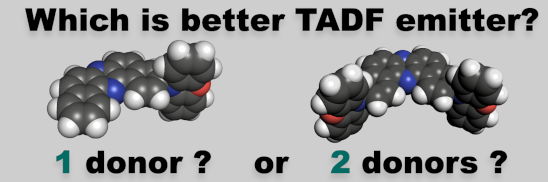
- -type compound (λPL = 521 nm for POZ-DBPHZ) in cyclohexane. These data indicate that the effective length of π-conjugation is not affected by the number of donors, probably due to the right D–A dihedral angle for both compounds in the ground state. In contrary, the slight blue-shift of the PL spectra of


Synthesis of 3,4,5-trisubstituted isoxazoles in water via a [3 + 2]-cycloaddition of nitrile oxides and 1,3-diketones, β-ketoesters, or β-ketoamides
Beilstein J. Org. Chem. 2022, 18, 446–458, doi:10.3762/bjoc.18.47

- only is environmentally friendly, but also finds significant applications in biological systems (e.g., click reactions, bio-conjugation, and bio-orthogonal chemistry). One of such applications is ligation chemistry, in which “click” chemistry through a [3 + 2] biorthogonal cycloaddition between nitrile
- a further cycloaddition. In addition, the conjugation between the new C=N bond and the enol double bond promotes the enol tautomer formation. This may also explain why the trifluoromethylated 1,3-diketones produced the trifluoromethyl-substituted isoxazoles with lower yields than the methyl



The role of chemistry in the success of oligonucleotides as therapeutics
Beilstein J. Org. Chem. 2022, 18, 197–199, doi:10.3762/bjoc.18.22

- nucleotides massively improves the drug-like properties of oligonucleotides. However, their efficient delivery to the desired tissue/organ also needs to be addressed. Conjugation of oligonucleotides to GalNAc (N-acetylgalactosamine) has successfully been used for targeted delivery of oligonucleotides (both

Mechanistic studies of the solvolysis of alkanesulfonyl and arenesulfonyl halides
Beilstein J. Org. Chem. 2022, 18, 120–132, doi:10.3762/bjoc.18.13
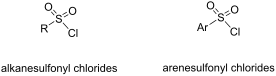
- standard reaction, the goodness of fit of the data using the Hammett substituent constants will be decreased. For example, for phenols which have a direct conjugation of a developing anion with an appropriate substituent, adjusted σ values are available for these substituents. The above is presented to


Efficient synthesis of ethyl 2-(oxazolin-2-yl)alkanoates via ethoxycarbonylketene-induced electrophilic ring expansion of aziridines
Beilstein J. Org. Chem. 2022, 18, 70–76, doi:10.3762/bjoc.18.6
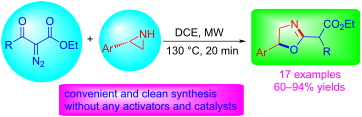
- p–π conjugation. This stabilization is not possible with alkyl groups, explaining why 2-alkylaziridines did not generate the corresponding products. Intermediates C undergo an intramolecular nucleophilic attack to yield ethyl (oxazolidin-2-ylidene)alkanoates D, which further isomerize to more stable
- different chemoselectivities. 2-Alkylideneoxazolidines and 2-alkyloxazolines are structural isomers and can possibly tautomerize each other. As a more electron-withdrawing group with more electron density on the carbonyl group, a ketone favors the conjugation of the double bond as well as the intramolecular


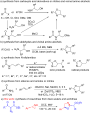
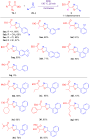


Total synthesis of the O-antigen repeating unit of Providencia stuartii O49 serotype through linear and one-pot assemblies
Beilstein J. Org. Chem. 2021, 17, 2915–2921, doi:10.3762/bjoc.17.199
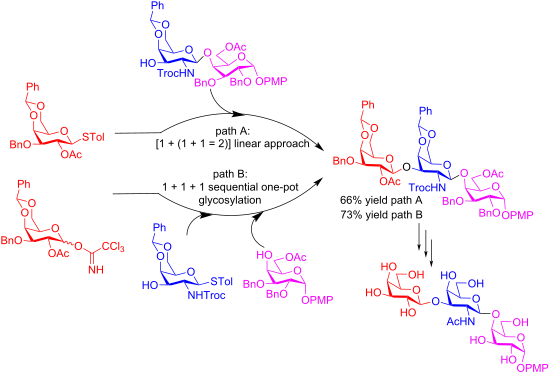
- for further conjugation to other moieties towards the synthesis of vaccine conjugates by removal of the anomeric PMP group. This has been previously demonstrated by removal of the anomeric PMP group, conversion to a glycosidic donor, and further conjugation to either linkers or amino acids by several


Effect of a twin-emitter design strategy on a previously reported thermally activated delayed fluorescence organic light-emitting diode
Beilstein J. Org. Chem. 2021, 17, 2894–2905, doi:10.3762/bjoc.17.197
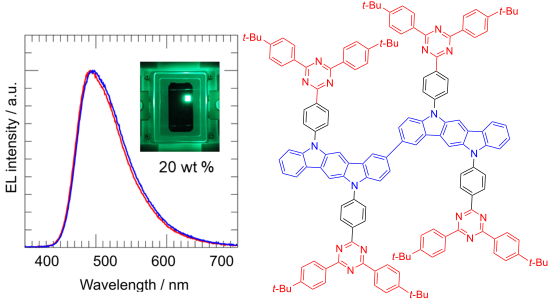
- = 0.62) than the values calculated for ICzTRZ (TDM = 7.9 Debye and f = 0.72). DICzTRZ shows a shallower HOMO at −5.03 eV, reflective of a certain degree of conjugation between the two indolocarbazole moieties, compared to the HOMO of ICzTRZ (−5.19 eV). The LUMO level remains essentially unchanged (−1.76


Photophysical, photostability, and ROS generation properties of new trifluoromethylated quinoline-phenol Schiff bases
Beilstein J. Org. Chem. 2021, 17, 2799–2811, doi:10.3762/bjoc.17.191
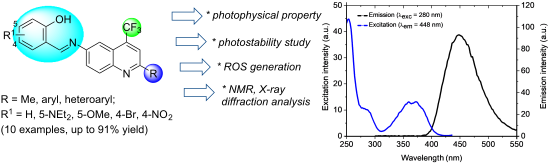
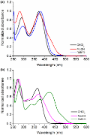
- attributed to a greater electronic conjugation provided by the imine function present in the molecules of the series 3. Photostability and singlet oxygen quantum yield (ΦΔ) assays In order to be efficient for applications in photobiology, organic dyes must be stable when subjected to light irradiation for




Ligand-dependent stereoselective Suzuki–Miyaura cross-coupling reactions of β-enamido triflates
Beilstein J. Org. Chem. 2021, 17, 2657–2662, doi:10.3762/bjoc.17.179
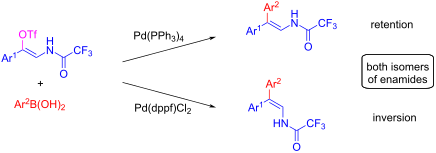
- bond of vinyl (pseudo)halides during the Suzuki coupling have been published [25][26][27][28][29]. Typically, inversion of configuration occurs on substrates containing a double bond in conjugation with an electron-withdrawing group, such as the carbonyl group in enones [27][30]. We hypothesized that