


Search results
Search for "five-membered ring" in Full Text gives 153 result(s) in Beilstein Journal of Organic Chemistry.
The hydrolysis of geminal ethers: a kinetic appraisal of orthoesters and ketals
Beilstein J. Org. Chem. 2016, 12, 1467–1475, doi:10.3762/bjoc.12.143
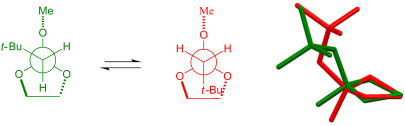
- geometry elements to optimise. In all cases, the five-membered ring moved towards the final planar oxonium ion, but no enthalpic barrier was found for the C(2)–OMe bond cleavage. This supports entropic control of this elimination reaction, and it is therefore not surprising that the more planar ring for
- -membered endo-cyclic orthoesters accompany increasingly bulky C(2) alkyl substitution. Dramatic increases in the hydroxonium catalytic coefficients for hydrolysis are observed for Cβ branching at C(2), which can lead to conformational distortion of the five-membered ring which lowers the activation barrier


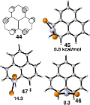
Ring-whizzing in polyene-PtL2 complexes revisited
Beilstein J. Org. Chem. 2016, 12, 1410–1420, doi:10.3762/bjoc.12.135
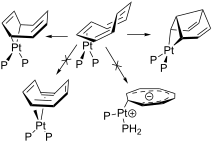
- orbital can interact in an η3 mode both within the five-membered ring, as well as, between the two. 39 has the correct topology to interact with b2 in η2 and η3 modes. We were able to locate four stationary points on the potential energy surface of pentalene–Pt(dpe). These are shown from a top view along






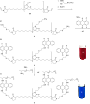
From N-vinylpyrrolidone anions to modified paraffin-like oligomers via double alkylation with 1,8-dibromooctane: access to covalent networks and oligomeric amines for dye attachment
Beilstein J. Org. Chem. 2016, 12, 1395–1400, doi:10.3762/bjoc.12.133

- . However, in contrast to the restricted monoalkylation of N-vinylcaprolactam [24], the five-membered ring of N-VP can be double alkylated in α-position. In this connection, 1-bromo-2-(2-bromoethoxy)ethane was used as alkylation reagent to allow the preparation of a spiro-type monomer [25] due to



Stereoselective synthesis of tricyclic compounds by intramolecular palladium-catalyzed addition of aryl iodides to carbonyl groups
Beilstein J. Org. Chem. 2016, 12, 1236–1242, doi:10.3762/bjoc.12.118
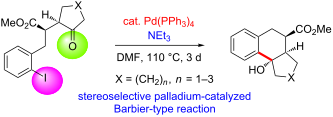
- intramolecular enolate arylation, a reaction that has been discovered by our group some years ago [11][12]. Apparently, under the reaction conditions a ketone enolate of 2 reacts with the iodoarene moiety to form the five-membered ring of 10. The configurational assignments of compounds 7 and 8 are in agreement


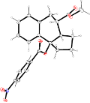


Unusual traits of cis and trans-2,3-dibromo-1,1-dimethylindane on the way from 1,1-dimethylindene to 2-bromo-, 3-bromo-, and 2,3-dibromo-1,1-dimethylindene
Beilstein J. Org. Chem. 2016, 12, 1178–1184, doi:10.3762/bjoc.12.113
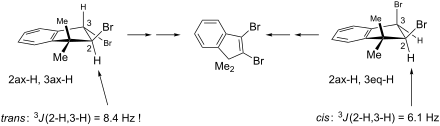
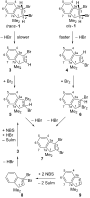
- -bromo-1,1-dimethylindene. Keywords: base-free dehydrobromination; cis/trans stereochemistry; five-membered ring conformation; indenes; NMR couplings; Introduction The basic mechanistic features of competing suprafacial and antarafacial additions of elemental bromine to an olefin are reasonably well



The synthesis of functionalized bridged polycycles via C–H bond insertion
Beilstein J. Org. Chem. 2016, 12, 985–999, doi:10.3762/bjoc.12.97
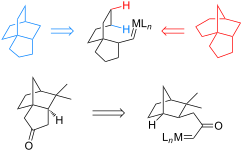
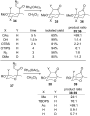
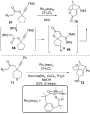
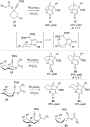
- profound effect on the preferred C–H insertion location (Scheme 14). As has been noted for other intramolecular insertions [42][43][44][45][46][47][48][49][50][51][52][53][54][55][56][57][58][59][60][61][62][63][64][65], five-membered ring formation is generally preferred over other ring sizes. Thus, the







Enantioselective carbenoid insertion into C(sp3)–H bonds
Beilstein J. Org. Chem. 2016, 12, 882–902, doi:10.3762/bjoc.12.87
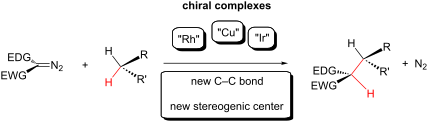
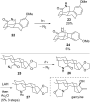
- -cuparenone (8) through the construction of a five-membered ring prepared by an enantioselective carbenoid insertion into a C(sp3)–H bond (Scheme 3) [34]. To carry out the cyclization, the carbenoid was formed by the action of Rh2(OAc)4 on the diazo compound 6. That intermediate intramolecularly inserted into


Cupreines and cupreidines: an established class of bifunctional cinchona organocatalysts
Beilstein J. Org. Chem. 2016, 12, 429–443, doi:10.3762/bjoc.12.46
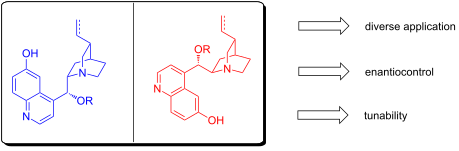
- easy to make from the corresponding cinchona alkaloids, making them attractive compounds for methodologists to have within their catalyst arsenal. They seem particularly suited to catalysis with systems that have an aromatic ring next to a five-membered ring – e.g., indoles, indenones, isatin etc


Enantioselective [3 + 2] annulation of α-substituted allenoates with β,γ-unsaturated N-sulfonylimines catalyzed by a bifunctional dipeptide phosphine
Beilstein J. Org. Chem. 2016, 12, 343–348, doi:10.3762/bjoc.12.37
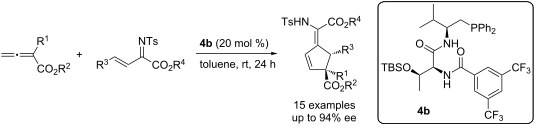
- allenoates and activated alkenes by Lu in 1995, this type of annulation reaction has received considerable attention due to its high efficiency and versatility in creating five-membered ring systems [14][15][16][17][18][19][20][21][22][23][24][25][26][27][28][29][30][31][32][33]. However, most of the earlier


Tandem processes promoted by a hydrogen shift in 6-arylfulvenes bearing acetalic units at ortho position: a combined experimental and computational study
Beilstein J. Org. Chem. 2016, 12, 260–270, doi:10.3762/bjoc.12.28
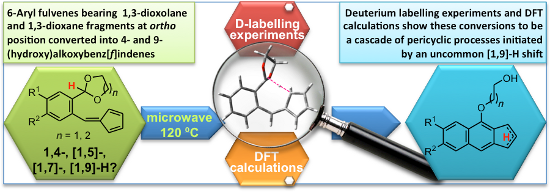
- five-membered ring (Scheme 5). With this in mind we prepared the monodeuterated acetal-fulvene 14 (see Supporting Information File 1) and submitted it to the habitual reaction conditions. As result, a mixture of the monodeuterated benz[f]indenes 18 and 19 was obtained, again in a relative 2:1 ratio
- equilibrium between both isomers, 5 and 6, established by two consecutive [1,5]-H shifts around its five-membered ring. To test this hypothesis, we heated a 4:1 mixture of isomeric 5c and 6c in deuterated DMSO solution at 120 °C for 24 h. In this way we could verify by 1H NMR analyses of reaction aliquots
- take place via an initial [1,9]-H shift. Moreover, we also considered that 5a and 6a could equilibrate by two consecutive [1,5]-H shifts occurring at the five-membered ring. By exploring the potential energy surface associated to these transformations we were able to locate transition structures TS10


New metathesis catalyst bearing chromanyl moieties at the N-heterocyclic carbene ligand
Beilstein J. Org. Chem. 2015, 11, 2795–2804, doi:10.3762/bjoc.11.300
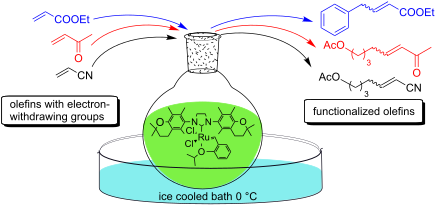
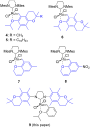
- ruthenium catalysts. Selected ruthenium metathesis catalyst bearing chromanyl moieties. π-Complex and rutenacyclobutane intermediate with a five-membered ring chelate. Numbering of carbon atoms in the chromanyl moiety. Synthesis of the new NHC precursor. Reagents and conditions: a) HNO3, CH2Cl2, 0 °C, 58




Mechanism, kinetics and selectivity of selenocyclization of 5-alkenylhydantoins: an experimental and computational study
Beilstein J. Org. Chem. 2015, 11, 1865–1875, doi:10.3762/bjoc.11.200

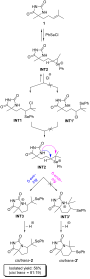
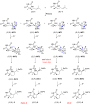
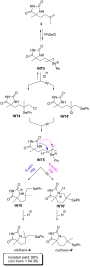
- five-membered ring (S,R)-TS-INT3 and (S,R)-TS-INT3, and two for the formation of the six-membered ring (S,R)-TS-INT3’ and (S,S)-TS-INT3’ (Figure 4). In (S,R)-TS-INT3 and (S,S)-TS-INT3 the N-C(5) bond is partially formed, the Se-C(5) bond is partially cleaved, whereas the Se-C(6) bond is becoming
- states for the formation of the five-membered ring (S,R)-TS-INT3 and (S,S)-TS-INT3 and six-membered ring (S,R)-TS-INT3’ and (S,S)-TS-INT3’. The crucial bond lengths are given in pm. Optimized geometries of intermediate bicyclic imidazolinium cations. The crucial bond lengths are given in pm. Optimized





Synthesis of the furo[2,3-b]chromene ring system of hyperaspindols A and B
Beilstein J. Org. Chem. 2015, 11, 265–270, doi:10.3762/bjoc.11.29
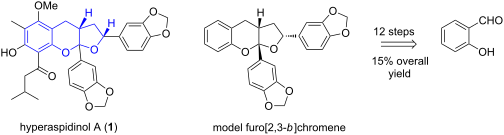
- to the large number of conformations available [24][25][26]. However, with the relatively fixed geometry for the five membered ring in 7a and 7b due to the fused chroman ring and the quarternary centre at C-11, analysis of the coupling constants was considered viable. In isomer 7a the coupling
- constant between H-9a and both H-8 and H-10 was 6.5 Hz, which corresponds to a ca. 50° dihedral angle between the protons, placing all three on the same face of the five membered ring (Figure 4). Additionally H-9b had coupling constants of 10.5 Hz and 12.6 Hz between H-8 and H-10, respectively, showing an




New highlights of the syntheses of pyrrolo[1,2-a]quinoxalin-4-ones
Beilstein J. Org. Chem. 2014, 10, 2377–2387, doi:10.3762/bjoc.10.248
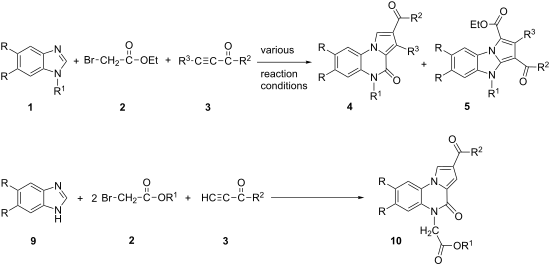
- from benzimidazoles unsubstituted at the five membered ring, alkyl bromoacetates and non-symmetrical electron-deficient alkynes in the molar ratio of 1:2:1, in 1,2-epoxybutane at reflux temperature, led directly to pyrrolo[1,2-a]quinoxalin-4-ones in fair yield by an one-pot three-component reaction
- starting from benzimidazole derivatives unsubstituted at the five membered ring, alkyl bromoacetates and non-symmetrical electron-deficient alkynes in the molar ratio of 1:2:1, in 1,2-epoxybutane at reflux temperature. Results and Discussion The one-pot three-component reaction of 1-substituted



Five-membered ring annelation in [2.2]paracyclophanes by aldol condensation
Beilstein J. Org. Chem. 2014, 10, 2021–2026, doi:10.3762/bjoc.10.210
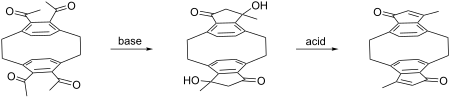
- and spectroscopic data. The sequence presented here constitutes the simplest route so far to cyclophanes carrying an annelated five-membered ring. Keywords: aldol condensation; cyclopentadienones; cyclophanes; multibridged cyclophanes; stereochemistry; X-ray analysis; Introduction We have reported
- mechanism is followed during the formation of the main product 15, the only difference between the pathways being the enolate formation, i.e., whether the second five-membered ring is produced by deprotonating a syn- or anti-positioned acetyl group. To learn more about the chemical properties of the above


Pyrrolidine nucleotide analogs with a tunable conformation
Beilstein J. Org. Chem. 2014, 10, 1967–1980, doi:10.3762/bjoc.10.205
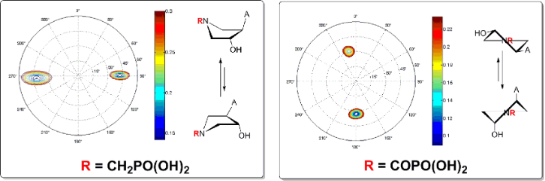
- relationship [8]. Exocyclic dihedral angles are in turn in direct relation with endocyclic dihedral angles between ring atoms defining the conformation of the five-membered ring based on the pseudorotation concept [9]. This straightforward approach is complicated by the presence of more than one rapidly
- Pseudorotation GUI version of the program has been developed, enabling the creation of conformational maps [12]. The conformational analysis using PSEUROT-based programs was originally designed for ribose or deoxyribose, but in general it can be used for any saturated five-membered ring. The program PSEUROT was
- amplitude describes the degree of distortion of the five-membered ring out of the plane and its value is usually in the range of 35°–45°. Conformational analysis using experimental vicinal 1H–1H scalar coupling constants (3JHH) together with PSEUROT-based programs is aimed at fitting the calculated 3JHH to


Application of cyclic phosphonamide reagents in the total synthesis of natural products and biologically active molecules
Beilstein J. Org. Chem. 2014, 10, 1848–1877, doi:10.3762/bjoc.10.195
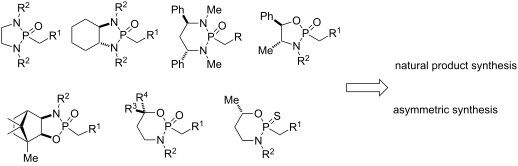
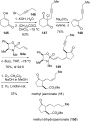
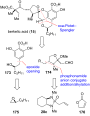
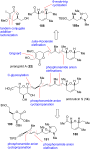
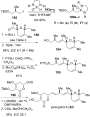
- through a conjugate addition sequence employing phosphonamide 28c, thereby setting two of the three stereocenters of the five-membered ring in a single step. Thus, deprotonation of chiral phosphonamide 28c and addition of the anion to 2(5H)-furanone (176) at −100 ºC, followed by trapping with excess












Visible light mediated intermolecular [3 + 2] annulation of cyclopropylanilines with alkynes
Beilstein J. Org. Chem. 2014, 10, 975–980, doi:10.3762/bjoc.10.96
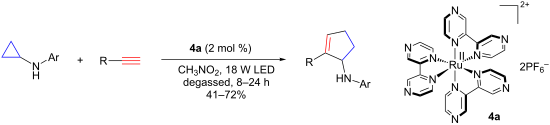
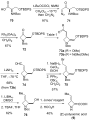
- cyclopropyl ring opening to generate distonic radical cation 26. The primary carbon radical of 26 adds to the terminal carbon of alkyne 27 to afford vinyl radical 28. Intramolecular addition of the vinyl radical to the iminium ion of distonic radical cation 28 closes the five membered ring and furnishes amine


Staudinger ligation towards cyclodextrin dimers in aqueous/organic media. Synthesis, conformations and guest-encapsulation ability
Beilstein J. Org. Chem. 2014, 10, 774–783, doi:10.3762/bjoc.10.73
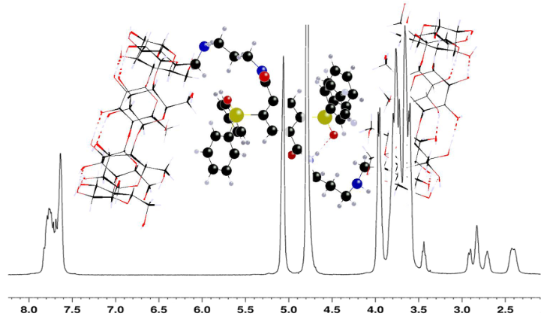
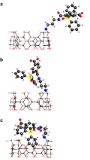
- ] that emerged following addition of the azido-β-CD in the CDCl3/DMF-d7 solution; however complete formation of the product required 48 h. Apparently steric factors influence the progress of the reaction, also considering the five-membered ring intermediate (Scheme 1b) required for the ligation to



Isocyanide-based multicomponent reactions towards cyclic constrained peptidomimetics
Beilstein J. Org. Chem. 2014, 10, 544–598, doi:10.3762/bjoc.10.50

- diastereoselectivities (70–99%). In a variation, they also performed the reaction with L-aspartic acid α-peptide esters yielding endo-β-lactam mimics 29 in good yields (49–64%, de 74–98%). Five-membered ring constraints In natural peptides, the cyclic proteinogenic amino acid proline has stabilizing and turn-inducing


Carbenoid-mediated nucleophilic “hydrolysis” of 2-(dichloromethylidene)-1,1,3,3-tetramethylindane with DMSO participation, affording access to one-sidedly overcrowded ketone and bromoalkene descendants§
Beilstein J. Org. Chem. 2014, 10, 307–315, doi:10.3762/bjoc.10.28

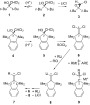
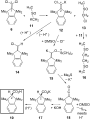
- -Bu as the base in warm THF or cyclohexane for deprotonating 14, the generated 12 was found [30] to undergo expansion (FBW) of its five-membered ring rather than the intended formation of the acid 10. As two demonstrations that FBW ring expansion is not an inevitable fate of bona-fide 12, we
- carbenoid chain product 28 (Scheme 5). Obviously, DMSO is a unique choice for oxidizing 12 in both the chain and the nonchain mechanistic options. The nonoxidizing nucleophiles PhCH2K and KN(SiMe3)2 can convert 12 to the expected nonacidic SNV products, whereas 12 prefers to expand its five-membered ring if


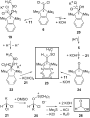
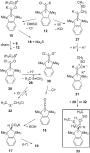
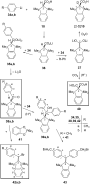
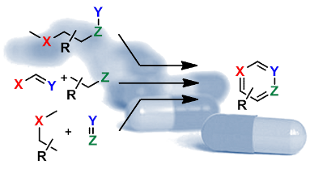
An overview of the synthetic routes to the best selling drugs containing 6-membered heterocycles
Beilstein J. Org. Chem. 2013, 9, 2265–2319, doi:10.3762/bjoc.9.265


Gold(I)-catalyzed formation of furans from γ-acyloxyalkynyl ketones
Beilstein J. Org. Chem. 2013, 9, 1774–1780, doi:10.3762/bjoc.9.206
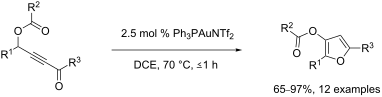
- carbon bearing the R1 substituent to afford the oxygenated five-membered ring E. Furan would finally be formed after tautomerization and protodemetalation of intermediate E. Conclusion We have reported an efficient, very general and regioselective preparation of functionalized furans through a gold(I


The preparation of several 1,2,3,4,5-functionalized cyclopentane derivatives
Beilstein J. Org. Chem. 2013, 9, 1705–1712, doi:10.3762/bjoc.9.195
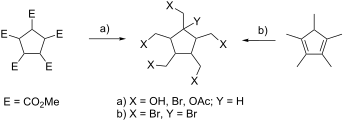
- -configuration of the substituents at the five-membered ring, as was shown by single crystal X-ray analysis (Figure 1). It is unclear at the present time whether the correspondingly configurated pentaalcohol was already present in the starting material 16 as a side-product, which had been overlooked in previous



Anodic coupling of carboxylic acids to electron-rich double bonds: A surprising non-Kolbe pathway to lactones
Beilstein J. Org. Chem. 2013, 9, 1630–1636, doi:10.3762/bjoc.9.186
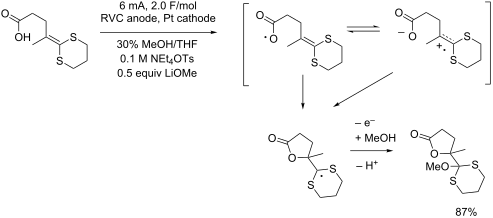
- afforded the five-membered ring product using either lithium methoxide or 2,6-lutidine as a base. Clearly, decarboxylation of the carboxylate anion was not a problem. In fact, cyclic voltammetry data suggest that the reaction originated from an oxidation of the ketene dithioacetal. The oxidation potential





