


Search results
Search for "biological activity" in Full Text gives 505 result(s) in Beilstein Journal of Organic Chemistry. Showing first 200.
Synthesis of 3(2)-phosphonylated thiazolo[3,2-a]oxopyrimidines
Beilstein J. Org. Chem. 2020, 16, 1947–1954, doi:10.3762/bjoc.16.161

- Thiazolopyrimidines, whose molecules includes both thiazole and pyrimidine rings, have a structural analogy with the antipsychotic drugs ritanserin and setoperone (Figure 1) [1][2][3]. To date, a wide spectrum of biological activity of thiazolopyrimidines has been determined: anticancer [4][5], antimicrobial [6][7
- containing practically significant heteroaromatic rings and a biologically active and hydrolysis-resistant phosphonate group, as it has been reported that the combination of several pharmacophore fragments in one molecule can lead to a synergistic increase in biological activity or an additional variety of


Stereoselective Biginelli-like reaction catalyzed by a chiral phosphoric acid bearing two hydroxy groups
Beilstein J. Org. Chem. 2020, 16, 1875–1880, doi:10.3762/bjoc.16.155
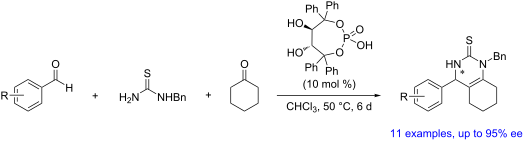
- activities [7][8]. For example, (S)-monastrol is 15-fold more effective in the inhibition of Eg 5 ATPase than its enantiomer, (R)-monastrol [9]. As more reports on the enantiospecific biological activity of DMPMs came to light, the development of an efficient and reliable asymmetric synthesis of enantiopure


Nonenzymatic synthesis of anomerically pure, mannosyl-based molecular probes for scramblase identification studies
Beilstein J. Org. Chem. 2020, 16, 1732–1739, doi:10.3762/bjoc.16.145
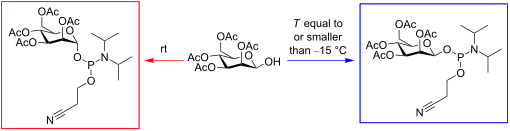
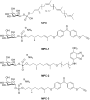
- -mannose (the α-anomer also shows biological activity, but to a lesser extent) [13][14][15], a short-chain (citronellol) mimic of dolichol [1][2][13], and a functional tag. The latter may either be a chemically reactive group (in MPC-1) or a fluorescent reporter group (in MPC-2). MPC-1 bears a benzophenone



Tuneable access to indole, indolone, and cinnoline derivatives from a common 1,4-diketone Michael acceptor
Beilstein J. Org. Chem. 2020, 16, 1722–1731, doi:10.3762/bjoc.16.144

- chemistry projects for the rapid access to a wide range of variously substituted compounds for structure–activity relationship studies. The biological activity of the molecules is currently being studied. Examples of bioactive nitrogen-containing heterocycles (indole [9], indolone [10], and cinnoline [11





Models of necessity
Beilstein J. Org. Chem. 2020, 16, 1649–1661, doi:10.3762/bjoc.16.137

- be used in cheminformatics applications to derive structure–property relationships for partition properties or solubility or structure–activity relationships for biological activity. Note, however, that the non-physically-observable model properties such as net atomic charges [18][19][38][39] are


Synthesis of new dihydroberberine and tetrahydroberberine analogues and evaluation of their antiproliferative activity on NCI-H1975 cells
Beilstein J. Org. Chem. 2020, 16, 1606–1616, doi:10.3762/bjoc.16.133
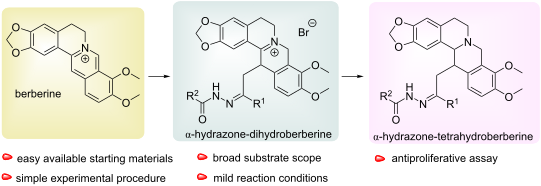
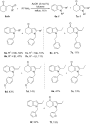
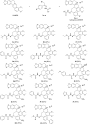
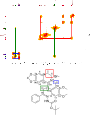
- [37][38]. Unlike BER, there have been few studies that concern the biological properties of functionalized DHBER. Attracted by the potentiality of this latter compound, we have realized the preparation of new arylhydrazono-functionalized DHBERs that were tested in vitro for their biological activity
- ; in particular, we focused our attention on their antiproliferative capacity, due to our previous research experiences on the anticancer properties of both natural and synthetic molecules [39][40][41][42]. A common strategy to increase the biological activity of a class of products can be the




Highly selective Diels–Alder and Heck arylation reactions in a divergent synthesis of isoindolo- and pyrrolo-fused polycyclic indoles from 2-formylpyrrole
Beilstein J. Org. Chem. 2020, 16, 1320–1334, doi:10.3762/bjoc.16.113
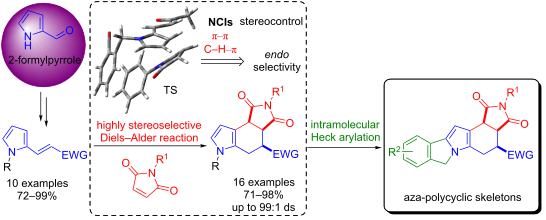
- (Scheme 6). Although the reactivity was much lower (10 days) compared to the cycloadditions with 2-vinylpyrroles 8a–h (7 days) (Table 2), the diastereoselectivity remained rather high and similar to derivatives 8g and 8h. Considering the significant biological activity of indoles, octahydropyrrolo[3,4-e
- that are known to have varied and robust pharmacological activity, such as isoborreverine (1) [12], mitomycin A (2) [13] and chlorizidine A (3) [14]. The indole moiety is incorporated into their structure, which is important because it is a seminal heterocycle that exhibits a wide range of biological
- activity [15][16] and great diversity as building block [17][18]. Among the tetracyclic scaffolds, isoindolo[2,1-a]indoles have attracted a particular interest from the synthetic point of view, either as the target or the motif for designing novel annulation methodologies [19][20][21]. Indeed, isoindole


Synthesis, antiinflammatory activity, and molecular docking studies of bisphosphonic esters as potential MMP-8 and MMP-9 inhibitors
Beilstein J. Org. Chem. 2020, 16, 1277–1287, doi:10.3762/bjoc.16.108

- biological activity methodology, computational details, and NMR/HRMS spectra of the final products. Acknowledgements Rodrigo Razo (RSRH) thanks to the Laboratorio Nacional de Supercómputo (LNS, Puebla) for the computer time, and Dr. Zeferino Gómez-Sandoval of the University of Colima for the software


A simple and easy to perform synthetic route to functionalized thienyl bicyclo[3.2.1]octadienes
Beilstein J. Org. Chem. 2020, 16, 1092–1099, doi:10.3762/bjoc.16.96
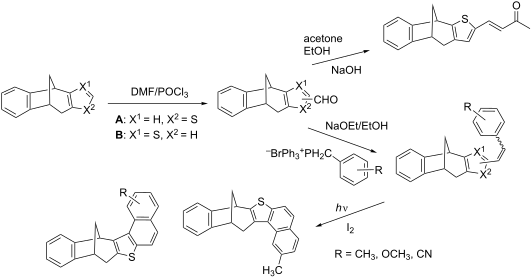
- between structure and biological activity. During our previous investigation a series of functionalized compounds with a benzobicyclo[3.2.1]octadiene skeleton was prepared, among which some showed cholinesterase inhibitory properties (Figure 2) [2][3]. The aim of this study was to prepare novel thiophene


Synthesis and anticancer activity of bis(2-arylimidazo[1,2-a]pyridin-3-yl) selenides and diselenides: the copper-catalyzed tandem C–H selenation of 2-arylimidazo[1,2-a]pyridine with selenium
Beilstein J. Org. Chem. 2020, 16, 1075–1083, doi:10.3762/bjoc.16.94
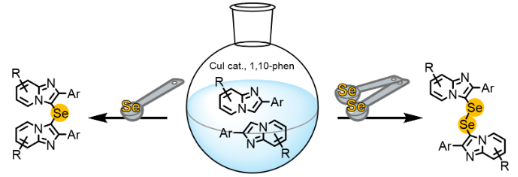
- The synthesis of organoselenium compounds and their biological activity have attracted considerable attention in research fields directed to drug discovery [1][2][3][4][5][6][7][8][9][10][11][12][13]. Among these compounds, heteroaryl selenides and heteroaryl diselenides have been synthesized by a
- variety of methods [14][15], and many of the targets exhibited biological activity (Figure 1). For example, bis(2-pyridyl) diselenide I has the potential to mitigate oxidative stress and inhibits the AChE activity [16], bis(quinolin-8-yl) diselenide (II) exhibited antioxidant activity in a skin cell model


Preparation of 2-phospholene oxides by the isomerization of 3-phospholene oxides
Beilstein J. Org. Chem. 2020, 16, 818–832, doi:10.3762/bjoc.16.75
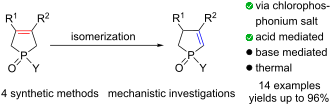
- importance for biologically active compounds, as specific functional groups are necessary to have a desired biological activity. Considering the functionalization of the five-membered P-heterocycles, the derivatives containing double bond(s) (i.e., phospholenes or phospholes) are of special importance, as a




Efficient synthesis of piperazinyl amides of 18β-glycyrrhetinic acid
Beilstein J. Org. Chem. 2020, 16, 798–808, doi:10.3762/bjoc.16.73
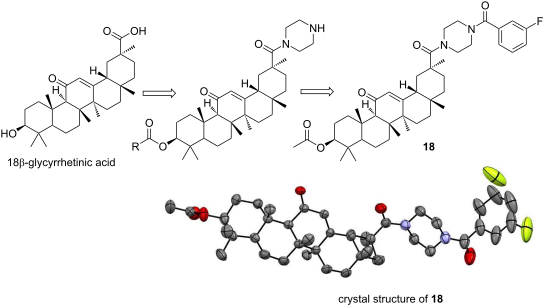
- [3], antitumor [4], and antibacterial [5] activity and their proberties as hepatic protective agents [6]. Over the past few decades, the emphasis was placed primarily on explaining structure–activity relationships of 18β-glycyrrhetinic acid derivatives to enhance their biological activity. The


Efficient synthesis of dipeptide analogues of α-fluorinated β-aminophosphonates
Beilstein J. Org. Chem. 2020, 16, 756–762, doi:10.3762/bjoc.16.69
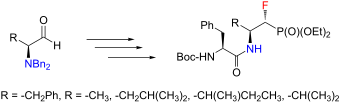
- organic chemistry in the field of the synthesis of building blocks with a potential biological activity. To date, scientists have developed many nucleophilic fluorinating reagents [17][18][19]. Among others, we can distinguish a family of such chemicals having in their structure a sulfonyl fluoride system
- with potential biological activity. Experimental General methods 1H NMR, 13C NMR, 19F NMR and 31P NMR spectra were obtained on a Bruker ASCEND 400 (400 MHz) and a Bruker ASCEND 600 (600 MHz) spectrometer. All 2D spectra were recorded on a Bruker ASCEND 600 (600 MHz) spectrometer. 1H NMR chemical shifts


Microwave-assisted efficient and facile synthesis of tetramic acid derivatives via a one-pot post-Ugi cascade reaction
Beilstein J. Org. Chem. 2020, 16, 663–669, doi:10.3762/bjoc.16.63
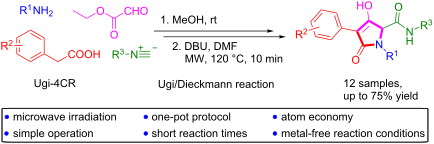
- exhibit a wide range of biological activities, including antibiotic [8], antiviral [9], antifungal [10], phytotoxic [11], cytotoxic [12][13], and enzyme inhibitory activities against bacterial DNA-directed RNA polymerase [14]. The wide range of biological activity and structural variation of this class of



Synthesis of disparlure and monachalure enantiomers from 2,3-butanediacetals
Beilstein J. Org. Chem. 2020, 16, 616–620, doi:10.3762/bjoc.16.57
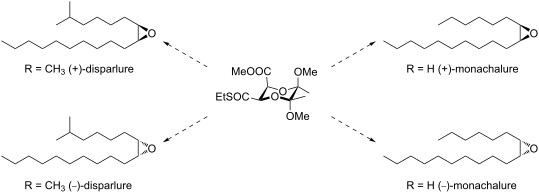
- biological activity, thus preventing cross-species attraction [11]. Due to the great economic damage caused by the gypsy moth and the nun moth, many synthetic routes for the preparation of (+)-disparlure (1) have been developed to monitor and control their populations. These methods use various approaches to
- ensure the required configuration of the asymmetric centers determining the biological activity of this compound. They include the use of naturally occurring chiral substrates, such as ʟ-glutamic acid [13], ʟ-tartaric acid [14][15][16], ᴅ-glucose [17], and sorbitol [18] as starting materials, as well as


Regio- and stereoselective synthesis of new ensembles of diversely functionalized 1,3-thiaselenol-2-ylmethyl selenides by a double rearrangement reaction
Beilstein J. Org. Chem. 2020, 16, 515–523, doi:10.3762/bjoc.16.47
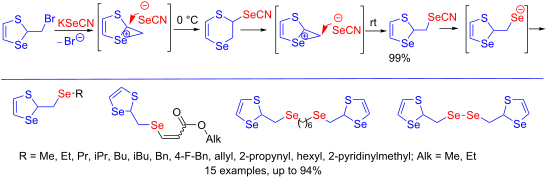
- activity based on affordable and environmentally friendly materials is another important trend in organoselenium chemistry [17]. Reviews on the biological activity of organoselenium compounds reported examples exhibiting high antitumor, antiviral, antimicrobial, and neuroprotective activities [12][18][19
- ]. Having established the synthesis of heterocycle 4 this unsaturated five-membered S,Se-containing compound was used as a starting material for the synthesis of novel ensembles of selenium heterocycles with promising biological activity. The treatment of 4 with organyl halides resulted in the efficient
- compound from selenium dihalides was the preparation of 1,4-selenasilafulvenes by cyclization reaction with diethynyldimethylsilane [15][16]. The creation of new methodologies for the synthesis of new classes of organoselenium compounds and especially selenium heterocycles, with promising biological


Two antibacterial and PPARα/γ-agonistic unsaturated keto fatty acids from a coral-associated actinomycete of the genus Micrococcus
Beilstein J. Org. Chem. 2020, 16, 297–304, doi:10.3762/bjoc.16.29
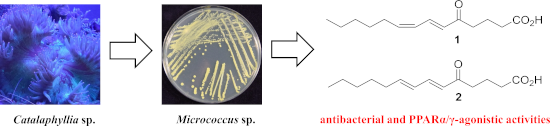
- ; Micrococcus; PPAR; Introduction Marine actinobacteria are considered as a potential source for novel natural products with high structural diversity, unique biological activity, and molecular modes of action beneficial to drug development [1][2][3]. Actinobacteria in marine environments are mostly found in


Ultrasonic-assisted unusual four-component synthesis of 7-azolylamino-4,5,6,7-tetrahydroazolo[1,5-a]pyrimidines
Beilstein J. Org. Chem. 2020, 16, 281–289, doi:10.3762/bjoc.16.27
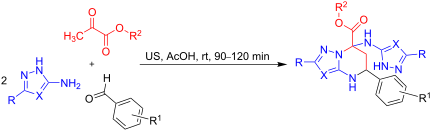
- "Investigation of structural features of nitrogen containing heterocycles with potential biological activity" (0119U100716). M. Murlykina was supported by the Grant of National Academy of Sciences of Ukraine for young scientists’ research laboratories and groups (0118U100275).


Synthesis and herbicidal activities of aryloxyacetic acid derivatives as HPPD inhibitors
Beilstein J. Org. Chem. 2020, 16, 233–247, doi:10.3762/bjoc.16.25
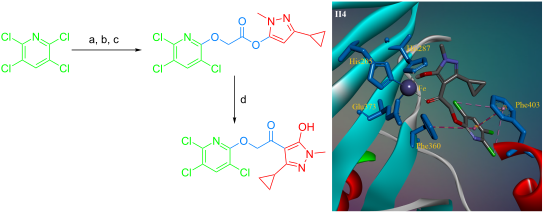
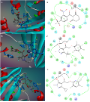
- biological activity against AtHPPD. Chemical structures of title compound II, III and their biological activity against AtHPPD. Postemergence crop safety of compounds II3, II4 and II5 (150 g ai/ha). Supporting Information Supporting Information File 76: Additional experimental and analytical data, and NMR
- spectra of synthesized compounds. Acknowledgments The author thanks Prof. Da-Yong Zhang and Hao Huang for experimental guidance, Zhejiang University Chemical Industry Research Institute for biological activity assay, and National Natural science Foundation of China (30973607, 81172934), "Double First




Synthesis of 4-(2-fluorophenyl)-7-methoxycoumarin: experimental and computational evidence for intramolecular and intermolecular C–F···H–C bonds
Beilstein J. Org. Chem. 2020, 16, 190–199, doi:10.3762/bjoc.16.22
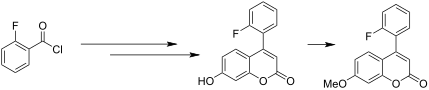
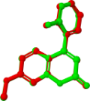
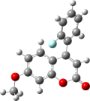
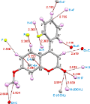
- , nitrogen, fluorine) and have been observed to govern the conformational structure of some molecules as well as the alignment of the molecules within a crystal structure [27][28][29]. Moreover, HBs have been reported to play a vital role in a ligand–receptor interaction that determines the biological
- activity of a molecule. Oxygen and nitrogen have been proven to be good hydrogen-bond acceptors which form strong intermolecular and intramolecular hydrogen bonds, however, fluorine is still denied hydrogen-bond acceptor status by some scientists. There is evidence of the existence of C–F···H interaction



Rapid, two-pot procedure for the synthesis of dihydropyridinones; total synthesis of aza-goniothalamin
Beilstein J. Org. Chem. 2020, 16, 135–139, doi:10.3762/bjoc.16.15

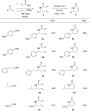
- significantly lower biological activity compared to the parent compound (IC50 = 942 µM, U251 cell line) [15][16]. However, Pilli and co-workers were able to demonstrate that acylation of aza-goniothalamin 1 yielded analogues such as compound 3 with significantly improved biological profiles (IC50 = 11 µM, U251



Potent hemithioindigo-based antimitotics photocontrol the microtubule cytoskeleton in cellulo
Beilstein J. Org. Chem. 2020, 16, 125–134, doi:10.3762/bjoc.16.14
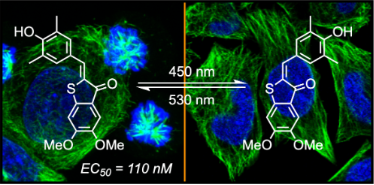
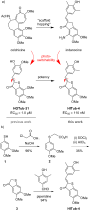
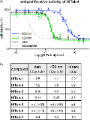
- to assess the biological activity of HITubs in all cellular experiments shown in this work. Since tubulin is a highly conserved protein target critical for survival in all cell types, we expected that, as for other colchicine domain tubulin inhibitors, trends in potency and in photoswitchability of





Reversible photoswitching of the DNA-binding properties of styrylquinolizinium derivatives through photochromic [2 + 2] cycloaddition and cycloreversion
Beilstein J. Org. Chem. 2020, 16, 111–124, doi:10.3762/bjoc.16.13
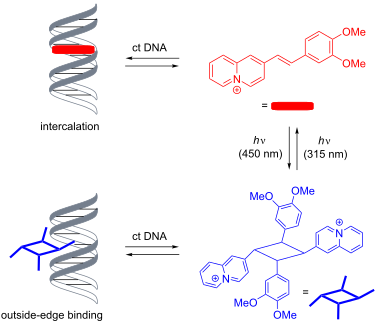
- ; photodimerization; photoswitches; Introduction The association of DNA-targeting drugs with nucleic acids [1][2][3][4][5][6][7][8] is considered one of the essential properties that determine their biological activity [9]. Specifically, a ligand may occupy particular binding sites of DNA or induce significant
- biological activity on and off due to the reversibility of the photoreaction [15]. Indeed, the application of light to induce and control bioactivity of pharmaceuticals or bio(macro)molecules has been convincingly demonstrated in the emerging field of photopharmacology [16][17][18]. Consequently, several


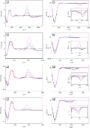


Understanding the role of active site residues in CotB2 catalysis using a cluster model
Beilstein J. Org. Chem. 2020, 16, 50–59, doi:10.3762/bjoc.16.7
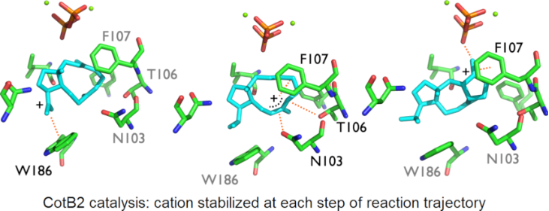
- with numerous pharmacological [7][8] and biological activities have been reported, rendering them important targets for medical and biotechnology research [9]. Chemical synthetic and sustainable biosynthetic strategies in synergy with the biological activity of different terpene natural products have


Light-controllable dithienylethene-modified cyclic peptides: photoswitching the in vivo toxicity in zebrafish embryos
Beilstein J. Org. Chem. 2020, 16, 39–49, doi:10.3762/bjoc.16.6
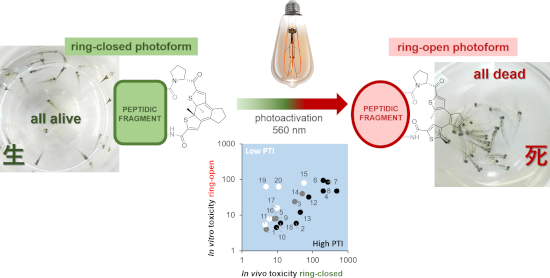
- pharmacophore (the drug is “switched OFF”), whereas the other photoform should restore the biological activity of the active element (the drug is “switched ON”). Correspondingly, an inactive drug (the OFF photoform) can be safely administered, and subsequently it can be locally activated for the therapy





