Search results
Search for "switch" in Full Text gives 193 result(s) in Beilstein Journal of Organic Chemistry.
Halogenated azobenzene acrylates: from efficient solution photoswitching to stable solid-state photochromic materials
Beilstein J. Org. Chem. 2026, 22, 782–794, doi:10.3762/bjoc.22.60
- -configuration) after irradiation with UV light. Furthermore, when a fluorescent pyrene moiety was embedded into the azopeptoids, the emission wavelength could be significantly modulated via the photoinduced azobenzene E/Z switch by allowing Förster resonance energy transfer (FRET) [14]. Azobenzene has also been
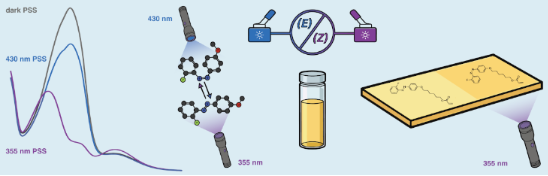
- derivatives). See Supporting Information File 1, Figures S53–64 for a similar visualization of the frontier molecular orbitals in all studied molecules. Photoinduced E/Z-isomerization The photoinduced E ↔ Z switching was investigated using 355 nm (forward switch) and 430 nm (reverse switch) LEDs. The E/Z
- photoconversion could be higher. The type of halogen has only a negligible effect. The reverse switch of 1a–f induced by 430 nm light afforded the E/Z molar ratios of 73:27–92:8 with no straightforward structure–switching property relationships. The recorded half-lives of the Z-isomer in the dark () range from


Configuration–packing synergy enabling integrated crystalline-state RTP and amorphous-state TADF
Beilstein J. Org. Chem. 2026, 22, 224–236, doi:10.3762/bjoc.22.16
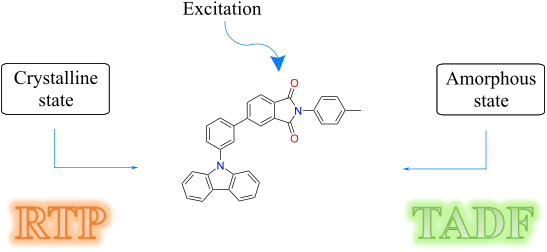
- films, our study emphasizes a configuration–packing synergy that enables integrated crystalline-state RTP and amorphous-state TADF within the same molecular framework. This comparison highlights how processing-controlled solid-state organization can switch the emissive pathways and provides additional


Rapid access to the core of malayamycin A by intramolecular dipolar cycloaddition
Beilstein J. Org. Chem. 2025, 21, 2542–2547, doi:10.3762/bjoc.21.196
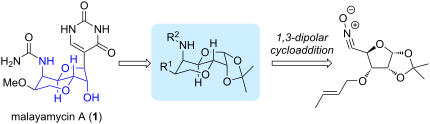
- , several conditions to cleave the N–O bond in 11 or 12 had not yielded any successful outcome. Therefore, we turned to adjust the synthetic sequence to switch the oxidation states at C2 and C3 (Scheme 4). It should be noted that compound 16 [38] was obtained as a stereoisomeric mixture of olefin, resulting




Rotaxanes with integrated photoswitches: design principles, functional behavior, and emerging applications
Beilstein J. Org. Chem. 2025, 21, 2345–2366, doi:10.3762/bjoc.21.179
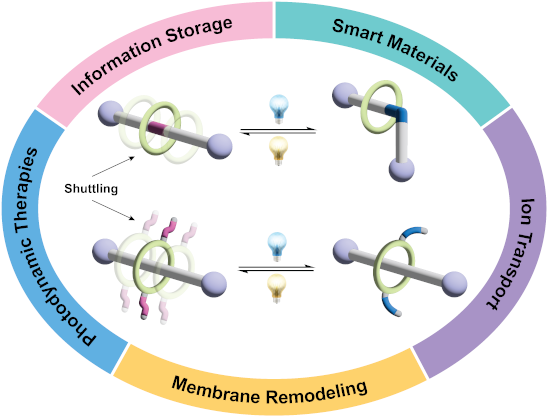
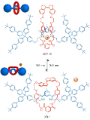
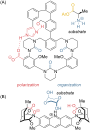
- dual orthogonal manipulation of the rotaxane’s conformational regulation and chiroptical switching properties. Thus, this system functions as a phototriggered chiral on–off switch in polar aprotic solvents. These types of rotaxanes hold promise for developing simple information storage materials and
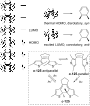
- reported in 2014 the first examples of rotaxanes with a dithienylethene switch on the axle [57]. They synthesized [3]- and [5]rotaxanes with a symmetric axle containing a dithienylethene in the center and alkylammonium binding sites on each side, which interact with N-hetero crown ether macrocycles
- -bonded to a chiral peptide station. This rotaxane works as a chiroptical switch by light-induced macrocycle movement along the axle [65]. The need to understand the photochemistry of fumaramides to aid their usage in various applications led to the design of rotaxanes containing different axles. Both





Chiral phosphoric acid-catalyzed asymmetric synthesis of helically chiral, planarly chiral and inherently chiral molecules
Beilstein J. Org. Chem. 2025, 21, 1864–1889, doi:10.3762/bjoc.21.145
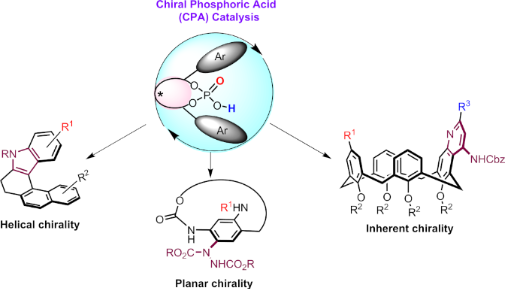
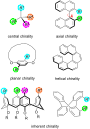
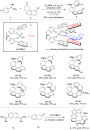
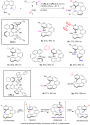
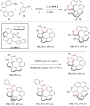
- aza[4]helicene 8e from various aldehydes with high enantioselectivity. In addition, dienamides were found to be compatible with this method, albeit requiring a switch to CPA 3 as the optimal catalyst, which generated the 1-enamide-substituted azahelicenes 8f,g, with significant potential for diverse











Photoswitches beyond azobenzene: a beginner’s guide
Beilstein J. Org. Chem. 2025, 21, 1808–1853, doi:10.3762/bjoc.21.143
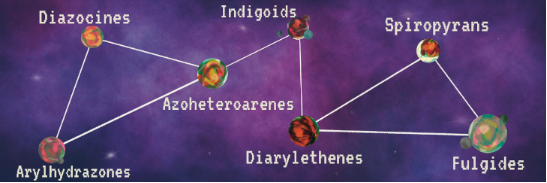
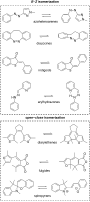
- preparation. Before introducing the different photoswitch classes in this review, we familiarise ourselves with different photophysical properties. A photochromic molecule can switch reversibly between a stable and a metastable state, which are shown in an energetic profile as two local minima (Figure 1
- overlapping with the Z-boat conformer, making it impossible to switch it any further (42% E in H2O/MeCN 9:1). A diazonine was also synthesised, which exhibits a UV–vis spectrum of the E-isomer very similar to that of E-azobenzene and an unusually long E–Z thermal half-life [54]. Synthesis The synthesis of
- groups can be added to the thioindigo fragment in p-position to the sulphur atom (Figure 15) [79]. Substituents in the o-position generate twisted hemithioindigos, which do not switch in polar solvents, due to an alternative deexcitation pathway [80]. Heteroaryl substituents are also reported: a






Research progress on calixarene/pillararene-based controlled drug release systems
Beilstein J. Org. Chem. 2025, 21, 1757–1785, doi:10.3762/bjoc.21.139
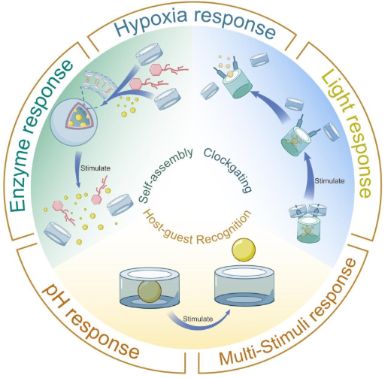
- –guest complexation realizes a reversible ON-OFF-ON type pseudo-monomeric ligand-gated ion transport switch [91]. The development of these pillararene-based materials has enriched the dynamic regulation methods of supramolecular structures and provided innovative approaches for prodrug design. 2 Stimulus
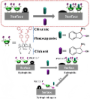
- balance is disrupted, leading to the dissociation of the complex and the release of the drug. This pH-sensitive "charge switch" mechanism enables CA8 to precisely control the release behavior of CPF, providing new insights for the development of environmentally responsive antibiotic delivery systems
- (Figure 3) [101]. This pH-sensitive "charge switch" mechanism enables CA8 to precisely control the release behavior of CPF, providing new insights for the development of environmentally responsive antibiotic delivery systems. Water-soluble aromatic macrocycles are commonly utilized in drug delivery






Chemical synthesis of glycan motifs from the antitumor agent PI-88 through an orthogonal one-pot glycosylation strategy
Beilstein J. Org. Chem. 2025, 21, 1587–1594, doi:10.3762/bjoc.21.122

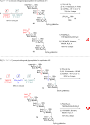
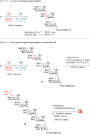
- all Bz groups with 1 M NaOH (dioxane/MeOH/H2O, room temperature). The monophosphorylated trisaccharide 1 was obtained in 60% overall yield over two steps from 12 after purification over a SephadexTM LH-20 column. It was noted that the switch of deprotection sequences (first Bz groups, second Bn and
- yield via the switch of the TBDPS group with the phosphate group. First global deprotection of Bn and Cbz groups in 18 with Pd(OH)2/C, followed by saponifications of all Bz groups with 1 M NaOH provided the desired monophosphorylated pentasaccharide 3 in 56% overall yield, which is the major glycan



pH-Controlled isomerization kinetics of ortho-disubstituted benzamidines: E/Z isomerism and axial chirality
Beilstein J. Org. Chem. 2025, 21, 1568–1576, doi:10.3762/bjoc.21.120
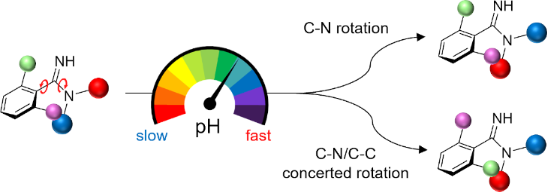
- benzamidine derivatives as a novel pH-responsive molecular switch. Keywords: atropisomer; conformation; isomerization; molecular switch; organobase; Introduction pH-Responsive molecular motors and switches are a class of functional organic molecules capable of reversible structural and electronic changes
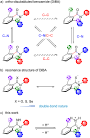
- formal substitution of the carbonyl oxygen atom of DiBA to an NH group, could act as a pH-responsive molecular switch (Figure 1c). Namely, the double-bond nature of an amidine moiety can be altered by the protonation of the amidine nitrogen atom. This suggests the possibility of controlling the rate of C
- conclusion, we demonstrated that the rate of the C–N bond rotation and racemization of ortho-disubstituted benzamidine could be controlled by the protonation of the amidine moiety and showed the potential for application as a pH-responsive molecular switch based on changes in the rotation rate of the two



Highly distinguishable isomeric states of a tripodal arylazopyrazole derivative on graphite through electron/hole-induced switching at ambient conditions
Beilstein J. Org. Chem. 2025, 21, 1496–1507, doi:10.3762/bjoc.21.112
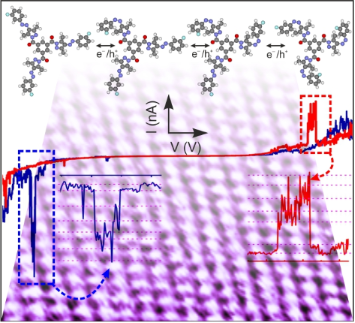
- molecular spin states [7][8][9] and electronic states [10][11] using tunneling electrons/holes have shown the potential to revolutionize quantum information processing. For a single molecular switch possessing multiple spins [7][8][9] or electronic states [10][11], the functional unit can be suitably
- switchable probe for light-driven reversible printing and erasing applications [29]. Besides exhibiting excellent photoswitching in solution phase, the tripodal photoswitches exhibit extended half-life of the ZZZ isomer in the solid-state as well [22][29]. The overall efficiency of the molecular switch could
- , quantum information processing based on single molecules can be revolutionized. In this article, we show the single molecule electron/hole-induced switching of a fluorinated tripodal N-functionalized arylazo-3,5-dimethylpyrazole derivative (FNAAP), a multi-functional molecular switch, on a graphite



Recent advances and future challenges in the bottom-up synthesis of azulene-embedded nanographenes
Beilstein J. Org. Chem. 2025, 21, 1272–1305, doi:10.3762/bjoc.21.99
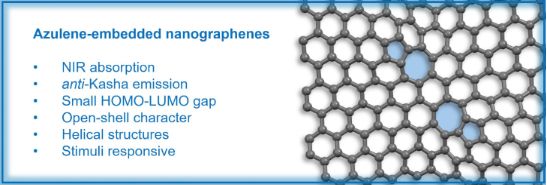
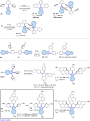
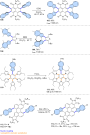
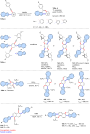
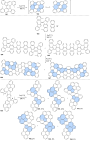
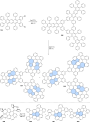
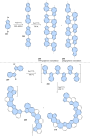
- to the dication induced an aromaticity switch, resulting in the pentagon–heptagon pair adopting an aromatic character. The group later extended this strategy to scaffold 91 decorated with two imide substituents, which was isolated in 4% yield [66]. Annulation of substituted azulenes Scholl-type






Silver(I) triflate-catalyzed post-Ugi synthesis of pyrazolodiazepines
Beilstein J. Org. Chem. 2025, 21, 915–925, doi:10.3762/bjoc.21.74
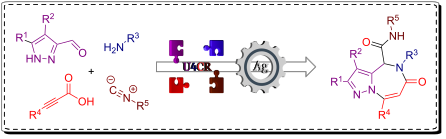
- pyrazolodiazepines 16w and 16x, respectively. Such an outcome is notable, as related carbocyclizations often switch to an exo mode when shifting from internal to terminal alkynes [61][62][63]. To demonstrate the robustness of our methodology, we tested a telescope procedure in which, after the Ugi step, the product


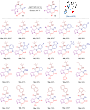


Recent advances in controllable/divergent synthesis
Beilstein J. Org. Chem. 2025, 21, 890–914, doi:10.3762/bjoc.21.73
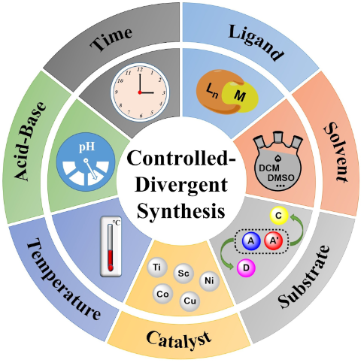
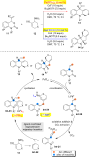
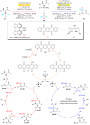
- activation in the divergent synthesis of silacyclic compounds (Scheme 14) [43]. This reaction employs the ODCS reagent to capture a five-membered C,C-palladacycle species, using reaction time as a control switch to enable transformations of three distinct substrates – acrylamides, 2-halo-N







Orthogonal photoswitching of heterobivalent azobenzene glycoclusters: the effect of glycoligand orientation in bacterial adhesion
Beilstein J. Org. Chem. 2025, 21, 736–748, doi:10.3762/bjoc.21.57
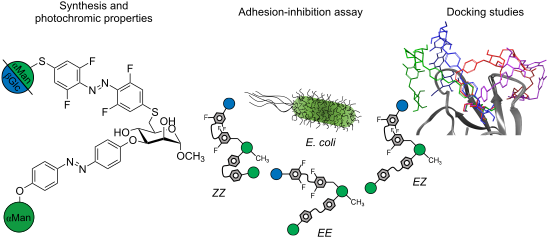
- ]. Specifically, the reversible E/Z isomerization of the azo group in azobenzene glycosides is suited to control the spatial presentation of glycoligands and, for example, switch carbohydrate-specific bacterial adhesion on and off [20][21][22][23]. Indeed, glycoazobenzene derivatives are excellent tools to


Synthesis of N-acetyl diazocine derivatives via cross-coupling reaction
Beilstein J. Org. Chem. 2025, 21, 490–499, doi:10.3762/bjoc.21.36
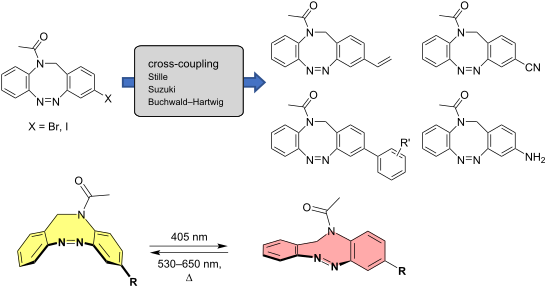
- designing a photoswitchable drug is to place the switch at a position in the pharmacophore that allows switching of the biological effect by irradiation with light without greatly reducing the overall activity by unselective interference with the inhibitor–receptor interaction. This is a difficult task


Beyond symmetric self-assembly and effective molarity: unlocking functional enzyme mimics with robust organic cages
Beilstein J. Org. Chem. 2025, 21, 421–443, doi:10.3762/bjoc.21.30
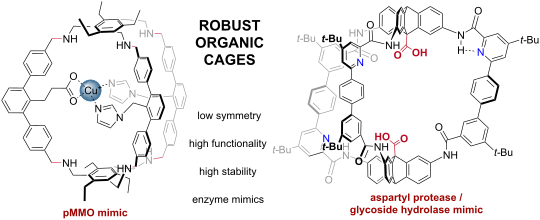
- release [216] and even switch catalysis on and off [196]. MOCs containing peptides in the edge pieces also look promising to direct catalysis [217]. Extended frameworks Metal-organic frameworks (MOFs) [218][219] and covalent organic frameworks (COFs) [220][221][222][223][224] are well-studied as




Red light excitation: illuminating photocatalysis in a new spectrum
Beilstein J. Org. Chem. 2025, 21, 296–326, doi:10.3762/bjoc.21.22
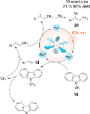
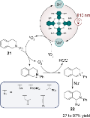
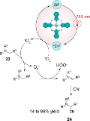
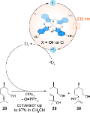
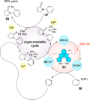
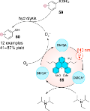
- reaction mixture. This step allows the oxidative addition of nickel on the aryl bromide 9 followed by the reductive elimination giving the desired product 11. Besides the innovative synthetic results obtained in this study, the authors underline a major advantage to switch to red light as it enables a
















Effect of substitution position of aryl groups on the thermal back reactivity of aza-diarylethene photoswitches and prediction by density functional theory
Beilstein J. Org. Chem. 2025, 21, 242–252, doi:10.3762/bjoc.21.16
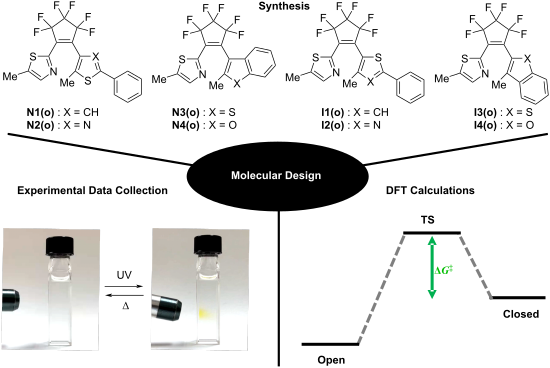
- replacing the rotor pyridyl group of a hydrazone switch with a phenyl group afforded long-lived negative photochromic compounds [49]. In addition, Hecht and co-workers reported that the thermal stability of indigos can be tuned by N-functionalization [50][51]. They revealed that the introduction of electron



Controlled oligomerization of [1.1.1]propellane through radical polarity matching: selective synthesis of SF5- and CF3SF4-containing [2]staffanes
Beilstein J. Org. Chem. 2024, 20, 3134–3143, doi:10.3762/bjoc.20.259
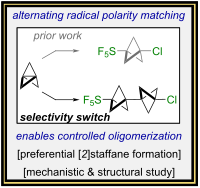
- to be more manageable than controlling oligomerization. However, under the right circumstances, alternating radical polarity matching throughout the chain propagation steps could be one way to theoretically "switch off" oligomerization beyond formation of a [2]staffane. Using this logic, our


Cyclodextrin-based rotaxanes for polymer materials: challenge on simultaneous realization of inexpensive production and defined structures
Beilstein J. Org. Chem. 2024, 20, 3026–3049, doi:10.3762/bjoc.20.252
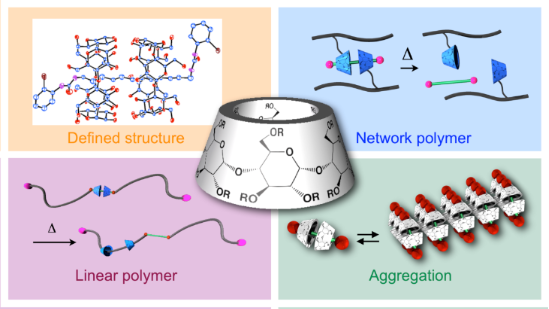
- is derived from the hydrophobic-interaction-based inclusion formation; thus they are only low number of reports on their structural control. The photoisomerization-based structural control system is often applied to CD-based rotaxane. Typically, the photo-switch behavior is used, and it is based on






O,S,Se-containing Biginelli products based on cyclic β-ketosulfone and their postfunctionalization
Beilstein J. Org. Chem. 2024, 20, 2143–2151, doi:10.3762/bjoc.20.184
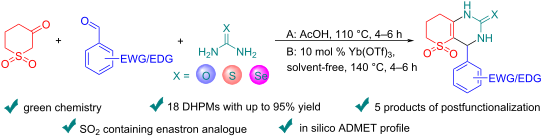
- -alkyl/aryl-substituted analogues, and aldehyde component switch to heteroaromatic (2-pyridinaldehyde) and aliphatic (iPrCHO, cinnamaldehyde). Unfortunately, we failed in both replacements and were unable to obtain any reasonable products. The list of unsuccessful reagents is shown in Figure S7 (see



A fiber-optic spectroscopic setup for isomerization quantum yield determination
Beilstein J. Org. Chem. 2024, 20, 1684–1692, doi:10.3762/bjoc.20.150
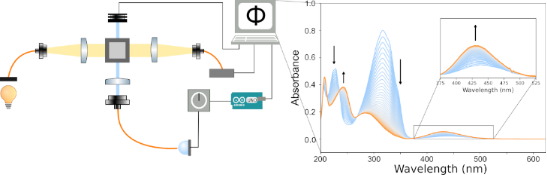
- molecular switch by UV–vis absorption spectroscopy in operando. We provide all the information necessary to build the setup as well as the scripts and examples to retrieve the quantum yields of forward and backward isomerization of a molecular photoswitch following the evolution of the absorption in the low
- the known absorption spectrum of the pure switch [17]. To retrieve the quantum yield values for forward and backward isomerization, we solved rate equations Equations 5 and 6 (or Equation 6 and Equation 7, when the monochromatic excitation light approximation was not considered) numerically using two


Benzylic C(sp3)–H fluorination
Beilstein J. Org. Chem. 2024, 20, 1527–1547, doi:10.3762/bjoc.20.137

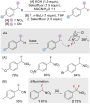
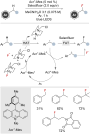
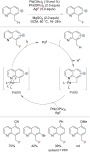
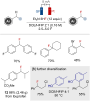
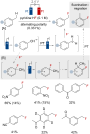
- on the arene were unsuccessful. Without substituents on the ring, aryl C–H activation and subsequent C–O bond formation occurred along with benzylic fluorination (7) (low efficiency). The presence of a p-methoxy group resulted in a switch in selectivity to acyloxylation 8’ as the major product. The
- is therefore not as concentrated in solution, allows for equilibration between benzylic radicals towards the more stable secondary radical. This switch in selectivity provides an interesting tool for selective fluorination in substrates with multiple benzylic sites. In 2017, Wu and co-workers




















A comparison of structure, bonding and non-covalent interactions of aryl halide and diarylhalonium halogen-bond donors
Beilstein J. Org. Chem. 2024, 20, 1428–1435, doi:10.3762/bjoc.20.125
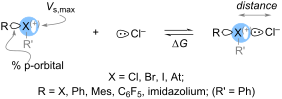
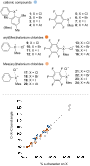
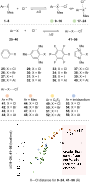
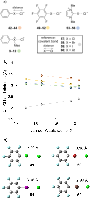
- Information File 1, Table S8) and the electronic energy at the BCPs, E(r) (Scheme 5). On the bonding continuum positive values of E(r) are generally associated non-covalent bonds and negative values of E(r) indicate increasing covalency [42]. We observed a switch from positive E(r) values for the lighter
- (halogen or hypervalent bond) between chloride anion and diarylchloronium cation 9 is non-covalent and likely dominated by electrostatic attraction. A similar switch from non-covalent halogen bond for the lighter (X = Cl and Br) to partially covalent halogen bond for the heavier (X = I and At) was also




Challenge N- versus O-six-membered annulation: FeCl3-catalyzed synthesis of heterocyclic N,O-aminals
Beilstein J. Org. Chem. 2024, 20, 1412–1420, doi:10.3762/bjoc.20.123
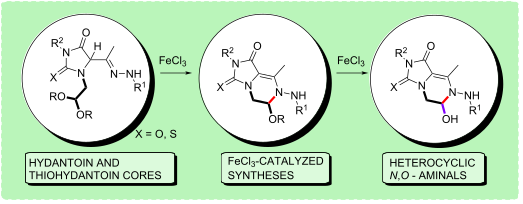
- represents an interesting example of auto-tandem catalysis in which FeCl3 promotes two subsequent reactions. For further confirmation to support our mechanistic hypothesis and in an attempt to switch the reaction toward the formation of hemiaminal 6a, we repeated the reaction of thiohydantoin 4j, (chosen as