Search results
Search for "dimer" in Full Text gives 381 result(s) in Beilstein Journal of Organic Chemistry. Showing first 200.
Deep-blue emitting 9,10-bis(perfluorobenzyl)anthracene
Beilstein J. Org. Chem. 2025, 21, 515–525, doi:10.3762/bjoc.21.39
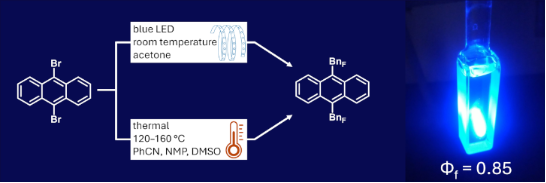
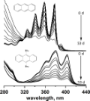
- photoirradiation of the ANTH solution, a set of new resonances (δ = 6.92 (m, 2H), 6.81 (m, 2H), and 4.55 (s, 1H) ppm) appeared and increased in intensity relative to the ANTH resonances. The new photoproduct was identified as a dimer, dianthracene, which had previously been shown to form under anaerobic UV





Unprecedented visible light-initiated topochemical [2 + 2] cycloaddition in a functionalized bimane dye
Beilstein J. Org. Chem. 2025, 21, 500–509, doi:10.3762/bjoc.21.37
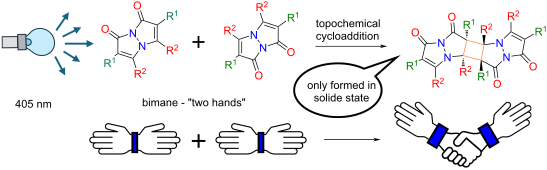
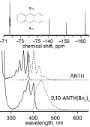
- a [2 + 2] cycloaddition reaction, with approximately 20% yield of the dimer in the crystal. This was particularly notable, given that the compound had spent minimal time in solution with limited exposure to visible light, and no exposure to ultraviolet light. To further explore this phenomenon, we
- packing mode. Extra precautions were taken to shield the compounds from light during synthesis, purification, and storage. After crystallizing each bimane, a vial containing multiple crystals was selected for irradiation studies. Cl2B (B), which showed 5% presence of the [2 + 2] dimer after
- crystallography, was irradiated, resulting in Cl2B (C), which showed approximately 18% dimer formation, while no dimerization was observed in the Me2B and Me4B (C) samples (see experimental section for details). The initial presence of the [2 + 2] dimer in the Cl2B (A) sample can be attributed to improper


Photomechanochemistry: harnessing mechanical forces to enhance photochemical reactions
Beilstein J. Org. Chem. 2025, 21, 458–472, doi:10.3762/bjoc.21.33
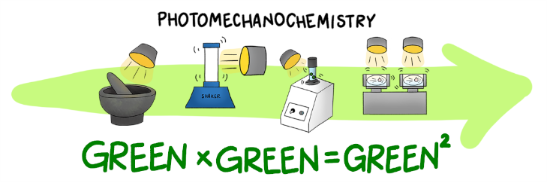
- coordinative bonds on one side and hydrogen bonds on the other. Surprisingly, when the crystals were manually ground for 5 min before irradiation, the conversion to dimer 1.2 remarkably increased to 88% in only 4 h of UV irradiation time. Overall, the role of manual grinding was not only to increase the
- shaking a 1:1 mixture of chalcone (4.1) and 1,1,6,6-tetraphenylhexa-2,4-diyne-1,6-diol (4.2) with a test-tube shaker under irradiation with a high-pressure Hg lamp, the [2 + 2] syn-head-to-tail dimer product 4.3 was obtained selectively in 80% yield after 10 h (Scheme 4) [66]. In detail, 4.2 works as a




Synthesis and characterizations of highly luminescent 5-isopropoxybenzo[rst]pentaphene
Beilstein J. Org. Chem. 2025, 21, 270–276, doi:10.3762/bjoc.21.19
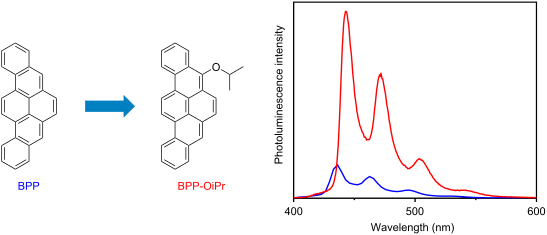
- singlet (S1) state [21]. Notably, a dimer of BPP, 5,5'-bibenzo[rst]pentaphene (BBPP), exhibited an enhanced PLQY of 44% through intensity borrowing from its bright S2 state as well as intriguing symmetry-breaking charge transfer between two BPP units. Moreover, the substitution of BPP with two electron




Efficient synthesis of fluorinated triphenylenes with enhanced arene–perfluoroarene interactions in columnar mesophases
Beilstein J. Org. Chem. 2024, 20, 3263–3273, doi:10.3762/bjoc.20.270
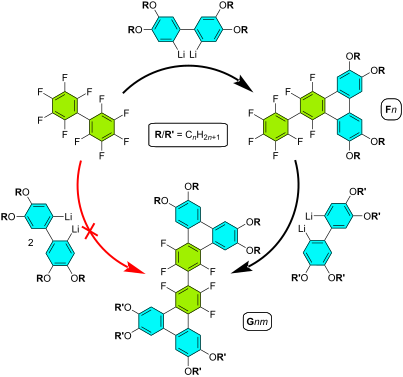
- derivatives: the in situ prepared 2Li-BP5/6 was reacted with F5/6 to yield the symmetrical discotic dimers, G55/G66 respectively, in an average yield of 42–45% (Scheme 1). The reaction of 2Li-BP8 with F4 was also successfully tested, and allowed the preparation of the unsymmetrical discotic dimer G48
- spectra. Their LUMO electron density maps distribute across to the side arm for F1 (−1.88 eV; −1.78 eV for PH1) and to the other triphenylene core for the dimer G11 (−1.78 eV). The π-conjugation of excited states results in a difference of their HOMO and LUMO energy levels: the fluorine dimer G11
- along the main axes: ORTEP diagram showing 50% thermal ellipsoid probability: carbon (gray), fluorine (green), and hydrogen (white). POM textures, observed between crossed polarizers of Janus and dimer, F6, F12, G66, and G48, respectively, as representative examples. More images can be seen in



C–H Trifluoromethylthiolation of aldehyde hydrazones
Beilstein J. Org. Chem. 2024, 20, 2883–2890, doi:10.3762/bjoc.20.242
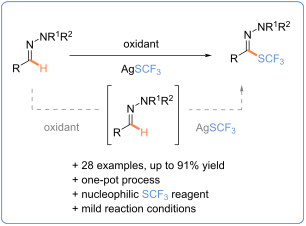
- expected product was detected (Scheme 4C). Having in mind that in the presence of an oxidant, the SCF3 dimer (SCF3)2 might be generated, an additional test was realized. In the presence of NCS in THF, AgSCF3 was converted into the corresponding dimer in 5 min (monitored by 19F NMR). Then, the reaction was



Copper-catalyzed yne-allylic substitutions: concept and recent developments
Beilstein J. Org. Chem. 2024, 20, 2739–2775, doi:10.3762/bjoc.20.232
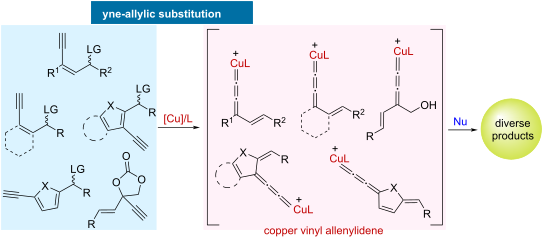
- showed that the reaction exhibits a negative nonlinear effect, while the kinetic experiments indicate that a mono-copper catalyst might be involved in the rate-limiting step. They speculated that the observed nonlinear effect might arise from the existence of both the inactive homo-dimer of ligands and













Synthesis of fluoroalkenes and fluoroenynes via cross-coupling reactions using novel multihalogenated vinyl ethers
Beilstein J. Org. Chem. 2024, 20, 2691–2703, doi:10.3762/bjoc.20.226

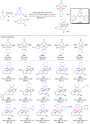
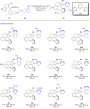
- allylpalladium chloride dimer or bis(triphenylphosphine)palladium dichloride were used as catalyst, the reaction proceeded with the same yield as that in Table 1, entry 4 (entries 7 and 8). Utilizing palladium catalyst such as bis(triphenylphosphine)palladium dichloride, all these reactions could convert 1a into
- low yields of 3a (Table 2, entries 2 and 3). In the case of palladium(II), which produced good yields of the Suzuki–Miyaura cross-coupling products, only a small amount of 3a was obtained (Table 2, entries 4–8). In particular, when the allylpalladium dichloride dimer was used, Sonogashira coupling


Deciphering the mechanism of γ-cyclodextrin’s hydrophobic cavity hydration: an integrated experimental and theoretical study
Beilstein J. Org. Chem. 2024, 20, 2635–2643, doi:10.3762/bjoc.20.221
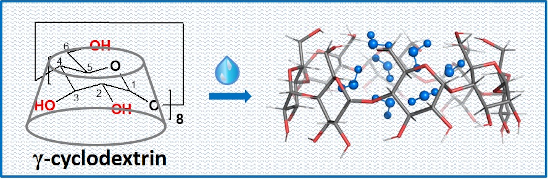
- appears unfavorable in comparison to a single water dimer and single water molecules located on the narrow rim (γ-CD–3H2O (b)). The first layer of water molecules is filled by three water molecules in the plane of the narrow rim, and the fourth incoming guest is displaced into the cavity upon optimization


Anion-dependent ion-pairing assemblies of triazatriangulenium cation that interferes with stacking structures
Beilstein J. Org. Chem. 2024, 20, 2567–2576, doi:10.3762/bjoc.20.215
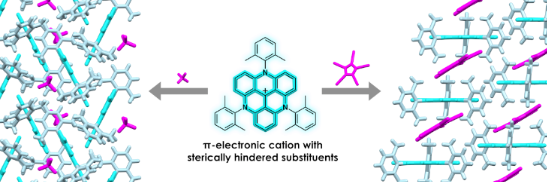
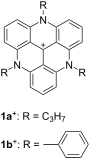
- proximally located PCCp− units formed a partially stacked dimer with a stacking distance of 3.43 Å. The B(C6F5)4− and PCCp− ion pairs with the nearest set of ion pairs showed the Etot values of −115.1 and −100.7 kcal/mol, respectively, with Ees/Edisp values of −48.6/−73.7 and −51.5/−54.9 kcal/mol



Evaluating the halogen bonding strength of a iodoloisoxazolium(III) salt
Beilstein J. Org. Chem. 2024, 20, 2401–2407, doi:10.3762/bjoc.20.204
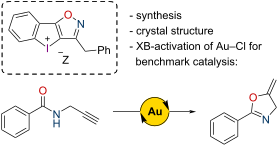
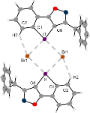
- = 10.9139(1) Å, c = 24.3668(3) Å, β = 95.601(1)°) and a density of 2.01865 g/cm3. Two units of the cationic XB donor form a dimer, which is bridged via two bromide ions (Figure 2). As usual for DAI salts, two XB axes are found on the elongations of the C–I bonds. On the one trans to the isoxazolium unit
- ). Halogen bonding dimer found in the crystal structure of 7Br. Ellipsoids are shown at 50% probability (carbon: grey, nitrogen: blue, oxygen: red, bromine: orange, iodine: purple) and hydrogen atoms are shown in standard ball-and-stick model (white). Halogen and hydrogen bonding is indicated dashed. 1H NMR




Asymmetric organocatalytic synthesis of chiral homoallylic amines
Beilstein J. Org. Chem. 2024, 20, 2349–2377, doi:10.3762/bjoc.20.201
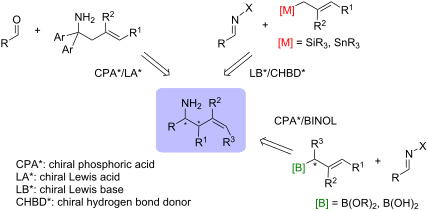
- concerted SN2 mechanism or SN1 mechanism with the allyl nucleophile addition step as rate-determining. Interestingly, the authors observed a 0.55 order in the catalyst, which indicates that a substantial part of the catalyst forms a hydrogen-bonded dimer with Kdiss ≈ 1000 M−1 when not in the catalytic cycle








Synthesis and reactivity of the di(9-anthryl)methyl radical
Beilstein J. Org. Chem. 2024, 20, 2254–2260, doi:10.3762/bjoc.20.193
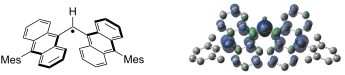
- unit allows for spin localization at the 10-position of anthracene through C–C bond rotation, resulting in a tail-to-tail σ-dimer (Figure 1b). The σ-dimer exhibits an equilibrium state between the monomer radical and the σ-dimer in solution, and mechano-stimulus-induced C–C bond fission in the solid
- activation barrier is only 2.94 kcal mol−1 (Supporting Information File 1, Figure S3). Thus, these two structures are likely in equilibrium and rapidly exchange with each other in solution. The energy difference between DAntM dimer (head-to-head σ-dimer) and DAntM radical monomer was also evaluated, showing
- that the dimer form is energetically preferable by about 3.97 kcal mol−1 (Supporting Information File 1, Figure S2). In VT-ESR measurements at low temperatures, the ESR signal integral decreased with cooling (Supporting Information File 1, Figure S4). However, even at 190 K, the relative signal


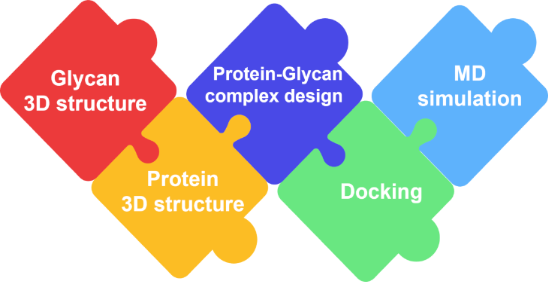
Computational toolbox for the analysis of protein–glycan interactions
Beilstein J. Org. Chem. 2024, 20, 2084–2107, doi:10.3762/bjoc.20.180


Radical reactivity of antiaromatic Ni(II) norcorroles with azo radical initiators
Beilstein J. Org. Chem. 2024, 20, 1967–1972, doi:10.3762/bjoc.20.172
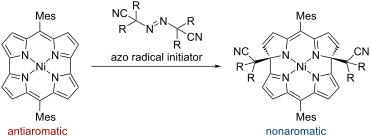
- toluene (Scheme 1). The reaction smoothly proceeded to afford dialkylated macrocycle 2a in 92% yield. In addition to 2a, monoalkylated product 3a and dipyrrin dimer 4a were obtained as minor products in 4% and 3% yield, respectively. The structure of 2a was unambiguously confirmed by single-crystal X-ray


Supramolecular assemblies of amphiphilic donor–acceptor Stenhouse adducts as macroscopic soft scaffolds
Beilstein J. Org. Chem. 2024, 20, 1590–1603, doi:10.3762/bjoc.20.142
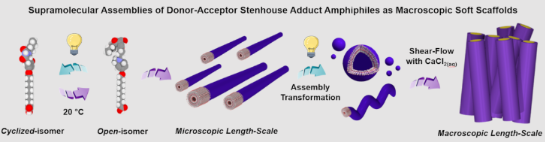
- = 2.24 nm could be attributed to the longer molecular axis of DA11 in dimer form, while that at d = 0.36 nm originated from π–π stacking of the DASA motif. Consistently, diffraction from the longer molecular axis of DA10 in dimer form was shorter (d = 2.19 nm) than that of DA11, revealing the subtle
- at 1.50 nm and 1.45 nm, respectively (Figure S11b and Figure S12b, Supporting Information File 1), revealing the shortened longer molecular axis of DA7 and DA6 in dimer form compared to DA11 and DA10. The observed major diffraction peaks of DA7 and DA6 macroscopic soft scaffolds also originated from




Synthetic applications of the Cannizzaro reaction
Beilstein J. Org. Chem. 2024, 20, 1376–1395, doi:10.3762/bjoc.20.120
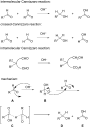
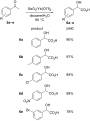
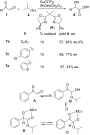
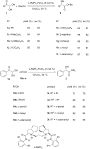
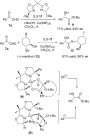
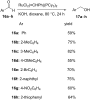
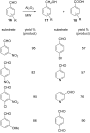
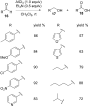
- , formed the product 93 in 36–59% yield along with the overoxidized compound 95, and the dimer 94 as byproducts. However, upon reaction with methanol under acidic conditions, the product 93 and the dimer 94 underwent a smooth transformation to the methyl acetal in high yields. Similar exposure of the









Cofactor-independent C–C bond cleavage reactions catalyzed by the AlpJ family of oxygenases in atypical angucycline biosynthesis
Beilstein J. Org. Chem. 2024, 20, 1198–1206, doi:10.3762/bjoc.20.102
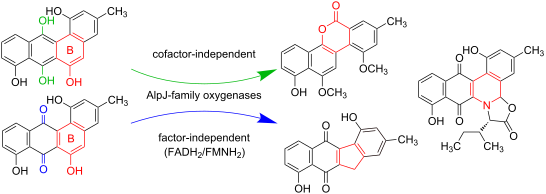
- contraction reactions, yielding a benzofluorene intermediate 4 and the dimer 5, both featuring a kinamycin skeleton (Scheme 1) [11][12]. Recent investigations unveiled the catalytic activity of the O-methyltransferase-like protein AlpH, which catalyzes a unique SAM-independent coupling of ʟ-glutamylhydrazine
- the spontaneous formation of a limited quantity of 1 derived from 8, we detected the generation of products, including the previously characterized benzofluorene intermediate 4 and benzofluorene dimer 5, alongside a novel compound, designated as 10 (Figure 1, trace d). High-resolution mass
- formation of product 4, which through a presumed radical-mediated reaction could spontaneously convert to the dimer 5. Additionally, compound 12 had the potential to be oxidized to hydroquinone–kinobscurinone 10, a proposed precursor of kinobscurinone. When employing 1 as the substrate, such cofactor


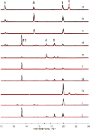


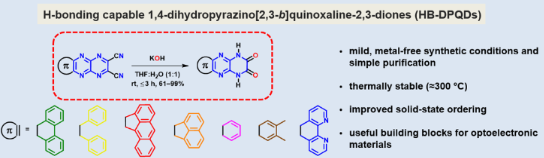
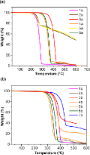
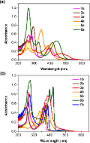
Structure–property relationships in dicyanopyrazinoquinoxalines and their hydrogen-bonding-capable dihydropyrazinoquinoxalinedione derivatives
Beilstein J. Org. Chem. 2024, 20, 1037–1052, doi:10.3762/bjoc.20.92
- respect to the carbonyl groups (Figure 6b) and 5.25° concerning peripheral rings 1 and 3 (Figure 6c). The unit cell is composed of a dimer of 2b held together by intermolecular N–H∙∙∙N and C–H∙∙∙O=C H-bonds with average distances of 2.30 Å and 2.28 Å, respectively (Figure 6d and 6e). The herringbone




Activity assays of NnlA homologs suggest the natural product N-nitroglycine is degraded by diverse bacteria
Beilstein J. Org. Chem. 2024, 20, 830–840, doi:10.3762/bjoc.20.75
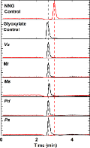
- ). As previously reported, Vs NnlA exhibited two major peaks, a lower molecular weight peak consistent with a dimer and a second peak consistent with a large oligomer [21]. By contrast, the chromatograms of the purified Ps, Mr, Ms, and Pd NnlA were dominated by a single peak ranging in molecular mass
- not change in samples containing reduced Vs NnlA compared with samples without Vs NnlA. Additionally, NO2− was not formed in these samples (Table S4, Supporting Information File 1). Alpha-fold model of NnlA A model of the Vs NnlA dimer was produced using AlphaFold2, which allows for predicting the
- °C in deoxygenated 30 mM tricine buffer at pH 7.5. Alpha-fold model of Vs NnlA dimer (cyan) overlayed with Pseudomonas aeruginosa (grey; PDB: 3VOL [35][36]) to estimate the position and orientation of the heme cofactor. Conserved residues in the distal heme pocket are labeled. Conserved basic




Switchable molecular tweezers: design and applications
Beilstein J. Org. Chem. 2024, 20, 504–539, doi:10.3762/bjoc.20.45
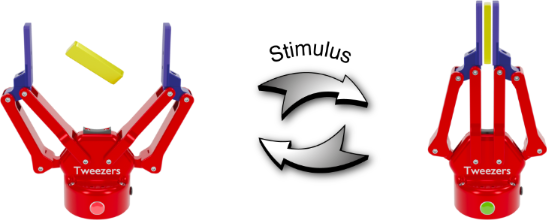
- bisalkynylplatinum(II)–terpyridine clips [54]. The dimer showed photocatalytic activity in the photooxidation of a secondary amine to the corresponding imine that could be deactivated and reactivated by opening or closing the tweezers. Variations on multidentate N-donor ligands have also been developed by Lehn and




Mono or double Pd-catalyzed C–H bond functionalization for the annulative π-extension of 1,8-dibromonaphthalene: a one pot access to fluoranthene derivatives
Beilstein J. Org. Chem. 2024, 20, 427–435, doi:10.3762/bjoc.20.37
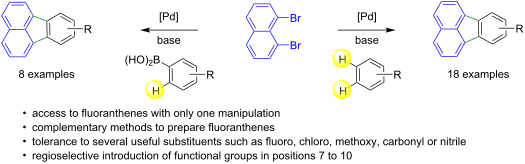
- employ very simple reaction conditions, should be of interest to chemists looking for quick pathways to functionalized fluoranthenes. Experimental General Allylpalladium chloride dimer (98%) and 1,4-bis(diphenylphosphino)butane (dppb) (98%) were purchased from Aldrich. DMA (99+%) extra pure was purchased


Synthesis of π-conjugated polycyclic compounds by late-stage extrusion of chalcogen fragments
Beilstein J. Org. Chem. 2024, 20, 287–305, doi:10.3762/bjoc.20.30
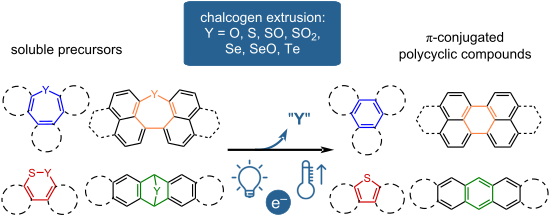
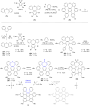
- corresponding boronic acid 9 and a Suzuki–Miyaura cross-coupling between 8 and 9 gave rise to dimer 10, followed by the oxidation of both acenaphthene units into 1,8-naphthalic anhydrides. Installation of the thiepine ring was achieved by a double nucleophilic aromatic substitution induced by sodium sulfide
- dinaphthooxepine bisimides [66], which are analogues of the dinaphthothiepine bisimides presented above with an oxygen atom substituting the sulfur atom (Scheme 9). Their synthesis was successfully achieved in two steps from the known intermediate 5,5’-linked 4-chloro-1,8-naphthalic anhydride dimer 11, already




Additive-controlled chemoselective inter-/intramolecular hydroamination via electrochemical PCET process
Beilstein J. Org. Chem. 2024, 20, 264–271, doi:10.3762/bjoc.20.27
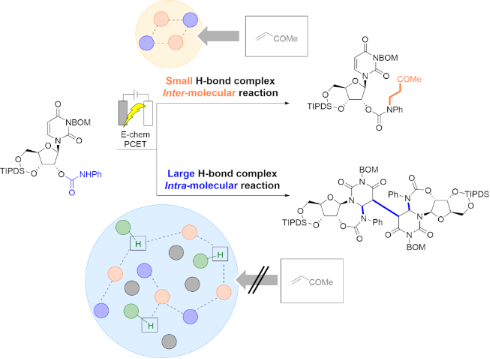
- of conjugate addition of a cathodically generated carbamate anion was ruled out, prompting us to consider that N-alkylation proceeded via a radical mechanism. On the other hand, the addition of 1,1,1,3,3,3-hexafluoro-2-propanol (HFIP) led to the predominant formation of cyclized dimer 4 without N
- -alkylation, whereas the use of AcOH provided N-alkylated product 3 (Table 1, entries 5 and 6). When acetonitrile (MeCN) was used as the solvent, cyclized dimer 4 was obtained (Table 1, entry 7). Next, 1 was subjected to cyclic voltammetry (CV) measurements under varying conditions (Figure 2). An oxidation
- this case, intramolecular radical trapping by the uracil nucleobase was preferred, leading to the formation of the cyclized alkyl radical D. Continuous radical recombination furnished dimer 4. Conclusion We observed additive-controlled inter- and intramolecular chemoselectivity in the hydroamination of


Electron-beam-promoted fullerene dimerization in nanotubes: insights from DFT computations
Beilstein J. Org. Chem. 2024, 20, 92–100, doi:10.3762/bjoc.20.10
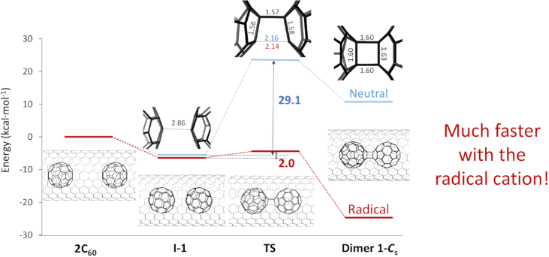
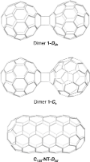
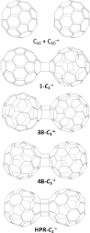
- with irreversible C–C fusions [7]. In phase 1, a [2 + 2] cycloadduct C120 dimer is formed, which was initially proposed to be with Cs symmetry, in contrast to the X-ray structure for the C120 dimer that shows D2h symmetry [3][9]. In phase 2, irreversible structural rearrangements occur leading to a
- % of the total encapsulation energy. As a consequence of the effective π−π interactions, the larger the contact between the fullerene dimer surface and the CNT wall the larger the encapsulation energy. This significant interaction is also apparent from an inspection of the electronic structure of the
- the dimerization of two neutral C60 molecules were also computed for comparison (Table 1). As products, we have considered dimer 1-D2h and dimer 1-Cs, which are products of reversible [2 + 2] cycloadditions (phase 1) between two [6,6]-bonds in the former case and, between a [6,6]-bond and a [6,5]-bond