


Search results
Search for "C–H activation" in Full Text gives 168 result(s) in Beilstein Journal of Organic Chemistry.
A journey in bioinspired supramolecular chemistry: from molecular tweezers to small molecules that target myotonic dystrophy
Beilstein J. Org. Chem. 2016, 12, 125–138, doi:10.3762/bjoc.12.14
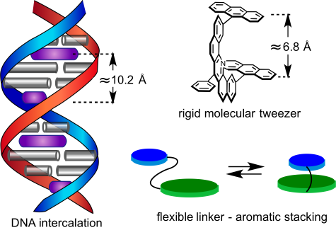
- , Darryl Rideout (coincidentally a Madison West High School classmate), Alanna Schepartz, Alan Schwabacher, George Trainor, Craig Wilcox, and Jeff Winkler. Ron Breslow had broad interests, with projects ranging from developing artificial enzymes, to novel anti-aromatic compounds, to remote C–H activation


Pyridylidene ligand facilitates gold-catalyzed oxidative C–H arylation of heterocycles
Beilstein J. Org. Chem. 2015, 11, 2737–2746, doi:10.3762/bjoc.11.295
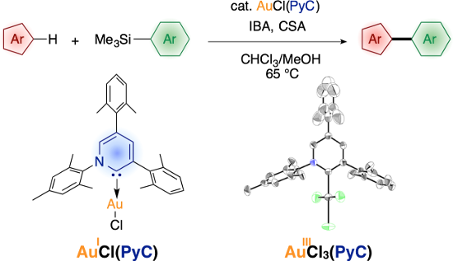
- be a key step in the catalytic cycle consisting of transmetalation with arylsilane, C–H activation and reductive elimination [69]. While gold(I) complexes bearing various ligands are used as gold(III) precursors, it remains unclear whether ligands can still coordinate to the gold center or not under




Recent advances in copper-catalyzed C–H bond amidation
Beilstein J. Org. Chem. 2015, 11, 2209–2222, doi:10.3762/bjoc.11.240

- ideal model of modern organic synthesis, the direct functionalization of inactivated C–H bonds has been proved to be a promising tool to enable atom and step economical synthesis. Inspired by the splendid advances that have taken place in the chemistry of C–H activation, the synthesis of amides has
- to be capable of catalyzing the C–H amidation reactions, copper is particularly advantageous because of the low cost, low toxicity and broad tolerance of copper catalysts. Therefore, the present review summarizes the advances on the copper-catalyzed C–H activation-based amidation (including related
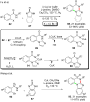
- bond was not favored. More notably, the exploration on the reaction mechanism disclosed that the activation of the alkyl C–H bond was initiated by the tert-butoxy radical (Scheme 6). Inspired by the alkane C–H activation, Yu and Cheng et al. [51] discovered that directly heating amides in cyclohexane




Half-sandwich nickel(II) complexes bearing 1,3-di(cycloalkyl)imidazol-2-ylidene ligands
Beilstein J. Org. Chem. 2015, 11, 2171–2178, doi:10.3762/bjoc.11.235
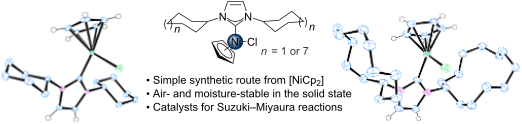
- has also been reported to trigger spontaneous C–H activation upon coordination to Rh(I) and Ir(I) complexes, leading to 14 electron Rh(III) and Ir(III) species [24][25]. While the methodology applied to ICy worked for IDD (Scheme 3b), repeated attempts to isolate the It-Bu analogue were unsuccessful


C–H bond halogenation catalyzed or mediated by copper: an overview
Beilstein J. Org. Chem. 2015, 11, 2132–2144, doi:10.3762/bjoc.11.230
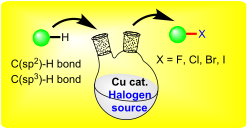
- the conventional electrophilic halogenation of arenes, the site selectivity was a main challenge and mixed haloarene products were frequently obtained. In 2006, Yu and co-workers [32] first realized the selective o-halogenation of pyridine-2-ylbenzenes 1 via C–H activation in a copper/O2 system. As
- -functionalized arene dimerization [37]. Besides the issue of selectivity, another major challenge in the DG-assisted C–H activation lied in the removal of the DG, which undermined the efficiency of the synthetic procedure. To alternate the hardly removable DG of the pyridine ring, Carretero and co-workers [38
- convert smoothly (Scheme 24). Besides catalyzing the halogenation of inactive alkane substrates via a typical C–H activation, copper catalysis also exhibited important application in the electrophilic halogenation of some active methylene substrates such as ketones or esters. Although these active




Active site diversification of P450cam with indole generates catalysts for benzylic oxidation reactions
Beilstein J. Org. Chem. 2015, 11, 1713–1720, doi:10.3762/bjoc.11.186
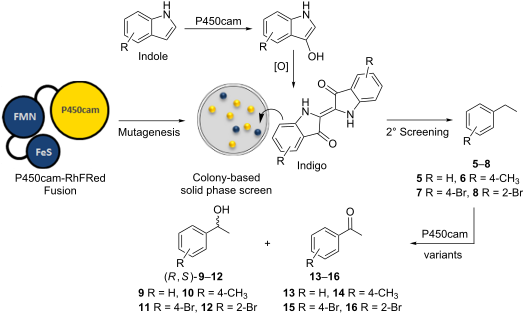
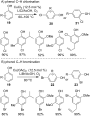
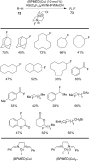
- monooxygenases are useful biocatalysts for C–H activation, and there is a need to expand the range of these enzymes beyond what is naturally available. A panel of 93 variants of active self-sufficient P450cam[Tyr96Phe]-RhFRed fusion enzymes with a broad diversity in active site amino acids was developed by
- hydroxylations. Keywords: active site mutagenesis; biotransformation; C–H activation; cytochrome P450cam monooxygenase; hydroxylation; Introduction Selective C–H activation and oxyfunctionalisation of hydrocarbons offers a route to chiral alcohols and other industrially important synthetic building blocks from


The facile construction of the phthalazin-1(2H)-one scaffold via copper-mediated C–H(sp2)/C–H(sp) coupling under mild conditions
Beilstein J. Org. Chem. 2015, 11, 1624–1631, doi:10.3762/bjoc.11.177

- scaffold has been developed by means of a copper-mediated cascade C–H/C–H coupling and intramolecular annulations and a subsequent facile hydrazinolysis. This C–H activation transformation proceeds smoothly with wide generality, good functional tolerance and high stereo- and regioselectivity under mild
- conditions. Through the removal of the directing group, the resulting moiety could easily be transformed into the phthalazin-1(2H)-one scaffold, which is known to be a privileged moiety and a bioactive nucleus in pharmaceuticals. Keywords: C–H activation; copper; phthalazin-1(2H)-one; Introduction The
- for the construction of the phthalazin-1(2H)-one scaffold. During the last decade, the transition metal-mediated C–H activation reaction has emerged as one of the most important and powerful methodologies for the formation of carbon–carbon bonds in a single synthetic operation [13][14][15][16]. From


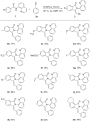
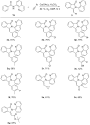


Pd(OAc)2-catalyzed dehydrogenative C–H activation: An expedient synthesis of uracil-annulated β-carbolinones
Beilstein J. Org. Chem. 2015, 11, 1360–1366, doi:10.3762/bjoc.11.146
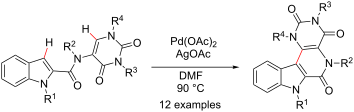
- .11.146 Abstract An intramolecular dehydrogenative C–H activation enabled an efficient synthesis of an uracil-annulated β-carbolinone ring system. The reaction is simple, efficient and high yielding (85–92%). Keywords: β-carbolinones; cyclization; dehydrogenative C–H activation; Pd(OAc)2; uracil
- dehydrogenative annulation of indole-carboxamides with alkynes etc [36]. The development of metal-catalyzed C–H activation reaction has revolutionized the way a synthetic chemist now approaches a traditional C–C bond disconnection [32][33][34][35][36][37][38][39][40][41][42][43][44]. Dehydrogenative C–H
- -carbolinones via a high yielding dehydrogenative C–H activation process. The key to the success of this reaction is the complementary electronic properties of the indole C3–H bond and the uracil C6–H bond. It is anticipated this efficient and atom economic approach can be emulated for the preparation of other


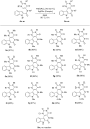


Radical-mediated dehydrative preparation of cyclic imides using (NH4)2S2O8–DMSO: application to the synthesis of vernakalant
Beilstein J. Org. Chem. 2015, 11, 1008–1016, doi:10.3762/bjoc.11.113

- persistent interest [28][29][30][31][32][33][34][35][36][37][38][39][40][41][42][43][44][45][46][47][48][49][50][51][52][53][54]. Results and Discussion While working on the development of a palladium-catalyzed decarboxylative C–H activation methodology to access the important core structure dihydroquinolone


Chiroptical properties of 1,3-diphenylallene-anchored tetrathiafulvalene and its polymer synthesis
Beilstein J. Org. Chem. 2015, 11, 972–979, doi:10.3762/bjoc.11.109
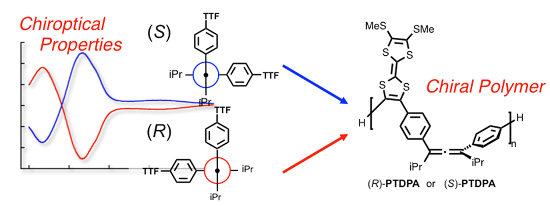
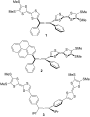
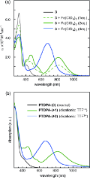
- carried out by direct C–H activation of the TTF unit, and the chiroptical properties of the resulting polymer were also investigated. Keywords: allene; axial chirality; chiroptical properties; redox; tetrathiafulvalene; Introduction Recently, there has been a growing interest in chiral π-conjugated
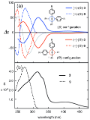
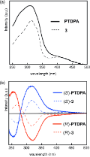
- chain scaffold (PTDPA) was also prepared using a direct C–H activation of the TTF framework. The resultant chiral polymers exhibited the characteristic Cotton effect associated with the central chiral 1,3-diphenylallene moieties. The polymer also did not undergo racemization under daylight. Moreover




Ruthenium-catalyzed C–H activation of thioxanthones
Beilstein J. Org. Chem. 2015, 11, 431–436, doi:10.3762/bjoc.11.49

- /bjoc.11.49 Abstract Thioxanthones – being readily available in one step from thiosalicylic acid and arenes – were used in ruthenium-catalyzed C–H-activation reaction to produce 1-mono- or 1,8-disubstituted thioxanthones in good to excellent yields. Scope and limitation of this reaction are presented
- . Keywords: C–H activation; metal catalysis; thioxanthones; Introduction Thioxanthones (Figure 1) belong as a unique member to the large group of benzoannelated heterocycles [1]. They have found extensive use in biomedical applications (drugs and other bioactive compounds [2][3][4][5]) and material sciences
- chemistry aiming at a high degree of substitution seems to be well explored [17][18]. This fact motivated us to extend existing methods [14][15] for the synthesis of substituted thioxanthones. We were intrigued by the fact that carbonyl-substituted arenes can undergo a smooth C–H activation and alkylation


Cross-dehydrogenative coupling for the intermolecular C–O bond formation
Beilstein J. Org. Chem. 2015, 11, 92–146, doi:10.3762/bjoc.11.13
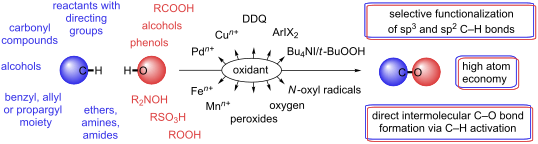
- reactions of CH- and OH-reagents, closely related C–H activation processes involving intermolecular C–O bond formation are discussed: acyloxylation reactions with ArI(O2CR)2 reagents and generation of O-reagents in situ from C-reagents (methylarenes, aldehydes, etc.). Keywords: acyloxylation; alkoxylation



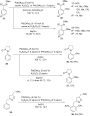


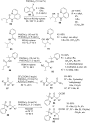


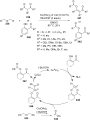


The Shono-type electroorganic oxidation of unfunctionalised amides. Carbon–carbon bond formation via electrogenerated N-acyliminium ions
Beilstein J. Org. Chem. 2014, 10, 3056–3072, doi:10.3762/bjoc.10.323
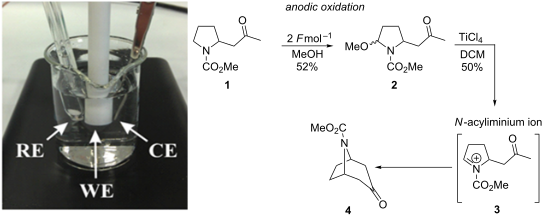
- to the C–H activation of low reactivity intermediates. In this article, containing over 100 references, we highlight the development of the Shono-type oxidations from the original direct electrolysis methods, to the use of electroauxiliaries before arriving at indirect electrolysis methodologies. We


Sequential decarboxylative azide–alkyne cycloaddition and dehydrogenative coupling reactions: one-pot synthesis of polycyclic fused triazoles
Beilstein J. Org. Chem. 2014, 10, 3031–3037, doi:10.3762/bjoc.10.321
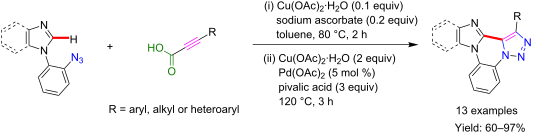
- (90–105 kcal/mol) to form a new, weaker C–M bond (50–80 kcal/mol), followed by generation of a new C–C bond. Generally, transition metal-catalyzed sp2 C–H activation is facilitated by directing groups [10][11][12][13] or heteroatoms in the heterocyclic compounds [14][15][16][17][18]. This methodology
- has been applied in the synthesis of polycyclic frameworks as well as in the preparation of biologically important compounds [19][20][21][22][23]. Further development of this reaction has led to double C–H activation which has been used for the construction of biaryl compounds [24][25][26][27][28][29
- ][30][31][32][33]. The double C–H activation (dehydrogenative cross coupling) reaction can be classified into two categories: intermolecular and intramolecular. There are several reports in literature describing intermolecular sp2 C–H/C–H coupling reactions [24][25][26][27][28][29][30][31][32][33


Lewis acid-catalyzed redox-neutral amination of 2-(3-pyrroline-1-yl)benzaldehydes via intramolecular [1,5]-hydride shift/isomerization reaction
Beilstein J. Org. Chem. 2014, 10, 2892–2896, doi:10.3762/bjoc.10.306

- : catalysis; C–H activation; hydride-shift; Lewis acid; redox reaction; Introduction The direct and selective functionalization of the inactive C(sp3)–H bond constitute an economically attractive strategy for organic syntheses [1][2][3][4][5][6][7][8][9][10]. Until now, a number of transition metals can be


Recent advances in the electrochemical construction of heterocycles
Beilstein J. Org. Chem. 2014, 10, 2858–2873, doi:10.3762/bjoc.10.303
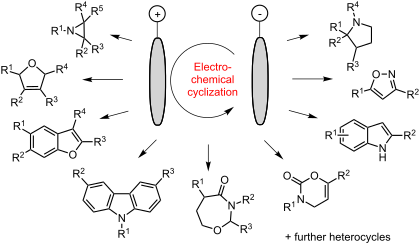
- certain functional groups [3][4]. In the last decades, research in this field has therefore been focused on the development of more efficient and selective strategies. In the current focus of heterocycle synthesis are C,H-activation with transition metal catalysts [5][6][7][8], oxidative cyclization using


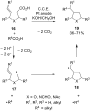


Exploration of C–H and N–H-bond functionalization towards 1-(1,2-diarylindol-3-yl)tetrahydroisoquinolines
Beilstein J. Org. Chem. 2014, 10, 2186–2199, doi:10.3762/bjoc.10.226

- wanted to use direct functionalization either via C–H activation or cross dehydrogenative coupling for C–C-bond-forming reactions avoiding the use of two prefunctionalized building blocks. Naturally, C–N-bond formation should proceed via Buchwald–Hartwig coupling. The target molecules can be considered


P(O)R2-directed Pd-catalyzed C–H functionalization of biaryl derivatives to synthesize chiral phosphorous ligands
Beilstein J. Org. Chem. 2014, 10, 2071–2076, doi:10.3762/bjoc.10.215
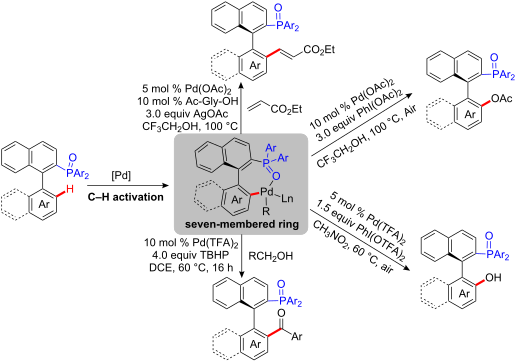
- . China 10.3762/bjoc.10.215 Abstract Chiral phosphorus ligands have been widely used in transition metal-catalyzed asymmetric reactions. Herein, we report a new synthesis approach of chiral biaryls containing a phosphorus moiety using P(O)R2-directed Pd-catalyzed C–H activation; the functionalized
- ]. Despite the progress in this area, only limited development has been accomplished through metal-catalyzed C–H activation to build C–P bonds [17][18]. As an alternative, we disclosed a novel protocol of palladium-catalyzed C–H functionalization by using the P(O)R2 moiety as a new directing group to
- -phenylboronic acid that is not applicable in these reactions. As the P(O)Ar2 group showed a better directing ability in the process of C–H activation, the axial chiral P(O)(OEt)2 4a was transformed into P(O)Ar2 by reacting with an arylgrignard reagent (Scheme 2) [32]. At the same time, the racemic substrates


Synthesis of 2-substituted tryptophans via a C3- to C2-alkyl migration
Beilstein J. Org. Chem. 2014, 10, 1991–1998, doi:10.3762/bjoc.10.207
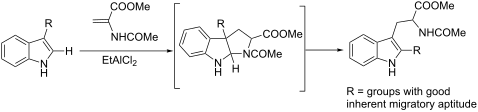
- ][57]. More recently, direct C2-arylation and alkylation of N-protected tryptophan methyl ester have been reported in the context of a more extensive study on C−H activation reactions [58][59][60][61]. The present procedure is comparable to those described previously in terms of yield, but it is


Synthesis of ethoxy dibenzooxaphosphorin oxides through palladium-catalyzed C(sp2)–H activation/C–O formation
Beilstein J. Org. Chem. 2014, 10, 1220–1227, doi:10.3762/bjoc.10.120
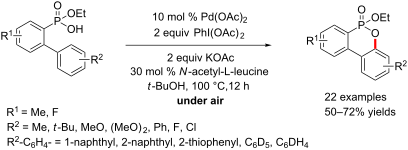
- We report an efficient Pd-catalyzed C(sp2)–H activation/C–O bond formation for the synthesis of ethoxy dibenzooxaphosphorin oxides from 2-(aryl)arylphosphonic acid monoethyl esters under aerobic conditions. Keywords: C–H activation; catalysis; cyclization; palladium; phosphorus heterocyclic compound
- ; Introduction Unreactive C(sp2)–H and C(sp3)–H bonds are ubiquitous in organic compounds [1][2][3][4][5][6][7], so that the development of methods for the transition metal-catalyzed C–H activation is one of the challenging goals in organic synthesis. Especially, the development of synthetic methods of C
- –heteroatom bond formation via C–H activation has received attention owing to the omnipresence of heterocyclic compounds in nature [8]. Recently, it has been demonstrated that the intramolecular bond formation between a heteroatom and a vicinal unreactive C–H is an efficient method for the synthesis of


Silver and gold-catalyzed multicomponent reactions
Beilstein J. Org. Chem. 2014, 10, 481–513, doi:10.3762/bjoc.10.46
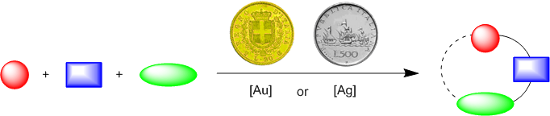
- °C, but also the cheaper Ph3PAuCl/AgOTf gave respectable results. Surprisingly, AuBr3 was not able to promote this cascade reaction. A special feature of this approach is that when R4 is a o-alkynylbenzene a further Au-catalyzed cascade process involving C–H activation can occur to give the


New developments in gold-catalyzed manipulation of inactivated alkenes
Beilstein J. Org. Chem. 2013, 9, 2586–2614, doi:10.3762/bjoc.9.294
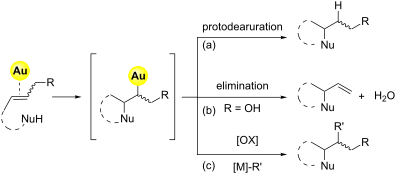
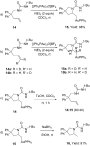
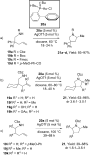
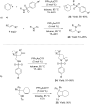
- . Cooperative [Au(I)]/menthol catalysis for the enantioselective intramolecular hydroamination of dienes. Acknowledgements Acknowledgment is made to Progetto FIRB “Futuro in Ricerca” Innovative sustainable synthetic methodologies for C–H activation processes, (MIUR, Rome) and the Università di Bologna.








Recent advances in transition metal-catalyzed Csp2-monofluoro-, difluoro-, perfluoromethylation and trifluoromethylthiolation
Beilstein J. Org. Chem. 2013, 9, 2476–2536, doi:10.3762/bjoc.9.287
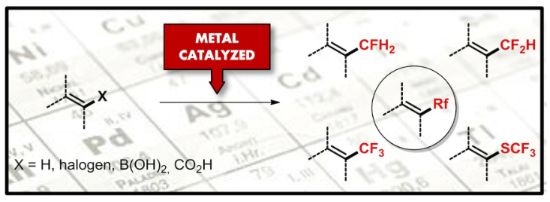
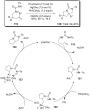
- results for nonaflate electrophiles. Otherwise, the scope is actually limited to six-membered vinyl sulfonates, and moderate yields were obtained with 2-alkyl substituted cyclohexenyl substrates. 3.1.2 Trifluoromethylation by means of C–H activation and an electrophilic CF3-source. In 2010, J.-Q. Yu and
- with lower yields than acetanilide. From the study of kinetic isotope effects in several experiments as well as of a Pd-insertion complex similarly to the work of J.-Q. Yu et al., the authors proposed a Pd(II)/Pd(IV) catalytic cycle starting with C–H activation of the substrate followed by oxidation of
- the complex with Umemoto’s reagent and completed by reductive elimination of the desired benzotrifluoride (Figure 2). 3.1.3 Perfluoroalkylation by means of C–H activation and a perfluoroalkyl radical-source. In contrast to the studies described above, the group of M. S. Sanford has developed a Pd


Enantioselective synthesis of planar chiral ferrocenes via palladium-catalyzed annulation with diarylethynes
Beilstein J. Org. Chem. 2013, 9, 1891–1896, doi:10.3762/bjoc.9.222

- enantioselectivity (up to 99% ee). Keywords: annulation; asymmetric catalysis; C–H activation; ferrocene; palladium; planar chirality; Introduction Chiral ferrocene derivatives have been widely applied to asymmetric catalysis, materials science, biomedical research, etc. [1][2][3][4]. Particularly, ferrocenes with
- ][28]. Despite these pioneering studies, the catalytic asymmetric methods to introduce ferrocenyl planar chirality are rather limited. Recently, a monoprotected amino acid was introduced as an efficient ligand in Pd-catalyzed enantioselective C–H activation by Yu and co-workers [29][30][31][32][33][34


Iron-catalyzed decarboxylative alkenylation of cycloalkanes with arylvinyl carboxylic acids via a radical process
Beilstein J. Org. Chem. 2013, 9, 1718–1723, doi:10.3762/bjoc.9.197
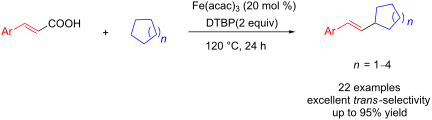
- , numerous transition-metal-catalyzed processes, such as Pd [12][13][14][15][16][17][18], Cu [19][20][21][22][23], Ru [24][25][26][27], Rh [28][29][30][31], Co [32][33][34], Au [35][36], Ir [37][38][39], Fe [40][41][42][43] and other metals [44][45][46][47], have been developed for sp3 C–H activation





