Search for "amino acids" in Full Text gives 543 result(s) in Beilstein Journal of Organic Chemistry. Showing first 200.
Beilstein J. Org. Chem. 2020, 16, 1163–1187, doi:10.3762/bjoc.16.103
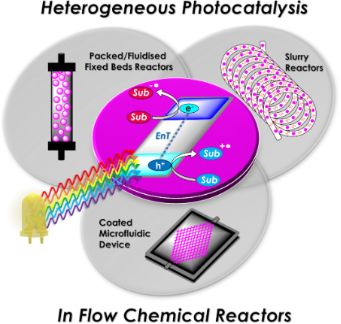
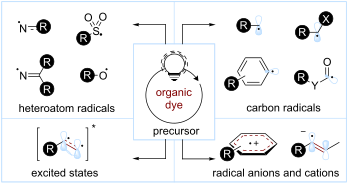
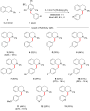
Graphical Abstract
Figure 1: Selected examples of organic dyes. Mes-Acr+: 9-mesityl-10-methylacridinium, DCA: 9,10-dicyanoanthra...
Scheme 1: Activation modes in photocatalysis.
Scheme 2: Main strategies for the formation of C(sp3) radicals used in organophotocatalysis.
Scheme 3: Illustrative example for the photocatalytic oxidative generation of radicals from carboxylic acids:...
Scheme 4: Illustrative example for the photocatalytic reductive generation of C(sp3) radicals from redoxactiv...
Figure 2: Common substrates for the photocatalytic oxidative generation of C(sp3) radicals.
Scheme 5: Illustrative example for the photocatalytic oxidative generation of radicals from dihydropyridines ...
Scheme 6: Illustrative example for the photocatalytic oxidative generation of C(sp3) radicals from trifluorob...
Scheme 7: Illustrative example for the photocatalytic reductive generation of C(sp3) radicals from benzylic h...
Scheme 8: Illustrative example for the photocatalytic generation of C(sp3) radicals via direct HAT: the cross...
Scheme 9: Illustrative example for the photocatalytic generation of C(sp3) radicals via indirect HAT: the deu...
Scheme 10: Selected precursors for the generation of aryl radicals using organophotocatalysis.
Scheme 11: Illustrative example for the photocatalytic reductive generation of aryl radicals from aryl diazoni...
Scheme 12: Illustrative examples for the photocatalytic reductive generation of aryl radicals from haloarenes:...
Scheme 13: Illustrative example for the photocatalytic reductive generation of aryl radicals from aryl halides...
Scheme 14: Illustrative example for the photocatalytic reductive generation of aryl radicals from arylsulfonyl...
Scheme 15: Illustrative example for the reductive photocatalytic generation of aryl radicals from triaryl sulf...
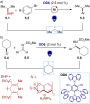
Scheme 16: Main strategies towards acyl radicals used in organophotocatalysis.
Scheme 17: Illustrative example for the decarboxylative photocatalytic generation of acyl radicals from α-keto...
Scheme 18: Illustrative example for the oxidative photocatalytic generation of acyl radicals from acyl silanes...
Scheme 19: Illustrative example for the oxidative photocatalytic generation of carbamoyl radicals from 4-carba...
Scheme 20: Illustrative example of the photocatalytic HAT approach for the generation of acyl radicals from al...
Scheme 21: General reactivity of a) radical cations; b) radical anions; c) the main strategies towards aryl an...
Scheme 22: Illustrative example for the oxidative photocatalytic generation of alkene radical cations from alk...
Scheme 23: Illustrative example for the reductive photocatalytic generation of an alkene radical anion from al...
Figure 3: Structure of C–X radical anions and their neutral derivatives.
Scheme 24: Illustrative example for the photocatalytic reduction of imines and the generation of an α-amino C(...
Scheme 25: Illustrative example for the oxidative photocatalytic generation of aryl radical cations from arene...
Scheme 26: NCR classifications and generation.
Scheme 27: Illustrative example for the photocatalytic reductive generation of iminyl radicals from O-aryl oxi...
Scheme 28: Illustrative example for the photocatalytic oxidative generation of iminyl radicals from α-N-oxy ac...
Scheme 29: Illustrative example for the photocatalytic oxidative generation of iminyl radicals via an N–H bond...
Scheme 30: Illustrative example for the photocatalytic oxidative generation of amidyl radicals from Weinreb am...
Scheme 31: Illustrative example for the photocatalytic reductive generation of amidyl radicals from hydroxylam...
Scheme 32: Illustrative example for the photocatalytic reductive generation of amidyl radicals from N-aminopyr...
Scheme 33: Illustrative example for the photocatalytic oxidative generation of amidyl radicals from α-amido-ox...
Scheme 34: Illustrative example for the photocatalytic oxidative generation of aminium radicals: the N-aryltet...
Scheme 35: Illustrative example for the photocatalytic oxidative generation of nitrogen-centered radical catio...
Scheme 36: Illustrative example for the photocatalytic oxidative generation of nitrogen-centered radical catio...
Scheme 37: Illustrative example for the photocatalytic oxidative generation of hydrazonyl radical from hydrazo...
Scheme 38: Generation of O-radicals.
Scheme 39: Illustrative examples for the photocatalytic generation of O-radicals from N-alkoxypyridinium salts...
Scheme 40: Illustrative examples for the photocatalytic generation of O-radicals from alkyl hydroperoxides: th...
Scheme 41: Illustrative example for the oxidative photocatalytic generation of thiyl radicals from thiols: the...
Scheme 42: Main strategies and reagents for the generation of sulfonyl radicals used in organophotocatalysis.
Scheme 43: Illustrative example for the reductive photocatalytic generation of sulfonyl radicals from arylsulf...
Scheme 44: Illustrative example of a Cl atom abstraction strategy for the photocatalytic generation of sulfamo...
Scheme 45: Illustrative example for the oxidative photocatalytic generation of sulfonyl radicals from sulfinic...
Scheme 46: Illustrative example for the photocatalytic generation of electronically excited triplet states: th...
Scheme 47: Illustrative example for the photocatalytic generation of electronically excited triplet states: th...
Beilstein J. Org. Chem. 2020, 16, 1111–1123, doi:10.3762/bjoc.16.98
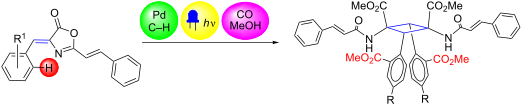
Graphical Abstract
Figure 1: (a) General scheme for truxillic acid derivatives; (b) general scheme for symmetric 1,3-diaminotrux...
Figure 2: (a) (Z)-4-Arylidene-2-aryl-5(4H)-oxazolones used for the synthesis of 1,3-diaminotruxillic derivati...
Figure 3: (Z)-4-Arylidene-2((E)-styryl)-5(4H)-oxazolones 2a–j used in this work and overall reaction scheme.
Figure 4: Molecular drawing of the oxazolone 2c.
Scheme 1: Ortho-palladation of oxazolones 2 by treatment with Pd(OAc)2 and different structures obtained for ...
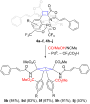
Scheme 2: [2 + 2] Photocycloaddition of cyclopalladated complexes 3 in solution to give the dinuclear cyclobu...
Figure 5: Molecular drawing of cyclobutane ortho-palladated 4a. Ellipsoids are shown at the 50% probability l...
Scheme 3: Release of the 1,3-diaminotruxillic bis-amino ester derivatives 5 by methoxycarbonylation of the Pd...
Beilstein J. Org. Chem. 2020, 16, 1022–1050, doi:10.3762/bjoc.16.91
Graphical Abstract
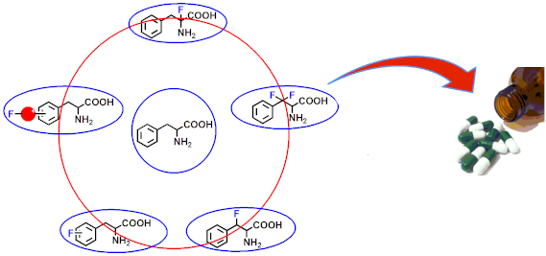
Figure 1: Categories I–V of fluorinated phenylalanines.
Scheme 1: Synthesis of fluorinated phenylalanines via Jackson’s method.
Scheme 2: Synthesis of all-cis-tetrafluorocyclohexylphenylalanines.
Scheme 3: Synthesis of ʟ-4-[sulfono(difluoromethyl)]phenylalanine (nPt: neopentyl, TCE: trichloroethyl).
Scheme 4: Synthesis of ʟ-4-[sulfono(difluoromethyl)]phenylalanine derivatives 17.
Scheme 5: Synthesis of fluorinated Phe analogues from Cbz-protected aminomalonates.
Scheme 6: Synthesis of tetrafluorophenylalanine analogues via the 3-methyl-4-imidazolidinone auxiliary 25.
Scheme 7: Synthesis of tetrafluoro-Phe derivatives via chiral auxiliary 31.
Scheme 8: Synthesis of 2,5-difluoro-Phe and 2,4,5-trifluoro-Phe via Schöllkopf reagent 34.
Scheme 9: Synthesis of 2-fluoro- and 2,6-difluoro Fmoc-Phe derivatives starting from chiral auxiliary 39.
Scheme 10: Synthesis of 2-[18F]FPhe via chiral auxiliary 43.
Scheme 11: Synthesis of FPhe 49a via photooxidative cyanation.
Scheme 12: Synthesis of FPhe derivatives via Erlenmeyer azalactone synthesis.
Scheme 13: Synthesis of (R)- and (S)-2,5-difluoro Phe via the azalactone method.
Scheme 14: Synthesis of 3-bromo-4-fluoro-(S)-Phe (65).
Scheme 15: Synthesis of [18F]FPhe via radiofluorination of phenylalanine with [18F]F2 or [18F]AcOF.
Scheme 16: Synthesis of 4-borono-2-[18F]FPhe.
Scheme 17: Synthesis of protected 4-[18F]FPhe via arylstannane derivatives.
Scheme 18: Synthesis of FPhe derivatives via intermediate imine formation.
Scheme 19: Synthesis of FPhe derivatives via Knoevenagel condensation.
Scheme 20: Synthesis of FPhe derivatives 88a,b from aspartic acid derivatives.
Scheme 21: Synthesis of 2-(2-fluoroethyl)phenylalanine derivatives 93 and 95.
Scheme 22: Synthesis of FPhe derivatives via Zn2+ complexes.
Scheme 23: Synthesis of FPhe derivatives via Ni2+ complexes.
Scheme 24: Synthesis of 3,4,5-trifluorophenylalanine hydrochloride (109).
Scheme 25: Synthesis of FPhe derivatives via phenylalanine aminomutase (PAM).
Scheme 26: Synthesis of (R)-2,5-difluorophenylalanine 115.
Scheme 27: Synthesis of β-fluorophenylalanine via 2-amino-1,3-diol derivatives.
Scheme 28: Synthesis of β-fluorophenylalanine derivatives via the oxazolidinone chiral auxiliary 122.
Scheme 29: Synthesis of β-fluorophenylalanine from pyruvate hemiketal 130.
Scheme 30: Synthesis of β-fluorophenylalanine (136) via fluorination of β-hydroxyphenylalanine (137).
Scheme 31: Synthesis of β-fluorophenylalanine from aziridine derivatives.
Scheme 32: Synthesis of β-fluorophenylalanine 136 via direct fluorination of pyruvate esters.
Scheme 33: Synthesis of β-fluorophenylalanine via fluorination of ethyl 3-phenylpyruvate enol using DAST.
Scheme 34: Synthesis of β-fluorophenylalanine derivatives using photosensitizer TCB.
Scheme 35: Synthesis of β-fluorophenylalanine derivatives using Selectflour and dibenzosuberenone.
Scheme 36: Synthesis of protected β-fluorophenylalanine via aziridinium intermediate 150.
Scheme 37: Synthesis of β-fluorophenylalanine derivatives via fluorination of α-hydroxy-β-aminophenylalanine d...
Scheme 38: Synthesis of β-fluorophenylalanine derivatives from α- or β-hydroxy esters 152a and 155.
Scheme 39: Synthesis of a series of β-fluoro-Phe derivatives via Pd-catalyzed direct fluorination of β-methyle...
Scheme 40: Synthesis of series of β-fluorinated Phe derivatives using quinoline-based ligand 162 in the Pd-cat...
Scheme 41: Synthesis of β,β-difluorophenylalanine derivatives from 2,2-difluoroacetaldehyde derivatives 164a,b....
Scheme 42: Synthesis of β,β-difluorophenylalanine derivatives via an imine chiral auxiliary.
Scheme 43: Synthesis of α-fluorophenylalanine derivatives via direct fluorination of protected Phe 174.
Figure 2: Structures of PET radiotracers of 18FPhe derivatives.
Figure 3: Structures of melfufen (179) and melphalan (180) anticancer drugs.
Figure 4: Structure of gastrazole (JB95008, 181), a CCK2 receptor antagonist.
Figure 5: Dual CCK1/CCK2 antagonist 182.
Figure 6: Structure of sitagliptin (183), an antidiabetic drug.
Figure 7: Structure of retaglpitin (184) and antidiabetic drug.
Figure 8: Structure of evogliptin (185), an antidiabetic drug.
Figure 9: Structure of LY2497282 (186) a DPP-4 inhibitor for the treatment of type II diabetes.
Figure 10: Structure of ulimorelin (187).
Figure 11: Structure of GLP1R (188).
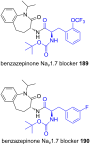
Figure 12: Structures of Nav1.7 blockers 189 and 190.
Beilstein J. Org. Chem. 2020, 16, 956–965, doi:10.3762/bjoc.16.84
Graphical Abstract
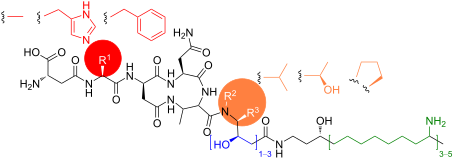
Figure 1: General biosynthesis of fabclavine Ia (1) in X. budapestensis (A) and representation of a shortened...
Figure 2: Comparison of the fcl BGCs in Xenorhabdus and Photorhabdus strains responsible for the fabclavine b...
Beilstein J. Org. Chem. 2020, 16, 917–955, doi:10.3762/bjoc.16.83
Graphical Abstract
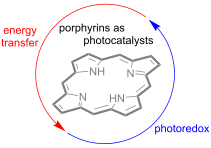
Figure 1: Chemical structures of the porphyrinoids and their absorption spectra: in bold are highlighted the ...
Figure 2: Photophysical and photochemical processes (Por = porphyrin). Adapted from [12,18].
Figure 3: Main dual photocatalysts and their oxidative/reductive excited state potentials, including porphyri...
Scheme 1: Photoredox alkylation of aldehydes with diazo acetates using porphyrins and a Ru complex. aUsing a ...
Scheme 2: Proposed mechanism for the alkylation of aldehydes with diazo acetates in the presence of TPP.
Scheme 3: Arylation of heteroarenes with aryldiazonium salts using TPFPP as photocatalyst, and corresponding ...
Scheme 4: A) Scope with different aryldiazonium salts and enol acetates. B) Photocatalytic cycles and compari...
Scheme 5: Photoarylation of isopropenyl acetate A) Comparison between batch and continuous-flow approaches an...
Scheme 6: Dehalogenation induced by red light using thiaporphyrin (STPP).
Scheme 7: Applications of NiTPP as both photoreductant and photooxidant.
Scheme 8: Proposed mechanism for obtaining tetrahydroquinolines by reductive quenching.
Scheme 9: Selenylation and thiolation of anilines.
Scheme 10: NiTPP as photoredox catalyst in oxidative and reductive quenching, in comparison with other photoca...
Scheme 11: C–O bond cleavage of 1-phenylethanol using a cobalt porphyrin (CoTMPP) under visible light.
Scheme 12: Hydration of terminal alkynes by RhIII(TSPP) under visible light irradiation.
Scheme 13: Regioselective photocatalytic hydro-defluorination of perfluoroarenes by RhIII(TSPP).
Scheme 14: Formation of 2-methyl-2,3-dihydrobenzofuran by intramolecular hydro-functionalization of allylpheno...
Scheme 15: Photocatalytic oxidative hydroxylation of arylboronic acids using UNLPF-12 as heterogeneous photoca...
Scheme 16: Photocatalytic oxidative hydroxylation of arylboronic acids using MOF-525 as heterogeneous photocat...
Scheme 17: Preparation of the heterogeneous photocatalyst CNH.
Scheme 18: Photoinduced sulfonation of alkenes with sulfinic acid using CNH as photocatalyst.
Scheme 19: Sulfonic acid scope of the sulfonation reactions.
Scheme 20: Regioselective sulfonation reaction of arimistane.
Scheme 21: Synthesis of quinazolin-4-(3H)-ones.
Scheme 22: Selective photooxidation of aromatic benzyl alcohols to benzaldehydes using Pt/PCN-224(Zn).
Scheme 23: Photooxidation of benzaldehydes to benzoic acids using Pt or Pd porphyrins.
Scheme 24: Photocatalytic reduction of various nitroaromatics using a Ni-MOF.
Scheme 25: Photoinduced cycloadditions of CO2 with epoxides by MOF1.
Figure 4: Electronic configurations of the species of oxygen. Adapted from [66].
Scheme 26: TPP-photocatalyzed generation of 1O2 and its application in organic synthesis. Adapted from [67-69].
Scheme 27: Pericyclic reactions involving singlet oxygen and their mechanisms. Adapted from [67].
Scheme 28: First scaled up ascaridole preparation from α-terpinene.
Scheme 29: Antimalarial drug synthesis using an endoperoxidation approach.
Scheme 30: Photooxygenation of colchicine.
Scheme 31: Synthesis of (−)-pinocarvone from abundant (+)-α-pinene.
Scheme 32: Seeberger’s semi-synthesis of artemisinin.
Scheme 33: Synthesis of artemisinin using TPP and supercritical CO2.
Scheme 34: Synthesis of artemisinin using chlorophyll a.
Scheme 35: Quercitol stereoisomer preparation.
Scheme 36: Photocatalyzed preparation of naphthoquinones.
Scheme 37: Continuous endoperoxidation of conjugated dienes and subsequent rearrangements leading to oxidized ...
Scheme 38: The Opatz group total synthesis of (–)-oxycodone.
Scheme 39: Biomimetic syntheses of rhodonoids A, B, E, and F.
Scheme 40: α-Photooxygenation of chiral aldehydes.
Scheme 41: Asymmetric photooxidation of indanone β-keto esters by singlet oxygen using PTC as a chiral inducer...
Scheme 42: Asymmetric photooxidation of both β-keto esters and β-keto amides by singlet oxygen using PTC-2 as ...
Scheme 43: Bifunctional photo-organocatalyst used for the asymmetric oxidation of β-keto esters and β-keto ami...
Scheme 44: Mechanism of singlet oxygen oxidation of sulfides to sulfoxides.
Scheme 45: Controlled oxidation of sulfides to sulfoxides using protonated porphyrins as photocatalysts. aIsol...
Scheme 46: Photochemical oxidation of sulfides to sulfoxides using PdTPFPP as photocatalyst.
Scheme 47: Controlled oxidation of sulfides to sulfoxides using SnPor@PAF as a photosensitizer.
Scheme 48: Syntheses of 2D-PdPor-COF and 3D-Pd-COF.
Scheme 49: Photocatalytic oxidation of A) thioanisole to methyl phenyl sulfoxide and B) various aryl sulfides,...
Scheme 50: General mechanism for oxidation of amines to imines.
Scheme 51: Oxidation of secondary amines to imines.
Scheme 52: Oxidation of secondary amines using Pd-TPFPP as photocatalyst.
Scheme 53: Oxidative amine coupling using UNLPF-12 as heterogeneous photocatalyst.
Scheme 54: Synthesis of Por-COF-1 and Por-COF-2.
Scheme 55: Photocatalytic oxidation of amines to imines by Por-COF-2.
Scheme 56: Photocyanation of primary amines.
Scheme 57: Synthesis of ᴅ,ʟ-tert-leucine hydrochloride.
Scheme 58: Photocyanation of catharanthine and 16-O-acetylvindoline using TPP.
Scheme 59: Photochemical α-functionalization of N-aryltetrahydroisoquinolines using Pd-TPFPP as photocatalyst.
Scheme 60: Ugi-type reaction with 1,2,3,4-tetrahydroisoquinoline using molecular oxygen and TPP.
Scheme 61: Ugi-type reaction with dibenzylamines using molecular oxygen and TPP.
Scheme 62: Mannich-type reaction of tertiary amines using PdTPFPP as photocatalyst.
Scheme 63: Oxidative Mannich reaction using UNLPF-12 as heterogeneous photocatalyst.
Scheme 64: Transformation of amines to α-cyanoepoxides and the proposed mechanism.
Beilstein J. Org. Chem. 2020, 16, 888–894, doi:10.3762/bjoc.16.80
Graphical Abstract
Scheme 1: Description of the starting materials 1a–f and 2a–f.
Scheme 2: Peptide coupling reactions, including the previous Fmoc cleavage.
Scheme 3: Cleavage of the fully protected peptides 6 and 7.
Beilstein J. Org. Chem. 2020, 16, 809–817, doi:10.3762/bjoc.16.74
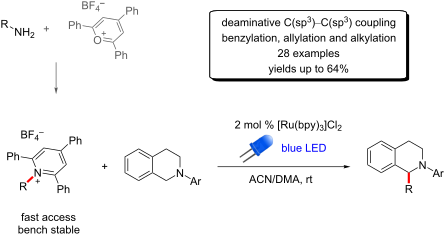
Graphical Abstract
Scheme 1: Examples of photocatalytic C–C bond formation by nucleophilic trapping of a reactive THIQ intermedi...
Figure 1: Kinetic profile for the benzylation of 1 to 3.
Scheme 2: Benzylation of N-phenyl-THIQ.
Scheme 3: Benzylation of substituted N-arylTHIQs.
Scheme 4: Removal of the PMP protecting group.
Scheme 5: Alkylation of N-phenyl-THIQ derivatives. Conditions: a2 mol % [Ir(dtbbpy)(ppy)2]PF6, DMA, 60 h; b2 ...
Scheme 6: Proposed mechanism.
Beilstein J. Org. Chem. 2020, 16, 691–737, doi:10.3762/bjoc.16.67
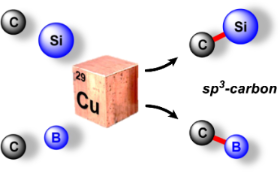
Graphical Abstract
Scheme 1: Pharmaceuticals possessing a silicon or boron atom.
Scheme 2: The first Cu-catalyzed C(sp3)–Si bond formation.
Scheme 3: Conversion of benzylic phosphate 6 to the corresponding silane.
Scheme 4: Conversion of alkyl triflates to alkylsilanes.
Scheme 5: Conversion of secondary alkyl triflates to alkylsilanes.
Scheme 6: Conversion of alkyl iodides to alkylsilanes.
Scheme 7: Trapping of intermediate radical through cascade reaction.
Scheme 8: Radical pathway for conversion of alkyl iodides to alkylsilanes.
Scheme 9: Conversion of alkyl ester of N-hydroxyphthalimide to alkylsilanes.
Scheme 10: Conversion of gem-dibromides to bis-silylalkanes.
Scheme 11: Conversion of imines to α-silylated amines (A) and the reaction pathway (B).
Scheme 12: Conversion of N-tosylimines to α-silylated amines.
Scheme 13: Screening of diamine ligands.
Scheme 14: Conversion of N-tert-butylsulfonylimines to α-silylated amines.
Scheme 15: Conversion of aldimines to nonracemic α-silylated amines.
Scheme 16: Conversion of N-tosylimines to α-silylated amines.
Scheme 17: Reaction pathway [A] and conversion of aldehydes to α-silylated alcohols [B].
Scheme 18: Conversion of aldehydes to benzhydryl silyl ethers.
Scheme 19: Conversion of ketones to 1,2-diols (A) and conversion of imines to 1,2-amino alcohols (B).
Scheme 20: Ligand screening (A) and conversion of aldehydes to α-silylated alcohols (B).
Scheme 21: Conversion of aldehydes to α-silylated alcohols.
Scheme 22: 1,4-Additions to α,β-unsaturated ketones.
Scheme 23: 1,4-Additions to unsaturated ketones to give β-silylated derivatives.
Scheme 24: Additions onto α,β-unsaturated lactones to give β-silylated lactones.
Scheme 25: Conversion of α,β-unsaturated to β-silylated lactams.
Scheme 26: Conversion of N-arylacrylamides to silylated oxindoles.
Scheme 27: Conversion of α,β-unsaturated carbonyl compounds to silylated tert-butylperoxides.
Scheme 28: Catalytic cycle for Cu(I) catalyzed α,β-unsaturated compounds.
Scheme 29: Conversion of p-quinone methides to benzylic silanes.
Scheme 30: Conversion of α,β-unsaturated ketimines to regio- and stereocontrolled allylic silanes.
Scheme 31: Conversion of α,β-unsaturated ketimines to enantioenriched allylic silanes.
Scheme 32: Regioselective conversion of dienedioates to allylic silanes.
Scheme 33: Conversion of alkenyl-substituted azaarenes to β-silylated adducts.
Scheme 34: Conversion of conjugated benzoxazoles to enantioenriched β-silylated adducts.
Scheme 35: Conversion of α,β-unsaturated carbonyl indoles to α-silylated N-alkylated indoles.
Scheme 36: Conversion of β-amidoacrylates to α-aminosilanes.
Scheme 37: Conversion of α,β-unsaturated ketones to enantioenriched β-silylated ketones, nitriles, and nitro d...
Scheme 38: Regio-divergent silacarboxylation of allenes.
Scheme 39: Silylation of diazocarbonyl compounds, (A) asymmetric and (B) racemic.
Scheme 40: Enantioselective hydrosilylation of alkenes.
Scheme 41: Conversion of 3-acylindoles to indolino-silanes.
Scheme 42: Proposed mechanism for the silylation of 3-acylindoles.
Scheme 43: Silyation of N-chlorosulfonamides.
Scheme 44: Conversion of acyl silanes to α-silyl alcohols.
Scheme 45: Conversion of N-tosylaziridines to β-silylated N-tosylamines.
Scheme 46: Conversion of N-tosylaziridines to silylated N-tosylamines.
Scheme 47: Conversion of 3,3-disubstituted cyclopropenes to silylated cyclopropanes.
Scheme 48: Conversion of conjugated enynes to 1,3-bis(silyl)propenes.
Scheme 49: Proposed sequence for the Cu-catalyzed borylation of substituted alkenes.
Scheme 50: Cu-catalyzed synthesis of nonracemic allylic boronates.
Scheme 51: Cu–NHC catalyzed synthesis of α-substituted allylboronates.
Scheme 52: Synthesis of α-chiral (γ-alkoxyallyl)boronates.
Scheme 53: Cu-mediated formation of nonracemic cis- or trans- 2-substituted cyclopropylboronates.
Scheme 54: Cu-catalyzed synthesis of γ,γ-gem-difluoroallylboronates.
Scheme 55: Cu-catalyzed hydrofunctionalization of internal alkenes and vinylarenes.
Scheme 56: Cu-catalyzed Markovnikov and anti-Markovnikov borylation of alkenes.
Scheme 57: Cu-catalyzed borylation/ortho-cyanation/Cope rearrangement.
Scheme 58: Borylfluoromethylation of alkenes.
Scheme 59: Cu-catalyzed synthesis of tertiary nonracemic alcohols.
Scheme 60: Synthesis of densely functionalized and synthetically versatile 1,2- or 4,3-borocyanated 1,3-butadi...
Scheme 61: Cu-catalyzed trifunctionalization of allenes.
Scheme 62: Cu-catalyzed selective arylborylation of arenes.
Scheme 63: Asymmetric borylative coupling between styrenes and imines.
Scheme 64: Regio-divergent aminoboration of unactivated terminal alkenes.
Scheme 65: Cu-catalyzed 1,4-borylation of α,β-unsaturated ketones.
Scheme 66: Cu-catalyzed protodeboronation of α,β-unsaturated ketones.
Scheme 67: Cu-catalyzed β-borylation of α,β-unsaturated imines.
Scheme 68: Cu-catalyzed synthesis of β-trifluoroborato carbonyl compounds.
Scheme 69: Asymmetric 1,4-borylation of α,β-unsaturated carbonyl compounds.
Scheme 70: Cu-catalyzed ACB and ACA reactions of α,β-unsaturated 2-acyl-N-methylimidazoles.
Scheme 71: Cu-catalyzed diborylation of aldehydes.
Scheme 72: Umpolung pathway for chiral, nonracemic tertiary alcohol synthesis (top) and proposed mechanism for...
Scheme 73: Cu-catalyzed synthesis of α-hydroxyboronates.
Scheme 74: Cu-catalyzed borylation of ketones.
Scheme 75: Cu-catalyzed borylation of unactivated alkyl halides.
Scheme 76: Cu-catalyzed borylation of allylic difluorides.
Scheme 77: Cu-catalyzed borylation of cyclic and acyclic alkyl halides.
Scheme 78: Cu-catalyzed borylation of unactivated alkyl chlorides and bromides.
Scheme 79: Cu-catalyzed decarboxylative borylation of carboxylic acids.
Scheme 80: Cu-catalyzed borylation of benzylic, allylic, and propargylic alcohols.
Beilstein J. Org. Chem. 2020, 16, 60–70, doi:10.3762/bjoc.16.8
Graphical Abstract
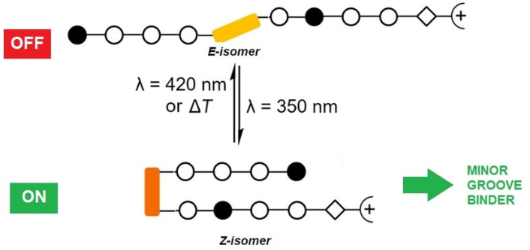
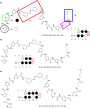
Scheme 1: Pyrrole–imidazole–azobenzene polyamides and the dsDNA target sequences employed in this study.
Scheme 2: Building blocks required for the synthesis of the photoswitchable Im/Py polyamides. A) Fmoc–Azo–OH 1...
Figure 1: Section of the 1H NMR (600 MHz) spectrum of polyamide P1. A) Initial thermal equilibrium. B) After ...
Figure 2: E/Z isomer ratio of the polyamides P1–P3. Values were obtained from the respective 1H NMR experimen...
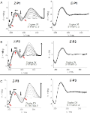
Figure 3: Titration experiments of target DNA sequences with P1–P3 in the photostationary Z-state and the the...
Figure 4: Titration of DNA containing single mutations (in bold) with P1–P3 in the photostationary Z-state an...
Beilstein J. Org. Chem. 2020, 16, 50–59, doi:10.3762/bjoc.16.7
Graphical Abstract
Scheme 1: Mechanism for formation of cyclooctat-9-en-7-ol, published similarly in [42].
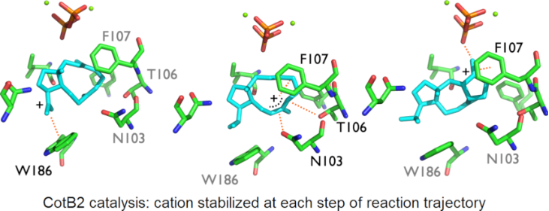
Figure 1: Computed electronic energy profiles (kcal/mol) for the CotB2 cyclase mechanism. The calculations us...
Figure 2: Intermediates A–I in the active site model. Interactions are marked by dashed orange lines, the int...
Figure 3: TS structures TS_A_B–TS_G/H_I in the active site model. Interactions are marked by dashed orange li...
Figure 4: Comparison between gas phase and active site model conformations. A) Intermediate D. B) Intermediat...
Beilstein J. Org. Chem. 2020, 16, 39–49, doi:10.3762/bjoc.16.6
Graphical Abstract
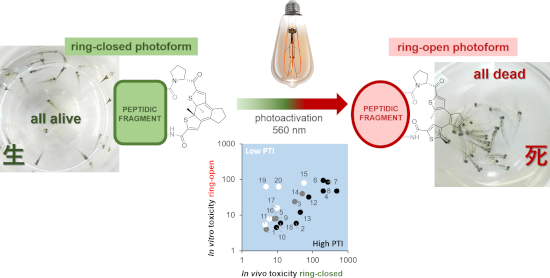
Figure 1: DAE photoswitch and photoswitchable peptides explored in this study. (A) The reversible photoisomer...
Figure 2: Two versions of the D. rerio embryotoxicity assay for DAE-modified peptides: timelines, peptide pho...
Figure 3: The in vivo toxicity against D. rerio embryos appears to be correlated with the empirical hydrophob...
Figure 4: D. rerio embryotoxicity of GS 1 and the photoswitchable analogues 2–20 correlated with their in vit...
Figure 5: Phototherapeutic cytotoxic action against HeLa cells of GS 1 and its photoswitchable analogues 2–20...
Beilstein J. Org. Chem. 2020, 16, 1–8, doi:10.3762/bjoc.16.1
Graphical Abstract
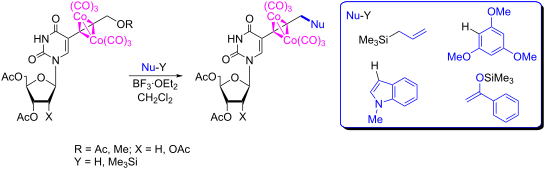
Scheme 1: Preparation of (2'-deoxy)-5-alkynyluridines 2 and 3, their dicobalt hexacarbonyl derivatives 4 and 5...
Figure 1: Structures of nucleosides 6 and 7, products of the Nicholas reaction.
Beilstein J. Org. Chem. 2019, 15, 2948–2957, doi:10.3762/bjoc.15.290
Graphical Abstract
Scheme 1: Ireland–Claisen rearrangement of allyl esters 1a–c.
Scheme 2: Ireland–Claisen rearrangement of 1c mediated by tertiary amines.
Figure 1: Organocatalysts used in this study. Conditions: typical procedure: 1. Et3N (4.9 equiv), DCM, −60 °C...
Scheme 3: Solvent-free Ireland–Claisen rearrangement of cinnamyl esters.
Figure 2: ωB97X-D/6-31G* calculated uncatalyzed Ireland–Claisen rearrangement of 1c. Charges on allylic oxyge...
Figure 3: ωB97X-D/6-31G* calculated Schreiner thiourea (12)-catalyzed Ireland–Claisen rearrangement of 1c. Ch...
Figure 4: ωB97X-D/6-31G* calculated Ph-thiourea (top) and squaramide-catalyzed (bottom) Ireland–Claisen rearr...
Figure 5: a) Rate of product formation; b) reaction profile without catalyst determined by 1H NMR.
Beilstein J. Org. Chem. 2019, 15, 2922–2929, doi:10.3762/bjoc.15.286
Graphical Abstract
Figure 1: Chemical structures of naturally occurring argyrins with potent antipseudomonal activity.
Figure 2: The biosynthetic pathway for argyrin production in Cystobacter sp. SBCb004 (Arg1, radical SAM-depen...
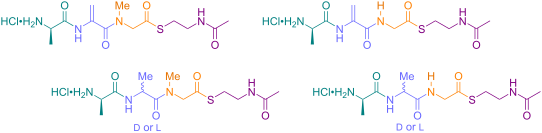
Figure 3: Designed mutasynthons 9–14 for argyrin biosynthesis. Peptides are based on three amino acids and ad...
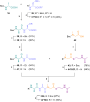
Scheme 1: Synthesis of tripeptide thioesters. Reagents and conditions: (a) SOCl2, EtOH, 78 °C; (b) IBCF, NMM,...
Scheme 2: Improved synthesis of the tripeptide thioester 14. Reagents and conditions: (a) SOCl2, EtOH, 78 °C;...
Figure 4: Analysis of mutasynthon 14 obtained via the convergent synthetic route by HPLC on a HILIC stationar...
Beilstein J. Org. Chem. 2019, 15, 2889–2906, doi:10.3762/bjoc.15.283
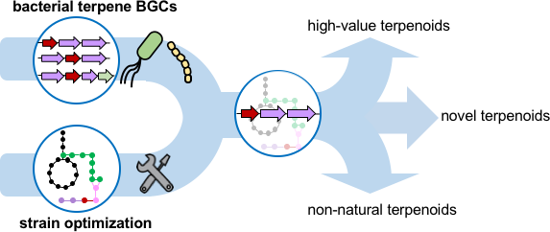
Graphical Abstract
Figure 1: Examples of bioactive terpenoids.
Figure 2: Repetitive electrophilic and nucleophilic functionalities in terpene and type II PKS-derived polyke...
Figure 3: Abundance and distribution of bacterial terpene biosynthetic gene clusters as determined by genome ...
Figure 4: Terpenoid biosynthesis. Terpenoid biosynthesis is divided into two phases, 1) terpene scaffold gene...
Figure 5: Mechanisms for type I, type II, and type II/type I tandem terpene cyclases. a) Tail-to-head class I...
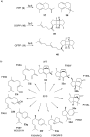
Figure 6: Functional TC characterization. a) Different terpenes were produced when hedycaryol (18) synthase a...
Figure 7: Selected examples of terpene modification by bacterial CYPs. a) Hydroxylation [89]. b) Carboxylation, h...
Figure 8: Off-target effects observed during heterologous expression of terpenoid BGCs. Unexpected oxidation ...
Figure 9: TC promiscuity and engineering. a) Spata-13,17-diene (39) synthase (SpS) can take C15 and C25 oligo...
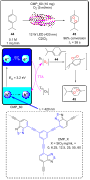
Figure 10: Substrate promiscuity and engineering of CYPs. a) Selected examples from using a CYP library to oxi...
Figure 11: Engineering of terpenoid pathways. a) Metabolic network of terpenoid biosynthesis. Toxic intermedia...
Beilstein J. Org. Chem. 2019, 15, 2872–2880, doi:10.3762/bjoc.15.281
Graphical Abstract
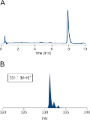
Figure 1: Plasmodia of P. polycephalum emit a mixture of volatiles predominated by terpenoids. A) GC chromato...
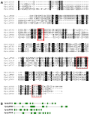
Figure 2: P. polycephalum contains four terpene synthase genes. A) Multiple sequence alignment of the protein...
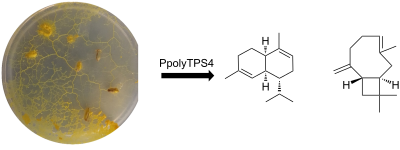
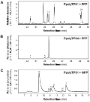
Figure 3: PpolyTPS1 and PpolyTPS4 have terpene synthase activities. A) GC chromatogram of sesquiterpenes prod...
Figure 4: Phylogenetic analysis of PpolyTPSs with TPSs from dictyostelid social amoebae (Dictyostelids), the ...
Beilstein J. Org. Chem. 2019, 15, 2830–2839, doi:10.3762/bjoc.15.276
Graphical Abstract
Figure 1: Pharmacologically relevant furoindoles.
Scheme 1: Synthesis of benzo[4,5]furo[3,2-b]indoles 5a–j. Conditions: (i) 1.2 equiv 2-bromophenylboronic acid...
Figure 2: Ortep of 5c (propability of ellipsoids: 45%).
Figure 3: Diindolofurans 6a–e.
Figure 4: Illustration of binding poses of selected inhibitors for the ENPP1 homology model: (a): suramin, (b...
Figure 5: 3D poses of docked selected inhibitors inside homology model of ENPP3. (a): suramin, (b): 5e, (c): ...
Beilstein J. Org. Chem. 2019, 15, 2447–2457, doi:10.3762/bjoc.15.237
Graphical Abstract
Figure 1: Bioactive molecules containing a tetrazole, pyridone or isoquinolone ring.
Scheme 1: Approaches for the synthesis of tetrazoles and isoquinolones and their interplay as designed in thi...
Scheme 2: Scope of the Ugi-azide-4CR/deprotection/acylation sequence. Ugi-azide-4CR conducted at the 2.0 mmol...
Scheme 3: Influence of substituents R and R2 on the reaction outcome. For compounds 4k–m the overall yield in...
Scheme 4: Influence of the alkyne and R1 substituent on the reaction outcome.
Scheme 5: Scope of acrylic, heterocyclic and ring-fused N-acylaminomethyl tetrazole substrates.
Scheme 6: Proposed reaction mechanism using substrates 1a and 3a.
Beilstein J. Org. Chem. 2019, 15, 2419–2427, doi:10.3762/bjoc.15.234
Graphical Abstract
Figure 1: Oxazolone pseudodipeptide 1 and tetrapeptide 2a.
Scheme 1: Synthesis of linear azido ester dipeptide 5 and tetrapeptide 7.
Scheme 2: Synthesis of oxazolone pseudopeptides 1, 2a and 2b.
Figure 2: Characteristic NOEs of 2a.
Figure 3: DMSO titration study of 2a.
Figure 4: 1H NMR temperature study of 2a.
Figure 5: Optimized helical conformations of (A) 2a, (B) 2b and (C) 9.
Figure 6: Ion transport activity (A) for 1, (B) for 2a, across EYPC-LUVs HPTS.
Figure 7: Cation (A) and anion (B) transport activity of 2a.
Figure 8:
Comparison of the ion transport activity of 2a and 2b at 20 µM across EYPC-LUVslucigenin (A). Conce...
Beilstein J. Org. Chem. 2019, 15, 2355–2368, doi:10.3762/bjoc.15.228
Graphical Abstract
Figure 1: CotB1 synthesizes geranylgeranyl diphosphate (GGDP) 3 from the substrates dimethylallyl diphosphate...
Figure 2: The bacterial diterpene synthase CotB2wt·Mg2+3·F-Dola in the closed, active conformation (PDB-ID 6G...
Figure 3: Conformational changes of CotB2 upon ligand binding. Superposition of CotB2’s open (teal), pre-cata...
Figure 4: View into the active site of CotB2wt·Mg2+3·F-Dola [37] superimposed with CotB2wt·Mg2+B·GGSDP [36]. (A) The ...
Figure 5: View into the active site of CotB2wt·Mg2+3·F-Dola [37]. Identical view as in Figure 4. (A) The bound F-Dola rea...
Figure 6: The WXXXXXRY motif in protein sequences of diterpene TPS from different bacteria. Highlighted is th...
Scheme 1: Overview of the altered product portfolio as a result of introduced point mutations in the active s...
Scheme 2: Catalytic mechanism of CotB2, derived from isotope labeling experiments [34,35], density functional theory...
Figure 7: (A) The inner surface of the active site is shown in gray. The bound F-Dola reaction intermediate i...
Scheme 3: Variants of CotB2 open the route to a novel product portfolio with altered cyclic carbon skeletons,...
Beilstein J. Org. Chem. 2019, 15, 2191–2203, doi:10.3762/bjoc.15.216
Graphical Abstract
Scheme 1: Design and functional parts of the FIND technology.
Scheme 2: Isolation of fungal strains with the FIND technology. 1. Collection of terrestrial or marine sample...
Figure 1: Secondary metabolites isolated from H. cf. alpina.
Figure 2: a) Significant 1H,1H-COSY and 1H,13C-HMBC correlations for compounds 1 and 2. b) Key NOESY correlat...
Beilstein J. Org. Chem. 2019, 15, 2003–2012, doi:10.3762/bjoc.15.196
Graphical Abstract
Figure 1: Withanolides from Physalis peruviana. A) Structures of the newly characterised truncated withanolid...
Figure 2: Key NMR correlations. (A) COSY and HMBC correlations for irinan A (2). (B) COSY and HMBC correlatio...
Figure 3: Structures and biosynthesis of androstanes. (A) Androstane backbone and androsterone (7) as a typic...
Figure 4: Intrinsic reactivity of 4ß-hydroxywithanolide E (1) under acidic/basic and oxidative conditions, re...
Beilstein J. Org. Chem. 2019, 15, 1913–1924, doi:10.3762/bjoc.15.187
Graphical Abstract
Figure 1: Structures of the compounds used in this study and labelling scheme for NMR spectra.
Figure 2: Spectra of complexes [1(LysOMe)2], [1(ArgOMe)2], [1(HisOMe)2]: 1H NMR (a–g) and ROESY (h–j) in meth...
Figure 3: CD (a) and UV (b) spectra of complexes [1(LysOMe)2], [1(PheOMe)2], [1(ValOMe)2], [1(ArgOMe)2], and [...
Figure 4: DOSY spectra of 1 (a), [1(LysOMe)2] (b), [1(ArgOMe)2] (c), [1(HisOMe)2] (d) and [LysOMe + 1(LysOMe)2...
Figure 5: 1H NMR spectra of 1 (a), LysOMe (b), 1H NMR and DOSY spectra of [1(LysOMe)2] (insets show the shape...
Figure 6: 1H NMR spectra of (R)-2 (a); [1((R)-2] (b); [1 + 1((R)-2] (c) (insets show the shape of signals f, ...
Figure 7: 1H NMR and DOSY spectra of (R)-2 (a); [1(R)-2] (b) (inset show the shape signals f, DMSO-d6, 298K, ...
Beilstein J. Org. Chem. 2019, 15, 1722–1757, doi:10.3762/bjoc.15.168
Graphical Abstract
Figure 1: Examples of three-carbon chirons.
Figure 2: Structures of derivatives of N-(1-phenylethyl)aziridine-2-carboxylic acid 5–8.
Figure 3: Synthetic equivalency of aziridine aldehydes 6.
Scheme 1: Synthesis of N-(1-phenylethyl)aziridine-2-carboxylates 5. Reagents and conditions: a) TEA, toluene,...
Scheme 2: Absolute configuration at C2 in (2S,1'S)-5a. Reagents and conditions: a) 20% HClO4, 80 °C, 30 h the...
Scheme 3: Major synthetic strategies for a 2-ketoaziridine scaffold [R* = (R)- or (S)-1-phenylethyl; R′ = Alk...
Scheme 4: Synthesis of cyanide (2S,1'S)-13. Reagents and conditions: a) NH3, EtOH/H2O, rt, 72 h; b) Ph3P, CCl4...
Scheme 5: Synthesis of key intermediates (R)-16 and (R)-17 for (R,R)-formoterol (14) and (R)-tamsulosin (15)....
Scheme 6: Synthesis of mitotic kinesin inhibitors (2R/S,1'R)-23. Reagents and conditions: a) H2, Pd(OH)2, EtO...
Scheme 7: Synthesis of (R)-mexiletine ((R)-24). Reagents and conditions: a) TsCl, TEA, DMAP, CH2Cl2, rt, 1 h;...
Scheme 8: Synthesis of (−)-cathinone ((S)-27). Reagents and conditions: a) PhMgBr, ether, 0 °C; b) H2, 10% Pd...
Scheme 9: Synthesis of N-Boc-norpseudoephedrine ((1S,2S)-(+)-29) and N-Boc-norephedrine ((1R,2S)-29). Reagent...
Scheme 10: Synthesis of (−)-ephedrine ((1R,2S)-31). Reagents and conditions: a) TfOMe, MeCN then NaBH3CN, rt; ...
Scheme 11: Synthesis of xestoaminol C ((2S,3R)-35), 3-epi-xestoaminol C ((2S,3S)-35) and N-Boc-spisulosine ((2S...
Scheme 12: Synthesis of ʟ-tryptophanol ((S)-41). Reagents and conditions: a) CDI, MeCN, rt, 1 h then TMSI, MeC...
Scheme 13: Synthesis of ʟ-homophenylalaninol ((S)-42). Reagents and conditions: a) NaH, THF, 0 °C to −78 °C, 1...
Scheme 14: Synthesis of ᴅ-homo(4-octylphenyl)alaninol ((R)-47) and a sphingolipid analogue (R)-48. Reagents an...
Scheme 15: Synthesis of florfenicol ((1R,2S)-49). Reagents and conditions: a) (S)-1-phenylethylamine, TEA, MeO...
Scheme 16: Synthesis of natural tyroscherin ((2S,3R,6E,8R,10R)-55). Reagents and conditions: a) I(CH2)3OTIPS, t...
Scheme 17: Syntheses of (−)-hygrine (S)-61, (−)-hygroline (2S,2'S)-62 and (−)-pseudohygroline (2S,2'R)-62. Rea...
Scheme 18: Synthesis of pyrrolidine (3S,3'R)-68, a fragment of the fluoroquinolone antibiotic PF-00951966. Rea...
Scheme 19: Synthesis of sphingolipid analogues (R)-76. Reagents and conditions: a) BnBr, Mg, THF, reflux, 6 h;...
Scheme 20: Synthesis of ᴅ-threo-PDMP (1R,2R)-81. Reagents and conditions: a) TMSCl, NaI, MeCN, rt, 1 h 50 min,...
Scheme 21: Synthesis of the sphingolipid analogue SG-14 (2S,3S)-84. Reagents and conditions: a) LiAlH4, THF, 0...
Scheme 22: Synthesis of the sphingolipid analogue SG-12 (2S,3R)-88. Reagents and conditions: a) 1-(bromomethyl...
Scheme 23: Synthesis of sphingosine-1-phosphate analogues DS-SG-44 and DS-SG-45 (2S,3R)-89a and (2S,3R)-89a. R...
Scheme 24: Synthesis of N-Boc-safingol ((2S,3S)-95) and N-Boc-ᴅ-erythro-sphinganine ((2S,3R)-95). Reagents and...
Scheme 25: Synthesis of ceramide analogues (2S,3R)-96. Reagents and conditions: a) NaBH4, ZnCl2, MeOH, −78 °C,...
Scheme 26: Synthesis of orthogonally protected serinols, (S)-101 and (R)-102. Reagents and conditions: a) BnBr...
Scheme 27: Synthesis of N-acetyl-3-phenylserinol ((1R,2R)-105). Reagents and conditions: a) AcOH, CH2Cl2, refl...
Scheme 28: Synthesis of (S)-linezolid (S)-107. Reagents and conditions: a) LiAlH4, THF, 0 °C to reflux; b) Boc2...
Scheme 29: Synthesis of (2S,3S,4R)-2-aminooctadecane-1,3,4-triol (ᴅ-ribo-phytosphingosine) (2S,3S,4R)-110. Rea...
Scheme 30: Syntheses of ᴅ-phenylalanine (R)-116. Reagents and conditions: a) AcOH, CH2Cl2, reflux, 4 h; b) MsC...
Scheme 31: Synthesis of N-Boc-ᴅ-3,3-diphenylalanine ((R)-122). Reagents and conditions: a) PhMgBr, THF, −78 °C...
Scheme 32: Synthesis of ethyl N,N’-di-Boc-ʟ-2,3-diaminopropanoate ((S)-125). Reagents and conditions: a) NaN3,...
Scheme 33: Synthesis of the bicyclic amino acid (S)-(+)-127. Reagents and conditions: a) BF3·OEt2, THF, 60 °C,...
Scheme 34: Synthesis of lacosamide, (R)-2-acetamido-N-benzyl-3-methoxypropanamide (R)-130. Reagents and condit...
Scheme 35: Synthesis of N-Boc-norfuranomycin ((2S,2'R)-133). Reagents and conditions: a) H2C=CHCH2I, NaH, THF,...
Scheme 36: Synthesis of MeBmt (2S,3R,4R,6E)-139. Reagents and conditions: a) diisopropyl (S,S)-tartrate (E)-cr...
Scheme 37: Synthesis of (+)-polyoxamic acid (2S,3S,4S)-144. Reagents and conditions: a) AD-mix-α, MeSO2NH2, t-...
Scheme 38: Synthesis of the protected 3-hydroxy-ʟ-glutamic acid (2S,3R)-148. Reagents and conditions: a) LiHMD...
Scheme 39: Synthesis of (+)-isoserine (R)-152. Reagents and conditions: a) AcCl, MeCN, rt, 0.5 h then Na2CO3, ...
Scheme 40: Synthesis of (3R,4S)-N3-Boc-3,4-diaminopentanoic acid (3R,4S)-155. Reagents and conditions: a) Ph3P...
Scheme 41: Synthesis of methyl (2S,3S,4S)-4-(dimethylamino)-2,3-dihydroxy-5-methoxypentanoate (2S,3S,4S)-159. ...
Scheme 42: Syntheses of methyl (3S,4S) 4,5-di-N-Boc-amino-3-hydroxypentanoate ((3S,4S)-164), methyl (3S,4S)-4-N...
Scheme 43: Syntheses of (3R,5S)-5-(aminomethyl)-3-(4-methoxyphenyl)dihydrofuran-2(3H)-one ((3R,5S)-168). Reage...
Scheme 44: Syntheses of a series of imidazolin-2-one dipeptides 175–177 (for R' and R'' see text). Reagents an...
Scheme 45: Syntheses of (2S,3S)-N-Boc-3-hydroxy-2-hydroxymethylpyrrolidine ((2S,3S)-179). Reagents and conditi...
Scheme 46: Syntheses of enantiomers of 1,4-dideoxy-1,4-imino-ʟ- and -ᴅ-lyxitols (2S,3R,4S)-182 and (2R,3S,4R)-...
Scheme 47: Synthesis of 1,4-dideoxy-1,4-imino-ʟ-ribitol (2S,3S,4R)-182. Reagents and conditions: a) AcOH, CH2Cl...
Scheme 48: Syntheses of 1,4-dideoxy-1,4-imino-ᴅ-arabinitol (2R,3R,4R)-182 and 1,4-dideoxy-1,4-imino-ᴅ-xylitol ...
Scheme 49: Syntheses of natural 2,5-imino-2,5,6-trideoxy-ʟ-gulo-heptitol ((2S,3R,4R,5R)-184) and its C4 epimer...
Scheme 50: Syntheses of (−)-dihydropinidine ((2S,6R)-187a) (R = C3H7) and (2S,6R)-isosolenopsins (2S,6R)-187b ...
Scheme 51: Syntheses of (+)-deoxocassine ((2S,3S,6R)-190a, R = C12H25) and (+)-spectaline ((2S,3S,6R)-190b, R ...
Scheme 52: Synthesis of (−)-microgrewiapine A ((2S,3R,6S)-194a) and (+)-microcosamine A ((2S,3R,6S)-194b). Rea...
Scheme 53: Syntheses of ʟ-1-deoxynojirimycin ((2S,3S,4S,5R)-200), ʟ-1-deoxymannojirimycin ((2S,3S,4S,5S)-200) ...
Scheme 54: Syntheses of 1-deoxy-ᴅ-galacto-homonojirimycin (2R,3S,4R,5S)-211. Reagents and conditions: a) MeONH...
Scheme 55: Syntheses of 7a-epi-hyacinthacine A1 (1S,2R,3R,7aS)-220. Reagents and conditions: a) TfOTBDMS, 2,6-...
Scheme 56: Syntheses of 8-deoxyhyacinthacine A1 ((1S,2R,3R,7aR)-221). Reagents and conditions: a) H2, Pd/C, PT...
Scheme 57: Syntheses of (+)-lentiginosine ((1S,2S,8aS)-227). Reagents and conditions: a) (EtO)2P(O)CH2COOEt, L...
Scheme 58: Syntheses of 8-epi-swainsonine (1S,2R,8S,8aR)-231. Reagents and conditions: a) Ph3P=CHCOOMe, MeOH, ...
Scheme 59: Synthesis of a protected vinylpiperidine (2S,3R)-237, a key intermediate in the synthesis of (−)-sw...
Scheme 60: Synthesis of a modified carbapenem 245. Reagents and conditions: a) AcOEt, LiHMDS, THF, −78 °C, 1.5...
Beilstein J. Org. Chem. 2019, 15, 1612–1704, doi:10.3762/bjoc.15.165
Graphical Abstract
Figure 1: Various drugs having IP nucleus.
Figure 2: Participation percentage of various TMs for the syntheses of IPs.
Scheme 1: CuI–NaHSO4·SiO2-catalyzed synthesis of imidazo[1,2-a]pyridines.
Scheme 2: Experimental examination of reaction conditions.
Scheme 3: One-pot tandem reaction for the synthesis of 2-haloimidazopyridines.
Scheme 4: Mechanistic scheme for the synthesis of 2-haloimidazopyridine.
Scheme 5: Copper-MOF-catalyzed three-component reaction (3-CR) for imidazo[1,2-a]pyridines.
Scheme 6: Mechanism for copper-MOF-driven synthesis.
Scheme 7: Heterogeneous synthesis via titania-supported CuCl2.
Scheme 8: Mechanism involving oxidative C–H functionalization.
Scheme 9: Heterogeneous synthesis of IPs.
Scheme 10: One-pot regiospecific synthesis of imidazo[1,2-a]pyridines.
Scheme 11: Vinyl azide as an unprecedented substrate for imidazo[1,2-a]pyridines.
Scheme 12: Radical pathway.
Scheme 13: Cu(I)-catalyzed transannulation approach for imidazo[1,5-a]pyridines.
Scheme 14: Plausible radical pathway for the synthesis of imidazo[1,5-a]pyridines.
Scheme 15: A solvent-free domino reaction for imidazo[1,2-a]pyridines.
Scheme 16: Cu-NPs-mediated synthesis of imidazo[1,2-a]pyridines.
Scheme 17: CuI-catalyzed synthesis of isoxazolylimidazo[1,2-a]pyridines.
Scheme 18: Functionalization of 4-bromo derivative via Sonogashira coupling reaction.
Scheme 19: A plausible reaction pathway.
Scheme 20: Cu(I)-catalyzed intramolecular oxidative C–H amidation reaction.
Scheme 21: One-pot synthetic reaction for imidazo[1,2-a]pyridine.
Scheme 22: Plausible reaction mechanism.
Scheme 23: Cu(OAc)2-promoted synthesis of imidazo[1,2-a]pyridines.
Scheme 24: Mechanism for aminomethylation/cycloisomerization of propiolates with imines.
Scheme 25: Three-component synthesis of imidazo[1,2-a]pyridines.
Figure 3: Scope of pyridin-2(1H)-ones and acetophenones.
Scheme 26: CuO NPS-promoted A3 coupling reaction.
Scheme 27: Cu(II)-catalyzed C–N bond formation reaction.
Scheme 28: Mechanism involving Chan–Lam/Ullmann coupling.
Scheme 29: Synthesis of formyl-substituted imidazo[1,2-a]pyridines.
Scheme 30: A tandem sp3 C–H amination reaction.
Scheme 31: Probable mechanistic approach.
Scheme 32: Dual catalytic system for imidazo[1,2-a]pyridines.
Scheme 33: Tentative mechanism.
Scheme 34: CuO/CuAl2O4/ᴅ-glucose-promoted 3-CCR.
Scheme 35: A tandem CuOx/OMS-2-based synthetic strategy.
Figure 4: Biomimetic catalytic oxidation in the presence of electron-transfer mediators (ETMs).
Scheme 36: Control experiment.
Scheme 37: Copper-catalyzed C(sp3)–H aminatin reaction.
Scheme 38: Reaction of secondary amines.
Scheme 39: Probable mechanistic pathway.
Scheme 40: Coupling reaction of α-azidoketones.
Scheme 41: Probable pathway.
Scheme 42: Probable mechanism with free energy calculations.
Scheme 43: MCR for cyanated IP synthesis.
Scheme 44: Substrate scope for the reaction.
Scheme 45: Reaction mechanism.
Scheme 46: Probable mechanistic pathway for Cu/ZnAl2O4-catalyzed reaction.
Scheme 47: Copper-catalyzed double oxidative C–H amination reaction.
Scheme 48: Application towards different coupling reactions.
Scheme 49: Reaction mechanism.
Scheme 50: Condensation–cyclization approach for the synthesis of 1,3-diarylated imidazo[1,5-a]pyridines.
Scheme 51: Optimized reaction conditions.
Scheme 52: One-pot 2-CR.
Scheme 53: One-pot 3-CR without the isolation of chalcone.
Scheme 54: Copper–Pybox-catalyzed cyclization reaction.
Scheme 55: Mechanistic pathway catalyzed by Cu–Pybox complex.
Scheme 56: Cu(II)-promoted C(sp3)-H amination reaction.
Scheme 57: Wider substrate applicability for the reaction.
Scheme 58: Plausible reaction mechanism.
Scheme 59: CuI assisted C–N cross-coupling reaction.
Scheme 60: Probable reaction mechanism involving sp3 C–H amination.
Scheme 61: One-pot MCR-catalyzed by CoFe2O4/CNT-Cu.
Scheme 62: Mechanistic pathway.
Scheme 63: Synthetic scheme for 3-nitroimidazo[1,2-a]pyridines.
Scheme 64: Plausible mechanism for CuBr-catalyzed reaction.
Scheme 65: Regioselective synthesis of halo-substituted imidazo[1,2-a]pyridines.
Scheme 66: Synthesis of 2-phenylimidazo[1,2-a]pyridines.
Scheme 67: Synthesis of diarylated compounds.
Scheme 68: CuBr2-mediated one-pot two-component oxidative coupling reaction.
Scheme 69: Decarboxylative cyclization route to synthesize 1,3-diarylimidazo[1,5-a]pyridines.
Scheme 70: Mechanistic pathway.
Scheme 71: C–H functionalization reaction of enamines to produce diversified heterocycles.
Scheme 72: A plausible mechanism.
Scheme 73: CuI-promoted aerobic oxidative cyclization reaction of ketoxime acetates and pyridines.
Scheme 74: CuI-catalyzed pathway for the formation of imidazo[1,2-a]pyridine.
Scheme 75: Mechanistic pathway.
Scheme 76: Mechanistic rationale for the synthesis of products.
Scheme 77: Copper-catalyzed synthesis of vinyloxy-IP.
Scheme 78: Regioselective product formation with propiolates.
Scheme 79: Proposed mechanism for vinyloxy-IP formation.
Scheme 80: Regioselective synthesis of 3-hetero-substituted imidazo[1,2-a]pyridines with different reaction su...
Scheme 81: Mechanistic pathway.
Scheme 82: CuI-mediated synthesis of 3-formylimidazo[1,2-a]pyridines.
Scheme 83: Radical pathway for 3-formylated IP synthesis.
Scheme 84: Pd-catalyzed urea-cyclization reaction for IPs.
Scheme 85: Pd-catalyzed one-pot-tandem amination and intramolecular amidation reaction.
Figure 5: Scope of aniline nucleophiles.
Scheme 86: Pd–Cu-catalyzed Sonogashira coupling reaction.
Scheme 87: One-pot amide coupling reaction for the synthesis of imidazo[4,5-b]pyridines.
Scheme 88: Urea cyclization reaction for the synthesis of two series of pyridines.
Scheme 89: Amidation reaction for the synthesis of imidazo[4,5-b]pyridines.
Figure 6: Amide scope.
Scheme 90: Pd NPs-catalyzed 3-component reaction for the synthesis of 2,3-diarylated IPs.
Scheme 91: Plausible mechanistic pathway for Pd NPs-catalyzed MCR.
Scheme 92: Synthesis of chromenoannulated imidazo[1,2-a]pyridines.
Scheme 93: Mechanism for the synthesis of chromeno-annulated IPs.
Scheme 94: Zinc oxide NRs-catalyzed synthesis of imidazo[1,2-a]azines/diazines.
Scheme 95: Zinc oxide-catalyzed isocyanide based GBB reaction.
Scheme 96: Reaction pathway for ZnO-catalyzed GBB reaction.
Scheme 97: Mechanistic pathway.
Scheme 98: ZnO NRs-catalyzed MCR for the synthesis of imidazo[1,2-a]azines.
Scheme 99: Ugi type GBB three-component reaction.
Scheme 100: Magnetic NPs-catalyzed synthesis of imidazo[1,2-a]pyridines.
Scheme 101: Regioselective synthesis of 2-alkoxyimidazo[1,2-a]pyridines catalyzed by Fe-SBA-15.
Scheme 102: Plausible mechanistic pathway for the synthesis of 2-alkoxyimidazopyridine.
Scheme 103: Iron-catalyzed synthetic approach.
Scheme 104: Iron-catalyzed aminooxygenation reaction.
Scheme 105: Mechanistic pathway.
Scheme 106: Rh(III)-catalyzed double C–H activation of 2-substituted imidazoles and alkynes.
Scheme 107: Plausible reaction mechanism.
Scheme 108: Rh(III)-catalyzed non-aromatic C(sp2)–H bond activation–functionalization for the synthesis of imid...
Scheme 109: Reactivity and selectivity of different substrates.
Scheme 110: Rh-catalyzed direct C–H alkynylation by Li et al.
Scheme 111: Suggested radical mechanism.
Scheme 112: Scandium(III)triflate-catalyzed one-pot reaction and its mechanism for the synthesis of benzimidazo...
Scheme 113: RuCl3-assisted Ugi-type Groebke–Blackburn condensation reaction.
Scheme 114: C-3 aroylation via Ru-catalyzed two-component reaction.
Scheme 115: Regioselective synthetic mechanism.
Scheme 116: La(III)-catalyzed one-pot GBB reaction.
Scheme 117: Mechanistic approach for the synthesis of imidazo[1,2-a]pyridines.
Scheme 118: Synthesis of imidazo[1,2-a]pyridine using LaMnO3 NPs under neat conditions.
Scheme 119: Mechanistic approach.
Scheme 120: One-pot 3-CR for regioselective synthesis of 2-alkoxy-3-arylimidazo[1,2-a]pyridines.
Scheme 121: Formation of two possible products under optimization of the catalysts.
Scheme 122: Mechanistic strategy for NiFe2O4-catalyzed reaction.
Scheme 123: Two-component reaction for synthesizing imidazodipyridiniums.
Scheme 124: Mechanistic scheme for the synthesis of imidazodipyridiniums.
Scheme 125: CuI-catalyzed arylation of imidazo[1,2-a]pyridines.
Scheme 126: Mechanism for arylation reaction.
Scheme 127: Cupric acetate-catalyzed double carbonylation approach.
Scheme 128: Radical mechanism for double carbonylation of IP.
Scheme 129: C–S bond formation reaction catalyzed by cupric acetate.
Scheme 130: Cupric acetate-catalyzed C-3 formylation approach.
Scheme 131: Control experiments for signifying the role of DMSO and oxygen.
Scheme 132: Mechanism pathway.
Scheme 133: Copper bromide-catalyzed CDC reaction.
Scheme 134: Extension of the substrate scope.
Scheme 135: Plausible radical pathway.
Scheme 136: Transannulation reaction for the synthesis of imidazo[1,5-a]pyridines.
Scheme 137: Plausible reaction pathway for denitrogenative transannulation.
Scheme 138: Cupric acetate-catalyzed C-3 carbonylation reaction.
Scheme 139: Plausible mechanism for regioselective C-3 carbonylation.
Scheme 140: Alkynylation reaction at C-2 of 3H-imidazo[4,5-b]pyridines.
Scheme 141: Two-way mechanism for C-2 alkynylation of 3H-imidazo[4,5-b]pyridines.
Scheme 142: Palladium-catalyzed SCCR approach.
Scheme 143: Palladium-catalyzed Suzuki coupling reaction.
Scheme 144: Reaction mechanism.
Scheme 145: A phosphine free palladium-catalyzed synthesis of C-3 arylated imidazopyridines.
Scheme 146: Palladium-mediated Buchwald–Hartwig cross-coupling reaction.
Figure 7: Structure of the ligands optimized.
Scheme 147: Palladium acetate-catalyzed direct arylation of imidazo[1,2-a]pyridines.
Scheme 148: Palladium acetate-catalyzed mechanistic pathway.
Scheme 149: Palladium acetate-catalyzed regioselective arylation reported by Liu and Zhan.
Scheme 150: Mechanism for selective C-3 arylation of IP.
Scheme 151: Pd(II)-catalyzed alkenylation reaction with styrenes.
Scheme 152: Pd(II)-catalyzed alkenylation reaction with acrylates.
Scheme 153: A two way mechanism.
Scheme 154: Double C–H activation reaction catalyzed by Pd(OAc)2.
Scheme 155: Probable mechanism.
Scheme 156: Palladium-catalyzed decarboxylative coupling.
Scheme 157: Mechanistic cycle for decarboxylative arylation reaction.
Scheme 158: Ligand-free approach for arylation of imidazo[1,2-a]pyridine-3-carboxylic acids.
Scheme 159: Mechanism for ligandless arylation reaction.
Scheme 160: NHC-Pd(II) complex assisted arylation reaction.
Scheme 161: C-3 arylation of imidazo[1,2-a]pyridines with aryl bromides catalyzed by Pd(OAc)2.
Scheme 162: Pd(II)-catalyzed C-3 arylations with aryl tosylates and mesylates.
Scheme 163: CDC reaction for the synthesis of imidazo[1,2-a]pyridines.
Scheme 164: Plausible reaction mechanism for Pd(OAc)2-catalyzed synthesis of imidazo[1,2-a]pyridines.
Scheme 165: Pd-catalyzed C–H amination reaction.
Scheme 166: Mechanism for C–H amination reaction.
Scheme 167: One-pot synthesis for 3,6-di- or 2,3,6-tri(hetero)arylimidazo[1,2-a]pyridines.
Scheme 168: C–H/C–H cross-coupling reaction of IPs and azoles catalyzed by Pd(II).
Scheme 169: Mechanistic cycle.
Scheme 170: Rh-catalyzed C–H arylation reaction.
Scheme 171: Mechanistic pathway for C–H arylation of imidazo[1,2-a]pyridine.
Scheme 172: Rh(III)-catalyzed double C–H activation of 2-phenylimidazo[1,2-a]pyridines and alkynes.
Scheme 173: Rh(III)-catalyzed mechanistic pathway.
Scheme 174: Rh(III)-mediated oxidative coupling reaction.
Scheme 175: Reactions showing functionalization of the product obtained by the group of Kotla.
Scheme 176: Mechanism for Rh(III)-catalyzed oxidative coupling reaction.
Scheme 177: Rh(III)-catalyzed C–H activation reaction.
Scheme 178: Mechanistic cycle.
Scheme 179: Annulation reactions of 2-arylimidazo[1,2-a]pyridines and alkynes.
Scheme 180: Two-way reaction mechanism for annulations reaction.
Scheme 181: [RuCl2(p-cymene)]2-catalyzed C–C bond formation reaction.
Scheme 182: Reported reaction mechanism.
Scheme 183: Fe(III) catalyzed C-3 formylation approach.
Scheme 184: SET mechanism-catalyzed by Fe(III).
Scheme 185: Ni(dpp)Cl2-catalyzed KTC coupling.
Scheme 186: Pd-catalyzed SM coupling.
Scheme 187: Vanadium-catalyzed coupling of IP and NMO.
Scheme 188: Mechanistic cycle.
Scheme 189: Selective C3/C5–H bond functionalizations by mono and bimetallic systems.
Scheme 190: rGO-Ni@Pd-catalyzed C–H bond arylation of imidazo[1,2-a]pyridine.
Scheme 191: Mechanistic pathway for heterogeneously catalyzed arylation reaction.
Scheme 192: Zinc triflate-catalyzed coupling reaction of substituted propargyl alcohols.