


Search results
Search for "substrate" in Full Text gives 1410 result(s) in Beilstein Journal of Nanotechnology. Showing first 200.
Sidewall angle tuning in focused electron beam-induced processing
Beilstein J. Nanotechnol. 2024, 15, 447–456, doi:10.3762/bjnano.15.40
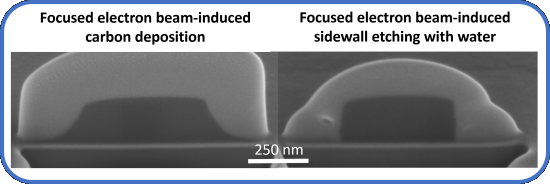
- , which was not indicated by a simple model based on etching. An analytical model was developed to include continued etching once the deposit has been removed at the exposed pixel. At this stage the secondary electrons from the substrate then cause the adsorbed water molecules to become effective in
- ; FEBIP; side wall angle; Introduction Focused electron beam-induced processing (FEBIP) is a technique in which a focused electron beam is directed onto a substrate with an adsorbed layer of precursor molecules. The precursor molecules are supplied from a gas injection system through a nozzle at close
- distance to the electron beam focus. The interaction of the incident and scattered electrons with the substrate and adsorbed precursor layer causes the dissociation of the precursor molecules. This results in either deposition of solid precursor fragments (focused electron beam-induced deposition, FEBID




Heat-induced morphological changes in silver nanowires deposited on a patterned silicon substrate
Beilstein J. Nanotechnol. 2024, 15, 435–446, doi:10.3762/bjnano.15.39
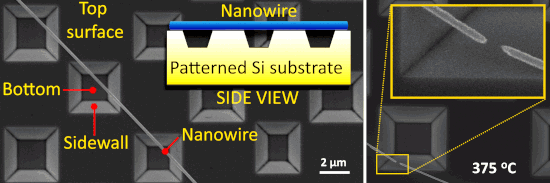
- fragmentation of NWs is attributed to the interplay between heat-enhanced diffusion and Rayleigh instability. In this work, we demonstrated that contact with the substrate plays an important role in the fragmentation process and can strongly affect the outcome of the heat treatment. We deposited silver NWs onto
- specially patterned silicon wafers so that some NWs were partially suspended over the holes in the substrate. Then, we performed a series of heat-treatment experiments and found that adhered and suspended parts of NWs behave differently under the heat treatment. Moreover, depending on the heat-treatment
- nanoscale devices [8]. When deposited on a transparent substrate in the form of a low-density mesh, metal NWs can provide electrical conductivity while retaining sufficient transparency. The growing demand for transparent conductive materials has stimulated numerous studies aimed at the design, preparation


Potential of a deep eutectic solvent in silver nanoparticle fabrication for antibiotic residue detection
Beilstein J. Nanotechnol. 2024, 15, 426–434, doi:10.3762/bjnano.15.38
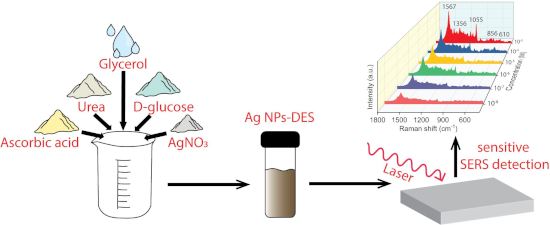
- NFT and SDZ, respectively. Besides, the linearity coefficients are extremely close to 1 in the range of 10−8 to 10−3 M of concentration, and the SERS substrate shows remarkable uniformity along with great selectivity. This powerful SERS performance indicates that DESs have tremendous potential in the
- synthesis of nanomaterials for biosensor substrate construction. Keywords: Ag NPs; antibiotic residue; deep eutectic solvents; potential; SERS; Introduction Surface-enhanced Raman scattering (SERS) is a ubiquitous technology for detecting and tracing substances, applied in various kinds of sensors. The
- , methemoglobinemia, allergy, damaged liver, nausea, and cancer [33][34][35][36]. Despite these side effects, they are illegally overused in the food industry and medicine, which threatens the human food chain and negatively affects public health [37]. By evaluating the SERS parameters of the Ag NPs-DES substrate


Unveiling the nature of atomic defects in graphene on a metal surface
Beilstein J. Nanotechnol. 2024, 15, 416–425, doi:10.3762/bjnano.15.37
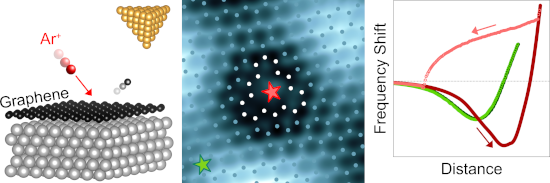
- depressions with a measured repeat distance of 2.59 ± 0.05 nm reflects the moiré pattern that is caused by the lattice mismatch between graphene and Ir(111), where graphene directions are aligned with directions of the metal substrate [25][42][43][44][45]. The lozenge unit cell of the coincidence lattice is
- increased tip–graphene hybridization compared to the far tunneling range, which may entail a modification of the graphene electronic structure or enhance the contribution of substrate states to the junction current [46]. The mounds and adjacent valleys of the moiré superstructure are characterized by
- on Pt(111) [14], and SiC() [16]. These resonances were interpreted as a collective excitation of the graphene π orbitals near the void [54], which depends on the coupling of the C atoms to the substrate surface. Therefore, the graphene–surface hybridization plays an important role in the occurrence


Classification and application of metal-based nanoantioxidants in medicine and healthcare
Beilstein J. Nanotechnol. 2024, 15, 396–415, doi:10.3762/bjnano.15.36
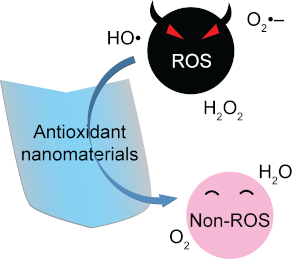
- reactions. In other words, ROS tend to react with chain-breaking antioxidants more rapidly than with the substrate [8][49]. Phenolic compounds are among the most effective chain-breaking antioxidants that appear in nature and can also be synthesized. For example, α-tocopherol (vitamin E) is a chain-breaking


Insect attachment on waxy plant surfaces: the effect of pad contamination by different waxes
Beilstein J. Nanotechnol. 2024, 15, 385–395, doi:10.3762/bjnano.15.35
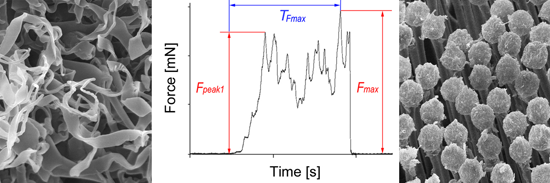
- absorption of the fluid from insect adhesive pads by porous media and/or the effect of surface roughness. Because of the more elaborate experimental design (three additional force measurements on the solid sample after the test on the porous substrate), a later study with the beetle Harmonia axyridis (Pallas
- ) (Coleoptera, Coccinellidae) proved the primary effect of absorption of the insect pad secretion by the porous substrate on the insect attachment force [25]. According to the contamination hypothesis, wax projections can completely or partially detach from the plant surface and adhere to the insect pads
- adhesive pads by the plant wax contributes to the reduction of insect attachment on waxy plant surfaces and to the subsequent long-term reduction of their attachment ability. We measured the traction forces of C. fastuosa male beetles on nine waxy plant surfaces and a reference smooth glass substrate. The




On the mechanism of piezoresistance in nanocrystalline graphite
Beilstein J. Nanotechnol. 2024, 15, 376–384, doi:10.3762/bjnano.15.34
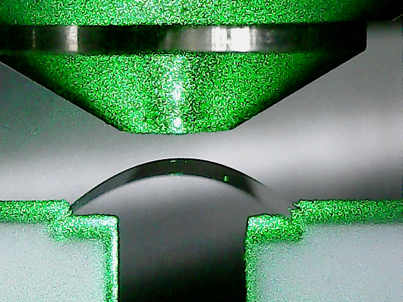
- Keithley 2636A device. The substrate holder and contacts holder were machined and attached to the stepper motor as shown in Figure 1a. A detailed description of the setup has been given by Kumar [23]. The complete setup was automated via self-programmed Python code. To completely eliminate any strain
- -induced changes in the contacts, the NCG was patterned such that the NCG itself is used as a contacting electrode (shown in Figure 1b). The area marked with a red square in Figure 1b (2 mm × 2 mm) is the active device area for sheet resistance measurements on a substrate of 10 mm × 10 mm area. Thin NCG
- ; subsequently, it was transferred onto a 100 μm thick PET substrate. For more details please see the Experimental section. Measured piezoresistance curves (with forward and reverse sweep) for a 5 nm thick patterned NCG film on the PET substrate are shown in Figure 2a. Sheet resistance values are plotted against


Investigating ripple pattern formation and damage profiles in Si and Ge induced by 100 keV Ar+ ion beam: a comparative study
Beilstein J. Nanotechnol. 2024, 15, 367–375, doi:10.3762/bjnano.15.33
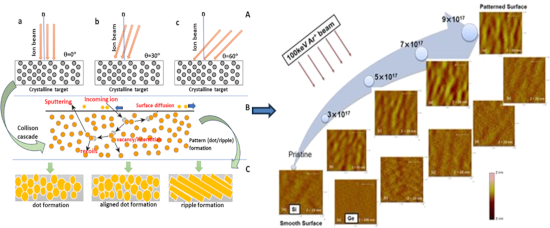
- to induce that type of energy deposition in the Ge lattice. This way, the defects can be produced and the substrate can be amorphized. The roughness and growth exponents have been deduced from the RMS surface roughness and power spectral density data to understand the mechanism of ripple formation on


Modulated critical currents of spin-transfer torque-induced resistance changes in NiCu/Cu multilayered nanowires
Beilstein J. Nanotechnol. 2024, 15, 360–366, doi:10.3762/bjnano.15.32
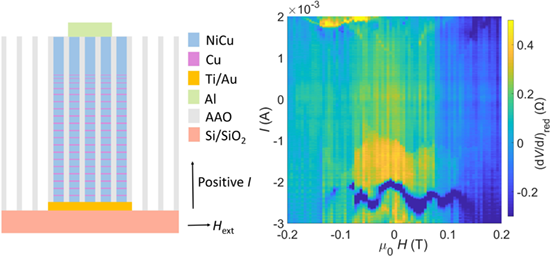
- vertically patterned magnetic nanowires on a Si substrate. With this approach we fabricated three-dimensional nanowire-based spin valve devices without the need of complex etching processes or additional spacer coating. Through this method, we successfully obtained NiCu/Cu multilayered nanowire arrays with a
- fabricated through a newly developed method, which enables to selectively deposit the magnetic nanowires on the Si substrate and to fabricate three-dimensional (3D) devices contacting a few or even single nanowires without complex etching processes [17] or additional spacer coating [18][19]. Results and
- Discussion The AAO template was fabricated by directly anodizing a ca. 1 µm thick aluminum (Al) film on a silicon (Si) substrate covered with 200 nm SiO2 and patterned Ti/Au (5/50 nm) bottom electrodes. It has pores with a diameter of around 35 nm, an interpore distance of around 50 nm, and a height of


Controllable physicochemical properties of WOx thin films grown under glancing angle
Beilstein J. Nanotechnol. 2024, 15, 350–359, doi:10.3762/bjnano.15.31
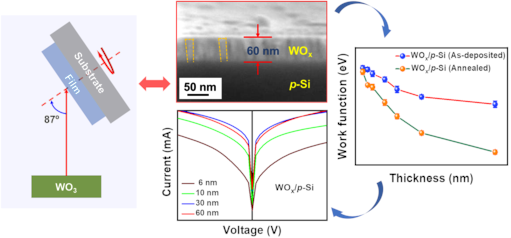
- ultrapure Ar gas (99.99%) using a mass flow controller at 30 sccm flow rate. The substrate holder was kept 12.5 cm away from the target at a glancing angle of 87° and 50 W rf power (Advanced Energy) was applied to the target, keeping the substrate holder grounded. Pre-sputtering was carried out for a
- duration of 1200 s to achieve stability in depositions and contamination-free films. A constant substrate rotation (10 rpm) was maintained to achieve uniform WOx films. Post-growth annealing of all WOx films (grown under the same conditions) was performed at 673 K for 60 min in a vacuum environment (3 × 10
- transport through the same. The I–V characteristics were recorded with a positive bias applied to the p-Si substrate. Figure 6a and Figure 6b show, respectively, the semi-log I–V curves (linear I–V curves are presented in Figure S4 of Supporting Information File 1) of WOx/p-Si heterostructures before and




Determining by Raman spectroscopy the average thickness and N-layer-specific surface coverages of MoS2 thin films with domains much smaller than the laser spot size
Beilstein J. Nanotechnol. 2024, 15, 279–296, doi:10.3762/bjnano.15.26
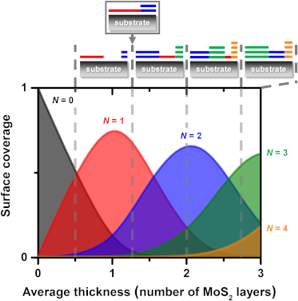
- range of A and B excitons [35]. All Raman spectra reported in this paper were recorded on different samples deposited on SiO2/Si(100) substrate. Hence, the second parameter essential to define is the SiO2 thickness. Indeed, the multiple reflection interferences that occur in the air/MoS2/SiO2/Si
- ) on the precise evaluation of the integrated intensities of the phonon modes of MoS2, namely A(A1g) and A(E12g), with respect to the integrated intensity of the 521 cm−1 mode from a bare area of the oxidized silicon substrate, A0(Si), used as an intensity reference [31], or from the silicon substrate
- evaluation of the temperature of MoS2 flakes prepared in different ways and that of the Si substrate as functions of the laser power impinging on the sample through a 100× objective (N.A. 0.9). The power was cycled between ≈5 μW and ≈2 mW. The temperature of MoS2 flakes is evaluated from the Stokes/anti


Ultrasensitive and ultrastretchable metal crack strain sensor based on helical polydimethylsiloxane
Beilstein J. Nanotechnol. 2024, 15, 270–278, doi:10.3762/bjnano.15.25
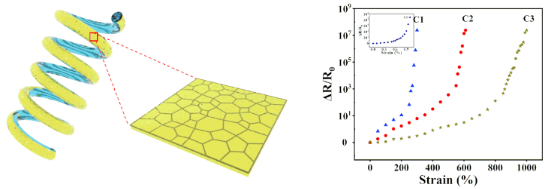
- metal crack sensors that exhibit exceptional performance in terms of ultrahigh sensitivity and ultrahigh stretchability. This is achieved by incorporating a helical structure into the substrate through a modeling process and, subsequently, depositing a thin film of gold onto the polydimethylsiloxane
- substrate via sputter deposition. The metal thin film is then pre-stretched to generate microcracks. The sensor demonstrates a remarkable stretchability of 300%, an exceptional sensitivity with a maximum gauge factor reaching 107, a rapid response time of 158 ms, minimal hysteresis, and outstanding
- film deposited on a microstructured polydimethylsiloxane (PDMS) substrate [21]. The sensor exhibits exceptional strain sensitivity, allowing for stretching of up to 20% strain. Liu et al. have successfully developed a strain sensor that exhibits high-performance characteristics [22]. A fish-scale-like


Design, fabrication, and characterization of kinetic-inductive force sensors for scanning probe applications
Beilstein J. Nanotechnol. 2024, 15, 242–255, doi:10.3762/bjnano.15.23
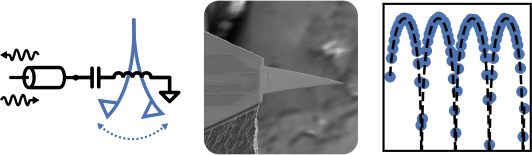
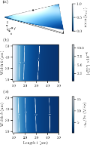
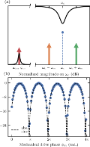
- meets the Si substrate. The FEM model gives the distribution of strain at the surface. Figure 2a shows the distribution of longitudinal strain εxx(x, y) for the fundamental bending mode of interest. The strain is normalized to its maximum value at the center of the clamping line. Figure 2b displays this
- 60 s. With the front side of the wafer protected, we flip over the wafer and etch through the Si-N using the same CHF3/SF6 process as in step (f) and the etch mask defined in step (c). We then use a Bosch process to etch through most of the Si substrate (approximately 450 μm deep) with an etch rate
- etch under the triangular silicon nitride plate and form a very straight clamping line to the Si substrate. However, the KOH etch is slow compared to the isotropic RIE process and attacks the Nb-Ti-N superconducting film. An additional lithography step was needed to protect the superconducting circuit



Quantitative wear evaluation of tips based on sharp structures
Beilstein J. Nanotechnol. 2024, 15, 230–241, doi:10.3762/bjnano.15.22
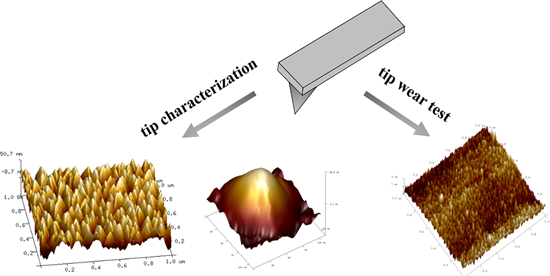
- studies. Another approach involves blind reconstruction based on AFM images. Bellotti et al. [15] introduced a uniquely shaped nanoparticle as a tip characterizer. They conducted tip shape analysis using AFM images centered on a single nanoparticle on a flat substrate to investigate the critical size of
- can be characterized by its distinct sharp structures, as shown in Figure 1. When the AFM tip scans over a minute columnar protrusion on the substrate, the resulting image contains information about the tip’s structure. By either analyzing the profile of these AFM images or directly observing the




Ion beam processing of DNA origami nanostructures
Beilstein J. Nanotechnol. 2024, 15, 207–214, doi:10.3762/bjnano.15.20
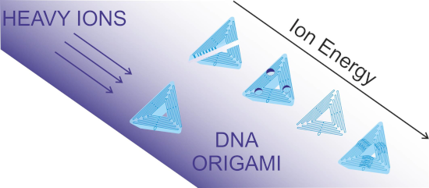
- ]. However, the situation can be different in DNA origami nanostructures stabilized by highly cross-linked and compact structures. When deposited on the surface, the strong immobilization by cations in between the DNA origami nanostructures and a hydrophilic substrate offer additional stability [16]. Indeed
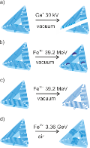
- nanometer scale and the nanometric precision of DNA origami-based assembly open possibilities in more precise tuning and control of nanofabrication. Here we analyze the consequences of ion beam irradiation on 2D DNA origami nanotriangles deposited on Si as a model substrate and resulting nanostructure
- °C nor 150 °C was reached under the irradiation conditions in the present experiments on the macroscopic level. The samples are placed on an aluminum block, and even at the highest fluences the substrate temperature is below 50 °C. The observed material evaporation resulting in the loss of


Graphene removal by water-assisted focused electron-beam-induced etching – unveiling the dose and dwell time impact on the etch profile and topographical changes in SiO2 substrates
Beilstein J. Nanotechnol. 2024, 15, 190–198, doi:10.3762/bjnano.15.18
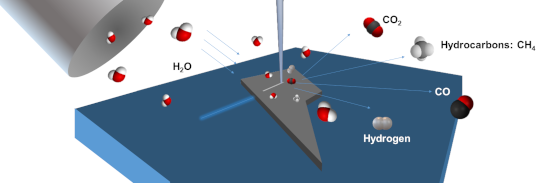
- nanopatterning, we have found significant morphological changes induced in the SiO2 substrate even at low electron dose values (<8 nC/μm2). We demonstrate that graphene etching and topographical changes in SiO2 substrates can be controlled via electron beam parameters such as dwell time and dose. Keywords
- applicable due to the high impact on the underlying substrate. Helium ion milling was believed to be the most suitable tool for structuring graphene [12]. However, it requires expensive equipment, and even this technique introduces a substantial number of defects into the graphene layer, as shown by Kim et
- of concept of water-assisted graphene etching. Moreover, the effects of changes in the topography of Si/SiO2 substrate during this process have not been addressed so far, as they may be observed only under certain experimental conditions. In a standard scanning electron microscope, the morphological


CdSe/ZnS quantum dots as a booster in the active layer of distributed ternary organic photovoltaics
Beilstein J. Nanotechnol. 2024, 15, 144–156, doi:10.3762/bjnano.15.14
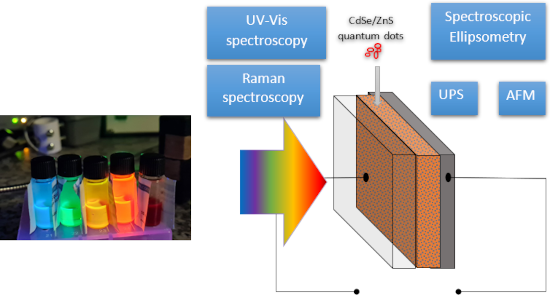
- ultrasonicated for 20 s and then applied to the substrate according to the test method. The angular velocity of the spin coater was also determined by the specific test method and its required film thickness. To keep the typical ratio of the donor and acceptor equal to 1:1 and simultaneously highlight the QD
- carried out for three incidence angles (65°, 70°, and 75°). A Bruker atomic force microscope (AFM) MULTIMODE 8 was used in the measurements in the ScanAsyst in Air mode, using silicon nitride probes (with a nominal tip radius of 2 nm and a spring constant equal to 0.4 N/m). The substrate was
- monocrystalline silicon. A WITec Alpha 300 M+ spectrometer with a 488 nm laser, 600 groove grating, and a 100× ZEISS objective was used for Raman measurements. The samples were deposited on a glass substrate. Ultraviolet photoelectron spectroscopy (UPS) was conducted in an ultrahigh-vacuum chamber with a base




In situ optical sub-wavelength thickness control of porous anodic aluminum oxide
Beilstein J. Nanotechnol. 2024, 15, 126–133, doi:10.3762/bjnano.15.12
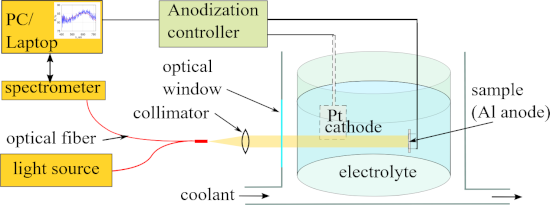
- heating, electrolyte flow [19], arrangement of the electrodes, and crystallographic orientation of the aluminum substrate [20]. In this work, we continuously recorded the reflectance spectra from a PAAO-coated aluminum surface during anodization. In a similar reflective interference spectroscopy (RIfS
- -center distance, and ≈30 nm pore diameter corresponded well to the expected results of using anodization in 0.3 M oxalic acid electrolyte and 40 V voltage [24][25]. PAAO is not a homogeneous material; instead, it consists of a porous layer and the barrier layer on top of the Al substrate (Figure 1b). To
- consistent thickness determination during anodization using reflectance measurements at normal incidence, it was sufficient to assume a single PAAO layer with the effective RI neff. A simplified model consisting of an Al substrate with the complex RI [29], PAAO with constant neff, and water with RI [30


New application of bimetallic Ag/Pt nanoplates in a colorimetric biosensor for specific detection of E. coli in water
Beilstein J. Nanotechnol. 2024, 15, 95–103, doi:10.3762/bjnano.15.9

- . This nanobiosensor has the ability to specifically bind to E. coli, increasing the peroxidase activity of the apt-Ag/Pt NPL. Finally, the blue color of the solution in the contaminated water samples was increased in the presence of 3,3′,5,5′-tetramethylbenzidine (TMB) as a substrate and H2O2. The assay
- of a chromogenic substrate, such as 3,3′,5,5′-tetramethylbenzidine (TMB), is widely employed. This conversion process can generate vibrant products when H2O2 is present [11][12]. Colorimetric biosensors often use chromogenic substrates such as TMB, ABTS, and o-phenylenediamine (OPD) to produce a
- visual readout signal through peroxidase mimetic activity. The TMB is preferred due to its reliance on a single organic substrate, eliminating the need for a helper molecule. Studies have shown TMB to be non-mutagenic, but it may still be carcinogenic. However, the low solubility of TMB in water requires


Study of the reusability and stability of nylon nanofibres as an antibody immobilisation surface
Beilstein J. Nanotechnol. 2024, 15, 83–94, doi:10.3762/bjnano.15.8

- mouse antibody, made in collaboration with the National Center for Biotechnology (CNB) – CSIC. 10-Acetyl-3,7-dihydroxyphenoxazine (ADHP, Ampliflu) was used as a fluorogenic substrate for horseradish peroxidase (HRP) (Sigma-Aldrich). BSA, from Sigma-Aldrich, labelled with RPE was selected as toxin
- excess reagents. Peroxidase-labelled streptavidin was added to detect immunocaptured ricin through biotin and streptavidin binding. A fluorescent peroxidase substrate (ADH, Ampliflu) was added, and the fluorescence was measured (λemission = 530 nm and λexcitation = 590 nm). This value was divided by the


Measurements of dichroic bow-tie antenna arrays with integrated cold-electron bolometers using YBCO oscillators
Beilstein J. Nanotechnol. 2024, 15, 26–36, doi:10.3762/bjnano.15.3
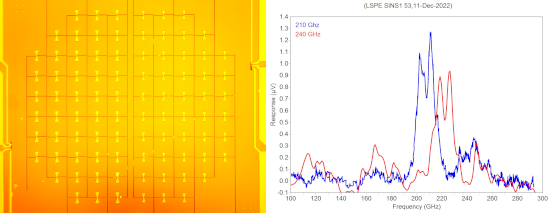
- We consider properties of dichroic antenna arrays on a silicon substrate with integrated cold-electron bolometers to detect radiation at frequencies of 210 and 240 GHz. This frequency range is widely used in cosmic microwave background experiments in space, balloon, and ground-based missions such as
- dichroic receiving systems, one should overcome the limitation of a silicon substrate, whose thickness affects the efficiency of detection as a refractive medium. In the case of close frequencies, however, one can find a compromise of matching the average frequency of both arrays with reasonable detection
- ] (Figure 1a). The basic element of the receiving matrix is a dipole bow-tie antenna, in the gap of which the CEB is embedded (Figure 1b). This matrix is located on a silicon substrate, which is 260 µm thick. Since the operation of the CEB in the matrix is assumed to be in the voltage bias mode, the


TEM sample preparation of lithographically patterned permalloy nanostructures on silicon nitride membranes
Beilstein J. Nanotechnol. 2024, 15, 1–12, doi:10.3762/bjnano.15.1

- submicrometer apertures were milled on SiN membranes using a focused ion beam. Furthermore, we have developed a new TEM sample preparation method, where we fabricated Py nanostructures on a bulk substrate with a SiN buffer layer and etched the substrate to create a thin SiN membrane under the Py nanostructure
- ion beam. This method avoids the resist-based fabrication, which is common in preparing nanodisk samples for TEM [8][20]. We have also developed a method of sample preparation for patterned nanostructures starting from a bulk substrate. This method is versatile and might be useful for more complicated
- magnetron sputtering through the resist aperture. We used DC magnetron sputtering in a pure Ar environment at a pressure of 1 Pa to deposit Py at room temperature. The effective permalloy target had a diameter of 8 mm. The sputtered material almost forms a parallel beam when it approaches the substrate at a


Determination of the radii of coated and uncoated silicon AFM sharp tips using a height calibration standard grating and a nonlinear regression function
Beilstein J. Nanotechnol. 2023, 14, 1200–1207, doi:10.3762/bjnano.14.99

- of SiO2 with height = 20 nm, grate distance = 2 µm, and pitch distance = 5 µm, on top of a silicon substrate, which allows for more space for the AFM tips to sweep along the height grate geometry. The corner edge radius of the grating height is not provided in the specification [15]. However, recent
- standard purchased from Budget Sensor [15], the grate height pattern made of silicon oxide (SiO2) has a height of 20 nm, a grate distance of 2 µm, and a pitch distance of 5 µm on top of the silicon substrate. So, the height distance that the tip end can slide along is equal to the distance measured from


A combined gas-phase dissociative ionization, dissociative electron attachment and deposition study on the potential FEBID precursor [Au(CH3)2Cl]2
Beilstein J. Nanotechnol. 2023, 14, 1178–1199, doi:10.3762/bjnano.14.98
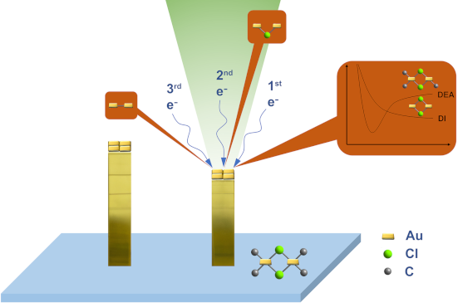
- the potential to widen the scope of applicable nanomaterials. In FEBID, a focused electron beam is directed onto the surface of a substrate in close proximity to a gas inlet, through which a precursor compound is supplied to deliver the material for the nanostructures to be built. For metallic
- structures, these precursor molecules are commonly organometallics that adsorb on the substrate and are decomposed by the electron beam irradiation. Ideally, a pure metal is deposited while fragmented volatile ligands are pumped away [11][12][13]. Several parameters affect the FEBID process, including the
- electron beam energy and current, the substrate material, the environment inside the deposition chamber, and the composition of the precursor [14][15][16][17]. Heretofore, various chemical vapor deposition (CVD) precursors have been applied for FEBID depositions. For gold nanostructures, these include, for



Spatial variations of conductivity of self-assembled monolayers of dodecanethiol on Au/mica and Au/Si substrates
Beilstein J. Nanotechnol. 2023, 14, 1169–1177, doi:10.3762/bjnano.14.97

- rougher and a flatter gold substrate on the lateral variation of the conductivity. We find that the roughness of the substrate crucially defines this variation. We conclude that it is paramount to adequately choose a gold substrate for investigations on molecular layer conductivity. Keywords: Au/mica; Au
- the use in applications, the properties of such layers of molecules and the interface they form with the metal substrate have to be investigated carefully and systematically. In order to achieve comparability between different types of molecules, ordered layers are favorable, which makes self
- substrate and the mercury electrode yields the conductivity of the SAM, averaged over the contact area of the mercury droplet. In such studies, one of the crucial problems was mercury filling out defects in the SAMs, which leads to short circuits and unreliable currents running through the microcontact





