


Search results
Search for "acylation" in Full Text gives 355 result(s) in Beilstein Journal of Organic Chemistry. Showing first 200.
Syntheses of 3,4- and 1,4-dihydroquinazolines from 2-aminobenzylamine
Beilstein J. Org. Chem. 2017, 13, 1470–1477, doi:10.3762/bjoc.13.145

- required functionalization of both amino groups present in 2-ABA was achieved by different routes involving selective N-acylation and cesium carbonate-mediated N-alkylation reactions, avoiding protection/deprotection steps. The heterocycles were efficiently synthesized in short reaction times by microwave
- , the selective acylation of the aliphatic amino group was achieved by the treatment of the diamine with benzoic acid in the presence of Zr(azobenzene-4,4´-dicarboxylate) [43], with tert-butylperoxybenzoate [44] and with isopropenyl acetate [45], or by a DCC-mediated coupling with a carboxylic acid [38
- amides 4a–c employing a THF solution of borane (yields 82–93%; see Supporting Information File 1 and Scheme 2). The synthesis of N-(2-aminobenzyl)amides 4a–k was achieved by selective N-acylation of 2-ABA or its N-substituted derivatives 3a–c, whose preparation is depicted in Scheme 2. In spite of the


A new member of the fusaricidin family – structure elucidation and synthesis of fusaricidin E
Beilstein J. Org. Chem. 2017, 13, 1430–1438, doi:10.3762/bjoc.13.140
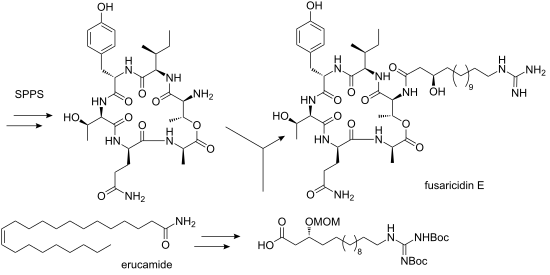
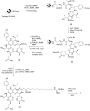
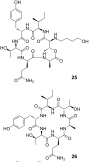
- the esterification with DIC/DMAP [12] as the double acylation product 18 could be detected (Scheme 3). Further investigations suggested DMAP to be responsible for the cleavage of the ΨMe,Me'Pro and after reduction of the amount of DMAP to 5 mol %, nearly no doubly acylated product was found. Besides
- single signal set, so the fate of the assumed minor stereoisomer remains unclear and it was probably lost during HPLC purification. The analysis also revealed that the acylation with the GHPD side chain was selective for the amine and no O-acylated product was formed. Side chain protecting groups were



A speedy route to sterically encumbered, benzene-fused derivatives of privileged, naturally occurring hexahydropyrrolo[1,2-b]isoquinoline
Beilstein J. Org. Chem. 2017, 13, 1413–1424, doi:10.3762/bjoc.13.138
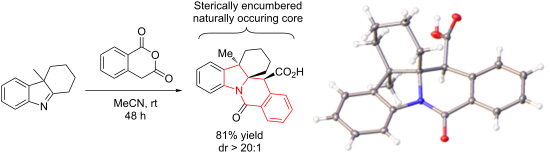
- ) N-acylation of the imine component followed by intramolecular Mannich reaction or (b) Mannich-type addition of the HPA enolate to a protonated imine component followed by intramolecular aminolysis of the cyclic anhydride moiety in Mannich adduct 13 (Scheme 3) [1]. Investigation of the CCR leading to


Nitration of 5,11-dihydroindolo[3,2-b]carbazoles and synthetic applications of their nitro-substituted derivatives
Beilstein J. Org. Chem. 2017, 13, 1396–1406, doi:10.3762/bjoc.13.136

- chemical methods for modification of ICZ derivatives. We have recently reported several synthetic procedures for regioselective C2,8-formylation and acylation of indolo[3,2-b]carbazoles, bearing electron-rich aromatic or heteroaromatic substituents at C-6 and C-12, and also demonstrated the usage of the


An improved preparation of phorbol from croton oil
Beilstein J. Org. Chem. 2017, 13, 1361–1367, doi:10.3762/bjoc.13.133
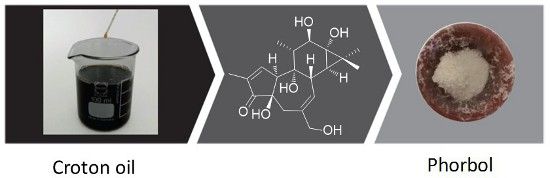
- , since the irritancy of phorbol esters is critically dependent on their acylation profile [6]. However, the native phorboid profile of croton oil is still poorly characterized in terms of analytical profile [24], and the recovery of the native highly lipophilic phorboid esters from the lipid matrix of


BODIPY-based fluorescent liposomes with sesquiterpene lactone trilobolide
Beilstein J. Org. Chem. 2017, 13, 1316–1324, doi:10.3762/bjoc.13.128
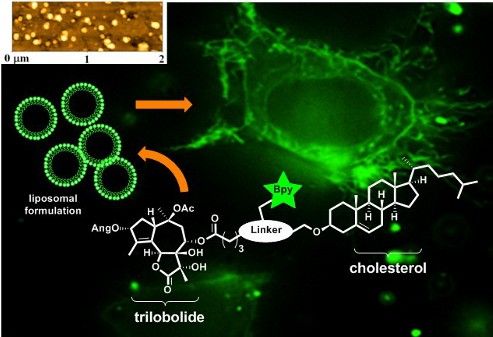
- reaction of 4-iodo-L-phenylalanine with thionyl chloride in MeOH in quantitative yield [33]. The successive acylation of the α-amino group with 5-azidovaleric acid catalyzed by T3P (propylphosphonic anhydride) in the mixture of pyridine and AcOEt gave azidoterminated product 1 in 70% yield. Alkaline




Total synthesis of elansolids B1 and B2
Beilstein J. Org. Chem. 2017, 13, 1280–1287, doi:10.3762/bjoc.13.124
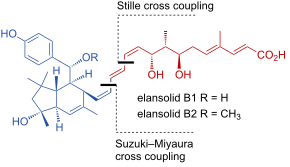
- iodide 17 after O-acylation, iodination of the terminal alkyne and finally diimide-mediated syn-reduction [11]. Next, DDQ-mediated removal of the PMB protecting group yielded vinyl iodide 18. The synthesis of both fragments 13 and 18 set the stage for the Suzuki–Miyaura coupling which delivered the


Glycoscience@Synchrotron: Synchrotron radiation applied to structural glycoscience
Beilstein J. Org. Chem. 2017, 13, 1145–1167, doi:10.3762/bjoc.13.114
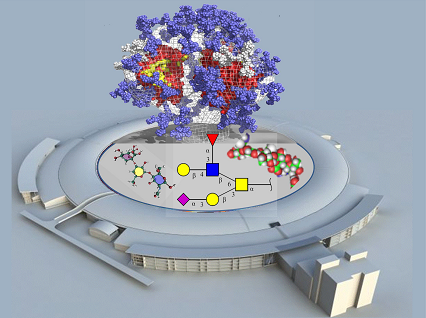
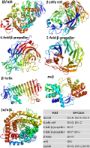
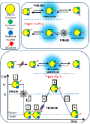
- oligosaccharide acceptor and GDP lead to the understanding of the FUT1 mechanism [40]. Carbohydrate esterases: Carbohydrate esterases perform the de-O or de-N-acylation of carbohydrates. From a mechanistic point of view, this family of enzymes is divided into two classes, according to the dual role played by the






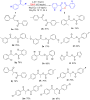
α-Acetoxyarone synthesis via iodine-catalyzed and tert-butyl hydroperoxide-mediateded self-intermolecular oxidative coupling of aryl ketones
Beilstein J. Org. Chem. 2017, 13, 1079–1084, doi:10.3762/bjoc.13.107

- previous reports [22][29]. Conclusion In summary, we have developed an efficient, novel, and metal-free synthesis of α-acetoxyaryl ketones from aryl ketones using I2−TBHP. A facile α-acylation reaction involving self-intermolecular oxidative coupling of aryl ketones was observed for the first time in the




Regioselective (thio)carbamoylation of 2,7-di-tert-butylpyrene at the 1-position with iso(thio)cyanates
Beilstein J. Org. Chem. 2017, 13, 1032–1038, doi:10.3762/bjoc.13.102

- has been reported that nitration and bromination of 2 take place at the 1-position (however, the bromine atom in 1-bromopyrene can migrate into the 4-position in the presence of AlCl3) [8][9], whereas Friedel–Crafts acylation and Vilsmeier formylation take place at the 4-position [10]. We recently
- whether TfOH-promoted Friedel–Crafts acylation of 2 will also occur at the 1-position. For this purpose, we examined the reaction of 2 with acetic acid and trifluoroacetic anhydride, (TFAA)/TfOH, according to our protocol used for the acylation of pyrene with alkynoic acids [25]. However, in this case we
- opinion, the observed difference in the regioselectivity of the (thio)carbamoylation and acylation of 2 may be due to different bulkiness of the reacting electrophile: the electrophilic center of the protonated iso(thio)cyanate is relatively unhindered and able to attack the electronically activated but




Automating multistep flow synthesis: approach and challenges in integrating chemistry, machines and logic
Beilstein J. Org. Chem. 2017, 13, 960–987, doi:10.3762/bjoc.13.97
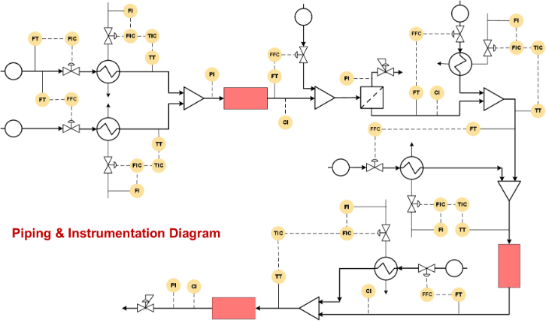
- and one separation step. In the first step, a Friedel–Crafts acylation of isobutylbenzene (1 equiv) and propionyl chloride (1.17 equiv) in the presence of AlCl3 as Lewis acid was carried out in a tubular reactor. The residence time is one minute, and the temperature is maintained at 87 °C. The outlet




First total synthesis of kipukasin A
Beilstein J. Org. Chem. 2017, 13, 855–862, doi:10.3762/bjoc.13.86
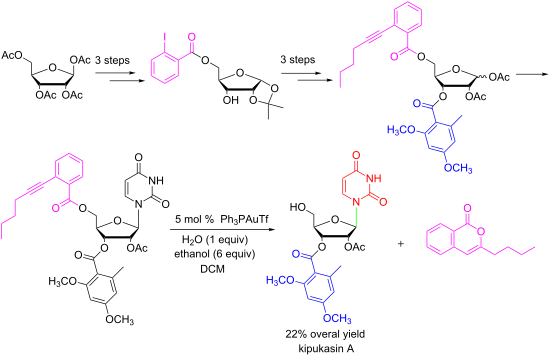
- Sonogashira cross-coupling with 1-hexyne provided ribose 14 in 78% yield [35]. Subsequently, using DMAP as acylation catalyst and triethylamine as base, the former synthesized 2,4-dimethoxy-6-methylbenzoyl chloride (9) reacted with ribose 14 to 3-O-(2,4-dimethoxy-6-methylbenzoyl)ribose 15 in 74% yield


DMAP-assisted sulfonylation as an efficient step for the methylation of primary amine motifs on solid support
Beilstein J. Org. Chem. 2017, 13, 806–816, doi:10.3762/bjoc.13.81
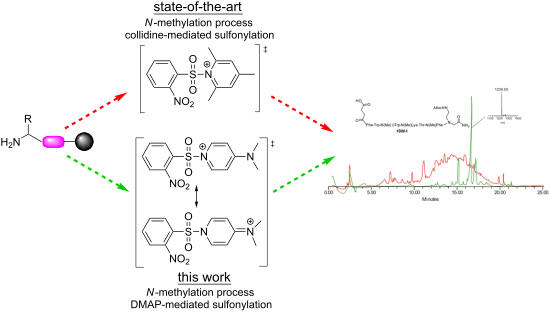
- several amine motifs. 4-Dimethylaminopyridine (DMAP) has been reported to assist in the sulfonylation and acylation of weak nucleophiles such as secondary amines, alcohols, amides, and sterically hindered amines when used as catalyst in addition to a base additive [28][29][30][31]. It has been suggested
- effective reagent compared to the other additives used. DMAP is used as a catalyst in acylation reactions as it acts via a nucleophilic addition mechanism [34][37][40]. In nucleophilic catalysed acylation, the mechanism involves a step in which the DMAP replaces the leaving group on the carbonyl group



Derivatives of the triaminoguanidinium ion, 5. Acylation of triaminoguanidines leading to symmetrical tris(acylamino)guanidines and mesoionic 1,2,4-triazolium-3-aminides
Beilstein J. Org. Chem. 2017, 13, 579–588, doi:10.3762/bjoc.13.57
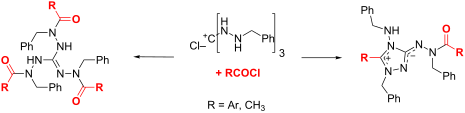
- went on to a 3,6-di(pyrazol-1-yl)-1,2,4,5-tetrazine [11], and with 1,1,1-trifluoro-2,4-pentanedione two branches of TAG-Cl were converted into pyrazoline moieties and the third one into an enaminone [12]. Not much is known about the acylation of triaminoguanidines. Reactions with carboxylic acids have
- -thiadiazolium-2-phenylaminides. We present now the results of our studies on the acylation of triaminoguanidines with carboxylic acid chlorides. Further, we show that N,N’,N’’-tris(benzylamino)guanidine reacts with acid chlorides to afford either the threefold N-acylation product or a mesoionic 1,2,4-triazolium
- ]. Results and Discussion Acylation of triaminoguanidine Triaminoguanidine is highly soluble in water [34], and triaminoguanidinium chloride (TAG-Cl, 1) is soluble in hot water or water/ethanol mixtures, but both are insoluble or sparingly soluble in common organic solvents. Since aqueous media cannot be


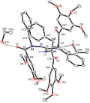


Pd- and Cu-catalyzed approaches in the syntheses of new cholane aminoanthraquinone pincer-like ligands
Beilstein J. Org. Chem. 2017, 13, 564–570, doi:10.3762/bjoc.13.55

- serve as sensors for aromatic compounds [24]. During the first decade of the XXI century, the main approaches to cyclic and pincer cholane derivatives were based on “classical” organic transformations (acylation, alkylation, etc.) [7][8][25][26][27]. Later, two modern synthetic approaches based on metal


Synthesis of 1-indanones with a broad range of biological activity
Beilstein J. Org. Chem. 2017, 13, 451–494, doi:10.3762/bjoc.13.48
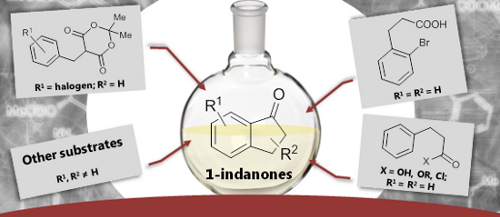
- of acylation or alkylation reaction, the intermediate 21a with activated aromatic ring, always led to the 1-indanone formation, in contrast to the acylated intermediate 21b with deactivated aromatic ring (Scheme 8). In the same year, Xu et al. have patented a synthesis of 5-chloro-1-indanone via the
- reaction of malonic acid with chlorobenzaldehyde [21]. In the first step, the substrates reacted in the presence of formic acid and diethylamine to form 3-chlorophenylpropionic acid followed by a intramolecular Friedel–Crafts acylation with malonyl chloride in the presence of zinc chloride to give 5-chloro
- -arylpropanoic and 4-arylbutanoic acids has been reported in 2015 by Le et al. [22]. The authors applied a microwave-assisted intramolecular Friedel–Crafts acylation catalyzed by metal triflate in triflate-anion containing ionic liquids. This synthesis proceeded with the goals of green chemistry and allowed to


Highly reactive, liquid diacrylamides via synergistic combination of spatially arranged curing moieties
Beilstein J. Org. Chem. 2017, 13, 372–383, doi:10.3762/bjoc.13.40
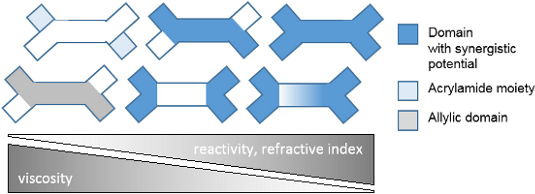
- could isolate crude diamines 8 and 9, containing significant amounts (10–15%) of the tertiary amines 8a and 9a (Scheme 3) or diamine 16, respectively; each could be used without further purification. Classical acylation with acetyl chloride or acryloyl chloride in the presence of triethylamine led to
- allyl chloride to 13, we could not observe any exothermic behavior or fast formation of the desired compound. So we decided to raise the temperature to 60 °C for 24 hours resulting in a significant increase of product formation. The subsequent direct acylation of the crude product 11 with acryloyl


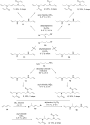






Polyketide stereocontrol: a study in chemical biology
Beilstein J. Org. Chem. 2017, 13, 348–371, doi:10.3762/bjoc.13.39
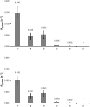
- resulting enantiomeric materials, it was then shown by autoradiography that acylation of all six DEBS proteins is highly specific for the (2S)-isomer (7) [26], implying that the six AT domains present in the multienzymes select exclusively this stereoisomer (Figure 5). Subsequent studies in vitro with a




NMR reaction monitoring in flow synthesis
Beilstein J. Org. Chem. 2017, 13, 285–300, doi:10.3762/bjoc.13.31
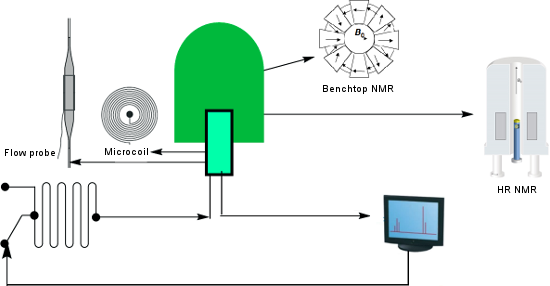
- with a line of <1 Hz in ethanol. As a proof-of-concept, the integrated flow system (microreactor-stripline NMR chip) was tested in the acylation of benzyl alcohol with acetyl chloride (Figure 7) using DIPEA as the base. The kinetics were studied by in situ monitoring and it was found that 70


A novel method for heterocyclic amide–thioamide transformations
Beilstein J. Org. Chem. 2017, 13, 174–181, doi:10.3762/bjoc.13.20

- heating isatine with malonic acid followed by esterification of the produced quinoline carboxylic acid with methanol in the presence of sulfuric acid at 80 °C for 6 h. 4-Arylphthalazin-1(2H)-ones A7 and A8 [24][25] were prepared by Friedel–Crafts acylation reaction of N-aminophthalimide with either


The digital code driven autonomous synthesis of ibuprofen automated in a 3D-printer-based robot
Beilstein J. Org. Chem. 2016, 12, 2776–2783, doi:10.3762/bjoc.12.276
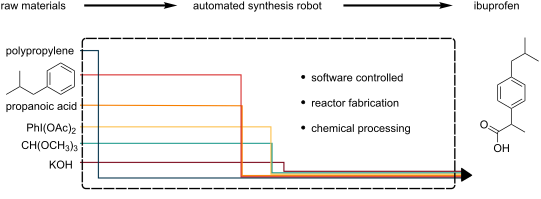
- platform is a three-step synthesis of the popular nonsteroidal anti-inflammatory drug ibuprofen ((R,S)-2-(4-(2-methylpropyl)phenyl)propanoic acid) starting from isobutylbenzene and propanoic acid (see Scheme 1). These starting materials undergo a Friedel–Crafts acylation using trifluoromethanesulfonic
- the debug feature of the process control software. For this progression was paused after each stage and aliquots taken from the reaction mixture to be analysed by NMR to ensure the synthesis was proceeding as planned (giving approximate yields by 1H NMR of 71% for the initial acylation step and 64



Symmetry-based approach to oligostilbenoids: Rapid entry to viniferifuran, shoreaphenol, malibatol A, and diptoindonesin G
Beilstein J. Org. Chem. 2016, 12, 2689–2693, doi:10.3762/bjoc.12.266

- diptoindonesin G, a potent cytotoxic and immunosuppressant agent [16][17], by using a highly efficient domino cyclodehydration/intramolecular Friedel–Crafts acylation/regioselective demethylation sequence as a key transformation. Very recently, a dual functional role of diptoindonesin G in modulating α and β


Et3B-mediated and palladium-catalyzed direct allylation of β-dicarbonyl compounds with Morita–Baylis–Hillman alcohols
Beilstein J. Org. Chem. 2016, 12, 2402–2409, doi:10.3762/bjoc.12.234

- of the MBH carboxylates with aliphatic 1,3-diketones in the presence of K2CO3. A drawback of these synthetic approaches is the need to first perform the acylation step of the corresponding allyl MBH alcohols. For this reason, we herein report an efficient direct method for the allylation of β


Tunable microwave-assisted method for the solvent-free and catalyst-free peracetylation of natural products
Beilstein J. Org. Chem. 2016, 12, 2222–2233, doi:10.3762/bjoc.12.214
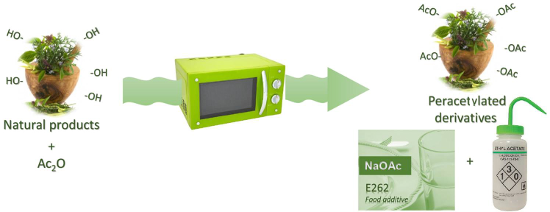
- several functionalities at room temperature in good to excellent yields, it is worth noting that some of them use metal-based catalysts needing long preparation procedures, or in the case of non-metal-based catalysts, inorganic acids are employed to activate acylation. On the other hand, the increasing


Solvent-free synthesis of novel para-menthane-3,8-diol ester derivatives from citronellal using a polymer-supported scandium triflate catalyst
Beilstein J. Org. Chem. 2016, 12, 2046–2054, doi:10.3762/bjoc.12.193
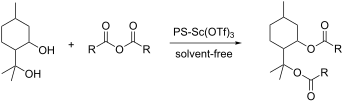
- environmentally friendly method for the synthesis of para-menthane-3,8-diol from natural citronellal oil in 96% yield, under solvent free aqueous conditions. The acylation of para-menthane-3,8-diol with various acid anhydrides over polymer-supported scandium triflate (PS-Sc(OTf)3) catalyst was subsequently
- : acylation; diesters; para-menthane-3,8-diol; PS-Sc(OTf)3; Introduction Although South Africa has a substantial petrochemical industry, the fine chemical industry is very small and most chemicals are imported. As such there is significant interest in the use of natural resources for the manufacture of added
- -known as an active insect repellent and can be found naturally as a minor component of citriodora oil [2]. Considering the chemical structure of 3, two reactive hydroxy groups are present which can undergo an organic transformation, such as acylation, to yield natural bio-based compounds. The acylation





