Search results
Search for "quinoline" in Full Text gives 196 result(s) in Beilstein Journal of Organic Chemistry.
Synthesis of SF5-containing benzisoxazoles, quinolines, and quinazolines by the Davis reaction of nitro-(pentafluorosulfanyl)benzenes
Beilstein J. Org. Chem. 2013, 9, 411–416, doi:10.3762/bjoc.9.43
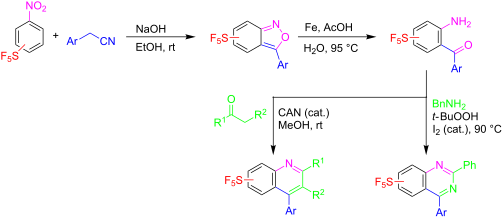
- observed compared to unsubstituted ortho-aminoacetophenone, but it could be overcome by using an excess of the condensation reagent and longer reaction times. Quinoline 12 was prepared in high yield by the Friedländer annulation reaction of 10a with excess ethyl acetoacetate in the presence of catalytic
- CAN using modified literature conditions (Scheme 3) [32]. Similarly, aminoketone 11a was condensed in good yield with cyclohexanone to provide quinoline 13 in good yield (Scheme 4). Finally, quinazoline 14 was synthesized by the reaction of aminoketone 11a with benzylamine in the presence of t-BuOOH
- Wipf and co-workers [29][30]. Synthesis of quinoline 12. Synthesis of quinoline 13. Synthesis of quinazoline 14. Synthesis of SF5-containing benzisoxazoles 7–9. Synthesis of ortho-aminobenzophenones 10 and 11. Supporting Information Supporting Information File 84: Experimental details


Synthesis of spiro[dihydropyridine-oxindoles] via three-component reaction of arylamine, isatin and cyclopentane-1,3-dione
Beilstein J. Org. Chem. 2013, 9, 8–14, doi:10.3762/bjoc.9.2
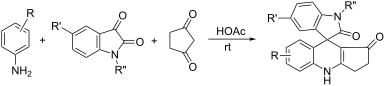
- three-component reaction of arylamine, isatin and cyclopentane-1,3-dione. Results and Discussion Recently we found that the four-component reactions of arylamine, acetylenedicarboxylate, isatin and dimedone in acetic acid resulted in the novel functionalized tetrahydrospiro[indoline-3,2’-quinoline


Flow photochemistry: Old light through new windows
Beilstein J. Org. Chem. 2012, 8, 2025–2052, doi:10.3762/bjoc.8.229


An efficient access to the synthesis of novel 12-phenylbenzo[6,7]oxepino[3,4-b]quinolin-13(6H)-one derivatives
Beilstein J. Org. Chem. 2012, 8, 1849–1857, doi:10.3762/bjoc.8.213

- Wentao Gao Guihai Lin Yang Li Xiyue Tao Rui Liu Lianjie Sun Institute of Superfine Chemicals, Bohai University, Jinzhou 121000, China 10.3762/bjoc.8.213 Abstract An efficient access to the tetracyclic-fused quinoline systems, 12-phenylbenzo[6,7]oxepino[3,4-b]quinolin-13(6H)-one derivatives 4a–l
- three-step route, offers easy access to tetracyclic-fused quinoline systems in short reaction times, and the products are obtained in moderate to good yields. Keywords: Eaton’s reagent; Friedel–Crafts acylation; Friedländer reaction; one-pot; PPA; quinoline; tetracyclic-fused; Introduction Polycyclic
- heterocycle-fused quinoline systems as important group compounds can be found in many biologically active natural products as well as in pharmacologically significant molecules, and have wide applications in medicinal chemistry [1][2][3][4]. It has been well-established that planar heterocycle-fused tri- or


A Wittig-olefination–Claisen-rearrangement approach to the 3-methylquinoline-4-carbaldehyde synthesis
Beilstein J. Org. Chem. 2012, 8, 1725–1729, doi:10.3762/bjoc.8.197

- Quinoline aldehydes are important synthetic intermediates in the synthesis of heterocyclic compounds that are used in the manufacturing of dyes [1] and pharmaceuticals [2][3]. 3-Substituted and 2,3-di-substituted quinoline-4-carbaldehyde derivatives are used in the synthesis of immunosuppressant KF20444 [4
- ] and 5-HT3 receptor antagonists [5]. Quinoline mevalonolactones, prepared from 3-methylquinoline-4-carbaldehyde, act as inhibitors of HMG-CoA reductase [6]. 3-Substituted quinoline-4-carbaldehyde derivatives are used in the development of molecular probes for the identification of extra interaction
- methods for the preparation of quinoline-4-carbaldehyde [12][13][14][15][16][17][18][19][20][21][22][23][24], only a few methods [6][9] are available for the preparation of 3-methylquinoline-4-carbaldehyde derivatives. In connection with the synthesis of camptothecin, we needed a general, high-yielding


Organocatalytic tandem Michael addition reactions: A powerful access to the enantioselective synthesis of functionalized chromenes, thiochromenes and 1,2-dihydroquinolines
Beilstein J. Org. Chem. 2012, 8, 1668–1694, doi:10.3762/bjoc.8.191

- reaction as the key step, reaction of aldehyde 56 with α,β-unsaturated aldehyde 57, catalyzed by chiral prolinol ethers Ie/HOAc in acetonitrile, provided quinoline derivative 58 with high yield and with high enantioselectivity (Scheme 29). In contrary to the work of Li, the presence of 4Å MS had a negative






Organocatalytic asymmetric addition of malonates to unsaturated 1,4-diketones
Beilstein J. Org. Chem. 2012, 8, 1452–1457, doi:10.3762/bjoc.8.165
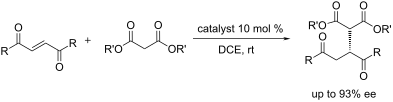
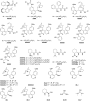
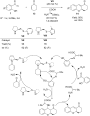
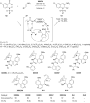
- the nucleophile to the tertiary amino group between the side chains of the catalysts. The re-face of the Michael acceptor is shielded by the flat quinoline unit and the si-attack of the malonate is preferred, affording R-selectivity (Figure 3). Determination of the absolute configuration The absolute


An intramolecular inverse electron demand Diels–Alder approach to annulated α-carbolines
Beilstein J. Org. Chem. 2012, 8, 829–840, doi:10.3762/bjoc.8.93
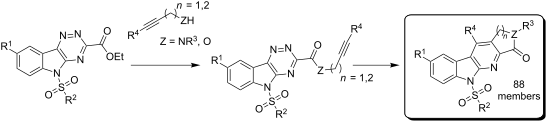
- ], isolated from roots of the West African plant Cryptolepis sanguinolenta [7]. Cryptotackieine, a member of the indolo[2,3-b]quinoline class of heterocycles [8], has been shown to be a strong inhibitor of Plasmodium falciparum growth [9]. 2-Amino-α-carbolines have also been identified as mutagens produced in


A novel and facile synthesis of 3-(2-benzofuroyl)- and 3,6-bis(2-benzofuroyl)carbazole derivatives
Beilstein J. Org. Chem. 2011, 7, 1533–1540, doi:10.3762/bjoc.7.180
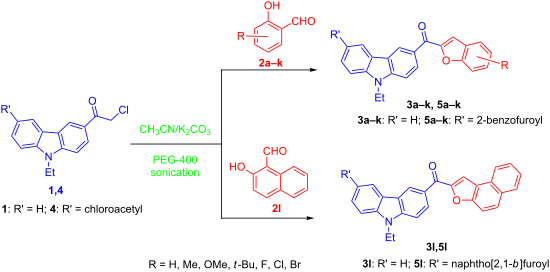
- benzofuroyl-based compounds [39][40][41][42][43]. We have recently reported the synthesis of quinolyl-substituted carbazoles [44] and benzofuranyl-substituted quinoline [45]. Thus, in light of the above findings and in the context of our ongoing work on the synthesis of new heterocyclic compounds, we found it


Functionalization of heterocyclic compounds using polyfunctional magnesium and zinc reagents
Beilstein J. Org. Chem. 2011, 7, 1261–1277, doi:10.3762/bjoc.7.147
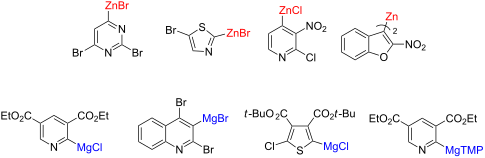
- -group are able to direct the zincation. Thus, the diiodoquinoline 22 is regioselectively zincated (25 °C, 12 h) to intermediate 23 leading to the polyfunctional quinoline 24 in 78% yield after copper(I)-mediated acylation (Scheme 4 and Supporting Information File 1, Procedure 1) [8]. This
- exchange reaction for the regioselective functionalization of quinolines. Thus, the 2,3-dibromoquinoline (65) is regioselectively converted to the 3-magnesiated quinoline derivative 66. Using the same exchange reagent, iPrMgCl·LiCl (64) and 2,4-dibromoquinoline (68), it is now possible to obtain the 4
- -magnesiated quinoline 69. All these magnesiations proceed at low temperature (−50 °C to −78 °C) and are complete within 2 h reaction time. After reaction with TsCN, the corresponding nitriles 67 and 70 were obtained in 84–85% yield (Scheme 12 and Supporting Information File 1, Procedure 5) [36]. The rate of


Multicomponent reaction access to complex quinolines via oxidation of the Povarov adducts
Beilstein J. Org. Chem. 2011, 7, 980–987, doi:10.3762/bjoc.7.110
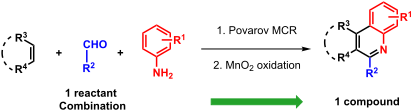
- tetrahydroquinolines obtained through the Povarov multicomponent reaction have been oxidized to the corresponding quinoline, giving access to a single product through a two-step sequence. Several oxidizing agents were studied and manganese dioxide proved to be the reagent of choice, affording higher yields, cleaner
- reactions and practical protocols. Keywords: manganese dioxide; multicomponent reactions; oxidation; Povarov; quinolines; tetrahydroquinolines; Introduction Heterocycles are ubiquitous scaffolds in pharmaceuticals, natural products and biologically active compounds. Quinoline systems in particular
- , Thompson et al. described the oxidation of fused pyrrolohydroquinolines (type 6) using MnO2 obtained from batteries. A kinetic competition between two processes was observed, and the desired double oxidation to the corresponding fused quinoline 7 took place, along with the oxidation–elimination sequence


Gold-catalyzed regioselective oxidation of terminal allenes: formation of α-methanesulfonyloxy methyl ketones
Beilstein J. Org. Chem. 2011, 7, 596–600, doi:10.3762/bjoc.7.69
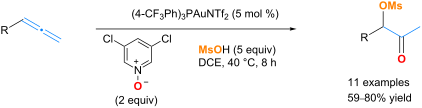
- ][13][14][15][16][17] or via allenes generated in situ [18][19][20][21]. We have recently shown that highly reactive gold carbenes can be generated from alkynes via gold-promoted intermolecular oxidation by pyridine/quinoline N-oxides [22][23][24][25], making benign alkynes effective surrogates of


First synthesis of 2-(benzofuran-2-yl)-6,7-methylene dioxyquinoline-3-carboxylic acid derivatives
Beilstein J. Org. Chem. 2011, 7, 210–217, doi:10.3762/bjoc.7.28
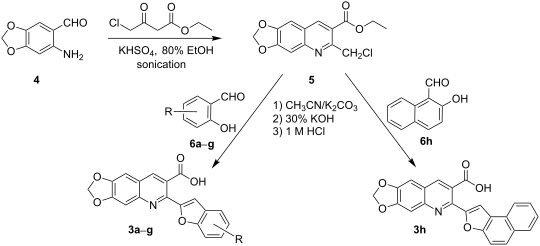
- Wentao Gao Jia Liu Yun Jiang Yang Li Institute of Superfine Chemicals, Bohai University, Jinzhou 121000, China 10.3762/bjoc.7.28 Abstract A facile and inexpensive synthesis of a series of novel methylenedioxy-bearing 2-(benzofuran-2-yl)-quinoline-3-carboxylic acid derivatives 3a–h via the one-pot
- ; methylenedioxy-bearing; one-pot; quinoline-3-carboxylic acid; salicylaldehyde; Introduction Heterocyclic systems containing a quinoline nucleus are an important group of compounds in medicinal chemistry, and are ubiquitous sub-structures associated with biologically active natural products [1][2][3][4]. Some
- quinoline compounds especially those containing heterocyclic systems at 2-position have been shown to display a wide spectrum of biological activities such as cytotoxic, anti-inflammatory and antifungal behavior [5][6]. For example, 2-(furan-2-yl)quinoline-4-carboxylic acid (and analogues) (1, Figure 1) was


Synthesis of 3-(quinolin-2-yl)- and 3,6-bis(quinolin-2-yl)-9H-carbazoles
Beilstein J. Org. Chem. 2010, 6, 966–972, doi:10.3762/bjoc.6.108

- : acetylcarbazole; β-aminoaldehyde; β-aminoketone; Friedländer condensation; sodium ethoxide; Introduction Nitrogen-containing heterocycles are a very important group of organic compounds because of their wide application in medicine, agriculture, and technology. Among these, quinoline and carbazole derivatives
- are of significant synthetic interest due to their diverse range of biological activities. Compounds containing a quinoline framework have been found applications as pharmaceuticals and agrochemicals, as well as being general synthetic building blocks [1][2][3]. Industrial, biological, and synthetic
- significance places this scaffold in a prestigious position. Studies on new quinoline derivatives appear frequently in the chemical literature. Therefore, significant effort continues to be directed toward the development of new quinolines . In particular, there is much current interest in the quinoline ring


Aromatic and heterocyclic perfluoroalkyl sulfides. Methods of preparation
Beilstein J. Org. Chem. 2010, 6, 880–921, doi:10.3762/bjoc.6.88
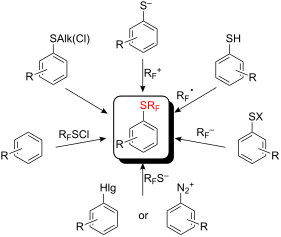
- heterocyclic compounds using trifluoromethylthiocopper (Scheme 23). The reaction is carried out by heating in a polar solvent (e.g. DMF, quinoline or N-methyl pyrrolidone) and the substrate can contain electron-donating or electron-withdrawing groups. Electron-withdrawing groups activate the iodo atom and


Synthesis of gem-difluoromethylenated analogues of boronolide
Beilstein J. Org. Chem. 2010, 6, No. 37, doi:10.3762/bjoc.6.37
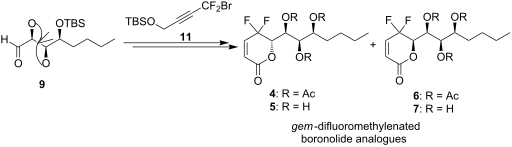
- attempts to convert the triple bond in compound 12a into the cis double bond via hydrogenation in the presence of Lindlar catalyst were unsuccessful. Even with the addition of quinoline, these reactions only resulted in inseparable mixtures. Fortunately, hydrogenation proceeded well by means of Pd–BaSO4
- –quinoline system [26], leading to the expected alcohol 13a in 96% yield. Subsequent selective removal of the primary TBS group in 13a with D-camphor-10-sulfonic acid (CSA) yielded the diol 14a in 80% yield. As expected, treatment of compound 14a with 0.2 equiv of 2,2,6,6-tetramethyl-1-piperidinyloxy (TEMPO


Fused bicyclic piperidines and dihydropyridines by dearomatising cyclisation of the enolates of nicotinyl-substituted esters and ketones
Beilstein J. Org. Chem. 2010, 6, No. 22, doi:10.3762/bjoc.6.22
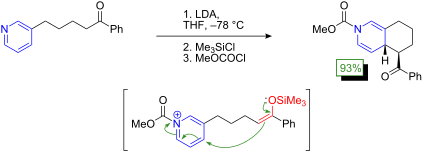
- : bicyclic; cyclisation; dearomatisation; enol ether; heterocycle; pyridine; quinoline; Introduction Oxidative [1][2][3] or reductive (nucleophilic) [4][5][6][7][8][9][10][11][12][13][14][15][16][17][18][19][20][21] dearomatising cyclisation reactions are effective strategies for rapidly building complexity


An enantiomerically pure siderophore type ligand for the diastereoselective 1 : 1 complexation of lanthanide(III) ions
Beilstein J. Org. Chem. 2009, 5, No. 78, doi:10.3762/bjoc.5.78
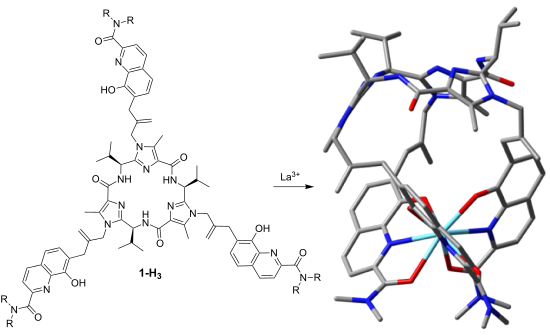
- peptidic scaffold and the final ligand 1a-H3 is obtained in good yield (90%). Successive Cope rearrangement of the spacers to the 5-position of the quinoline moiety is not observed under the chosen reaction conditions. 1H NMR spectra of 4 and 1a-H3 show pronounced differences for the resonances of the 8




Regioselective alkynylation followed by Suzuki coupling of 2,4-dichloroquinoline: Synthesis of 2-alkynyl- 4-arylquinolines
Beilstein J. Org. Chem. 2009, 5, No. 32, doi:10.3762/bjoc.5.32

- -dichloroquinoline; palladium; water; Introduction 2-Alkynyl pyridine and its benzo (i.e. quinoline) derivative possessing an aryl group at the C-4 position (A, Figure 1) have attracted considerable interest due to their utility in the development of compounds of potential pharmacological interest [1][2][3]. 2
- -Alkenyl/alkynylquinolines, have been reported to possess anti-retroviral properties [4]. Only few methods are known for the synthesis of A. Considering the possible C–C bond forming reactions on a pyridine/quinoline ring (Figure 1), the synthesis of A can be carried out following two main strategies e.g
- . (a) arylation at C-4 followed by alkynylation at C-2 or (b) alkynylation at C-2 followed by arylation at C-4. Methodologies based on strategy ‘a’ have been reported earlier. For example, Sonogashira coupling of a terminal alkyne with 2-chloro-4-aryl substituted quinoline [3] in the presence of (PPh3


Quinoline based receptor in fluorometric discrimination of carboxylic acids
Beilstein J. Org. Chem. 2008, 4, No. 52, doi:10.3762/bjoc.4.52

- Kumaresh Ghosh Suman Adhikari Asoke P. Chattopadhyay Purnendu Roy Chowdhury Department of Chemistry, University of Kalyani, Kalyani, Nadia-741235, India Chembiotek Research International Pvt. Ltd., Salt Lake City, Kolkata-700 091, India 10.3762/bjoc.4.52 Abstract Quinoline and naphthalene-based
- value and did not form any excimer upon complexation with the same acids under similar conditions. This established the role of quinoline ring nitrogen in binding with the acids. Keywords: carboxylic acid recognition; excimer emission; naphthalene; quinoline; Introduction The sensing and monitoring of
- - and dicarboxylic acids by a large number of receptors of different architectures is known [11][12][13][14]. We have also reported a series of synthetic receptors for carboxylic acids of various types [15][16][17][18]. In continuation, we report here a new quinoline based sensor 1 (Figure 1) which is


New modification of the Perkow reaction: halocarboxylate anions as leaving groups in 3-acyloxyquinoline- 2,4(1H,3H)-dione compounds
Beilstein J. Org. Chem. 2005, 1, No. 17, doi:10.1186/1860-5397-1-17
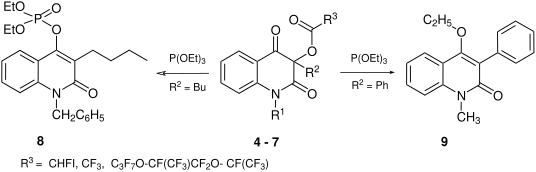
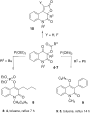
- 72 Zlín, Czech Republic Zentiva, U Kabelovny 130, 10237 Prague 10, Czech Republic 10.1186/1860-5397-1-17 Abstract Substituted 3-(fluoroacyloxy)quinoline-2,4(1H,3H)-diones including 3-(fluoroiodoacetoxy) derivatives react with triethyl phosphite to afford either the product of the Perkow reaction or
- the corresponding 4-ethoxyquinolin-2(1H)-one. In both reactions, the fluorocarboxylate anion acts as the first observed leaving group. This observation restricts the application of the intramolecular Horner-Wadsworth-Emmons synthesis to modify quinoline-2,4(1H,3H)-diones by the annulation of
- the sugar skeleton and its multiple acetoxy groups. In this communication we would like to report on the ability of halocarboxylate anions to act as leaving groups in the reactions of 3-(haloacyloxy)-quinoline-2,4(1H,3H)-diones with triethyl phosphite to afford 8 and 9, the products of the Perkow