


Search results
Search for "amino group" in Full Text gives 408 result(s) in Beilstein Journal of Organic Chemistry. Showing first 200.
Construction of CF2 moieties in FDA-approved drugs (2016–2025): industrial routes, mechanisms, and scale-up considerations
Beilstein J. Org. Chem. 2026, 22, 1122–1150, doi:10.3762/bjoc.22.91
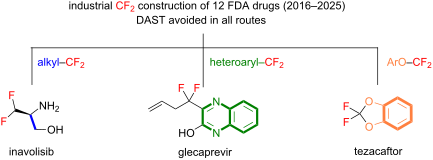
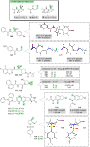
- adopted, two key points are most critical. First, the fluorination step should avoid the direct use of the DAST reagent; for example, the continuous flow approach used in route e can be adopted. Second, the conversion of the carboxy group to an amino group should avoid the use of azide reagents whenever


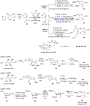


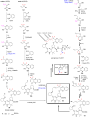


Amino acid-based surfactants: sustainable synthesis and antimicrobial mechanisms
Beilstein J. Org. Chem. 2026, 22, 1067–1085, doi:10.3762/bjoc.22.85
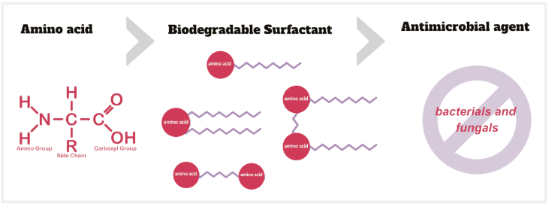
- and LKM (Table 1, entries 17 and 18), TMKM bears a fixed positive charge on the α-amino group, independent of pH. This structural modification results in consistent activity against Gram-positive bacteria (MIC 6–50 μg/mL) without requiring protonation at physiological pH, making it particularly


Site-specific labelling of native peptides and proteins: chemical and enzymatic strategies
Beilstein J. Org. Chem. 2026, 22, 857–881, doi:10.3762/bjoc.22.67
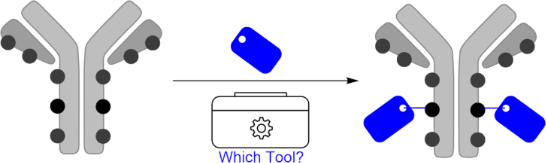
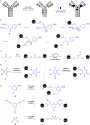
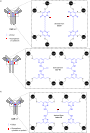
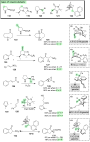
- reagent, 1) was used to label the α-amino group of insulin during sequence determination (Scheme 1a). Its selectivity over lysine’s ε-amine originates from the low pKa of the N-terminus, influenced by the adjacent carbonyl group and systematically characterized at ≈6–7 (Scheme 1b) [7]. Building on this
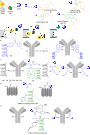
- variants for antibody conjugation [146]. Exploiting the ability of sortase to accept the ε-amino group of lysine, the enzyme was fused to an antibody Fc-binding domain protein (protein Z/pZ), positioning it near surface-exposed lysine on the target antibody for isopeptide bond modification (Scheme 14b
- key amines on insulin, including the N-terminal glycine of chain A, the N-terminal phenylalanine of chain B and the ε-amino group of lysine B29. Using a colony picker and UPLC analysis, mutations were introduced within the binding pocket (to enhance localised recognition of insulin) and at distal








A mild and atom-efficient four-component cascade strategy for the construction of biologically relevant 4-hydroxyquinolin-2(1H)-one derivatives
Beilstein J. Org. Chem. 2026, 22, 244–256, doi:10.3762/bjoc.22.18
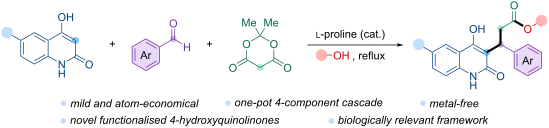
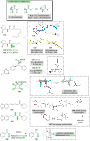
- yields (Scheme 5). The proposed mechanism of the four-component reaction is illustrated in Scheme 6. ʟ-Proline, via its amino group, nucleophilically attacks the carbonyl of the aromatic aldehyde, forming an iminium zwitterion intermediate A. Concurrently, ʟ-proline promotes the generation of the


Competitive cyclization of ethyl trifluoroacetoacetate and methyl ketones with 1,3-diamino-2-propanol into hydrogenated oxazolo- and pyrimido-condensed pyridones
Beilstein J. Org. Chem. 2025, 21, 2716–2729, doi:10.3762/bjoc.21.209
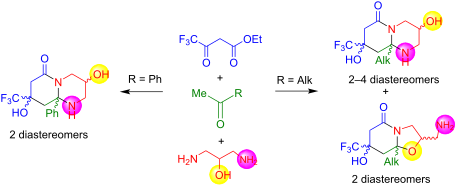
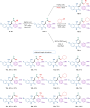
- at the acyl moiety with the amino group of diamino alcohol 3 to generate a three-component intermediate B (Scheme 4). The latter undergoes intramolecular cyclization involving the C=N bond in two equally probable directions: by adding a free amino group to form a hexahydropyrimidine ring of
- imine reaction center. This makes the center softer, which favors the interaction with the amino group to generate the hexahydropyrimidine intermediate C. The methyl, ethyl and butyl substituents of intermediate B have a positive inductive effect, which increases with the lengthening of the alkyl chain
- intermediate B, which becomes softer for attack by the amino group. It is worth noting that the diastereoselectivity of octahydropyrido[1,2-a]pyrimidinones formation 4a–c in the reactions with alkyl methyl ketones 2a–c is also affected by the length of the alkyl chain, with the number of diastereomers


Thiazolidinones: novel insights from microwave synthesis, computational studies, and potentially bioactive hybrids
Beilstein J. Org. Chem. 2025, 21, 2618–2636, doi:10.3762/bjoc.21.203
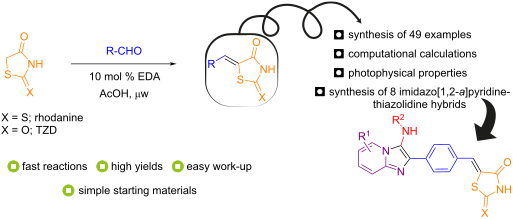
- ], tetrahydrobenzo[b]pyrans [68], and pyrrolo[3,4-c]quinolinediones [69]. EDDA favors the enol formation of the thiazolidinone (2) through hydrogen donation from the protonated amino group, thus facilitating its removal and formation of enol ii (Scheme 4). This enol adds to the carbonyl group of the aromatic
- band around 350 nm was observed. This increase can be explained by deprotonation of the structures, which facilitates solvation effects by water molecules. The cause for the tautomerism effect at acidic pH may be due to the protonation of the basic site of the amino group present in the derivatives






Isoorotamide-based peptide nucleic acid nucleobases with extended linkers aimed at distal base recognition of adenosine in double helical RNA
Beilstein J. Org. Chem. 2025, 21, 2513–2523, doi:10.3762/bjoc.21.193
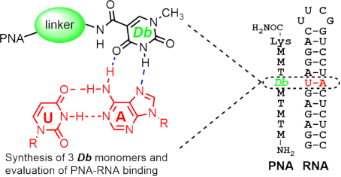
- from glutaric anhydride [30]. In fact, molecular dynamics simulations did confirm that the amide carbonyl of the linker forms a stable H-bond to the amino group of C (Figure 7C). Since the distal guanosine in the C–G base pair is a mismatch with the isoorotic acid binding moiety, the isoorotamide


Halogenated butyrolactones from the biomass-derived synthon levoglucosenone
Beilstein J. Org. Chem. 2025, 21, 2297–2301, doi:10.3762/bjoc.21.175
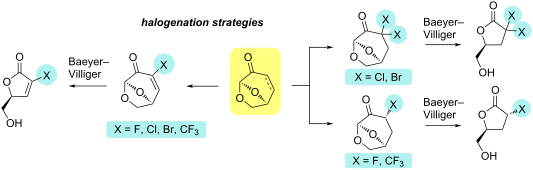
- morpholine via an aza-Michael addition and condensation (Scheme 3). It was envisaged that the β-amino group could act as a stable functional group resulting in Baylis–Hillman-like reactivity. An extensive survey of reaction conditions using Selectfluor and N-fluorobenzenesulfonimide (NFSI) as the sources of




Pathway economy in cyclization of 1,n-enynes
Beilstein J. Org. Chem. 2025, 21, 2260–2282, doi:10.3762/bjoc.21.173
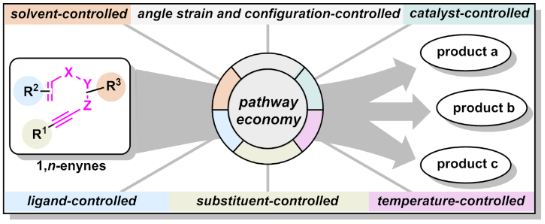
- quinazolinone's amino group. When this carbon atom was in a sp2 hybridization state, the C3 position of the indole attacked the inner side of the triple bond under the action of a gold catalyst, leading to a 6-exo-dig cyclization to yield 1,2-fused quinazolinones 146 (Scheme 30, path a). When the carbon atom was


Research towards selective inhibition of the CLK3 kinase
Beilstein J. Org. Chem. 2025, 21, 2250–2259, doi:10.3762/bjoc.21.172
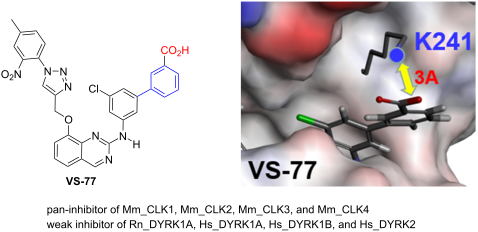
- below. Molecular modeling studies First, molecular modeling experiments suggested that our initial hypothesis was correct: the most potent compound VS-77 seems actually able to form a salt bridge with lysine 241, since the acid is located close to the amino group of this lysine (about 3 Å, Figure 5


Enantioselective desymmetrization strategy of prochiral 1,3-diols in natural product synthesis
Beilstein J. Org. Chem. 2025, 21, 1932–1963, doi:10.3762/bjoc.21.151

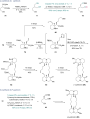
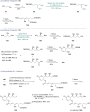
- ), compound 154 underwent epoxidation followed by acid-mediated cyclization to yield bicyclic compound 155. The synthesis was completed through a nine-step conversion of 155 to obtain (−)-dysiherbaine (156). To construct the asymmetric quaternary carbon centers with an amino group, the Kang group developed a












Chiral phosphoric acid-catalyzed asymmetric synthesis of helically chiral, planarly chiral and inherently chiral molecules
Beilstein J. Org. Chem. 2025, 21, 1864–1889, doi:10.3762/bjoc.21.145
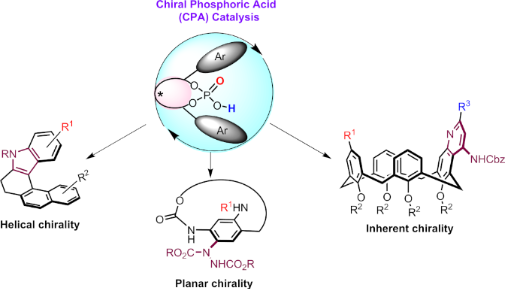
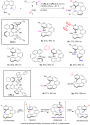
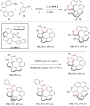
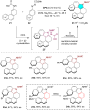
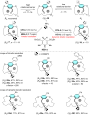
- enantioselective synthesis of planarly chiral macrocycles through a dynamic kinetic resolution approach [15]. Despite bearing an amino group on the phenyl ring, the configuration of the macrocyclic paracyclophane 32 was found to be unstable at room temperature. Consequently, by employing a CPA-catalyzed asymmetric
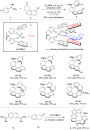
- chirality transfer process. Notably, while only the amino group of the co-catalysts was shown to engage in the catalytic cycle, the 2-acyl group of 73 was believed to participate in hydrogen bonding interactions with the substrate and the CPA catalyst, playing additional crucial roles. In addition to










Synthesis of chiral cyclohexane-linked bisimidazolines
Beilstein J. Org. Chem. 2025, 21, 1786–1790, doi:10.3762/bjoc.21.140
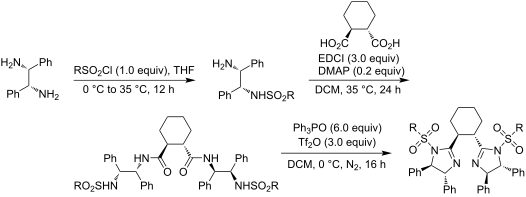
- -protected amino group. On the basis of the previous report [28], a possible reaction mechanism is presented in Scheme 3. The reaction of triphenylphosphine oxide and triflic anhydride first generates an activating agent, the Hendrickson reagent (A). The amide in cyclohexane-1,2-dicarboxamides 4


Microwave-enhanced additive-free C–H amination of benzoxazoles catalysed by supported copper
Beilstein J. Org. Chem. 2025, 21, 1462–1476, doi:10.3762/bjoc.21.108
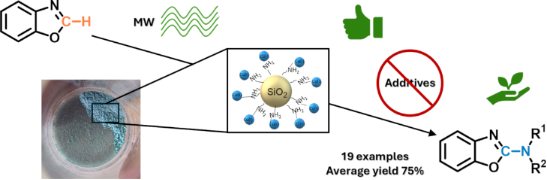
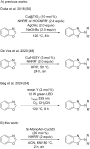
- changes in the position and shape of the νNH2 and δNH2 bands are observed, which are an indirect indication of the interaction of the amino group with the metal (curve b) [51]. On the other hand, major changes are observed in the spectrum of 5 wt % Si –MonoAm-Cu(II) (curve d). These are particularly



Tautomerism and switching in 7-hydroxy-8-(azophenyl)quinoline and similar compounds
Beilstein J. Org. Chem. 2025, 21, 1404–1421, doi:10.3762/bjoc.21.105
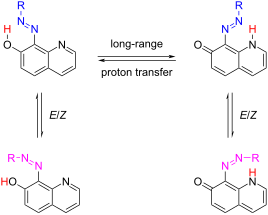
- acceptors is more pronounced. The effect of the amino group is stronger comparing to NMe2 due to the steric hindrance in the latter. Since in 1 the azo group, an acceptor, is placed on position 8, it is also expended to bring additional inherent stabilization of the 1K tautomer. The effect of the




Synthesis of pyrrolo[3,2-d]pyrimidine-2,4(3H)-diones by domino C–N coupling/hydroamination reactions
Beilstein J. Org. Chem. 2025, 21, 1010–1017, doi:10.3762/bjoc.21.82
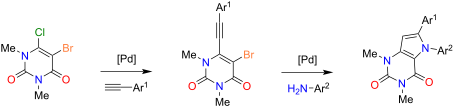
- amino group. The corresponding fluorescence quantum yields were also strongly affected by the substitution pattern of the pyrrolouracils. Compounds 4k and 4l show very high fluorescence quantum yields of 83% and 71%, respectively, what might be reasoned by the strong donor ability of the NMe2-functional



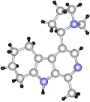
Studies on the syntheses of β-carboline alkaloids brevicarine and brevicolline
Beilstein J. Org. Chem. 2025, 21, 955–963, doi:10.3762/bjoc.21.79
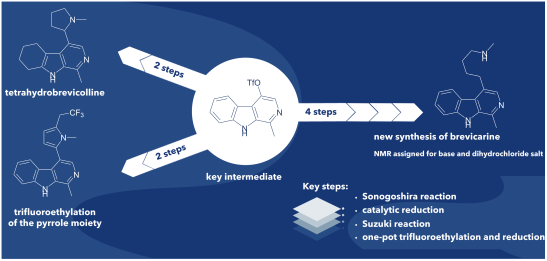
- -monomethylation of the primary amino group of compound 25 by alkylation with methyl iodide or by Eschweiler–Clarke reductive amination with formaldehyde and formic acid were unsuccessful, because the dimethylated byproduct was also formed, even when one equivalent alkylating agent was used. Finally, our efforts


Silver(I) triflate-catalyzed post-Ugi synthesis of pyrazolodiazepines
Beilstein J. Org. Chem. 2025, 21, 915–925, doi:10.3762/bjoc.21.74
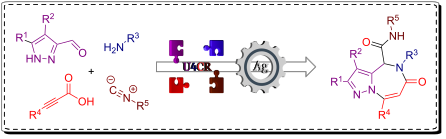
- ]. In 2015, García-Valverde and co-workers described an alternative synthesis of benzo[e][1,4]diazepines 6, exploring the nitro group of 2-nitrobenzoic acid as a masked amino group. The release was achieved through the post-Ugi reduction of the nitro group with SnCl2 triggering concomitant




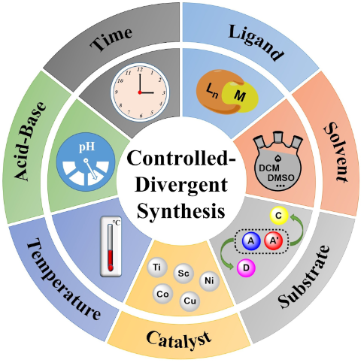
Recent advances in controllable/divergent synthesis
Beilstein J. Org. Chem. 2025, 21, 890–914, doi:10.3762/bjoc.21.73
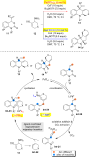
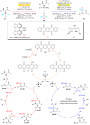
- enhanced electrophilicity of palladium facilitates preferential coordination with the amino group and activates the alkyne to form the intermediate Int-14 instead of Int-14'. Subsequent nucleophilic cyclization generates intermediate Int-15. Following CO insertion, complex Int-16 is formed, and reductive
- the hydroxy group to form complex Int-17 and the amino group undergoes nucleophilic attack to generate Int-18. After CO insertion complex Int-19 is produced and reductive elimination ultimately affords the indolo[3,2-c]coumarin product 10. In 2023, the Garg group achieved the first example of







4-(1-Methylamino)ethylidene-1,5-disubstituted pyrrolidine-2,3-diones: synthesis, anti-inflammatory effect and in silico approaches
Beilstein J. Org. Chem. 2025, 21, 817–829, doi:10.3762/bjoc.21.65
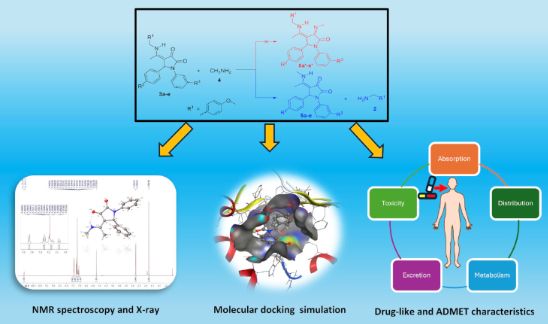
- coupling between the secondary amino proton and the proton resonance at 2.76 ppm (see Supporting Information File 1). Therefore, the doublet resonance signal at 2.76 ppm correlates to three protons from the methyl group (CH3) directly bonded to the nitrogen atom of the secondary amino group (NH
- -hybridized carbon atom directly bonded to the nitrogen atom of the secondary amino group of compound 5a. In the structure of each pyrrolidine-2,3-dione derivative 3a–e, there is an α,β-unsaturated ketone moiety in which the π systems of the C=C and C=O bonds could overlap each other to yield an extended
- a dihedral angle of 49.86(10) 86.22(11)° with the phenyl rings C6–C11 and C18–C23, respectively. The angle between both phenyl rings is 70.76(11)°. The stereochemistry around the double bond is Z, allowing an intramolecular N–H···O hydrogen bond between one of the carbonyl oxygen atoms and the amino


Synthesis of HBC fluorophores with an electrophilic handle for covalent attachment to Pepper RNA
Beilstein J. Org. Chem. 2025, 21, 727–735, doi:10.3762/bjoc.21.56
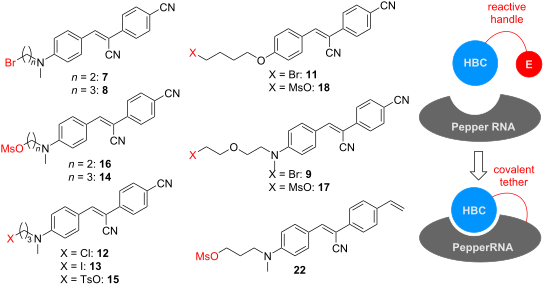
- fluorophores that provide the parent HBC530 ((4-((2-hydroxyethyl)(methyl)amino)benzylidene)cyanophenylacetonitrile) stilbene core [7] but offer an electrophilic alkyl handle on the amino group replacing the original N-hydroxyethyl residue. Three of them have been applied in the cellular applications (Brc3HBC



Origami with small molecules: exploiting the C–F bond as a conformational tool
Beilstein J. Org. Chem. 2025, 21, 680–716, doi:10.3762/bjoc.21.54
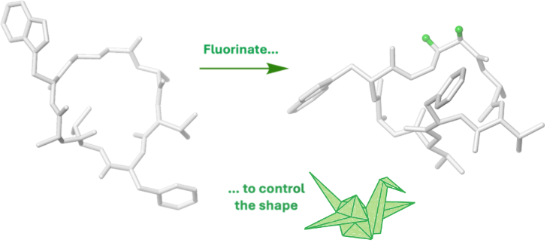
- that features both an ester moiety and an amino group will be discussed later, in section 5 of this review [112]. 4 Sugars We have examined several classes of molecules of gradually increasing complexity, progressing from alkanes (section 1) to ethers (section 2) and then alcohols (section 3
- is that the amino group becomes less basic when an inductively electron-withdrawing fluorine atom is nearby. This effect can be exploited to adjust the charge-state of a drug molecule, which can help in optimising the drug’s target-binding and/or bioavailability [154][173][174][175][176][177][178
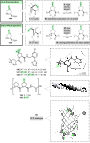
- their proximity to the amino group. But there is another aspect to the modulation of pKaH of amines by fluorine: conformation matters, too [182]. If the F–C–C–N alignment is gauche (as in 105, Figure 11), the pKaH will be lowered by ≈1 log unit compared to the non-fluorinated amine. However, if the F–C



Binding of tryptophan and tryptophan-containing peptides in water by a glucose naphtho crown ether
Beilstein J. Org. Chem. 2025, 21, 541–546, doi:10.3762/bjoc.21.42
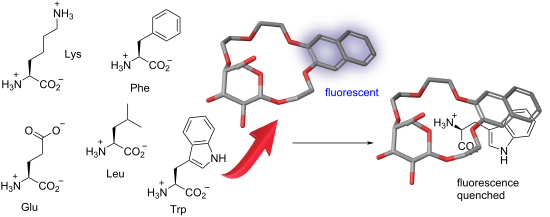
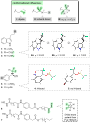
- tripeptides 2–7 consisting of one tryptophan and two alanine residues. We varied the position of the tryptophan in the peptide sequence, N-terminus in 2, middle of the chain in 3, and C-terminus in 4 to check if this affects their binding by 1. To probe the importance of the N-terminal amino group in the


Cryptophycin unit B analogues
Beilstein J. Org. Chem. 2025, 21, 526–532, doi:10.3762/bjoc.21.40
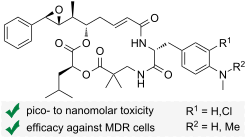
- chain length [21]. The exchange by an amino group showed a similar trend, however, N,N-dimethylation of the amino group again increased cytotoxicity significantly [20]. Nevertheless, this cryptophycin might only be conjugated via an ammonium-based self-immolative linker [22]. We envisioned the synthesis
- containing a dimethylamino motif did not require an additional protecting group, ring closure was performed through alkene cross metathesis, which has been accomplished reliably and with good yields for other cryptophycins [11][26][27]. However, for the synthesis of a cryptophycin with a monomethylated amino
- group in unit B a suitable protecting group, i.e., allyloxycarbonyl (Alloc), must be used. Since the presence of this allylic double bond would most likely interfere with a clean reaction outcome after alkene cross metathesis, we decided for a more classical ring-closure strategy through



Synthesis of N-acetyl diazocine derivatives via cross-coupling reaction
Beilstein J. Org. Chem. 2025, 21, 490–499, doi:10.3762/bjoc.21.36
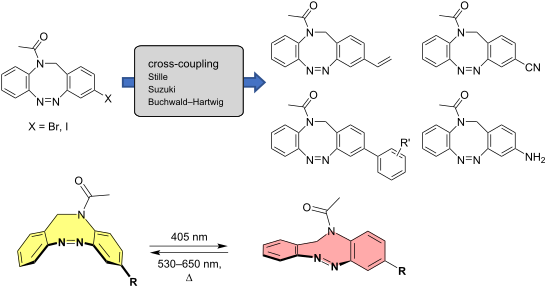
- pH 7.4 compared to 41% in acetonitrile, while in acidic aqueous media a PSS of 62% E for the Z→E photoisomerization was observed. This is due to the complete protonation of the amino group converting it to an electron-deficient substituent. The thermal half-lives of 13 and 21 increase by a factor of





