Search results
Search for "biomass" in Full Text gives 82 result(s) in Beilstein Journal of Organic Chemistry.
Synthesis of diaryl phosphates using phytic acid as a phosphorus source
Beilstein J. Org. Chem. 2026, 22, 213–223, doi:10.3762/bjoc.22.15
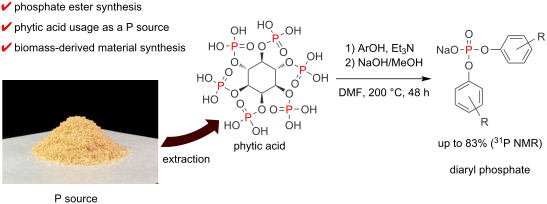
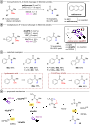
- rely on phosphate rock but instead uses biomass as a phosphorus source. Keywords: diaryl phosphates; phosphate esters; phosphate ester synthesis; phosphorus recovery; phytic acid; Introduction Phytic acid (myo-inositol-1,2,3,4,5,6-hexakisphosphate, Scheme 1) is a phosphorus-rich molecule, which is
- esterification with alcohols using sustainable biomass-derived phytic acid as a phosphorus source (Figure 2E). This approach can facilitate the development of environmentally friendly phosphate ester production as well as phosphorus recovery and recycling techniques. To date, the preparation of phosphate esters
- synthetic route for phosphate esters derived from a significantly underutilized phosphorus source. This approach may facilitate the development of an environmentally friendly phosphate production and phosphorus recovery procedure using biomass as a resource without employing phosphorus chloride or upstream




One-pot synthesis of ethylmaltol from maltol
Beilstein J. Org. Chem. 2025, 21, 2755–2760, doi:10.3762/bjoc.21.212

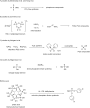
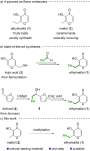
- from corncob to access pyromeconic acid [6]. The second group of synthetic strategies takes advantage of furfural (4), which originates from the acid-catalyzed dehydration of agricultural biomass. It is then converted with an ethyl Grignard compound to alcohol 5 [7]. From alcohol 5, oxidation state


Halogenated butyrolactones from the biomass-derived synthon levoglucosenone
Beilstein J. Org. Chem. 2025, 21, 2297–2301, doi:10.3762/bjoc.21.175
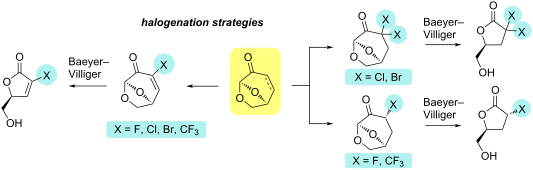
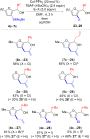
- [14][15]. In recent years, the chiral biomass derivatives levoglucosenone (LGO, 5) and its reduced form Cyrene® (6) have gained increased attention as platforms for drug discovery [16][17][18][19]. The bicyclic ketone 5 is the major product from the pyrolysis of acid-treated cellulose [20], while its
- reactions for 5 to give substrates for the Baeyer–Villiger oxidation resulting in halogenated butyrolactones, which is an unexplored chemical space for this biomass derivative. Results and Discussion The halogenated LGO derivatives 7a and 7b were prepared using literature procedures [22][23]. The reaction
- the Baeyer–Villiger reaction without epoxidation may be challenging. Conclusion In conclusion, we have successfully established halogenation strategies of the biomass derivates 5 and 6, including fluorinations and trifluoromethylation. Baeyer–Villiger oxidations of these materials provide access to




C2 to C6 biobased carbonyl platforms for fine chemistry
Beilstein J. Org. Chem. 2025, 21, 2103–2172, doi:10.3762/bjoc.21.165
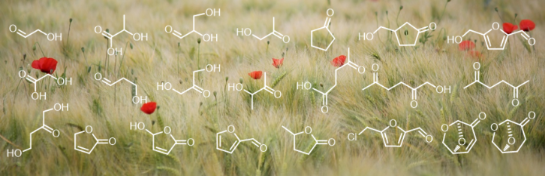
- level of oxygen content in biomass, small molecules arising from biomass often possess a carbonyl group. This is why biobased platform molecules possessing a carbonyl group, either under the form of an aldehyde, a ketone, an acid or an ester, play a dominant role in biobased chemistry. This review aims
- : aldehydes; biobased chemistry; biomass; carbonyl; fine chemicals; ketones; multicomponent; platforms; sustainability; Introduction Shifting towards sustainable practices in the chemical industry relies on continued advancement of green chemistry sciences which aim to minimize the global environmental
- dedicated to the conversion of biomass-derived platform molecules [10][11]. Recent studies have also highlighted the potential of biobased aromatic compounds as sustainable alternatives to their fossil-derived counterparts [12][13][14][15]. Developing biobased solvents [16][17] and platform chemicals from


Preparation of a furfural-derived enantioenriched vinyloxazoline building block and exploring its reactivity
Beilstein J. Org. Chem. 2025, 21, 1737–1741, doi:10.3762/bjoc.21.136

- reactions. Out of these, the aza-Diels–Alder reaction with TsNCO was successful, leading to a highly diastereoselective formation of an oxazolo[3,2-c]pyrimidine derivative. Keywords: aza-Diels–Alder reaction; electrosynthesis; furfural; valinol; vinyloxazoline; Introduction The utilization of biomass as
- an alternative to fossil feedstock is central to circular economy for the production of value-added products [1][2][3][4][5][6][7]. Furfural [furan-2-carbaldehyde (1)], a platform compound derived from lignocellulosic biomass, has been utilized to obtain a range of versatile chemicals with
- MeOH with acetic acid as an additive. This is a step toward the large scale synthesis of enantioenriched vinyloxazolines 6 from biomass-derived furfural, however, several challenges remain such as replacing LiClO4 as electrolyte at the oxidation step and avoiding chromatography for purification


Influence of the cation in hypophosphite-mediated catalyst-free reductive amination
Beilstein J. Org. Chem. 2025, 21, 1661–1670, doi:10.3762/bjoc.21.130

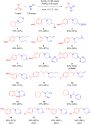
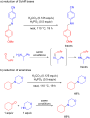
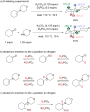
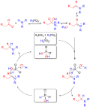
- fertilizers in agrochemistry phosphates [20]. Multiple literature reports indicate that changing the alkali metal cations can strongly affect diverse chemical processes including radical reactions [27], electrochemical processes [28], and biomass pyrolysis [29]. However, hypophosphites derived from alkali


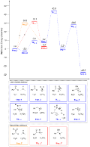
Azide–alkyne cycloaddition (click) reaction in biomass-derived solvent CyreneTM under one-pot conditions
Beilstein J. Org. Chem. 2025, 21, 1544–1551, doi:10.3762/bjoc.21.117
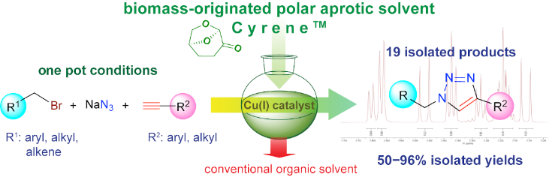
- CyreneTM, as a biomass-originated polar aprotic solvent, could be utilized as an alternative reaction medium for one-pot copper(I)-catalyzed azide–alkyne cycloaddition (click or CuAAC) reactions, for the synthesis of various 1,2,3-triazoles under mild conditions. Nineteen products involving N-substituted-4
- -phenyl-1H-1,2,3- and 1-allyl-4-substituted-1H-1,2,3-triazoles were synthesized under one-pot conditions and isolated with good to excellent yields (50–96%) and purity (>98%). The observed results represent an example that proves that biomass-derived safer solvents can be introduced into a synthetically
- should be strictly limited, particularly in the pharmaceutical industry. To develop an environmentally benign alternative to this useful method, the identification of an alternative reaction medium is highly desired. Among the recently characterized biomass-based potential solvents dihydrolevoglucosenone


Recent advances in amidyl radical-mediated photocatalytic direct intermolecular hydrogen atom transfer
Beilstein J. Org. Chem. 2025, 21, 1306–1323, doi:10.3762/bjoc.21.100
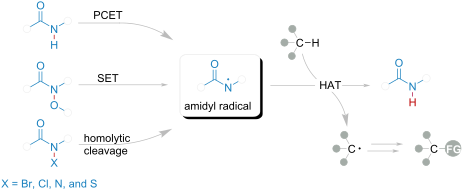
- 450002, PR China National Engineering Research Center of Low-Carbon Processing and Utilization of Forest Biomass, Nanjing Forestry University, Nanjing 210037, PR China 10.3762/bjoc.21.100 Abstract In recent years, amidyl radicals have emerged as highly efficient and versatile reagents for hydrogen atom


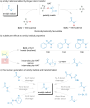




Optimized synthesis of aroyl-S,N-ketene acetals by omission of solubilizing alcohol cosolvents
Beilstein J. Org. Chem. 2025, 21, 1201–1206, doi:10.3762/bjoc.21.97
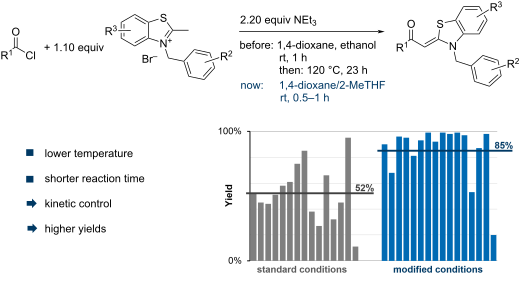
- . This can be obtained from renewable biomass and is therefore considered to be a "green" solvent. In 2-MeTHF (conditions (C)), product 1f was isolated with a yield of 95% and derivative 1h with a yield of 91%. This shows that the sustainable solvent is a potent alternative to 1,4-dioxane. With the new


Antibiofilm and cytotoxic metabolites from the entomopathogenic fungus Samsoniella aurantia
Beilstein J. Org. Chem. 2025, 21, 327–339, doi:10.3762/bjoc.21.23
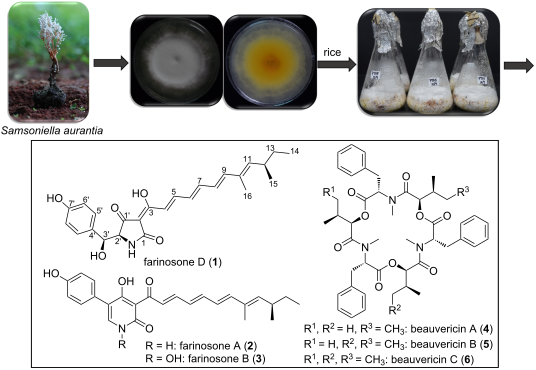
- preformed biofilm assay, dispersing a 24 hour preformed biofilm up to a concentration of 15.62 µg/mL with an eradication capacity of 43%. To evaluate whether the remaining biofilm biomass in the wells was metabolically active or not, a cell viability (XTT) assay was conducted after 24 hour treatment of S
- dispersing the encapsulated cells [16]. The results (Figure 6) yielded striking significance, revealing that the biomass remained metabolically inactive in biofilms treated with 1 and 2 low to concentrations of 3.9 and 1.9 µg/mL, respectively. It is worth noting here that both compounds followed a similar
- in biofilm formation of S. aureus although there are, of course, other binding factors that contribute to the formation of biofilms [19]. Overall, the results suggested that farinosones D (1) and A (2) were effective against S. aureus biofilms as demonstrated by their ability to reduce biomass and


Synthesis of disulfides and 3-sulfenylchromones from sodium sulfinates catalyzed by TBAI
Beilstein J. Org. Chem. 2025, 21, 253–261, doi:10.3762/bjoc.21.17
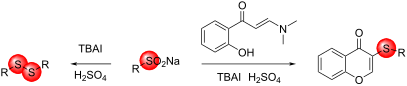
- Zhenlei Zhang Ying Wang Xingxing Pan Manqi Zhang Wei Zhao Meng Li Hao Zhang School of Chemistry and Material Engineering, Anhui Provincial Key Laboratory of Green Carbon Chemistry, Engineering Research Center of Biomass Conversion and Pollution Prevention of Anhui Educational Institutions, Biomass



Visible-light-mediated flow protocol for Achmatowicz rearrangement
Beilstein J. Org. Chem. 2024, 20, 2493–2499, doi:10.3762/bjoc.20.213
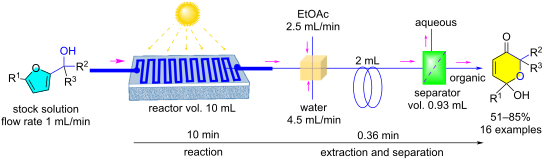
- light and biomass-derived furfuryl alcohols as starting material making it more environmental benign. Results and Discussion A batch process Achmatowicz rearrangement mediated by less expensive rose bengal as photocatalyst (PC) was first reported by Vassilikogiannakis et al. [24] and was further
- as sun light, as a greener approach and easily available biomass-derived furfuryl alcohols as starting materials. The flow platform with the developed protocol was utilized successfully to make several dihyropyranones that may find wide applications in medicinal and materials chemistry and natural


The Groebke–Blackburn–Bienaymé reaction in its maturity: innovation and improvements since its 21st birthday (2019–2023)
Beilstein J. Org. Chem. 2024, 20, 1839–1879, doi:10.3762/bjoc.20.162
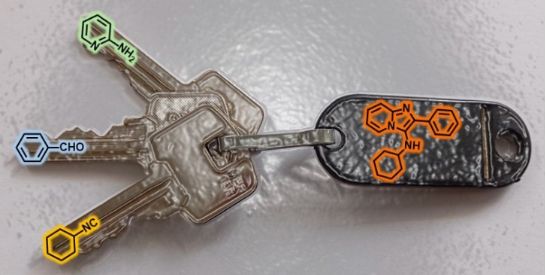
- compounds or molecules derived from biomass have been recently published. Due to the relatively drastic conditions of the GBB reaction and the inherent lability of these structurally complex building blocks, often specific reaction conditions have been developed to successfully obtain the multicomponent
- , the use of 5-HMF (23) [36], a renewable carbon source derived from biomass, responds to these requirements. This aldehyde displays additional functionalities useful for further modifications of the GBB adducts, but some optimization was necessary due to its intolerance to high temperatures and






Polymer degrading marine Microbulbifer bacteria: an un(der)utilized source of chemical and biocatalytic novelty
Beilstein J. Org. Chem. 2024, 20, 1635–1651, doi:10.3762/bjoc.20.146
- structural similarity to two other β-agarases, ZgAgaA and ZgAgaB, from Zobellia galactanivorans, which is a model marine bacterium for the bioconversion of algal biomass [29][107][108][109]. The crystal structure suggested that the thermostability of rAgaA likely derives from the numerous surface salt
- -linked homopolymer of N-acetyl-β-ᴅ-glucosamine (GlcNAc), the second most abundant biomass on earth after cellulose (Figure 4). Approximately 1011 tons of chitin are produced annually in nature, about 70% of which originate from the ocean. Most of the chitin is recycled by bacteria and fungi as carbon and




Electrophotochemical metal-catalyzed synthesis of alkylnitriles from simple aliphatic carboxylic acids
Beilstein J. Org. Chem. 2024, 20, 1497–1503, doi:10.3762/bjoc.20.133
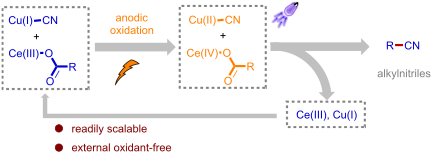
- ][18]. Owing to the prevalence of aliphatic carboxylic acids in biomass and natural products, decarboxylative cyanation represents one of the most straightforward and attractive approaches to accessing alkylnitriles [19][20]. As an elegant example, Barton demonstrated the application of redox-active


Sustainable tandem acylation/Diels–Alder reaction toward versatile tricyclic epoxyisoindole-7-carboxylic acids in renewable green solvents
Beilstein J. Org. Chem. 2024, 20, 1308–1319, doi:10.3762/bjoc.20.114
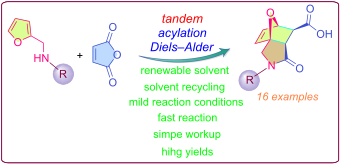
- among the main sources of serious environmental problems [2]. However, the risk of depletion of these resources in the near future has led researchers to research and develop safer, environmentally friendly and renewable resources [3][4][5]. Biomass is an important and more economical renewable source


Manganese-catalyzed C–C and C–N bond formation with alcohols via borrowing hydrogen or hydrogen auto-transfer
Beilstein J. Org. Chem. 2024, 20, 1111–1166, doi:10.3762/bjoc.20.98

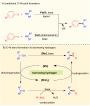
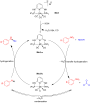
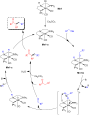
- friendly and atom-economical process for C–C and C–N bond formations utilizing alcohol as an alkylating agent and hydrogen donor, producing water as the only side-product [6][7][8][9]. Notably, alcohols are inexpensive, abundant and can be obtained from biomass, which makes this method even more attractive















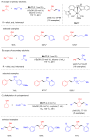

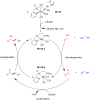


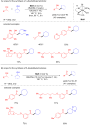
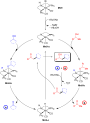









Skeletal rearrangement of 6,8-dioxabicyclo[3.2.1]octan-4-ols promoted by thionyl chloride or Appel conditions
Beilstein J. Org. Chem. 2024, 20, 823–829, doi:10.3762/bjoc.20.74
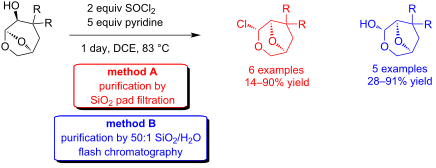
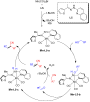
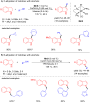
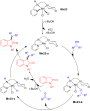
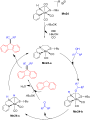
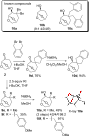
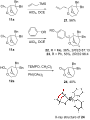
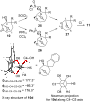
- ) is produced selectively when cellulose-containing materials, including lignocellulosic biomass, are acidified and pyrolysed [1][2]. Lab scale synthesis of this chiral material can be accomplished in a single step without special glassware [3], while large scale production of the reduction product




Synthesis of 5-arylidenerhodanines in L-proline-based deep eutectic solvent
Beilstein J. Org. Chem. 2023, 19, 1537–1544, doi:10.3762/bjoc.19.110

- potential of those solvents in many applications (electrodeposition, organic syntheses, biomass extraction, etc.) [11][12]. The more recent ones also deal with the importance of a better characterization of DES [13] and a clear evaluation of their sustainability via life-cycle assessment to evaluate the
- formation of the expected 5-benzylidenerhodanine 3i under the optimized conditions with a slightly lower yield (3i versus 3a). Finally, we also decided to investigate the reactivity of 5-hydroxymethylfurfural (HMF). Indeed, HMF is considered as one of the most promising biomass-derived platform chemicals


Non-noble metal-catalyzed cross-dehydrogenation coupling (CDC) involving ether α-C(sp3)–H to construct C–C bonds
Beilstein J. Org. Chem. 2023, 19, 1259–1288, doi:10.3762/bjoc.19.94
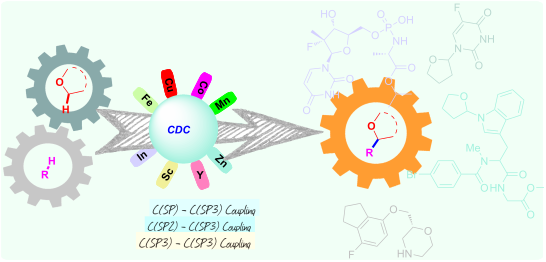
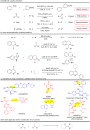
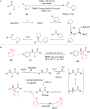
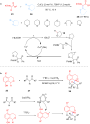
- CDC reaction to be a new generation method for the construction of C–C bonds and it has received extensive attention and in-depth research [16][17][18][19][20][21][22][23][24]. The building blocks of ethers are widely found in biomass, chemical feedstocks, biologically active drugs, and natural





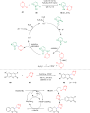

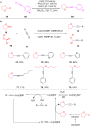


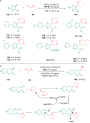


Photoredox catalysis harvesting multiple photon or electrochemical energies
Beilstein J. Org. Chem. 2023, 19, 1055–1145, doi:10.3762/bjoc.19.81
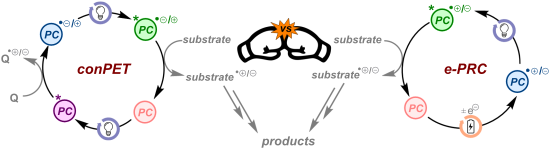

























Photoredox catalysis enabling decarboxylative radical cyclization of γ,γ-dimethylallyltryptophan (DMAT) derivatives: formal synthesis of 6,7-secoagroclavine
Beilstein J. Org. Chem. 2023, 19, 918–927, doi:10.3762/bjoc.19.70
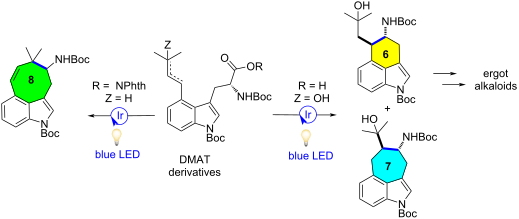
- ][32][33], modification of biomacromolecules [34], and relatively complex pharmaceutical agents [35][36][37][38]. Photocatalysis tremendously enriches the synthetic compound library, providing a precious alternative to directly modify abundant natural substrates, including biomass, which usually


C3-Alkylation of furfural derivatives by continuous flow homogeneous catalysis
Beilstein J. Org. Chem. 2023, 19, 582–592, doi:10.3762/bjoc.19.43
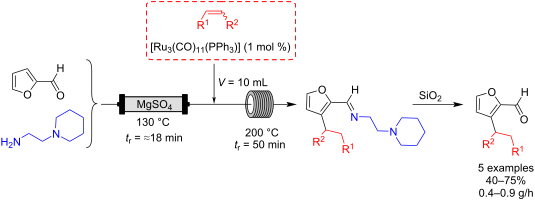
- formation of the imine directing group and the C3-functionalization with some vinylsilanes and norbonene. Keywords: biomass; C–H activation; flow; furfural; homogeneous catalysis; Introduction The conversion of biomass derivatives into value-added products is one of the key branches of green chemistry and


Oxa-Michael-initiated cascade reactions of levoglucosenone
Beilstein J. Org. Chem. 2022, 18, 1457–1462, doi:10.3762/bjoc.18.151
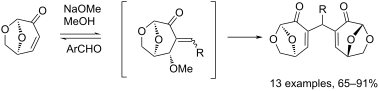
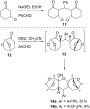
- derived from biomass pyrolysis, due to its reactive functionality, and the chirality which derives from glucose [4][5][6][7]. Reactions of 1 where the α,β-unsaturated ketone participates as an electrophile are usually completely diastereoselective, as the approach of the nucleophile is controlled by the
- ]. The reaction is interesting as both furfural and 1 are present along with water in crude biomass pyrolysates, and so the reaction could affect yields of 1 [3][17][18]. Samet and co-workers have reported a similar condensation of 1 with salicylaldehyde resulting in chiral chromene derivative 4 [19][20
- approximate 90° dihedral angle. Conclusion This work has described a novel reaction of a cyclic biomass-derived α,β-unsaturated ketone with aromatic aldehydes. The ready availability of levoglucosenone in large quantities from biomass could make compounds such as 5 of interest for green chiral materials


Modular synthesis of 2-furyl carbinols from 3-benzyldimethylsilylfurfural platforms relying on oxygen-assisted C–Si bond functionalization
Beilstein J. Org. Chem. 2022, 18, 1256–1263, doi:10.3762/bjoc.18.131
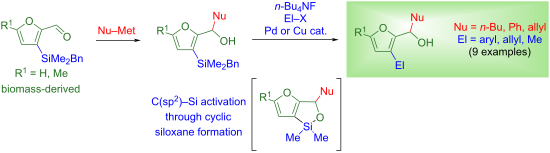
- biomass-derived furfural and 5-methylfurfural, are converted into 3-silylated 2-furyl carbinols upon condensation with organomagnesium or organolithium reagents. The hydroxy unit of the carbinol adducts can be exploited to promote C3(sp2)–Si bond functionalization through intramolecular activation. Two
- carbinols from renewable feedstock. Keywords: biomass; copper; cyclic siloxanes; 2-furyl carbinols; silicon; Introduction Progress towards the use of nonedible renewable feedstock to replace fossil resources as starting material for high-value chemicals is an important endeavor of modern synthesis [1][2
- , we have demonstrated that C3-benzyldimethylsilyl-appended furfurals are useful platforms that offer modular access to 3-substituted 2-furyl carbinols. This strategy represents a new, simple, and selective way to decorate the biomass-derived furan nucleus, allowing to reach synthetically relevant