


Search results
Search for "free energy" in Full Text gives 207 result(s) in Beilstein Journal of Organic Chemistry. Showing first 200.
Cascade transformation of 2-(diazoacetyl)-2H-azirines to 2-aroyl-3-hydroxy-1H-pyrroles via condensation with aromatic aldehydes
Beilstein J. Org. Chem. 2026, 22, 897–904, doi:10.3762/bjoc.22.70
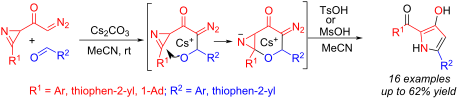
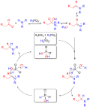
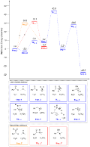
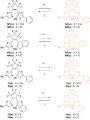
- ) exhibiting a lower relative Gibbs free energy than the starting compounds. According to the calculations, the reaction of azirine 1a and benzaldehyde 2c results in the formation of two diastereomers, (RR,SR)- and (RR,RR)-A, which can undergo a conformational transition to intermediates (RR,SR)- and (RR,RR)-B
- diastereoisomer (1RR,3RR,6RR)-Phe-4 has a Gibbs free energy 1.95 kcal/mol higher than the diastereoisomer (1RR,3SR,6RR)-Phe-4 (Scheme 3), i.e., under the conditions of the equilibrium reaction at 298 K, the diastereoisomer (1RR,3SR,6RR)-Phe-4 should be the main product (the ratio of diastereoisomers (1RR,3SR,6RR


Unsymmetrical sulfoxides with sterically hindered catechol fragment: synthesis, structure, electrochemical properties, and antiradical activity
Beilstein J. Org. Chem. 2026, 22, 828–837, doi:10.3762/bjoc.22.65
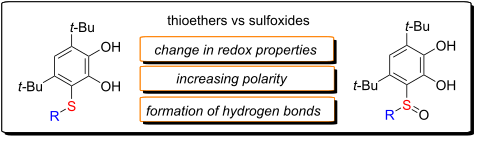
- 1.82–1.91 V. The value of Epox2 for the above-mentioned compounds is shifted anodically by 0.26–0.31 V relative to the corresponding thioethers, reflecting an increase in the Gibbs free energy (ΔG) of the electrooxidation process by 12–15 kcal/mol. Redox transformations at the sulfur atom occur in


Using generative AI to transform peptide hits into small molecule leads
Beilstein J. Org. Chem. 2026, 22, 672–679, doi:10.3762/bjoc.22.51
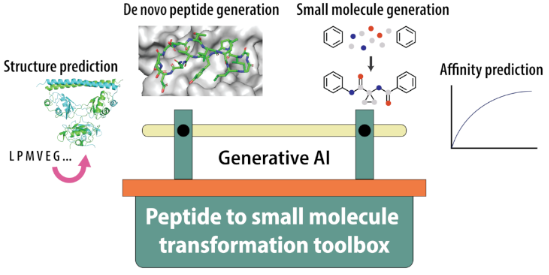
- molecule candidates, providing potential alternatives to traditional computationally expensive physics-based workflows such as docking, MD, and free-energy perturbation (FEP) calculations for affinity estimation. For example, Boltz-2 features a strong emphasis on affinity prediction in addition to its core


Photoorganocatalytic trifluoromethylation of (het)arenes in green conditions
Beilstein J. Org. Chem. 2026, 22, 662–671, doi:10.3762/bjoc.22.50
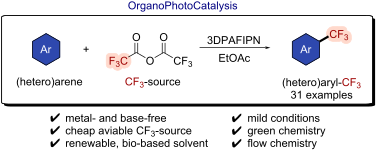
- CF3 radical, is an endothermic process. The subsequent attack of the electrophilic CF3 radical on the benzene ring, accompanied by its oxidation, proceeds through exothermic steps. The proton transfer to the solvent constitutes the most favorable step, resulting in an overall free energy change (ΔG




Computational prediction of C–H hydricities and their use in predicting the regioselectivity of electron-rich C–H functionalisation reactions
Beilstein J. Org. Chem. 2026, 22, 603–610, doi:10.3762/bjoc.22.46
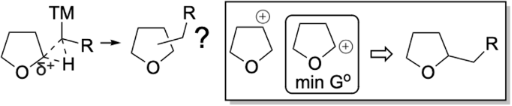
- voltammetry (PACV). In this regime, Cheng et al. explicitly report an uncertainty of ±50 mV for the PACV-derived potentials. This alone corresponds to an uncertainty of the order of ≈1 kcal/mol per 50 mV term in the free-energy expression (and can compound when multiple electrochemical terms contribute); this


![[Graphic 6]](/bjoc/content/inline/1860-5397-22-46-i8.svg?max-width=637&scale=1.18182)


Experimental and DFT studies on the regioselective methanolysis of 5-azido-9-oxabicyclo[6.1.0]nonan-4-yl 4-nitrobenzoate isomers
Beilstein J. Org. Chem. 2026, 22, 547–556, doi:10.3762/bjoc.22.40
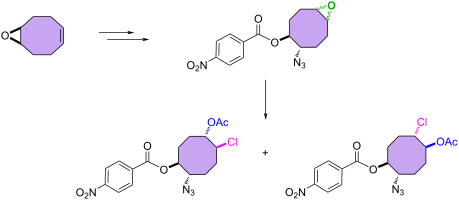
- computations were performed to gain insights into the mechanism underlying regioselectivity for the methanolysis of the isomeric epoxides 9 (Figure 3). Detailed mechanistic routes involving all possible intermediates responsible for the regioselectivity step were constructed and the free energy barriers for
- formed in both pathways. Free energy computations indicate that the intermediate 12 is thermodynamically more stable by 4.9 kcal mol−1 compared to intermediate 15. The nucleophilic attack by chloride ion bifurcates into two paths, namely C1- (route a) and C2-attacks (route b) for intermediates 12 and 15
- , 1239, 1015, 720; HRESIMS (m/z): [M+ + Na] calcd for C17H19ClN4O6, 433.0891; found, 433.0885. Some important bioactive molecules with an azide group. The X-ray crystal structure of 10. Relative free energy profile for the methanolysis of the isomeric epoxides 9. Mulliken charge analysis of protonated


Reactivity umpolung of the cycloheptatriene core in hexa(methoxycarbonyl)cycloheptatriene
Beilstein J. Org. Chem. 2026, 22, 64–70, doi:10.3762/bjoc.22.2
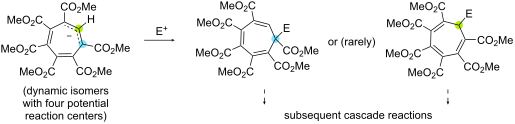
- negative free energy changes for all the stages of this reaction. A chlorination experiment with 2,2,6,6-tetramethylpiperidinyloxyl revealed a trace amount of a trap product detected by high-resolution mass spectrometry to support the radical mechanism. However, this does not exclude the possibility of a


Sustainable electrochemical synthesis of aliphatic nitro-NNO-azoxy compounds employing ammonium dinitramide and their in vitro evaluation as potential nitric oxide donors and fungicides
Beilstein J. Org. Chem. 2025, 21, 2739–2754, doi:10.3762/bjoc.21.211
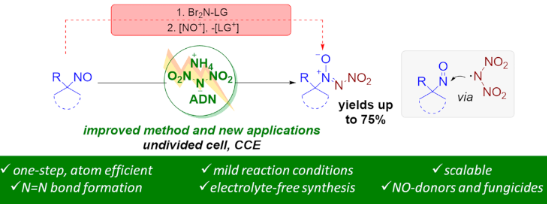
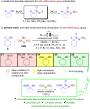
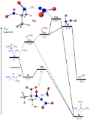
- of 0.1 V/s at 298 K. Free energy diagram of possible interaction pathways between 1a and dinitramide-derived radical A according to ωB97X-3c [94]/CPCM(MeCN) level of theory. Free energies ΔG and activation free energies ΔG≠ are given in kcal/mol. Dashed lines correspond to spin-state-changing





Mechanistic insights into hydroxy(tosyloxy)iodobenzene-mediated ditosyloxylation of chalcones: a DFT study
Beilstein J. Org. Chem. 2025, 21, 2703–2715, doi:10.3762/bjoc.21.208
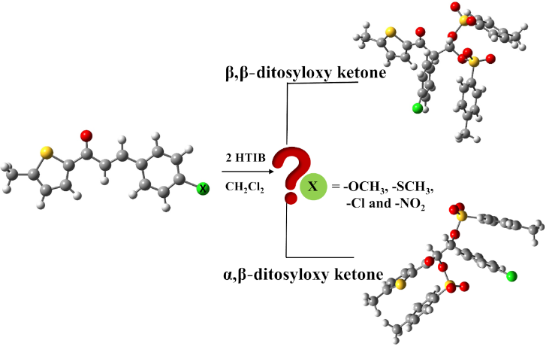
- , the detailed calculated reaction mechanism differs. Scheme 2 and Scheme 3 depicts the reaction mechanism for these two possible cases, i.e., when X is electron-donating and electron-withdrawing, respectively. Figure 1 depicts the free energy reaction profile for the chalcone with X = -SCH3. The
- corresponding reaction profile for X = -OCH3 has been discussed in our earlier study [34]. Figure 2 and Figure 3 present the free energy reaction profiles for chalcones with X = -Cl and X = -NO2, respectively. Table 1 lists the free energy and potential energy for various intermediates and transition states for
- chalcones with different substituents, X = -SCH3, -Cl, -NO2 including the data for X = -OCH3. The difference between free energies for consecutive reaction species are shown over arrows in Figures 1, 2 and 3 for substituents X = -SCH3, -Cl and -NO2, respectively. Table 1 also reports these free energy


Synthesis of the tetracyclic skeleton of Aspidosperma alkaloids via PET-initiated cationic radical-derived interrupted [2 + 2]/retro-Mannich reaction
Beilstein J. Org. Chem. 2025, 21, 2470–2478, doi:10.3762/bjoc.21.189
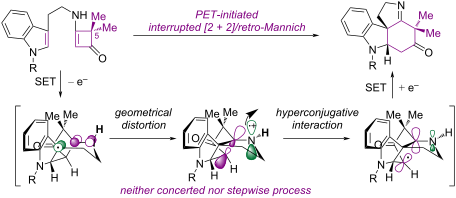
- the N atom is positioned antiperiplanar to the adjacent C19–C3 bond, an intermediate IN4 with a bicyclo[2.2.0]hexane unit was successfully located. However, the Gibbs free energy of IN4 (ΔG° = +27.4 kcal/mol) is significantly higher than the activation energy of TS2 (ΔG‡ = 22.4 kcal/mol). This energy


Recent advances in Norrish–Yang cyclization and dicarbonyl photoredox reactions for natural product synthesis
Beilstein J. Org. Chem. 2025, 21, 2315–2333, doi:10.3762/bjoc.21.177
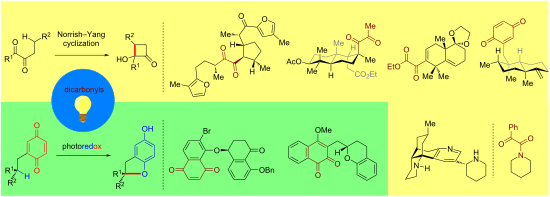
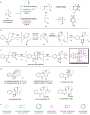
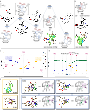
- cyclization of the saturated C5–C6; c) calculated Gibbs free energy difference (ΔΔG‡) for 1,5-HAT processes of 22 and 30. Total synthesis of avarane-type meroterpenoids. Total synthesis of gracilisoid A. Divergent total synthesis of gracilisoids B–I. Mechanism of the late-stage biomimetic photooxidation







Influence of the cation in hypophosphite-mediated catalyst-free reductive amination
Beilstein J. Org. Chem. 2025, 21, 1661–1670, doi:10.3762/bjoc.21.130

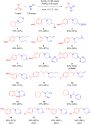
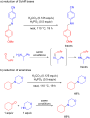
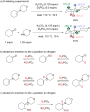
- confirmed by D-experiments. The whole sequence of transformations was finished by the reduction of the charged iminium cation with the hypophosphite anion forming N,N,N-dimethylbenzylammonium phosphite in exergonic manner with a total Gibbs free energy gain of −26.8 kcal/mol (Step_5). Noteworthy, the target


On the aromaticity and photophysics of 1-arylbenzo[a]imidazo[5,1,2-cd]indolizines as bicolor fluorescent molecules for barium tagging in the study of double-beta decay of 136Xe
Beilstein J. Org. Chem. 2025, 21, 1627–1638, doi:10.3762/bjoc.21.126
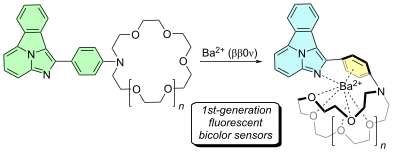
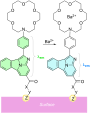
- energies computed at 298.17 K. We also extended this study to the interaction between complexes 15a–d and benzene (14) and computed the corresponding complexation energies as In addition, Figure 4 includes the chief geometric parameters of the different complexes, as well as the corresponding free energy
- a relatively lower ΔGrxn free energy for 17c, given the lower charge available for further interaction with the phenyl group. The geometry of complex 17d (n = 4) resembles that found for parent 15d, since the 21-crown-7 moiety adopts a concave–convex shape, in which the barium cation occupies a





Azobenzene protonation as a tool for temperature sensing
Beilstein J. Org. Chem. 2025, 21, 1528–1534, doi:10.3762/bjoc.21.115
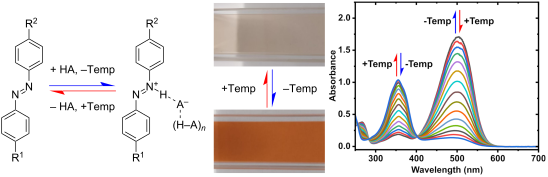
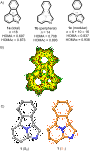
- with the 3H+ ion. All geometry-optimized structures for compounds 1–3 are shown in Supporting Information File 1, Figures S19–S28). Table 1 presents the calculated Gibbs free energy changes (∆G°) for the complexes. Among the XH+MSA−MSA (X = 1, 2 or 3) complexes, 3 shows the highest protonation


Wittig reaction of cyclobisbiphenylenecarbonyl
Beilstein J. Org. Chem. 2025, 21, 1454–1461, doi:10.3762/bjoc.21.107
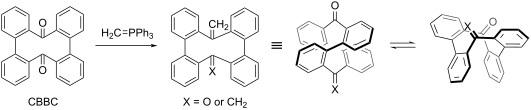
- of 1.5 kcal mol−1 and 3.2 cal K−1 mol−1, respectively (Figure S26 in Supporting Information File 1). These physical parameters give a free energy ΔG298 of 0.55 kcal mol−1, indicating approximately a 2:5 ratio of figure-eight and bathtub conformations at room temperature. Mono-olefin 3 exhibited



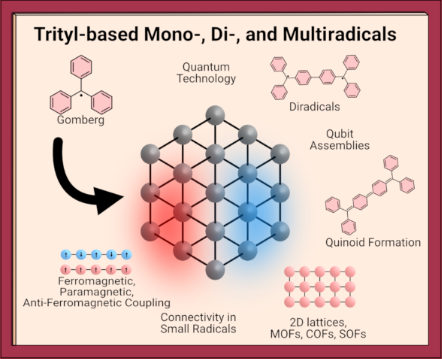
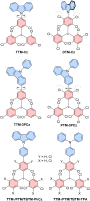
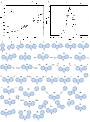
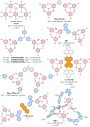
On the photoluminescence in triarylmethyl-centered mono-, di-, and multiradicals
Beilstein J. Org. Chem. 2025, 21, 964–998, doi:10.3762/bjoc.21.80







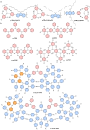
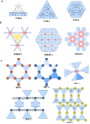


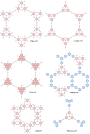
Beyond symmetric self-assembly and effective molarity: unlocking functional enzyme mimics with robust organic cages
Beilstein J. Org. Chem. 2025, 21, 421–443, doi:10.3762/bjoc.21.30
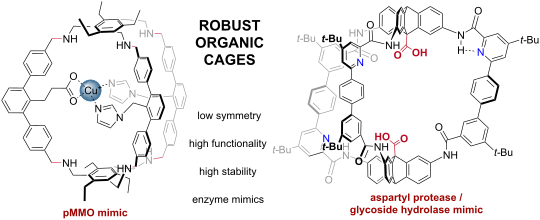
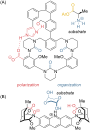
- free energy transition barrier can be framed in terms of contributions from polarization and organization by the catalyst/system. Typical catalysis modes using macrocycle cavities performing (non-specific) hydrophobic substrate binding. (A) Macrocycles that confine two reagents close together to alter




Effect of substitution position of aryl groups on the thermal back reactivity of aza-diarylethene photoswitches and prediction by density functional theory
Beilstein J. Org. Chem. 2025, 21, 242–252, doi:10.3762/bjoc.21.16
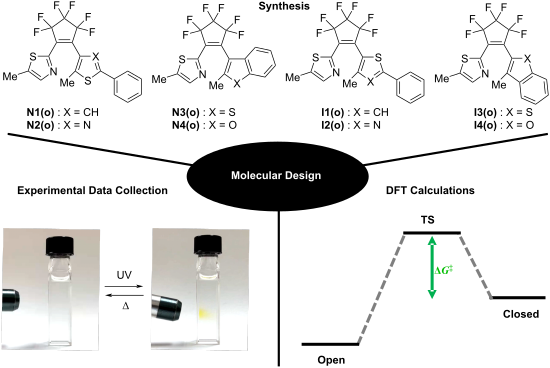
- compounds N3, N4, and I1–I4. The activation enthalpy (ΔH‡) and activation entropy (ΔS‡) in the thermal reaction were determined from the intercept and slope. Using these values, the experimental activation free energy (ΔG‡(exp)), the k value, and the half-life (t1/2) at 298 K were calculated and the results
- transition state for N1–N4 and I1–I4 using various functionals in combination with a 6-31G(d) basis set. The theoretical activation free energy (ΔG‡(calc)) at 298 K was determined as the difference in the sum of electronic energy and thermal free energy correction between the closed-ring isomer and the



Quantifying the ability of the CF2H group as a hydrogen bond donor
Beilstein J. Org. Chem. 2025, 21, 189–199, doi:10.3762/bjoc.21.11
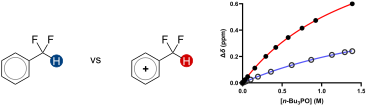
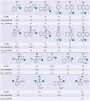
- , with other easily accessible parameters. We first calculated the Gibbs free energy of formation (ΔGcalc) of the HB complexes of HB donors with trimethylphosphine oxide (Me3PO), which models n-Bu3PO as a hydrogen bond acceptor, and compared these values with experimental data. We realized that such an
- HB complex. Values for ΔGcalc were then calculated as the weighted average of the free energy of each HB complex as in which PMe3PO···HB,a and PMe3PO···HB,b are the percent populations of the HB complex of Me3PO with the donor conformer a and b, respectively; PMe3PO | HB,a and PMe3PO | HB,b are the
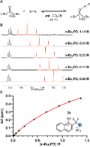
- the HB complex with tri-n-butylphosphine oxide at 298 K in anhydrous CD3CN. The Kd for 6b was not determined due to the formation of non-HB-mediated adducts (Figure S34 in Supporting Information File 1). The corresponding experimental Gibbs free energy of binding (ΔGexp) is calculated based on the Kd



Direct trifluoroethylation of carbonyl sulfoxonium ylides using hypervalent iodine compounds
Beilstein J. Org. Chem. 2024, 20, 3182–3190, doi:10.3762/bjoc.20.263
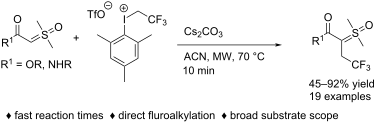
- ° and C–I bond lengths of 2.1 Å (I–CH2CF3) and 3.2 Å. Finally, a 37.8 kcal/mol activation energy between XB-2 and B for path 1 was calculated. On the other hand, path 2 had a much lower Gibbs free energy of activation of 24.3 kcal/mol, where the angle of attack from 1a to 2a’ was found at approximately
- -mediated and SN2 reaction mechanisms. Ultimately, the nudged elastic band climbing image (NEB-CI) method predicted the SN2 pathway to be favoured, and transition state optimization showed this to possess a Gibbs free energy of activation of 24.3 kcal/mol. This report shows the ease with which sulfoxonium


Surprising acidity for the methylene of 1,3-indenocorannulenes?
Beilstein J. Org. Chem. 2024, 20, 3144–3150, doi:10.3762/bjoc.20.260
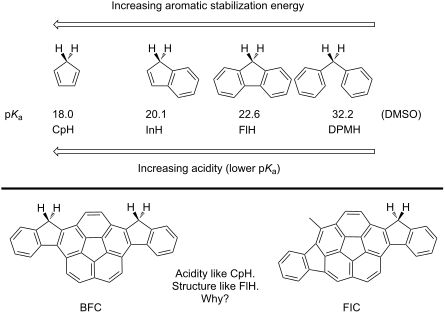
- for a CpH-PAH like BFC or FIC in DMSO? From the initial structural analogy to fluorene there is a substantial 8 pKa unit difference, which is nearly 11 kcal/mol in ambient reaction free energy. Computations (B97-D/def2-TZVPP(THF)//B97-D/def2-TZVPP(THF)) also predict pKa values of 14.4 and 14.3 for FIC
- ]. Electronic and thermal free energy differences between neutral and anion were compared to a reference pentafluorophenylfluorene, and subsequently converted to pKa values by dividing by 1.36. Visualization and analysis of structural and property results were obtained using Avogadro [35]. Our group develops


Controlled oligomerization of [1.1.1]propellane through radical polarity matching: selective synthesis of SF5- and CF3SF4-containing [2]staffanes
Beilstein J. Org. Chem. 2024, 20, 3134–3143, doi:10.3762/bjoc.20.259
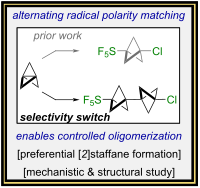
- , alternatively, INT1 could be added to another equiv of 1 via TS2 to form INT2. Although formation of 4 is notably more thermodynamically favorable than INT2 (ΔΔG = −9.2 kcal/mol), a small difference in activation free energy is predicted (ΔΔG‡ = −1.4 kcal/mol). This, at least in part, provides an explanation as
- here that the free energy of activation is lower for chlorination, albeit only by 0.4 kcal/mol. This is consistent with the notion that the kinetic preference can be overcome by increasing the concentration of 1 relative to CF3SF4Cl. In the second product-determining step, Cl atom abstraction by INT5
- challenges in the synthesis of [n]staffanes using excess [1.1.1]propellane (1). (Bottom) selective synthesis of [2]staffanes bearing the SF5 (2) and CF3SF4 (3) groups (this work). Computed free energy profile for the oligomerization of [1.1.1]propellane (1) following SF5 radical addition at PWPB95-D4/def2


Advances in the use of metal-free tetrapyrrolic macrocycles as catalysts
Beilstein J. Org. Chem. 2024, 20, 3085–3112, doi:10.3762/bjoc.20.257
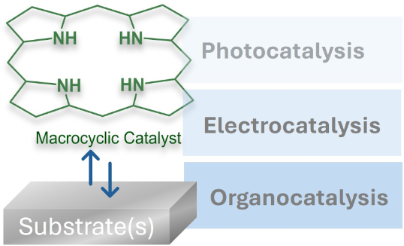
- conditions also supported the generation of the radical anion [67]˙−. Furthermore, the authors used thermodynamic theoretical calculations to investigate catalytic steps, finding that the protonation of [67]˙− to generate [67-H] is thermodynamically favored (free energy of +2.39 kcal mol−1) over its
- reduction to highly energetic dianion [67]2− (free energy of +36.3 kcal mol−1). Combining experimental and theoretical observations, the authors proposed the most favorable hydrogen generation mechanism to be E–P–E–P; where E stands for reduction and P means protonation (Figure 19). Acid protonates the


Synthesis and antimycotic activity of new derivatives of imidazo[1,2-a]pyrimidines
Beilstein J. Org. Chem. 2024, 20, 2806–2817, doi:10.3762/bjoc.20.236
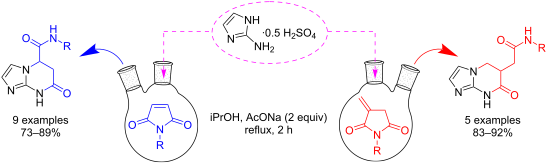
- and 7a are formed (Scheme 4). Although intermediate 7a has a lower activation energy (∆G = −0.23 kcal/mol), further recyclization processes are not possible due to the positive free energy change (∆G > 0). In this context, the formation of the final product is only possible to proceed via intermediate
- irreversible process, given that it is thermodynamically challenging to revert the formed target product 4a to the original starting substances or the corresponding intermediate 6a (∆G(4a→6a) = + 4.04 kcal/mol). Meanwhile, a minimal difference in the free energy of intermediates 6a and 7a may facilitate their


Computational design for enantioselective CO2 capture: asymmetric frustrated Lewis pairs in epoxide transformations
Beilstein J. Org. Chem. 2024, 20, 2668–2681, doi:10.3762/bjoc.20.224
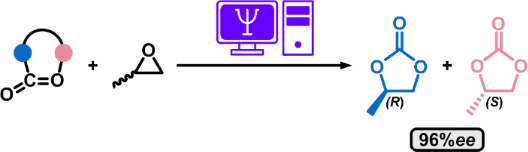
- free energy correction at double-zeta. The kinetics of some reactions were calculated, applying the transition state theory [40]. Within this theory, the rate constant of an elementary reaction with the free energy barrier ΔG‡ is given by Equation 1, where k is the rate constant in s−1, kB is the
- catalytic reaction (δE) is considered. King et al. [48] introduced the concept of the energy span of a simulated catalytic cycle by defining it as the difference between the highest and lowest free energy stationary points [49][50]. More precisely, the energy span can be defined using Equation 6, where Ti
- axis represents the free energy of the first stationary point of the selected pair and the y axis represents the free energy of the other stationary point of the pair. According to the volcano plots, the best theoretically predicted catalysts are those nearest to the lowest predicted δE values





