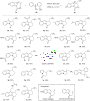
Search results
Search for "trifluoromethyl" in Full Text gives 401 result(s) in Beilstein Journal of Organic Chemistry. Showing first 200.
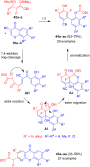
Heterocycle-guided synthesis of m-hetarylanilines via three-component benzannulation
Beilstein J. Org. Chem. 2024, 20, 2208–2216, doi:10.3762/bjoc.20.188
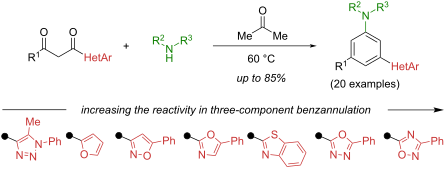
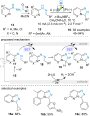
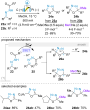
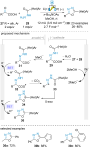
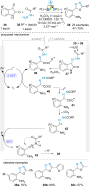
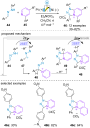
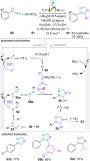
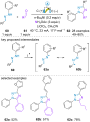
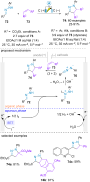
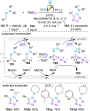
- situ-generated acetone imines in a (3 + 3) manner to afford meta-substituted anilines (Scheme 1C) [53][54]. Various EWGs (ester, carbamoyl, ketone, trifluoromethyl) have been successfully employed which motivated us to evaluate other possible EWGs. Results and Discussion Based on the fact, that many


Factors influencing the performance of organocatalysts immobilised on solid supports: A review
Beilstein J. Org. Chem. 2024, 20, 2129–2142, doi:10.3762/bjoc.20.183
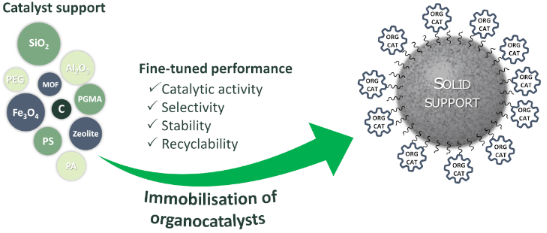
- binding with an electron-withdrawing group. This acidity can result in stronger hydrogen bonds between the substrate and the catalyst C30, which contains a bis(trifluoromethyl)phenyl-modified squaramide moiety. This stronger interaction potentially enhances the catalyst–substrate interaction, allowing for


From perfluoroalkyl aryl sulfoxides to ortho thioethers
Beilstein J. Org. Chem. 2024, 20, 2108–2113, doi:10.3762/bjoc.20.181
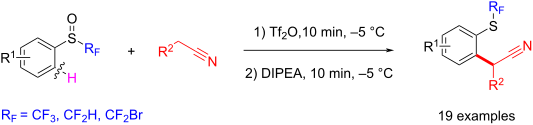
- Discussion We started our optimization with the reaction between acetonitrile and phenyl trifluoromethyl sulfoxide (1a, Table 1). We firstly chose the same stoichiometry as described in our previous study and tried to reduce the reaction time by the help of microwave heating (Table 1, entry 1). Under these
- decided to use 2 equivalents of DIPEA at low temperature. After ten minutes at −15 °C to allow for the reaction between phenyl trifluoromethyl sulfoxide (1a) and acetonitrile, the base was added and the reaction was stirred for the same amount of time. To our delight, a good NMR yield of 74% was received
- 1h–j proved also efficient for this rearrangement giving rise to the corresponding thioethers 2h–j in good NMR yields and lower isolated yield in the case of the more volatile adduct 2i. Finally, trifluoromethyl selenoxide 1k was tested as a substrate, and the rearranged product was obtained in a low

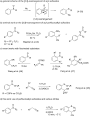


Multicomponent syntheses of pyrazoles via (3 + 2)-cyclocondensation and (3 + 2)-cycloaddition key steps
Beilstein J. Org. Chem. 2024, 20, 2024–2077, doi:10.3762/bjoc.20.178





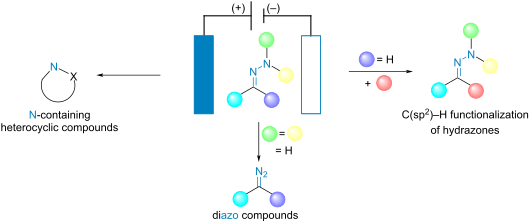
Harnessing the versatility of hydrazones through electrosynthetic oxidative transformations
Beilstein J. Org. Chem. 2024, 20, 1988–2004, doi:10.3762/bjoc.20.175
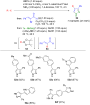
- two carbone graphite electrodes. The Togni reagent 127 was chosen as a source of trifluoromethyl radical with redox neutral and electron-rich hydrazones through a paired electrolysis. In contrast, the Langlois reagent 128 was preferred for electron-poor substrates through an electrooxidative process


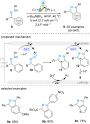






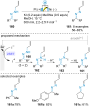
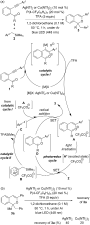
Development of a flow photochemical process for a π-Lewis acidic metal-catalyzed cyclization/radical addition sequence: in situ-generated 2-benzopyrylium as photoredox catalyst and reactive intermediate
Beilstein J. Org. Chem. 2024, 20, 1973–1980, doi:10.3762/bjoc.20.173
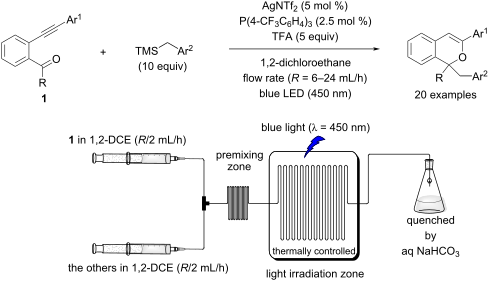
- batch reaction (Table 2, entry 4: 57% vs 10%). The reaction of 1e substituted with a strong electron-withdrawing trifluoromethyl group afforded the product 3e in high yield (Table 2, entry 5: 77%), again confirming the high efficiency of the flow reaction system (batch: 54%). Next, the effects of the
- substituent at the meta-position were investigated. Substrate 1f having a methoxy group afforded compound 3f in only moderate yield (Table 2, entry 6: 39%), similar to the batch reaction (40%). The reactions of substrates having a methyl, bromo, or trifluoromethyl group gave the corresponding products 3g–i
- , respectively, in high yields (Table 3, entries 4 and 5). The aldehyde 1q bearing a strong electron-withdrawing trifluoromethyl group at the para-position gave product 3q in moderate yield (Table 3, entry 6: 63%), with the recovery of substrate 1q (18%). The reaction of ortho-methyl-substituted aldehyde 1r


1,2-Difluoroethylene (HFO-1132): synthesis and chemistry
Beilstein J. Org. Chem. 2024, 20, 1955–1966, doi:10.3762/bjoc.20.171
- (trifluoromethyl)amine easily reacted with (Z)-1,2-difluoroethylene to form the addition product in high yield (Scheme 11) [89]. However, the stereochemistry of this reaction has not been reported. A similar reaction of (Z)-1,2-difluoroethylene with N-chloroimidobis(sulfonyl fluoride) (Scheme 12) [90] was shown to
- -Difluoroethylene synthesis from perfluoropropyl vinyl ether. Deuteration reaction of 1,2-difluoroethylene. Halogen addition to 1,2-difluoroethylene. Hypohalite addition to 1,2-difluoroethylene. N-Bromobis(trifluoromethyl)amine addition to 1,2-difluoroethylene. N-Chloroimidobis(sulfonyl fluoride) addition to 1,2


Solvent-dependent chemoselective synthesis of different isoquinolinones mediated by the hypervalent iodine(III) reagent PISA
Beilstein J. Org. Chem. 2024, 20, 1914–1921, doi:10.3762/bjoc.20.167
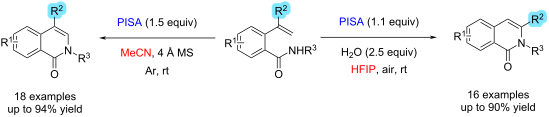
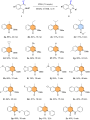
- % yield. Additional experiments were then carried out using N-methoxy-2-(prop-1-en-2-yl)benzamide with different substituents R2. Both electron-donating (methyl, alkoxy, dimethylamino) and electron-withdrawing substituents (fluoro, chloro, trifluoromethyl) were well tolerated on the phenyl ring and gave
- group (trifluoromethyl, fluoro, chloro) was located on the phenyl ring, various amounts of 4-substituted isoquinolinone derivatives 2k,m,n were observed along with the formation of 3h,j,k, respectively. Furthermore, a substrate containing a naphthalene unit was also compatible with the reaction




Novel oxidative routes to N-arylpyridoindazolium salts
Beilstein J. Org. Chem. 2024, 20, 1906–1913, doi:10.3762/bjoc.20.166
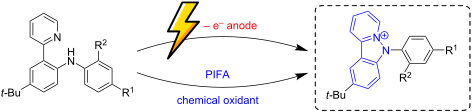
- contained some other compounds, which have not been identified. Among the amines studied, amine A3 is less prone to oxidation (due to the electron-withdrawing effect of the trifluoromethyl group) and is the less basic; the presence of a lutidine base even more fastens deprotonation of the radical cation


Electrochemical radical cation aza-Wacker cyclizations
Beilstein J. Org. Chem. 2024, 20, 1900–1905, doi:10.3762/bjoc.20.165
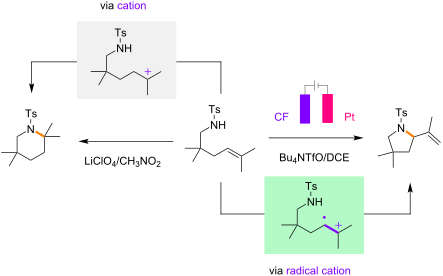
- trisubstituted alkenes (Figure 1). As described above, the electron density in the aryl rings does not seem to have a significant impact on the reaction, since alkenes possessing methyl 2, methoxy 5, and trifluoromethyl 6 groups were all high yielding. This observation was supported by the cyclic voltammetric




Oxidative fluorination with Selectfluor: A convenient procedure for preparing hypervalent iodine(V) fluorides
Beilstein J. Org. Chem. 2024, 20, 1785–1793, doi:10.3762/bjoc.20.157
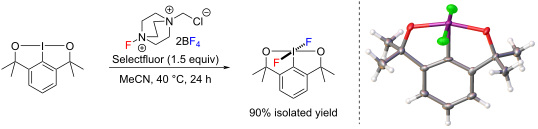
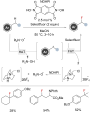
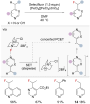
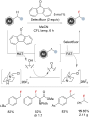
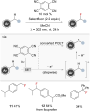
- investigate hypervalent iodine(V) fluorides has been limited primarily by their difficult preparation traditionally using harsh fluorinating reagents such as trifluoromethyl hypofluorite and bromine trifluoride. Here, we report a mild and efficient route using Selectfluor to deliver hypervalent iodine(V
- them easily because they normally require harsh fluorinating reagents. The synthesis of hypervalent iodine(V) fluoride 3 was reported by Amey and Martin in 1979 using the highly toxic gas, trifluoromethyl hypofluorite (Scheme 2A), and they later prepared bicyclic hypervalent iodine(V) fluoride 4 using
- contains two trifluoromethyl groups in the sidearm which could alter the electronic effects significantly. We therefore decided to prepare a small series of monocyclic trifluoro(aryl)-λ5-iodanes, where the sidearm substituents were changed stepwise from methyl to trifluoromethyl groups, so that we also


Syntheses and medicinal chemistry of spiro heterocyclic steroids
Beilstein J. Org. Chem. 2024, 20, 1713–1745, doi:10.3762/bjoc.20.152


Benzylic C(sp3)–H fluorination
Beilstein J. Org. Chem. 2024, 20, 1527–1547, doi:10.3762/bjoc.20.137

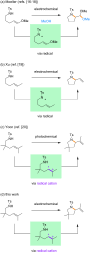
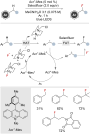
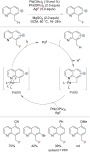
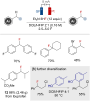
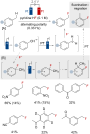
- -(trifluoromethyl)aniline in conjunction with external ligand 5 facilitated the formation of a series of fluorinated α-amino acids. Xu and co-workers also disclosed a palladium-catalysed protocol for the fluorination of simple benzylic substrates bearing a bidentate directing group (Figure 8) [42]. Yields varied




















Synthesis of 4-functionalized pyrazoles via oxidative thio- or selenocyanation mediated by PhICl2 and NH4SCN/KSeCN
Beilstein J. Org. Chem. 2024, 20, 1453–1461, doi:10.3762/bjoc.20.128
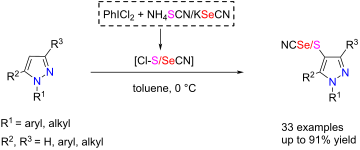
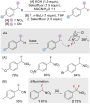
- used as an effective anti-inflammatory pharmaceutical [23]. On the other hand, organic thiocyanates usually serve as useful synthetic intermediates that can be conveniently converted to sulfur-containing derivatives including sulfides [24], disulfides [25], thiocarbamates [26], and trifluoromethyl


Generation of alkyl and acyl radicals by visible-light photoredox catalysis: direct activation of C–O bonds in organic transformations
Beilstein J. Org. Chem. 2024, 20, 1348–1375, doi:10.3762/bjoc.20.119
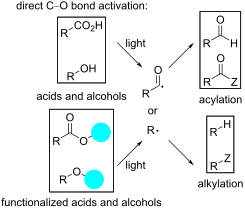
- , Wang and co-workers [30] demonstrated the photomediated synthesis of γ,γ-difluoroallylic ketones by reacting trifluoromethyl alkenes and acids in the presence of PPh3 additive and iridium photocatalyst in basic medium (Scheme 3). This methodology was suitable for a wide range of carboxylic acids in the





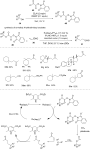
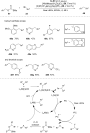

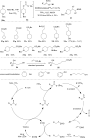
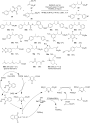
Domino reactions of chromones with activated carbonyl compounds
Beilstein J. Org. Chem. 2024, 20, 1256–1269, doi:10.3762/bjoc.20.108
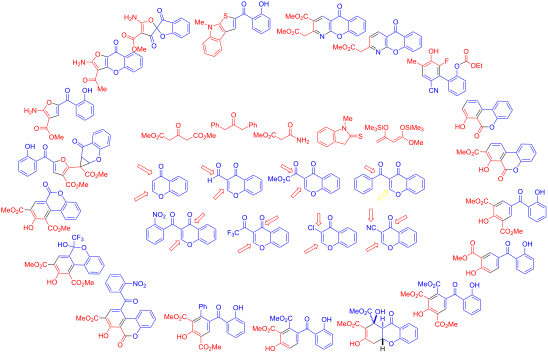
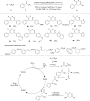
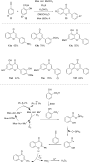
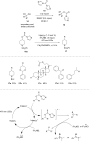
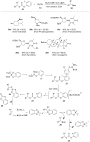
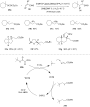
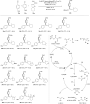
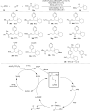
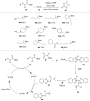
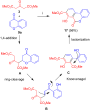
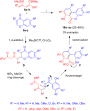
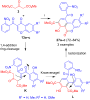
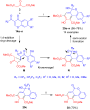
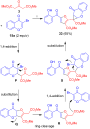
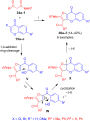
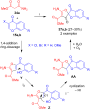
- electrophilicity. The products are finally generated by intramolecular formation of a semi-acetal. The yields were generally good (56–78%). The yields for pentafluoroethyl- and heptafluoropropyl-substituted derivatives were slightly better than the yields of trifluoromethyl-substituted derivatives which might be









Synthesis and optical properties of bis- and tris-alkynyl-2-trifluoromethylquinolines
Beilstein J. Org. Chem. 2024, 20, 1246–1255, doi:10.3762/bjoc.20.107
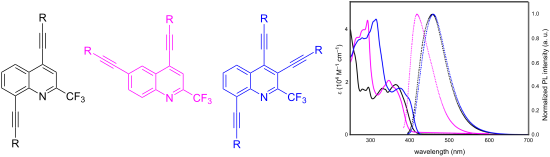
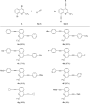
- properties of selected products, bis- and tris-alkynylated quinolines, were studied to gain insights into how the substitution pattern at different positions may alter the optical properties. Results and Discussion The starting material, 4,8-dibromo-2-(trifluoromethyl)quinoline (4), was synthesized from 2
- -bromoaniline (1a) and ethyl trifluoroacetoacetate (2), adapting a known procedure from Schlosser and Marull (Scheme 1) [17]. The cyclization of 1a with 2a chemoselectively afforded 8-bromo-2-trifluoromethyl-4-quinolone (3) rather than 8-bromo-4-trifluoromethyl-2-quinolone. Bromination of 3 with phosphoryl
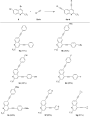
- electronic push–pull interaction of the thiophene and the quinoline moieties via the alkyne. Finally, we focussed on the synthesis of tris-alkynylated quinolines starting from 3,4,8-tribromo-2-(trifluoromethyl)quinoline (11). Starting material 11 was synthesized in very good yield from quinolone 3 by








Direct synthesis of acyl fluorides from carboxylic acids using benzothiazolium reagents
Beilstein J. Org. Chem. 2024, 20, 921–930, doi:10.3762/bjoc.20.82
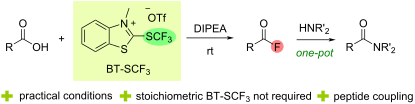
- afford (trifluoromethyl)thioethers, while subsequent work focused on the direct deoxygenative synthesis of fluorinated thioesters from carboxylic acids [29][30][31]. In each case, the reactions proceeded smoothly under operationally simple conditions while BT-SCF3 and related BT-SRF reagents are easy-to
- -handle solids that can be readily produced on a multigram scale from relatively inexpensive starting materials. During the optimisation studies for the latter process with carboxylic acid substrates, in addition to the desired (trifluoromethyl)thioester products, small amounts of the corresponding acyl
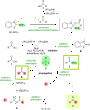
- , reacting BT-SCF3 with carboxylic acids 1 under similar conditions provides (trifluoromethyl)thioesters 3 via a concerted deoxytrifluoromethylthiolation process from tetrahedral intermediate A affording thiocarbamate by-product B [31]. To test whether thioester species could act as intermediates in the



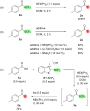
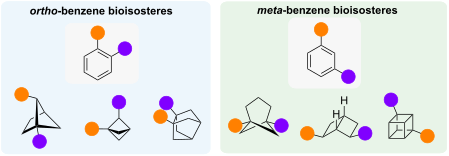
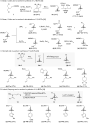
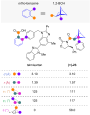
(Bio)isosteres of ortho- and meta-substituted benzenes
Beilstein J. Org. Chem. 2024, 20, 859–890, doi:10.3762/bjoc.20.78




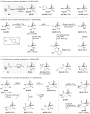


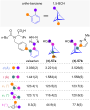
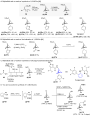


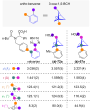


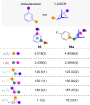

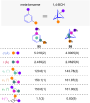


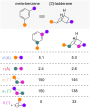




Ortho-ester-substituted diaryliodonium salts enabled regioselective arylocyclization of naphthols toward 3,4-benzocoumarins
Beilstein J. Org. Chem. 2024, 20, 841–851, doi:10.3762/bjoc.20.76
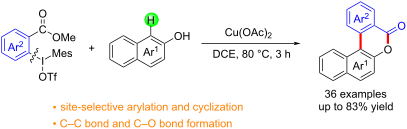
- this reaction, regardless of the electronic nature and position of the substituents. The desired 3,4-benzocoumarin products 3ba–ma were obtained in yields of 21–59%. Notably, substituents such as halogens (F, Cl, and Br), methyl, methoxy, and trifluoromethyl groups at the ortho-, meta-, or para


Ligand effects, solvent cooperation, and large kinetic solvent deuterium isotope effects in gold(I)-catalyzed intramolecular alkene hydroamination
Beilstein J. Org. Chem. 2024, 20, 479–496, doi:10.3762/bjoc.20.43
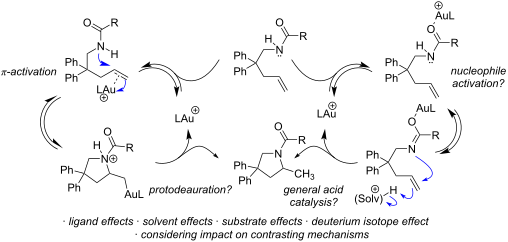
- than those in CD2Cl2). However, this did not hold true uniformly. When a commercially available electron-acceptor ligand known as “Jackiephos” (bis(3,5-bis(trifluoromethyl)phenyl)(2′,4′,6′-triisopropyl-3,6-dimethoxybiphenyl-2-yl)phosphine was used as the AuNTf2 salt (6a), in CD2Cl2, the reaction rate
- further (see Supporting Information File 1, Figure S19). This comparison reveals that the Jackiephos supported gold accelerates the reaction more than (PhO)P(o-biphenyl)2 does, although this may be in part an anion effect [7]. The bis(trifluoromethyl)aryl substituent is expected to be more electron






(E,Z)-1,1,1,4,4,4-Hexafluorobut-2-enes: hydrofluoroolefins halogenation/dehydrohalogenation cascade to reach new fluorinated allene
Beilstein J. Org. Chem. 2024, 20, 452–459, doi:10.3762/bjoc.20.40
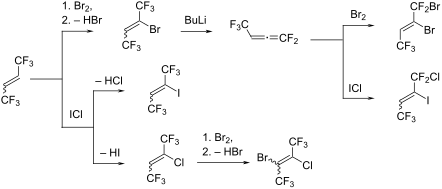
- the formation of the corresponding olefin [12]. Another area of application of olefins 1a,b is based on C=C double bond addition reactions. As early as 1968, Atherton and Fields showed that (Z)- and (E)-butenes 1a,b reacted with diazotrifluoroethane to give 3,4,5-tris(trifluoromethyl)pyrazoline [13
- demonstrated that 1,1,1,4,4,4-hexafluorobut-2-ene reacts with dithietane, sulfur and KF with the formation of the corresponding 1,3-dithiole [16]. Also, a recent patent presents a method for the preparation of 5,6-bis(trifluoromethyl)-1,2,4-triazine-3-carboxylic acid ethyl ester starting from 1,1,1,4,4,4
- completion of the reaction and subsequent treatment of the reaction mixture with 2 N hydrochloric acid, 2,3-bis(trifluoromethyl)-1-(4-fluorophenyl)prop-2-ene-1-ol (10) was detected in the 19F NMR spectrum. It should be noted that, in addition to the unreacted starting aldehyde 9, the formation of olefin 1b


Mechanisms for radical reactions initiating from N-hydroxyphthalimide esters
Beilstein J. Org. Chem. 2024, 20, 346–378, doi:10.3762/bjoc.20.35
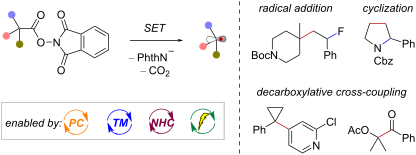
- with aryl thiols [70]. Further studies showed that 4-(trifluoromethyl)thiophenol (97) could act as a catalytic reductant in the aminodecarboxylation reaction of NHPI esters derived from α-amino acids [71] (Scheme 19). Accordingly, visible light irradiation of a mixture consisting of N-Boc-alanine NHPI






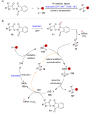
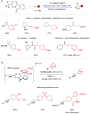


Copper-catalyzed multicomponent reaction of β-trifluoromethyl β-diazo esters enabling the synthesis of β-trifluoromethyl N,N-diacyl-β-amino esters
Beilstein J. Org. Chem. 2024, 20, 212–219, doi:10.3762/bjoc.20.21
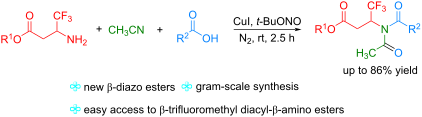
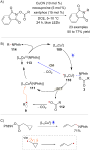
- IKERBASQUE, Basque Foundation for Science, Alameda Urquijo 36-5, Plaza Bizkaia, 48011 Bilbao, Spain 10.3762/bjoc.20.21 Abstract An efficient multicomponent reaction of newly designed β-trifluoromethyl β-diazo esters, acetonitrile, and carboxylic acids via an interrupted esterification process under copper
- -catalyzed conditions has been developed, which affords various unsymmetrical β-trifluoromethyl N,N-diacyl-β-amino esters in good to excellent yields. The reaction features mild conditions, a wide scope of β-amino esters and carboxylic acids, and also applicability to large-scale synthesis, thus providing an
- efficient way for the synthesis of β-trifluoromethyl β-diacylamino esters. Furthermore, this reaction represents the first example of a Mumm rearrangement of β-trifluoromethyl β-diazo esters. Keywords: β-carbonyl diazo; copper catalyst; fluoroalkyl diazo; Mumm rearrangement; unsymmetrical β-diacylamino




Visible-light-induced radical cascade cyclization: a catalyst-free synthetic approach to trifluoromethylated heterocycles
Beilstein J. Org. Chem. 2024, 20, 118–124, doi:10.3762/bjoc.20.12
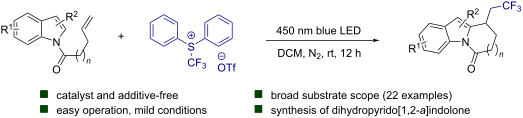
- Chemistry and Chemical Engineering, Henan Normal University, Xinxiang, Henan 453007, China 10.3762/bjoc.20.12 Abstract A visible-light-promoted research protocol for constructing dihydropyrido[1,2-a]indolone skeletons is herein described proceeding through a cascade cyclization mediated by trifluoromethyl
- enables a rapid access to heterocycles containing a trifluoromethyl group. Keywords: cascade reaction; indole derivatives; photocatalysis; radical chain process; trifluoromethylation; Introduction Dihydropyrido[1,2-a]indolone (DHPI) skeletons are commonly found in natural products and pharmaceutical
- an electron-withdrawing functional moiety into drug molecules would increase their metabolic stability [20], by avoiding, e.g., fast oxidation by cytochrome P450 oxidases [21]. In particular, the introduction of a trifluoromethyl group (–CF3) was shown to increase the metabolic stability of molecules