Search results
Search for "fluorophores" in Full Text gives 108 result(s) in Beilstein Journal of Organic Chemistry.
The role of spacer length and flexibility in peptide self-assembly
Beilstein J. Org. Chem. 2026, 22, 986–996, doi:10.3762/bjoc.22.77
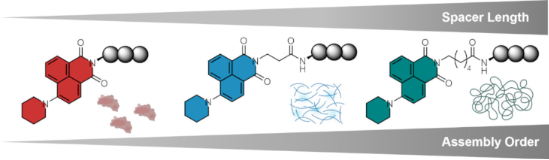
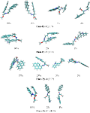
- -assembly and therefore supramolecular morphologies. During self-assembly, the attached fluorophores are brought into close proximity, enabling electronic coupling between transition dipoles that can result in characteristic spectral shifts [49]. This behavior is commonly rationalized within the framework
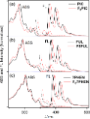
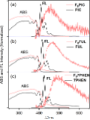
- fluorophores, the three peptide conjugates were investigated at 100 μM under non-assembling conditions (100% TFE) and assembling conditions (1% TFE, 99% PBS). In the dissolved state (100% TFE, Figure 3B), all three peptide conjugates exhibited similar absorbance maxima at 430 ± 2 nm. Upon switching to aqueous


A practical CO2-mediated synthesis of 5,6-carboxylated silicon-rhodamines for targeted probe development
Beilstein J. Org. Chem. 2026, 22, 915–924, doi:10.3762/bjoc.22.72
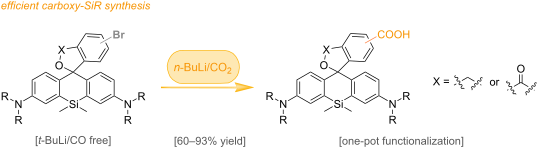
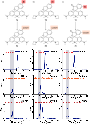
- .22.72 Abstract Silicon-rhodamine (SiR) dyes are among the most important fluorophores for super-resolution imaging owing to their far-red emission, high photostability, and tunable lactone–zwitterion equilibrium. However, their broader application in targeted probe development has been limited by the
- emerged as one of the most important fluorophores for live-cell bioimaging [3][4][5][6][7] by virtue of their high brightness, excellent photostability [8][9][10], and, most importantly, tunable lactone–zwitterion (L–Z) equilibrium [11][12][13]. This distinctive feature enables controllable fluorescence
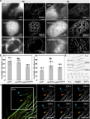
- -resolution imaging. Among them, probes 4a and 4b, corresponding to HMSiR-Halo and AzeHMSiR-Halo originally reported by the Urano and Xu groups [30][32][33][34], respectively, are widely used fluorophores for single-molecule imaging because of their excellent spontaneous blinking properties. Accordingly, the



Conformational effects on iodide binding: a comparative study of flexible and rigid carbazole macrocyclic analogs
Beilstein J. Org. Chem. 2025, 21, 2369–2375, doi:10.3762/bjoc.21.181
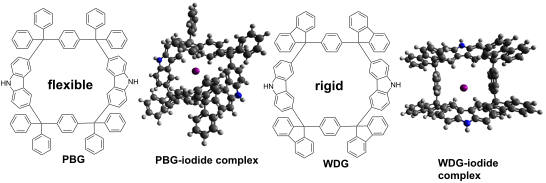
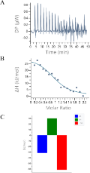
- binding ability to iodide ions in chloroform solution. It should be noted that the titration curve did not approach saturation, which may be attributed to conformational changes occurring during the quenching process. At high quencher concentrations, structural alterations in fluorophores could induce



Rotaxanes with integrated photoswitches: design principles, functional behavior, and emerging applications
Beilstein J. Org. Chem. 2025, 21, 2345–2366, doi:10.3762/bjoc.21.179
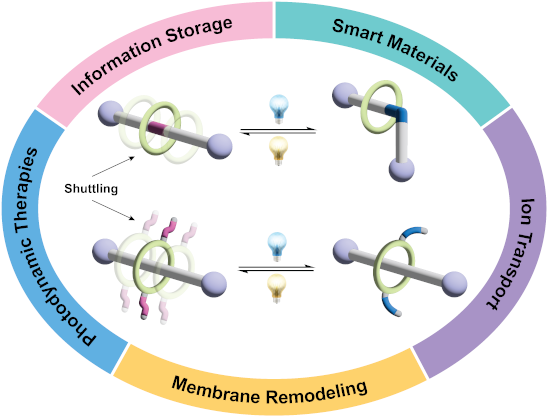
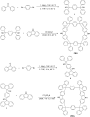
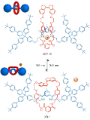
- , Lin and co-workers reported [2]rotaxanes that contain naphthalimide fluorophores on the macrocycle and a spiropyran as one of the axle stoppers [17]. The photoswitching of the spiropyran was used to modulate the photoluminescence of the rotaxane through Förster resonance energy transfer (FRET) with





Synthesis of optically active folded cyclic dimers and trimers
Beilstein J. Org. Chem. 2025, 21, 1603–1612, doi:10.3762/bjoc.21.124

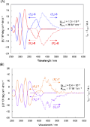
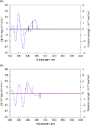
- same absolute configuration. The |glum| value of 7 was 0.4 × 10⁻³ (Figure S18A, Supporting Information File 1), which was lower than that of 6. In the case of the film states of 6 and 7, low PL brightness and intermolecular random orientation of fluorophores resulted in noisy CPL signals. The CD


Biobased carbon dots as photoreductants – an investigation by using triarylsulfonium salts
Beilstein J. Org. Chem. 2025, 21, 1024–1030, doi:10.3762/bjoc.21.84
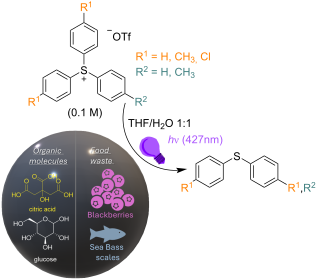
- typically exhibit excitation-dependent emission spectra and large Stokes shifts, features that are uncommon in traditional molecular fluorophores and semiconductor nanoparticles, and such behavior is attributed to the intrinsic heterogeneity of the CDs. The peculiar photophysics of carbon dots arises from


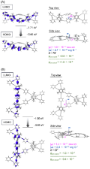
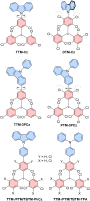
On the photoluminescence in triarylmethyl-centered mono-, di-, and multiradicals
Beilstein J. Org. Chem. 2025, 21, 964–998, doi:10.3762/bjoc.21.80
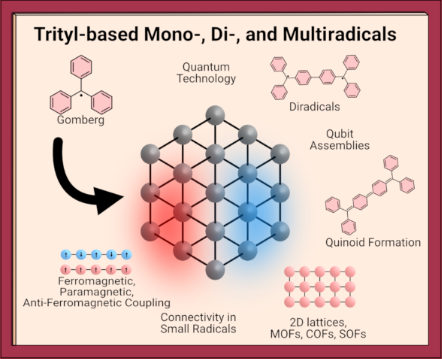
- ]. The donor-functionalized trityl molecules exhibit only few vibrational modes in the above mentioned spectral range, leading to relatively high ϕ at long wavelengths (≈800 nm). These molecules seem to overcome the typical restriction of the energy gap rule, where the ϕ of conventional fluorophores









Synthesis of HBC fluorophores with an electrophilic handle for covalent attachment to Pepper RNA
Beilstein J. Org. Chem. 2025, 21, 727–735, doi:10.3762/bjoc.21.56
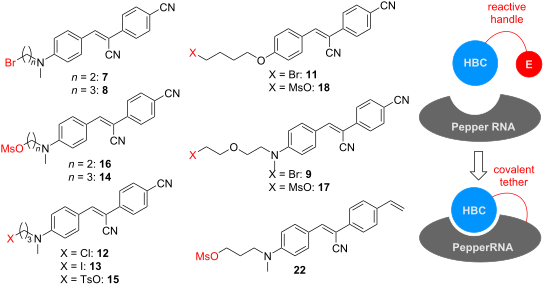
- Raphael Bereiter Ronald Micura Institute of Organic Chemistry, Center for Molecular Biosciences, Innsbruck (CMBI), University of Innsbruck, Innrain 80-82, 6020 Innsbruck, Austria 10.3762/bjoc.21.56 Abstract The fluorescent light-up aptamer (FLAP) Pepper can utilize fluorophores that are equipped
- )cyanophenylacetonitrile) fluorophores for easy access, which will contribute to the rapid dissemination of the RNA imaging approaches associated therewith. Keywords: covalent RNA labeling; FLAP; fluorophore synthesis; HBC530; self-alkylating ribozymes; Introduction The discovery of fluorescent reporters, such as green
- fluorophores that provide the parent HBC530 ((4-((2-hydroxyethyl)(methyl)amino)benzylidene)cyanophenylacetonitrile) stilbene core [7] but offer an electrophilic alkyl handle on the amino group replacing the original N-hydroxyethyl residue. Three of them have been applied in the cellular applications (Brc3HBC



Photochemically assisted synthesis of phenacenes fluorinated at the terminal benzene rings and their electronic spectra
Beilstein J. Org. Chem. 2025, 21, 670–679, doi:10.3762/bjoc.21.53
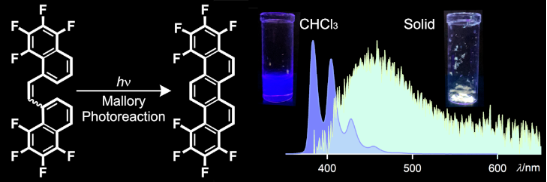
- molecules displayed high hole mobility [20][21][22][23][24][25][26] and imide-fused phenacenes served as n-type organic semiconductors [27]. It was also disclosed that donor–acceptor-type phenacenes provided environment-dependent fluorophores showing solvatochromic fluorescence behavior [28][29]. Because





Photocatalyzed elaboration of antibody-based bioconjugates
Beilstein J. Org. Chem. 2025, 21, 616–629, doi:10.3762/bjoc.21.49
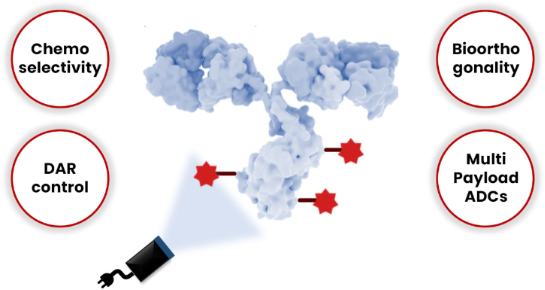
- antibodies in disease detection and treatment is that they are adorned with functional units (e.g., fluorophores, radionuclides, toxic payloads) that must be efficiently and selectively installed through compatible synthetic methods. Dozens of ADCs have been approved for clinical uses, and to date all are


Synthesis and characterizations of highly luminescent 5-isopropoxybenzo[rst]pentaphene
Beilstein J. Org. Chem. 2025, 21, 270–276, doi:10.3762/bjoc.21.19
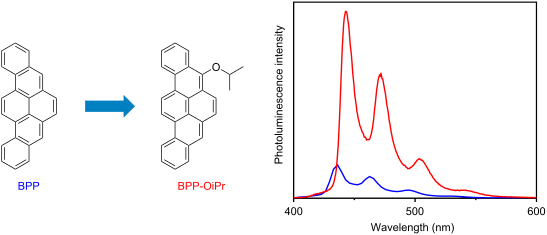
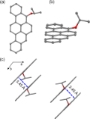
- by scanning electron microscopy. The intriguing optical properties of BPP and its derivatives may lead to their application as fluorophores. Keywords: benzo[rst]pentaphene; intramolecular charge transfer; nanocrystals; photoluminescence; polycyclic aromatic hydrocarbon; Introduction Polycyclic




Tunable full-color dual-state (solution and solid) emission of push–pull molecules containing the 1-pyrindane moiety
Beilstein J. Org. Chem. 2024, 20, 3016–3025, doi:10.3762/bjoc.20.251
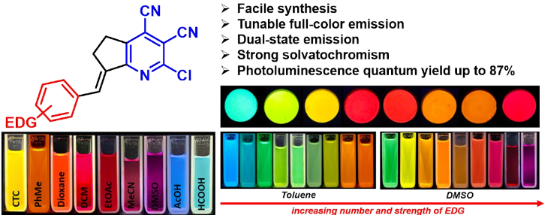
- unchanged. This represents a rare approach for the design of such fluorophores. Arylidene derivatives of pyrindane were found to be efficient fluorescent dyes showing a moderate to high emission quantum yield. The push–pull molecules were also characterized by a dual-state emission (in solution and in the
- , which is a rare approach for such fluorophores. Another rare phenomenon for push–pull molecules is dual-state emission (DSE) [45][46][47]. At the same time, the scope of applications of fluorophores exhibiting DSE is much wider. This is due to the fact that DSE molecules, after absorbing energy, are


Synthesis of pyrrole-fused dibenzoxazepine/dibenzothiazepine/triazolobenzodiazepine derivatives via isocyanide-based multicomponent reactions
Beilstein J. Org. Chem. 2024, 20, 2870–2882, doi:10.3762/bjoc.20.241
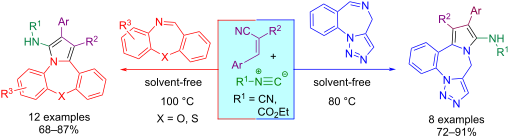
- their suitable fluorophores [49][50][51]. The UV–vis absorption and emission spectra of products 4 and 6 were studied in ethanol at 298 K. The absorption range (λabs) was 400–225 nm, and the emission range (λem) was 560–400 nm. These findings are shown in Figure S3 in Supporting Information File 1. An





Synthesis and antimycotic activity of new derivatives of imidazo[1,2-a]pyrimidines
Beilstein J. Org. Chem. 2024, 20, 2806–2817, doi:10.3762/bjoc.20.236
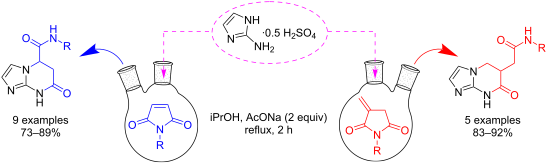
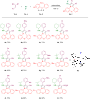
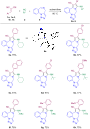
- filtered off, washed with water (2 × 5 mL) and recrystallized from a mixture of DMF/iPrOH 1:2. The title compounds 5a–e were obtained as white solids. Some biologically active compounds and organic fluorophores containing the imidazo[1,2-a]pyrimidine nucleus. Existing approaches to imidazo[1,2-a


Photoluminescence color-tuning with polymer-dispersed fluorescent films containing two fluorinated diphenylacetylene-type fluorophores
Beilstein J. Org. Chem. 2024, 20, 2682–2690, doi:10.3762/bjoc.20.225
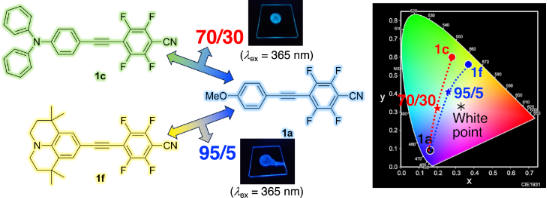
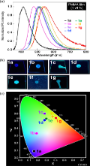
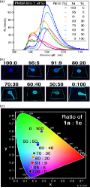
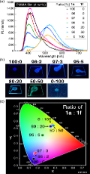
- if blue and green–yellow or yellow fluorophores are blended in appropriate ratios, a binary blend with color coordinates (0.20, 0.32) can be achieved, which approaches the white point of pure white emission. These findings contribute to the development of effective lighting and display devices as new
- the PMMA film containing a mixture of 1a and 1c indicate that the use of fluorophores with PL bands on the longer-wavelength side is more effective in approaching the ideal white color than green–yellow fluorophore 1c. Photoluminescence behavior of PMMA dispersion films containing a mixture of blue
- film containing a fluorinated diphenylacetylene with a tetramethyljulolidine skeleton exhibited yellow PL. Intensive investigation of the PL behavior of these PMMA films blended as a binary mixture of blue and green–yellow or yellow fluorophores showed smooth energy transfer from the high-energy


The Groebke–Blackburn–Bienaymé reaction in its maturity: innovation and improvements since its 21st birthday (2019–2023)
Beilstein J. Org. Chem. 2024, 20, 1839–1879, doi:10.3762/bjoc.20.162
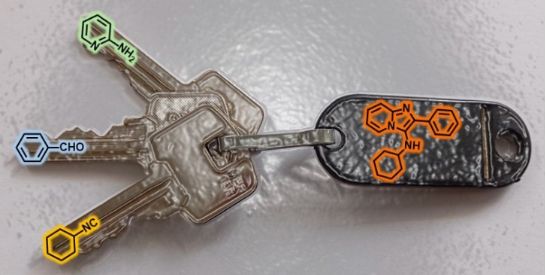
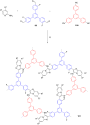
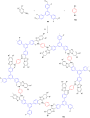
- excellent yields (71–89%). Dömling et al. have used glyoxal dimethyl acetal as orthogonal bifunctional monoprotected aldehyde to synthetize GBB dimers as potential fluorophores. More details are given in chapter 5 [43]. The GBB reaction can be exploited also in the late-stage functionalization of natural






Syntheses and medicinal chemistry of spiro heterocyclic steroids
Beilstein J. Org. Chem. 2024, 20, 1713–1745, doi:10.3762/bjoc.20.152
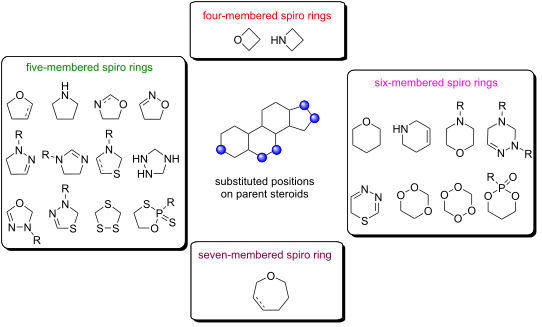
- steroids 124a–e, adducts 125a–d and 126a–e were easily obtained as single diastereomers via a Pictet–Spengler condensation with coumarins A and B (used as fluorophores) under acidic conditions (Scheme 35). Computational binding studies of compound 126c in the ligand-binding pocket of enzyme 17β-HSD5


Synthesis of N-acyl carbazoles, phenoxazines and acridines from cyclic diaryliodonium salts
Beilstein J. Org. Chem. 2024, 20, 12–16, doi:10.3762/bjoc.20.2
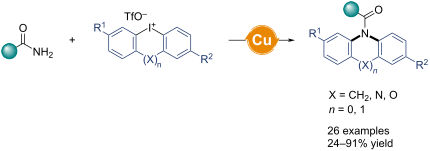
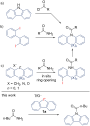
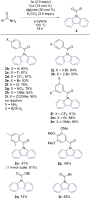
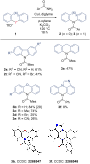
- nitrile-substituted carbazoles 2s and 2t, which are potent fluorophores. While 2s was isolated in 61% yield, the additional 6-bromo-substituent diminished the yield of 2t to 47%. When we subjected 6-membered 10H-dibenzo[b,e]iodinin-5-iums to our conditions, we synthesized the N-acyl dihydroacridane 3a

Thienothiophene-based organic light-emitting diode: synthesis, photophysical properties and application
Beilstein J. Org. Chem. 2023, 19, 1849–1857, doi:10.3762/bjoc.19.137
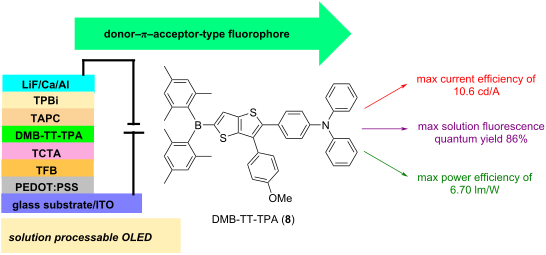
- efficiencies pointed out that DMB-TT-TPA (8) is among the best D–π–A modal fluorophores suitable for an OLED application. Moreover, the photophysical properties of DMB-TT-TPA (8) were investigated through time-resolved fluorescence studies (390 nm laser source in THF). The fluorescence lifetime (τ) of DMB-TT


A deep-red fluorophore based on naphthothiadiazole as emitter with hybridized local and charge transfer and ambipolar transporting properties for electroluminescent devices
Beilstein J. Org. Chem. 2023, 19, 1664–1676, doi:10.3762/bjoc.19.122
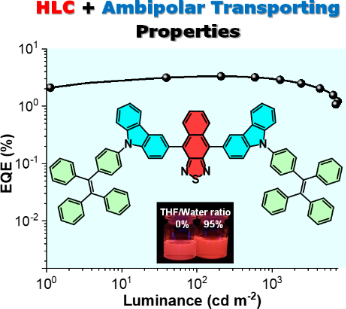
- coordinates of (0.664, 0.335)), an EQEmax of 3.32% and exciton utilization efficiency (EUE) of 47%. Keywords: ambipolar material; deep red fluorophore; hybridized local and charge transfer; naphthothiadiazole; OLED; organic light-emitting diode; Introduction Recently, organic fluorophores with efficient
- designing new DR/NIR organic fluorophores in combination with device engineering to build up the performance of DR/NIR OLEDs. In general, to realize high fluorescence in the DR/NIR region from the organic fluorophores, the challenges of their pronounced non-radiative processes, and high planarity and
- extended π-conjugation lengths which eventually favor the undesired formation of poorly emissive molecular aggregates must be overcome. Alternatively, donor–acceptor (D–A)-type organic fluorophores have been introduced and successfully exploited for the development of fluorophores with DR/NIR emissions


pH-Responsive fluorescent supramolecular nanoparticles based on tetraphenylethylene-labelled chitosan and a six-fold carboxylated tribenzotriquinacene
Beilstein J. Org. Chem. 2023, 19, 635–645, doi:10.3762/bjoc.19.45
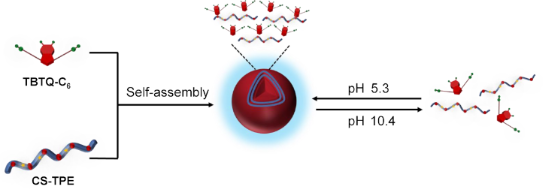
- powders of CS-TPE exhibit a pale-yellow appearance under normal daylight conditions and emit intense green-blue light when exposed to UV irradiation (365 nm). This phenomenon differs greatly from the fluorescence properties of conventional ACQ fluorophores, which are typically nonfluorescent under UV




Phenanthridine–pyrene conjugates as fluorescent probes for DNA/RNA and an inactive mutant of dipeptidyl peptidase enzyme
Beilstein J. Org. Chem. 2023, 19, 550–565, doi:10.3762/bjoc.19.40
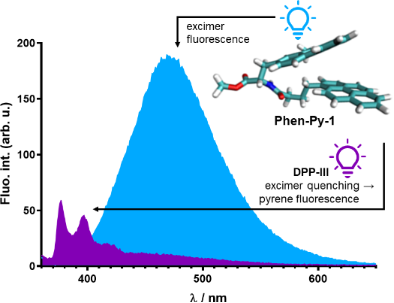
- the pyrene unit as well as combinations of pyrene with other aromatic fluorophores could improve the properties [7]. Recently, Takaishi et al. reported chiral exciplex dyes having pyrenyl, perylenyl, and 4-(dimethylamino)phenyl groups incorporated in their structure, which showed circularly polarized
- formed an exciplex [15], and conjugates formed of pyrene and an amino acid-fluorescent nucleobase derivative qAN1, differing in length and flexibility between fluorophores [16]. Due to pre-organization, both conjugates strongly interacted with ds-DNA/RNA grooves with similar affinity but opposite




Synthesis, optical and electrochemical properties of (D–π)2-type and (D–π)2Ph-type fluorescent dyes
Beilstein J. Org. Chem. 2022, 18, 1047–1054, doi:10.3762/bjoc.18.106
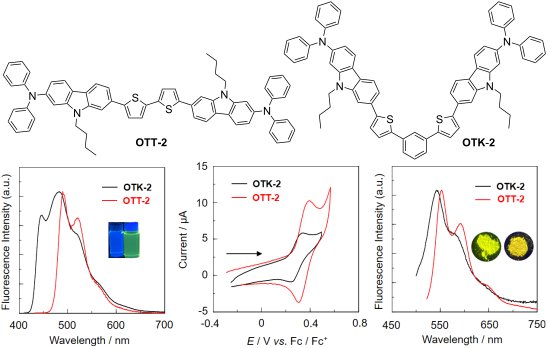
- intermolecular π–π interactions between the fluorophores leading to delocalization of excitons or excimers in the solid state would be responsible for the bathochromic shifts of λmax,abs and λmax,fl and lowering of Φfl with change of state from solution to solid [34][35][36]. The τfl-solid values of OTK-2 and


1,2-Naphthoquinone-4-sulfonic acid salts in organic synthesis
Beilstein J. Org. Chem. 2022, 18, 53–69, doi:10.3762/bjoc.18.5
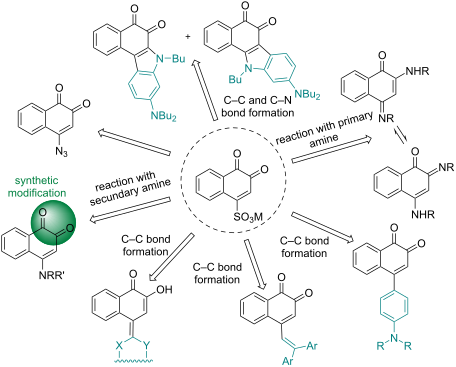
- enhancement behavior with a blueshift in the emission maximum upon enclathration of various types of organic solvents. It is important to note that other authors carried out the reaction of 18 with N,N-diethylaniline without the presence of Ni(II) [104][105]. In the search for fluorophores of heterocyclic


Chemical approaches to discover the full potential of peptide nucleic acids in biomedical applications
Beilstein J. Org. Chem. 2021, 17, 1641–1688, doi:10.3762/bjoc.17.116
- promising fluorescent enhancements and an ability to detect mismatches in live cells [155]. Overall, the TO- and BisQ-modified FIT PNAs are currently among the most promising fluorescent PNA probes. While promising, the studies discussed in this section leave plenty of room for designing better fluorophores