Search results
Search for "correlation" in Full Text gives 644 result(s) in Beilstein Journal of Organic Chemistry. Showing first 200.
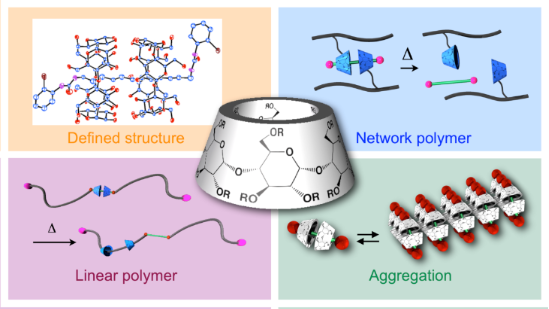
Cyclodextrin-based rotaxanes for polymer materials: challenge on simultaneous realization of inexpensive production and defined structures
Beilstein J. Org. Chem. 2024, 20, 3026–3049, doi:10.3762/bjoc.20.252






4,6-Diaryl-5,5-difluoro-1,3-dioxanes as chiral dopants for liquid crystal compositions
Beilstein J. Org. Chem. 2024, 20, 2940–2945, doi:10.3762/bjoc.20.246
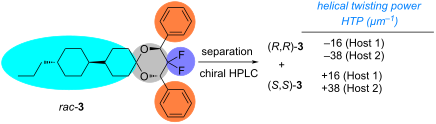
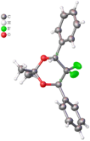
- enantiomers (R,R)-3/(S,S)-3, (R,R)-4/(S,S)-4 were obtained by slow evaporation from n-heptane solution and structures were determined by X-ray diffraction, which allowed the correlation of the chiroptical properties with the configuration (Figure 2 and Figure 3). The HTP of all enantiomers were measured with


Structure and thermal stability of phosphorus-iodonium ylids
Beilstein J. Org. Chem. 2024, 20, 2931–2939, doi:10.3762/bjoc.20.245
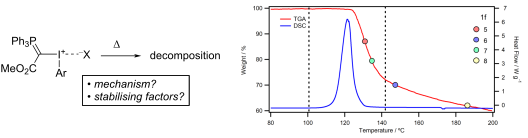
- phosphoranyl(aryl)iodonium compounds 1f–i, no direct correlation between the substituents’ Hammett parameter σp and the decomposition onset temperature Tonset was observed (Supporting Information File 1, Figure S13). However, the DSC thermograms of iodonium ylids with electron-poor aryl substituents (1h,i
- -iodonium ylids at 10 °C min−1 in N2 (full dataset in Supporting Information File 1). (b) First derivatives of TGA thermograms normalised to the intensity of the first peak. (c) Correlation of Tonset with the dihedral angle φ (between the R–I–X bond and the plane of the arene substituent). (d–g) DSC


Synthesis and antimycotic activity of new derivatives of imidazo[1,2-a]pyrimidines
Beilstein J. Org. Chem. 2024, 20, 2806–2817, doi:10.3762/bjoc.20.236
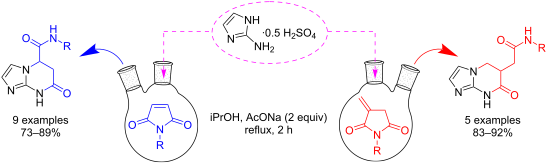
- unambiguous assignment of the signals for the methine and methylene groups of compounds 4 and 5 was carried out based on the correlations found in the NOESY 1H,1H and HMBC 1H,13C spectra. As an example, the key correlation interactions for compounds 4d and 5d are depicted in Figure 3. Thus, in the NOESY
- C-3 of the imidazole core, would not be possible for the alternative imidazopyrimidine system. These results allowed us to reject the structure 11. The lack of correlation in the HMBC spectra between the protons of the amide fragment and the C-5 carbon atom, as well as the presence of cross-peaks of


Synthesis of benzo[f]quinazoline-1,3(2H,4H)-diones
Beilstein J. Org. Chem. 2024, 20, 2708–2719, doi:10.3762/bjoc.20.228
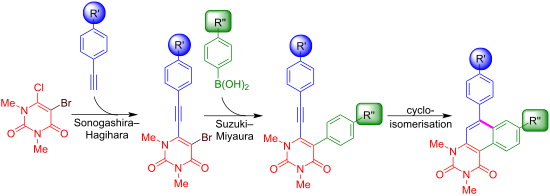
- recorded on Bruker AVANCE 300 III, 250II, or 500 spectrometers. The analysed chemical shifts δ are referenced to the residual solvent signals of the deuterated solvents CDCl3 (δ = 7.26 ppm/77.16 ppm). Multiplicities due to spin–spin correlation are reported as follows: s = singlet, d = doublet, dd = double




Computational design for enantioselective CO2 capture: asymmetric frustrated Lewis pairs in epoxide transformations
Beilstein J. Org. Chem. 2024, 20, 2668–2681, doi:10.3762/bjoc.20.224
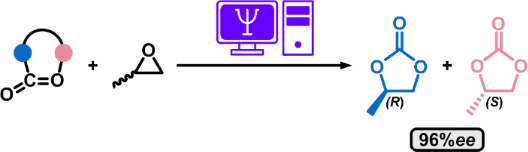
- process. Considering a reaction with six stationary points (REACTANTS, E1, TS2, E2, TS3, and PRODUCTS), which can be catalysed by n potential catalysts, the program calculates the correlation between the energy span and all possible pairs of stationary points for the n catalysts. For instance, it
- utilised. The same variables (energy of pre-TS01 assembly and Min2) were considered, which yielded a correlation with a R2 value of 0.71. As depicted in Figure 7A, it is clear that the best family for this mechanism is family 2, followed by families 3 and 4. Family 1, similar to the previous group
- indicated. Coupling reaction between PO and CO2. Depending on the catalyst considered, the reaction follows mechanism 1, 2, or 3. VOLCANO plot group 1. The free energies of pre-TS01 assembly and Min2 are considered for the correlation. (A) On the left, the compounds of families 1, 3, 4, and 5 were used for


Applications of microscopy and small angle scattering techniques for the characterisation of supramolecular gels
Beilstein J. Org. Chem. 2024, 20, 2608–2634, doi:10.3762/bjoc.20.220
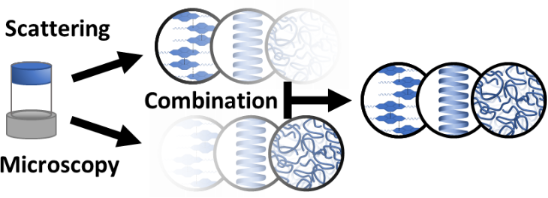
- the supramolecular fibres, CSLM was used to identify the mode of molecular assembly of each component. By comparing the CSLM images arising from the different fluorescent probes, there was shown to be a weak correlation between the resulting images, indicating that the fibres self-sort and separately
- accessibility of such techniques can be limited [77]. It has been previously established that there is a direct correlation between the bulk properties of self-assembled materials and their nanostructures [79][80] and microstructures [81][82]. Recently, Adams et al. utilised SANS to quantify the fibrillar
- nanostructure [79]. To investigate the effect of the gelator concentration on the density of the hydrogel network, SANS was used to determine the correlation length (Figure 17). As the concentration of the gelator increased, a decrease in the correlation length was measured which evidences a decrease in the


Homogeneous continuous flow nitration of O-methylisouronium sulfate and its optimization by kinetic modeling
Beilstein J. Org. Chem. 2024, 20, 2408–2420, doi:10.3762/bjoc.20.205
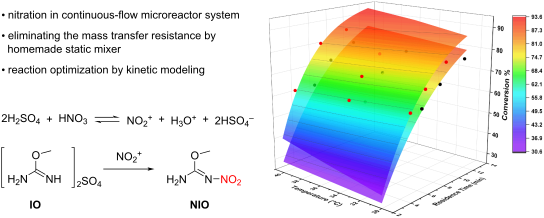
- concentrations. Determining the intrinsic reaction kinetics Given the strong correlation between the observed HNO3-based reaction rate constant and the H2SO4 mass fraction, intrinsic reaction constants independent of H2SO4 concentrations were determined to study the intrinsic kinetics of the reaction. Previous


![[Graphic 1]](/bjoc/content/inline/1860-5397-20-205-i17.svg?max-width=637&scale=1.18182)


Catalysing (organo-)catalysis: Trends in the application of machine learning to enantioselective organocatalysis
Beilstein J. Org. Chem. 2024, 20, 2280–2304, doi:10.3762/bjoc.20.196
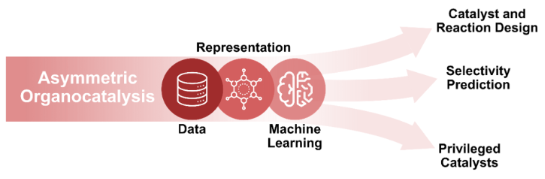
- ]. While the accuracy of the model is paramount, interpretability is also highly desirable. In this regard, MLR bears the advantage that it yields a directly interpretable function which can be used for mechanistic inference. However, it is important to note that the caveat of correlation and causality




Cell-free protein synthesis with technical additives – expanding the parameter space of in vitro gene expression
Beilstein J. Org. Chem. 2024, 20, 2242–2253, doi:10.3762/bjoc.20.192
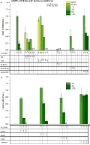
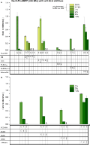
- -free extract as a reference. Correlation of fluorescence intensities and protein concentrations Plasmids for CFPS were expressed in E. coli BL21 (DE3) and purified as described by Rolf et al. [18]. The quantifications of purified proteins and set dilution series were performed with the Bradford assay
- . Fluorescence was measured with FLUOstar® Omega multi-mode microplate reader (BMG LABTECH, Ortenberg, Germany) under the same conditions as for the in vitro-produced proteins to determine the correlation between fluorescence intensity and protein concentration for each protein. Fractional yield The fractional

Heterocycle-guided synthesis of m-hetarylanilines via three-component benzannulation
Beilstein J. Org. Chem. 2024, 20, 2208–2216, doi:10.3762/bjoc.20.188
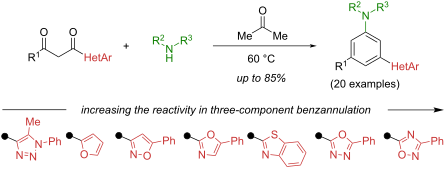
- /chemoinformatics calculations were also performed to correlate the observed reactivity with the charges on the carbonyl group of 1,3-diketones. Unfortunately, no reliable correlation was found between the charges and the reactivity of the 1,3-diketones with the present set of heterocyclic substituents or with the


Allostreptopyrroles A–E, β-alkylpyrrole derivatives from an actinomycete Allostreptomyces sp. RD068384
Beilstein J. Org. Chem. 2024, 20, 1981–1987, doi:10.3762/bjoc.20.174
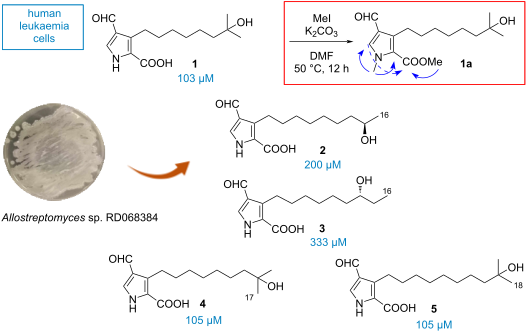
- carbon (δC 70.1), and one of the methylene carbons (C13: δC 44.8). The formyl proton H7 showed HMBC correlations to the olefinic carbons C3, C4, and C5 and the olefinic methine proton H5 was correlated with C2, C3, C4, and C7. These correlation data allowed the assignment of a carbon sequence C2–C3–C4–C5
- and the attachment of the formyl group at C4. Furthermore, HMBC correlations from two methylene protons H28 to the olefinic carbons C2, C3, and C4 connected the chain part at C3. A 1H,15N-HMBC correlation was seen from H5 to a nitrogen at δN 161.4, which suggested the presence of a nitrogen atom
- adjacent to C5. A correlation to the acyl carbonyl carbon (C6) was not available at this stage. In order to obtain further information for connectivity, compound 1 was reacted with methyl iodide and K2CO3 to give a bismethylated derivative 1a. A methyl proton at δH 3.94 was of an N-methyl group (δC 38.5


2-Heteroarylethylamines in medicinal chemistry: a review of 2-phenethylamine satellite chemical space
Beilstein J. Org. Chem. 2024, 20, 1880–1893, doi:10.3762/bjoc.20.163
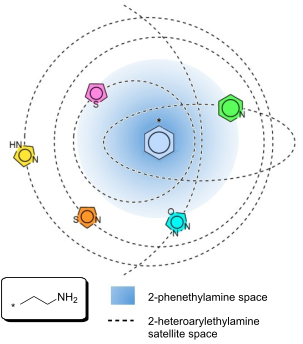
- α4β2 nicotinic cholinergic receptor ligands with nanomolar activities in rat brain homogenates (Scheme 2). The idea behind these AEP structures was to check activity correlation against a nicotine series. The comparison of Ki values of both series showed a moderate correlation, which opens the
- )-[3H]-baclofen displacement. QSAR studies have been developed in order to examine the pivotal role of the aromatic moiety of baclofen-like compounds [25]. In this sense, the QSAR equation revealed HOMO/LUMO orbital energies are critical for a high correlation with binding strength. An in vivo




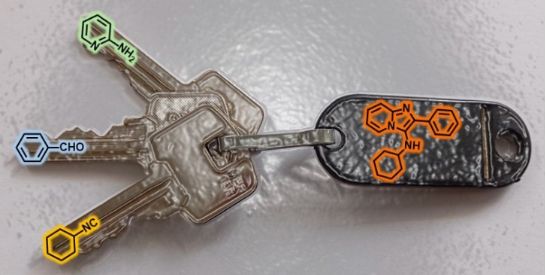
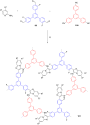
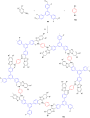
The Groebke–Blackburn–Bienaymé reaction in its maturity: innovation and improvements since its 21st birthday (2019–2023)
Beilstein J. Org. Chem. 2024, 20, 1839–1879, doi:10.3762/bjoc.20.162






Hetero-polycyclic aromatic systems: A data-driven investigation of structure–property relationships
Beilstein J. Org. Chem. 2024, 20, 1817–1830, doi:10.3762/bjoc.20.160
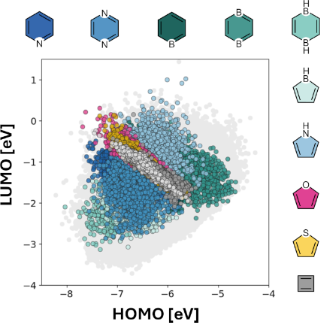
- similar correlation to size, however, our data-driven analysis revealed that the underlying source of the correlation is not just the molecular size, per se, but rather the formation of linear stretches (substructures that are linearly annulated) [6]. Accordingly, the longer the linear stretch, the higher



pKalculator: A pKa predictor for C–H bonds
Beilstein J. Org. Chem. 2024, 20, 1614–1622, doi:10.3762/bjoc.20.144
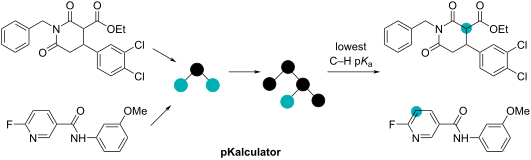
- . Furthermore, we employ our model on 1043 pKa-dependent reactions (aldol, Claisen, and Michael) and successfully indicate the reaction sites with a Matthew’s correlation coefficient (MCC) of 0.82. Keywords: C–H pKa values; pKa predictor; Introduction Over the years, the ability to selectively break a C–H
- as steric hindrance and base reactivity, ensuring even more precise predictions for reaction sites. Correlating computed values and experimental pKa values for 695 compounds. r: Pearson correlation coefficient; ρ: Spearman’s rank correlation coefficient; MAE: mean absolute error; RMSE: root mean
- squared error. QM calculations were carried out at the CAM-B3LYP/def2-TZVPPD CPCM(DMSO)//GFN2-xTB ALPB(DMSO) level of theory. ML-predicted pKa values vs QM-computed pKa values of the held-out test set (155 compounds; 789 pKa values). r: Pearson correlation coefficient; ρ: Spearman’s rank correlation


![[Graphic 9]](/bjoc/content/inline/1860-5397-20-144-i12.svg?max-width=637&scale=1.3000021)


Divergent role of PIDA and PIFA in the AlX3 (X = Cl, Br) halogenation of 2-naphthol: a mechanistic study
Beilstein J. Org. Chem. 2024, 20, 1580–1589, doi:10.3762/bjoc.20.141
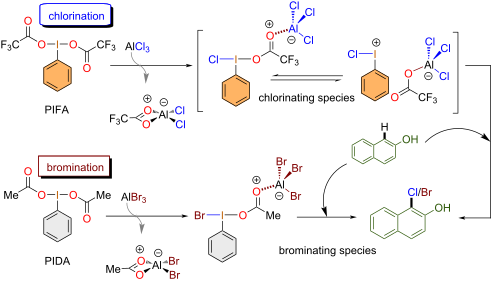
- different hypervalent iodine reagents for this reaction. To find the correlations between experiments and theoretical calculations, chlorination and bromination of 2-naphthol using PIFA/AlCl3 and PIDA/AlBr3 were carried out. Consequently, we found an excellent correlation between the yield and the energy


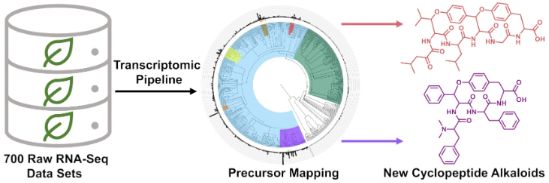
Mining raw plant transcriptomic data for new cyclopeptide alkaloids
Beilstein J. Org. Chem. 2024, 20, 1548–1559, doi:10.3762/bjoc.20.138
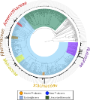
- . ameranicus using UHPLC-HRMS/MS. Finally, we generated a global natural product social (GNPS) network to show the correlation between metabolites from these different plant species (Figure 5) [29]. Cyclopeptides in Ceanothus americanus The GNPS network showed the presence of multiple features from C
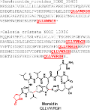
- and Leu-β is supported by HMBC correlation between Tyr-C3 (δ 156.3 ppm) and Tyr-C4 (δ120.5 ppm) and NOESY correlation between Tyr4-H (δ 7.01 ppm, 1H) and Leuβ-H (δ 4.80 ppm, 1H). Similar to other characterized cyclopeptide alkaloids, J-coupling constant (Jα-β = 8.0 Hz) supports S-stereochemistry at





Bioinformatic prediction of the stereoselectivity of modular polyketide synthase: an update of the sequence motifs in ketoreductase domain
Beilstein J. Org. Chem. 2024, 20, 1476–1485, doi:10.3762/bjoc.20.131
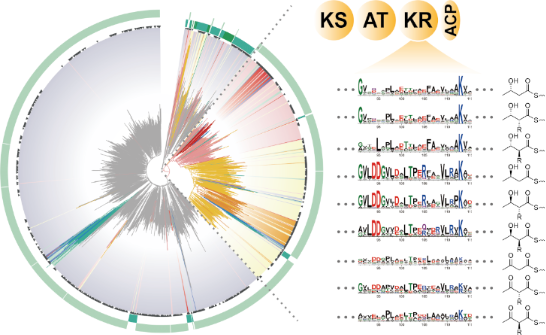
- indicate that the previously identified fingerprint motifs remain valid for KRs in β-modules from actinobacteria, but their reliability diminishes for KRs from other module types or taxonomic origins. Additionally, we have identified several new motifs that exhibit a strong correlation with the
- most of actinobacterial β-module KRs do fall within there). Overall, the motifs having correlation with stereoselectivity are summarized in Table S1 in Supporting Information File 1. Below we provide a detailed guideline for stereochemical prediction of KRs. For non-actinobacterial PKSs


Synthesis of 2-benzyl N-substituted anilines via imine condensation–isoaromatization of (E)-2-arylidene-3-cyclohexenones and primary amines
Beilstein J. Org. Chem. 2024, 20, 1468–1475, doi:10.3762/bjoc.20.130
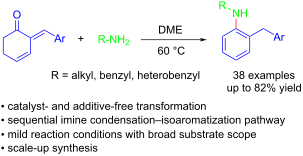
- -cyclohexenone. This is further supported by the 13C NMR spectrum, which contains two peaks at δ = 38.4 and 47.7 indicating the two types of benzylic carbons. The NMR data of known compound 4ab were also in good correlation with previously reported data [19]. The synthetic practicability of the protocol was



Predicting bond dissociation energies of cyclic hypervalent halogen reagents using DFT calculations and graph attention network model
Beilstein J. Org. Chem. 2024, 20, 1444–1452, doi:10.3762/bjoc.20.127
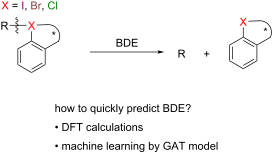
- both homolytic and heterolytic bond dissociation energies (BDEs) critical for assessing the chemical stability and functional group transfer capability of cyclic hypervalent halogen compounds using density functional theory (DFT) analysis. A moderate linear correlation was observed between the
- homolytic BDEs across different halogen centers, while a strong linear correlation was noted among the heterolytic BDEs across these centers. Furthermore, we developed a predictive model for both homolytic and heterolytic BDEs of cyclic hypervalent halogen compounds using machine learning algorithms. The


A comparison of structure, bonding and non-covalent interactions of aryl halide and diarylhalonium halogen-bond donors
Beilstein J. Org. Chem. 2024, 20, 1428–1435, doi:10.3762/bjoc.20.125
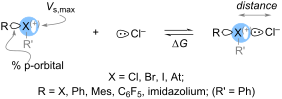
- -qzvpp for iodine and tellurium and in the gas phase. In our present work using M06-2x/6-311+G(d) with def2-txvpp for iodine and astatine, we observed excellent agreement in the correlation between orbitals used on the halonium center and the C–X–C bond angle, i.e., molecular geometry, from our prior
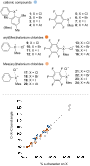
- consistent with Bent’s rule in which greater p-character is directed toward more electronegative ligands [44]. We also consider a correlation between Vs,max of the halogen-bond donor and ΔG of the halogen bond (Scheme 6c) [45]. Although a modest linear correlation (R2 = 0.90) was observed over all data
- combination of p-character (%) and σ-hole (Vs,max) provided the highest correlation based on linear regression analysis of ΔGDFT vs ΔGcalc, wherein ΔGcalc is obtained from Equation 1 [46]. Our model was developed with normalized parameters of % p-orbital character and Vs,max and therefore a comparison of the




Synthesis and physical properties of tunable aryl alkyl ionic liquids based on 1-aryl-4,5-dimethylimidazolium cations
Beilstein J. Org. Chem. 2024, 20, 1278–1285, doi:10.3762/bjoc.20.110
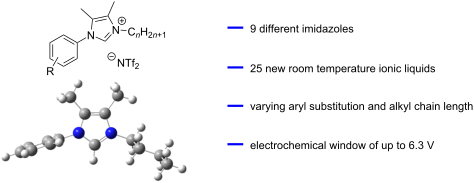
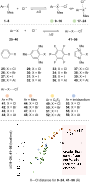
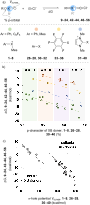
- their high viscosity, the 4-Br substituted TAAILs 46 and 47 display the lowest conductivities (96 and 62 μS cm−1, respectively). To visualize the correlation between conductivity and viscosity, the conductivity is plotted against the viscosity in Figure 3. The 4-OCF3 substituted TAAIL 52 shows a similar


Stability trends in carbocation intermediates stemming from germacrene A and hedycaryol
Beilstein J. Org. Chem. 2024, 20, 1189–1197, doi:10.3762/bjoc.20.101
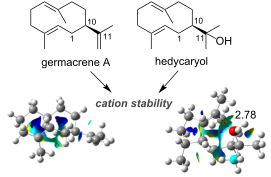
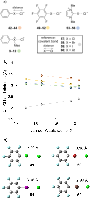
- below. This analysis allows us to understand the correlation between the stability of hedycaryols and the C+···OH distances, as this descriptor presents the difference in stability trends between hedycaryol and germacrene A cations, which is due to the hydroxy group in hedycaryol cations. where ΔΔEHed
- -Ger = ΔEHed − ΔEGer is the difference between corresponding hedycaryol and germacrene A cations (e.g., A and A-OH). The correlation coefficient, R2, is 0.75, indicating a correlation between the energy difference between carbocations and the C+-OH distance in hedycaryol cations. For example, F-OH has
- to repulsive and yellow represents slightly attractive interactions. The bottom two plots are side views of the cations and emphasize the relatively puckered structure of B compared to A. NCI plots for F and H hedycaryol cations. The C+···OH distances (Å) are shown in black. Correlation plot relating


Enantioselective synthesis of β-aryl-γ-lactam derivatives via Heck–Matsuda desymmetrization of N-protected 2,5-dihydro-1H-pyrroles
Beilstein J. Org. Chem. 2024, 20, 940–949, doi:10.3762/bjoc.20.84
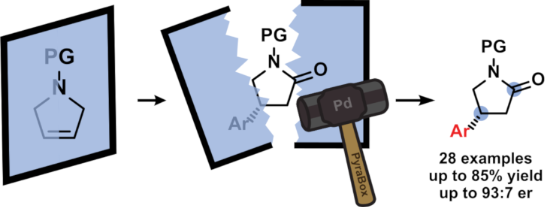
- determined by the correlation of their optical rotations with that of the previously reported aryl-lactam 4bb [23], and its deprotected analog [24], as well as with the intermediates 5b, 5a, and 6 in the (R)-rolipram (5b) and (R)-baclofen hydrochloride (6) [25] syntheses. Assignment of the stereochemistry of