Search results
Search for "purification" in Full Text gives 1642 result(s) in Beilstein Journal of Organic Chemistry. Showing first 200.
Ceratinadin G, a new psammaplysin derivative possessing a cyano group from a sponge of the genus Pseudoceratina
Beilstein J. Org. Chem. 2024, 20, 3215–3220, doi:10.3762/bjoc.20.267
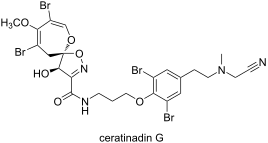
- 49.8 ppm were used as internal references. Mass spectra were acquired on a JEOL JMS-T100LP spectrometer. Flash column chromatography was performed using a Biotage Isolera flash purification system. Extraction and isolation The EtOAc-soluble material (2.45 g) of the methanol extract (38.06 g) from the


Germanyl triazoles as a platform for CuAAC diversification and chemoselective orthogonal cross-coupling
Beilstein J. Org. Chem. 2024, 20, 3198–3204, doi:10.3762/bjoc.20.265
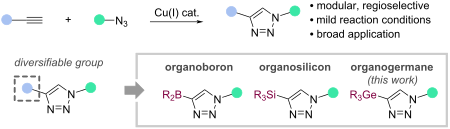
- displaying an arylboronic acid and MIDA ester (22 and 23) gave no reaction, side reactions were observed with a dialkynyl germane (24), and the product derived from azide 25 was unstable to purification. To further demonstrate the compatibility and utility of germanyl alkynes in CuAAC reactions, we applied


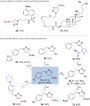
Synthesis of extended fluorinated tripeptides based on the tetrahydropyridazine scaffold
Beilstein J. Org. Chem. 2024, 20, 3174–3181, doi:10.3762/bjoc.20.262
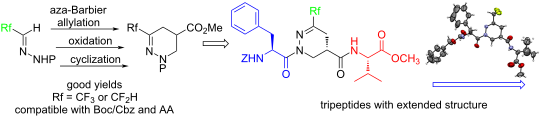
- yields and used directly in the next step without further purification (Scheme 2). In the case of Boc-protected hydrazones, the reaction must be carefully followed and reacted less than 2 hours in order to avoid the cleavage of the Boc group. The hydrazones 3e and 3f substituted by N-Cbz-ʟ-phenylalanine
- compounds 7e and 7f, no competition with the NH of the phenylalanine was observed. The corresponding tetrahydropyridazines 7a–f were obtained in moderate to good yields (Scheme 5). Concerning compounds 7e and 7f, each diastereomer of the 1:1 ratio mixture could be isolated after purification by flash silica


Synthesis of the 1,5-disubstituted tetrazole-methanesulfonylindole hybrid system via high-order multicomponent reaction
Beilstein J. Org. Chem. 2024, 20, 3077–3084, doi:10.3762/bjoc.20.256
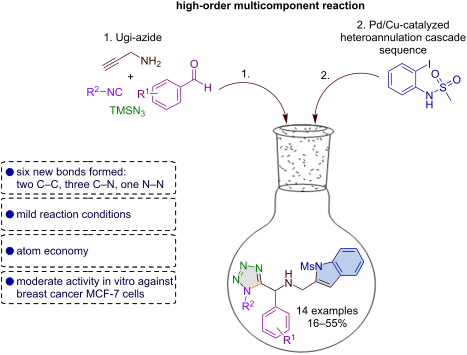
- -disubstituted tetrazole-methanesulfonylindole derivatives, with yields ranging from 16% to 55% after purification by column chromatography. Despite some yields being modest, they are deemed reasonable considering the reaction’s structural complexity, atom economy, and the efficiency achieved in terms of time

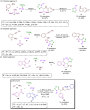


Chemical structure metagenomics of microbial natural products: surveying nonribosomal peptides and beyond
Beilstein J. Org. Chem. 2024, 20, 3050–3060, doi:10.3762/bjoc.20.253
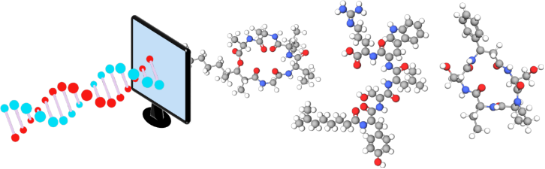
- it has been isolated via the lengthy iterative purification process guided by bioactivity. Rediscovery is inevitable based on such a workflow, and this is essentially due to our inability to predict the chemical structure ahead of time. Does this have to be the case? The instructions for natural


Cyclodextrin-based rotaxanes for polymer materials: challenge on simultaneous realization of inexpensive production and defined structures
Beilstein J. Org. Chem. 2024, 20, 3026–3049, doi:10.3762/bjoc.20.252
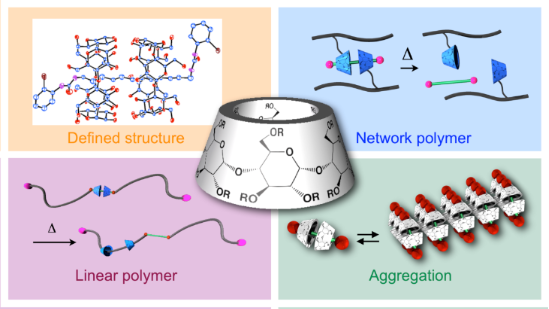
- species. As these modifications proceeded effectively with high yields (>90%) without any taxing purification by chromatography, a simple filtration-based purification was sufficient. This synthetic method enabled a flexible molecular design of the CD-based rotaxane framework in an easy, scalable manner
- six glucose units exist in the usual CD molecules, causing the necessity of the purification step to isolate only the mono-substituted product from the mixture containing others, such as two- or three-substituted species or the starting material (CD) itself. For example, a typical mono-substituted α






Tailored charge-neutral self-assembled L2Zn2 container for taming oxalate
Beilstein J. Org. Chem. 2024, 20, 3007–3015, doi:10.3762/bjoc.20.250
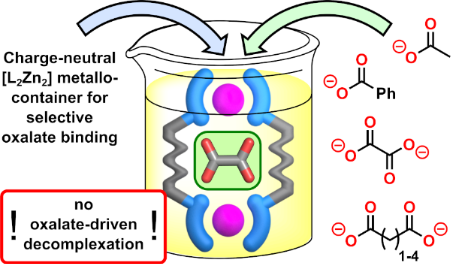
- be volatile to simplify complex purification. Second, the solubility of the neutral host complexes usually needs to be improved by the installation of solubility groups, which must be considered during ligand design. The biggest strength of metallocages and metallocontainers, whether they are
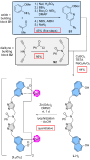
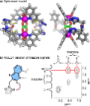
- acetate salt results in a charge-neutral and bench-stable [L2Zn2] metallocontainer. Purification of the complex is achieved by lyophilization which accomplishes the removal of acetic acid as only byproduct of the complexation reaction and DMSO as solvent. The charge-neutral receptor is obtained as a



gem-Difluorovinyl and trifluorovinyl Michael acceptors in the synthesis of α,β-unsaturated fluorinated and nonfluorinated amides
Beilstein J. Org. Chem. 2024, 20, 2946–2953, doi:10.3762/bjoc.20.247
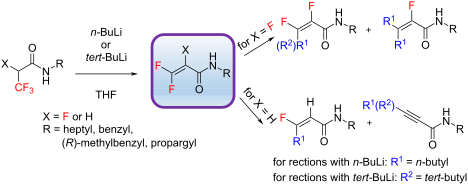
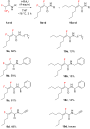
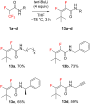
- products. These highly stable compounds were isolated after purification on silica gel in good yields (Scheme 2) and characterized by spectroscopic methods. The reaction proceeded with very high Z-stereoselectivity (Scheme 2, compounds 9a–d). In the 19F NMR spectra of crude mixtures, only trace amounts of




4,6-Diaryl-5,5-difluoro-1,3-dioxanes as chiral dopants for liquid crystal compositions
Beilstein J. Org. Chem. 2024, 20, 2940–2945, doi:10.3762/bjoc.20.246
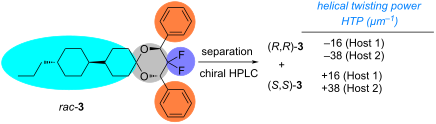
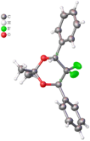
- purification. Ketalization of rac-2 with liquid crystal-like ketone 1 [43] (in toluene) or 2,2-dimethoxypropane 5 (in THF) provided dioxanes rac-3 and rac-4 in 56% and 62% yields, respectively (Scheme 2). Samples of rac-3 and rac-4 were separated by preparative HPLC on a chiral phase. Suitable crystals of all


Recent advances in transition-metal-free arylation reactions involving hypervalent iodine salts
Beilstein J. Org. Chem. 2024, 20, 2891–2920, doi:10.3762/bjoc.20.243

- . The reaction of H2A with the diaryliodonium salt in phosphate buffer resulted in the expected arylated conjugate in an hour with a maximum of 98% conversion, yielding sulfur arylated product in 54% isolated yield after purification by HPLC. Additionally, the functionalization of the ketone with a
- high conversions (83–93%) in 1–20 hours. Purification by HPLC yielded the isolated oxime conjugates in excellent amounts. This methodology presents a promising approach for the late-stage variation of proteins and peptides, offering versatility and efficiency in aqueous environments. In addition to




C–H Trifluoromethylthiolation of aldehyde hydrazones
Beilstein J. Org. Chem. 2024, 20, 2883–2890, doi:10.3762/bjoc.20.242
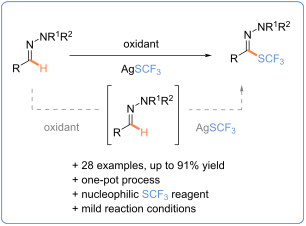
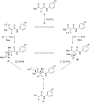
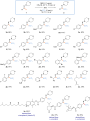
- being explained by a tedious purification. Interestingly, the methodology was successfully applied to the functionalization of aliphatic hydrazones 1s and 1t and even the hydrazone derived from citronellal 1u. The method was functional group-tolerant to various functional groups (nitro, CN, ester



Synthesis of pyrrole-fused dibenzoxazepine/dibenzothiazepine/triazolobenzodiazepine derivatives via isocyanide-based multicomponent reactions
Beilstein J. Org. Chem. 2024, 20, 2870–2882, doi:10.3762/bjoc.20.241
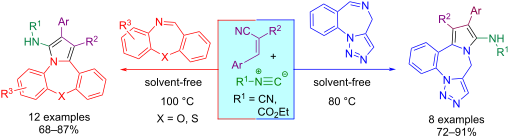
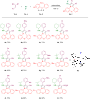
- information All commercially available reagents and chemicals were bought from Merck & Co. and utilized without extra purification. The melting points of all synthesized compounds were measured utilizing an Electrothermal 9200 apparatus. 1H and 13C NMR and spectra in CDCl3 and DMSO-d6 solvents were recorded
- purification process must be carried out under the mentioned personal protective equipment. The reaction on a larger scale is carried out under special safety conditions [57][58][59]. 3-(Cyclohexylamino)-2-phenyldibenzo[b,f]pyrrolo[1,2-d][1,4]oxazepine-1-carbonitrile (4a); ethyl 2-(4-chlorophenyl)-3


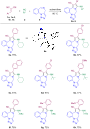

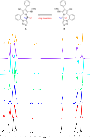


N-Glycosides of indigo, indirubin, and isoindigo: blue, red, and yellow sugars and their cancerostatic activity
Beilstein J. Org. Chem. 2024, 20, 2840–2869, doi:10.3762/bjoc.20.240
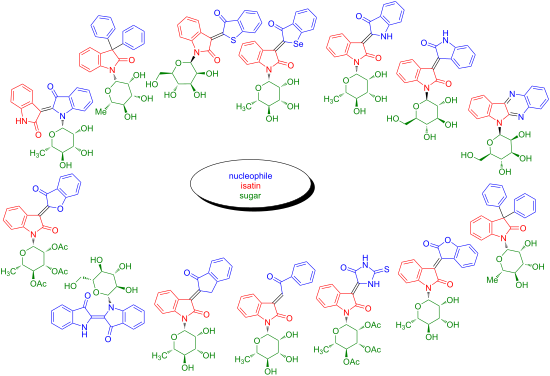
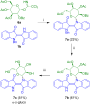
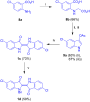
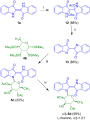
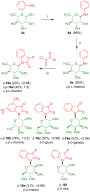
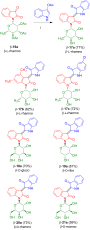
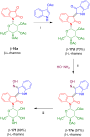
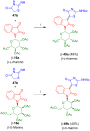
- latter were treated, without chromatographic purification, with MsCl (methanesulfonyl chloride), NEt3, and DMAP to give the desired products E-β-43a,b. Similarly, glucosides E-β-43c,d and galactoside E-β-43e were obtained. In contrast to oxoindirubin-N-rhamnoside β-41a, all glycosides were obtained as


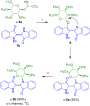









Synthesis of tricarbonylated propargylamine and conversion to 2,5-disubstituted oxazole-4-carboxylates
Beilstein J. Org. Chem. 2024, 20, 2827–2833, doi:10.3762/bjoc.20.238

- were purchased from commercial sources (Kanto Chemical Co., Inc. or Fujifilm Wako Pure Chemical Corp.) and used without further purification. Super dehydrated, stabilizer-free THF was used as solvent and purchased from Fujifilm Wako Pure Chemical Corp. DEMO was supplied by Kumiai Chemical Industry Co


Mechanochemical difluoromethylations of ketones
Beilstein J. Org. Chem. 2024, 20, 2799–2805, doi:10.3762/bjoc.20.235
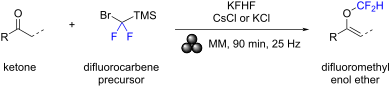
- spectroscopy with 1,2-dichloroethane as the internal standard. After these analyses, isolating the products by column chromatography was attempted. Unfortunately, many products were highly volatile and very non-polar, rendering the purification difficult. As a result, in several cases only little or no product


Access to optically active tetrafluoroethylenated amines based on [1,3]-proton shift reaction
Beilstein J. Org. Chem. 2024, 20, 2776–2783, doi:10.3762/bjoc.20.233
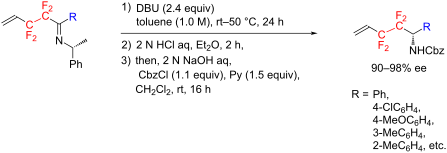
- a smooth [1,3]-proton shift reaction with a high chirality transfer, affording the corresponding rearranged products in acceptable yields. Without purification, these products were subjected to acid hydrolysis and the subsequent N-Cbz protection, providing the optically active tetrafluoroethylenated



Synthesis of spiroindolenines through a one-pot multistep process mediated by visible light
Beilstein J. Org. Chem. 2024, 20, 2722–2731, doi:10.3762/bjoc.20.230
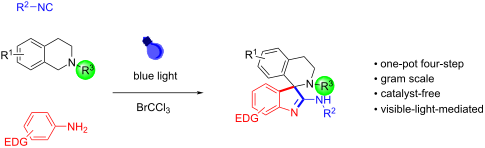
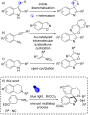
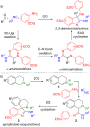
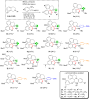
- materials (Scheme 1d). The synthetic procedure is achieved using blue light irradiation and bromotrichloromethane (BrCCl3), as a one-pot procedure, minimizing chemical wastes, avoiding purification of intermediates, and simplifying practical aspects. Results and Discussion We have recently published the one
- point, allowing the easy purification of the products. As expected, the reaction conducted in the absence of the carbocatalyst led to the obtainment of 2a with comparable yield (Table 1, entries 3 and 4), demonstrating that 1a is a sufficiently activated substrate for the 3C Ugi-type reaction to occur
- the solvent and using Et3N as additive for the eluent of the chromatography on silica gel. With these improvements, we have demonstrated that the yields are comparable to those obtained with purification on alumina but reaching significantly higher degrees of purity of the final products (see




Synthesis of benzo[f]quinazoline-1,3(2H,4H)-diones
Beilstein J. Org. Chem. 2024, 20, 2708–2719, doi:10.3762/bjoc.20.228
- -Flight (TOF) LC–MS. The solvent, toluene, was purchased as dry solvent and applied without further purification. Other reagents, catalysts, ligands, acids, and bases were used as purchased from commercial suppliers. Column chromatography was performed on Merck Silica gel 60 (particle size 63–200 μm




Synthesis of fluoroalkenes and fluoroenynes via cross-coupling reactions using novel multihalogenated vinyl ethers
Beilstein J. Org. Chem. 2024, 20, 2691–2703, doi:10.3762/bjoc.20.226

- purification. All experiments were carried out under argon atmosphere in flame-dried glassware using standard inert techniques for introducing reagents and solvents unless otherwise noted. Suzuki–Miyaura cross-coupling with multihalogenated vinyl ethers 1 To a solution of 1 (1.0 equiv), triphenylphosphine (10


Transition-metal-free decarbonylation–oxidation of 3-arylbenzofuran-2(3H)-ones: access to 2-hydroxybenzophenones
Beilstein J. Org. Chem. 2024, 20, 2655–2667, doi:10.3762/bjoc.20.223
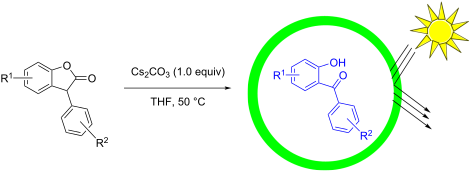
- -hydroxybenzophenones as efficient UV-protectors. Experimental All chemicals were procured from Sigma-Aldrich (AR grade) and used without any further purification. All solvents were purchased from Merck, and were distilled or dried, wherever applicable, following standard procedures. The organic extracts were dried




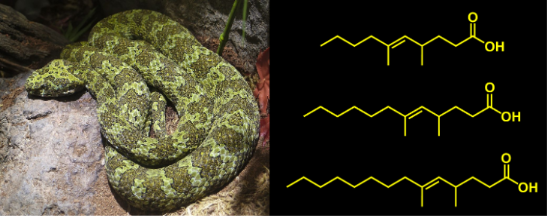
The scent gland composition of the Mangshan pit viper, Protobothrops mangshanensis
Beilstein J. Org. Chem. 2024, 20, 2644–2654, doi:10.3762/bjoc.20.222
- distilled before use. All other chemicals were used without purification unless otherwise stated. Air- and H2O-sensitive reactions were performed under N2. ASAP-APCI-MS was performed on an Expression MS (Advion) mass spectrometer equipped with an APCI ionization source operated in positive mode. The
- freshly distilled propanal (1, 2.1 mL, 30 mmol) were added to a 50 mL flask. The mixture was stirred at 0 °C for 1 h. The residue was filtered and washed twice with diethyl ether, and the solvent was removed in vacuo. The crude product was used without further purification. EIMS (70 eV) m/z (%): 125 (40
- room temperature. The solvent was removed and the residue was washed twice with pentane and dried under vacuum. The product was used without further purification. Analytical data were identical to those reported earlier. 1-Methylheptyltriphenylphosphonium iodide (5): In a manner similar to [31


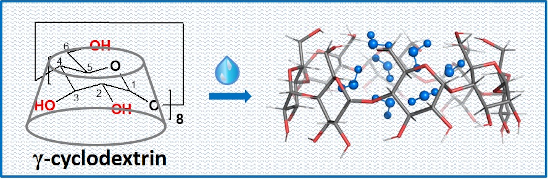
Deciphering the mechanism of γ-cyclodextrin’s hydrophobic cavity hydration: an integrated experimental and theoretical study
Beilstein J. Org. Chem. 2024, 20, 2635–2643, doi:10.3762/bjoc.20.221
- , whereas in β-CD it is a one-step process. Experimental Materials γ-CD was used as received (without further purification or modification) from Wacker Chemie AG (CAVAMAX FOOD) with a purity of ≥98%. Experimental measurements The thermal behavior of γ-CD was investigated with a Perkin Elmer DSC7


Base-promoted cascade recyclization of allomaltol derivatives containing an amide fragment into substituted 3-(1-hydroxyethylidene)tetronic acids
Beilstein J. Org. Chem. 2024, 20, 2585–2591, doi:10.3762/bjoc.20.217
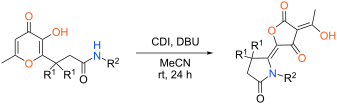
- purification. The synthetic utility of the prepared tetronic acids was demonstrated by further transformations at the hydroxyethylidene fragment. The structures of one obtained tetronic acid and one product of derivatization were confirmed by X-ray analysis. Keywords: allomaltol; base-promoted recyclization
- purification procedure are the advantages of the considered method. The synthetic utility of obtained tetronic acids was demonstrated by preparation of enamine and enehydrazine derivatives. The structures of one target tetronic acid and synthesized enehydrazine were established by X-ray analysis. Experimental


Transition-metal-free synthesis of arylboronates via thermal generation of aryl radicals from triarylbismuthines in air
Beilstein J. Org. Chem. 2024, 20, 2577–2584, doi:10.3762/bjoc.20.216
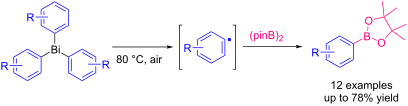
- without further purification. All solvents were used without distillation. Triarylbismuthines 1 were synthesized according to the previously reported procedures [62]. 1H, 13C{1H}, and 11B NMR spectra were recorded in CDCl3 using a Bruker AVANCE III HD 500 spectrometer at 500, 126, and 160 MHz



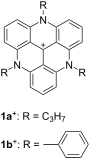
Anion-dependent ion-pairing assemblies of triazatriangulenium cation that interferes with stacking structures
Beilstein J. Org. Chem. 2024, 20, 2567–2576, doi:10.3762/bjoc.20.215
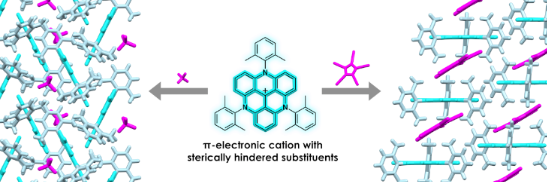
- further purification unless otherwise stated. According to the previous procedure [30], 4,8,12-tris(2,6-dimethylphenyl)-4,8,12-triazatriangulenium as a Cl− ion pair, 2+-Cl−, was prepared. NMR spectra used in the characterization of products were recorded on a JEOL ECA-600 600 MHz spectrometer. All NMR