Search results
Search for "optoelectronic properties" in Full Text gives 48 result(s) in Beilstein Journal of Organic Chemistry.
Pentacyclic aromatic heterocycles from Pd-catalyzed annulation of 1,5-diaryl-1,2,3-triazoles
Beilstein J. Org. Chem. 2025, 21, 2524–2534, doi:10.3762/bjoc.21.194
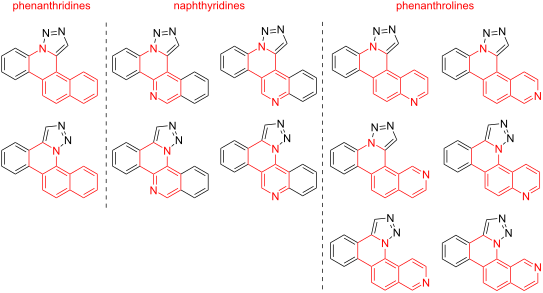
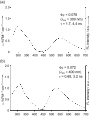
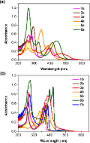
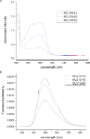
- the NMR timescale. These trends were observed similarly for the other analogs of this study (see Supporting Information File 1). Optoelectronic properties of each annulated product and its respective control compound were examined via UV–visible absorption and emission spectroscopy. Figure 6 shows the


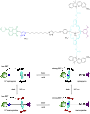
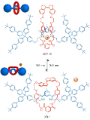
Rotaxanes with integrated photoswitches: design principles, functional behavior, and emerging applications
Beilstein J. Org. Chem. 2025, 21, 2345–2366, doi:10.3762/bjoc.21.179
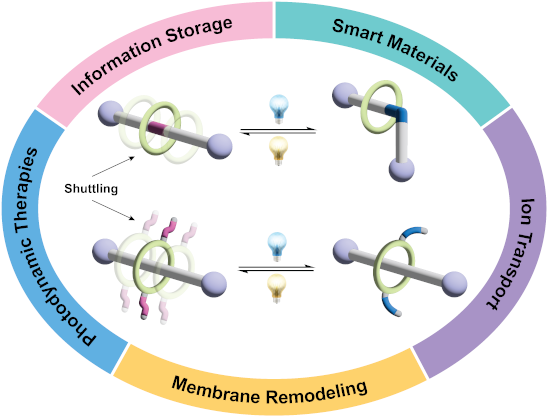
- for precise control over their structural, dynamic, and functional properties. By harnessing light as a non-invasive stimulus with high spatial and temporal resolution, these photoswitches allow for the modulation of the rotaxanes’ intra- and intermolecular interactions, optoelectronic properties, and
- mechanical work, such as lifting objects. In other systems, photoswitchable rotaxanes have been used to modulate optoelectronic properties, creating opportunities for applications in information storage, sensing, optical devices, and anti-counterfeiting technologies. Recently, the incorporation of




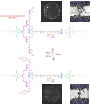

Synthesis of an aza[5]helicene-incorporated macrocyclic heteroarene via oxidation of an o-phenylene-pyrrole-thiophene icosamer
Beilstein J. Org. Chem. 2025, 21, 1561–1567, doi:10.3762/bjoc.21.119
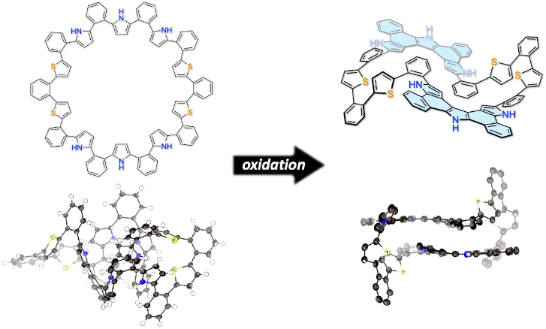
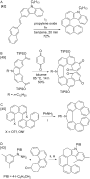
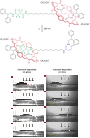
- in detail. Keywords: cyclophane; fluorescence; heterohelicene; intramolecular oxidative coupling; Introduction Conjugated macrocyclic polyarenes have attracted significant attention due to their stimuli-responsive optoelectronic properties, dynamic structural changes, and host–guest interactions [1


Advances in nitrogen-containing helicenes: synthesis, chiroptical properties, and optoelectronic applications
Beilstein J. Org. Chem. 2025, 21, 1422–1453, doi:10.3762/bjoc.21.106
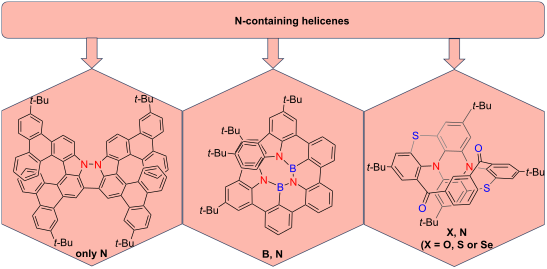
- helical architectures, have attracted considerable attention due to their intrinsic chirality and tunable optoelectronic properties. Among them, nitrogen-doped helicenes (azahelicenes) and their heteroatom-co-doped counterparts – such as B/N-, O/N-, S/N-, and Se/N-doped helicenes – have emerged as highly
- ; optoelectronic applications; Introduction Helicenes, a class of non-planar polycyclic aromatic hydrocarbons characterized by ortho-fused aromatic rings forming a helical framework, have attracted significant attention due to their inherent chirality, unique optoelectronic properties, and wide-ranging
- in applications such as organic light-emitting diodes (OLEDs) [8], circularly polarized luminescence (CPL) [9], and chiral photocatalysis [10]. In the past decade, heteroatom-containing helicenes have attracted increasing attention due to their tunable optoelectronic properties and potential

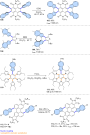
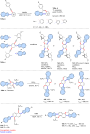
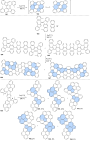
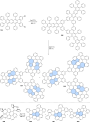
Recent advances and future challenges in the bottom-up synthesis of azulene-embedded nanographenes
Beilstein J. Org. Chem. 2025, 21, 1272–1305, doi:10.3762/bjoc.21.99
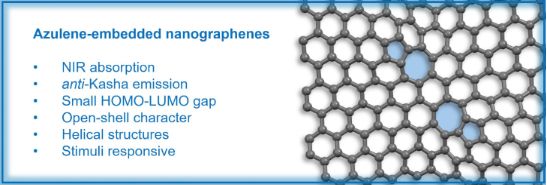
- molecular orbital (HOMO) and lowest unoccupied molecular orbital (LUMO) [19]. This distinctive behaviour gives rise to intriguing optoelectronic properties, making azulene an attractive candidate for practical applications. For example, graphene nanoribbons with azulene defects are promising materials for






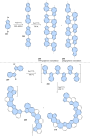
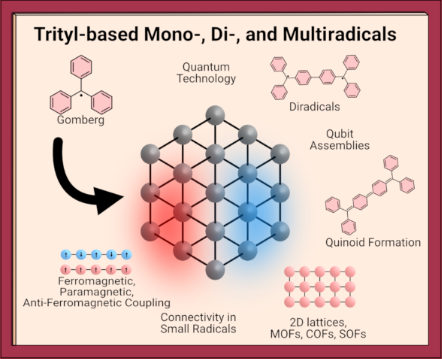
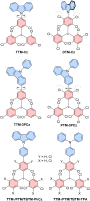
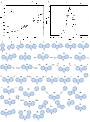
On the photoluminescence in triarylmethyl-centered mono-, di-, and multiradicals
Beilstein J. Org. Chem. 2025, 21, 964–998, doi:10.3762/bjoc.21.80





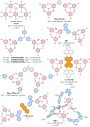


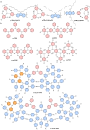
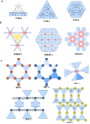


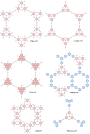
Synthesis and characterizations of highly luminescent 5-isopropoxybenzo[rst]pentaphene
Beilstein J. Org. Chem. 2025, 21, 270–276, doi:10.3762/bjoc.21.19
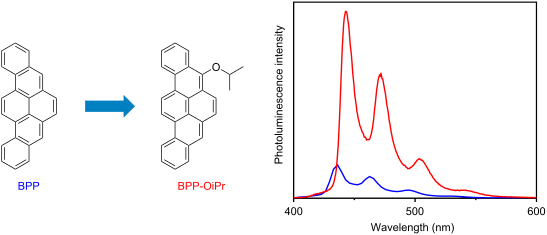
- optimized by density functional theory (DFT) calculations (Figure S2 in Supporting Information File 1). The optoelectronic properties of BPP-OiPr 3 and BPP-dione 4 were initially investigated by UV–vis absorption spectroscopy in comparison with BPP 2 (Figure 2a). BPP 2 and BPP-OiPr 3 displayed similar and




Synthesis, characterization, and photophysical properties of novel 9‑phenyl-9-phosphafluorene oxide derivatives
Beilstein J. Org. Chem. 2024, 20, 3299–3305, doi:10.3762/bjoc.20.274
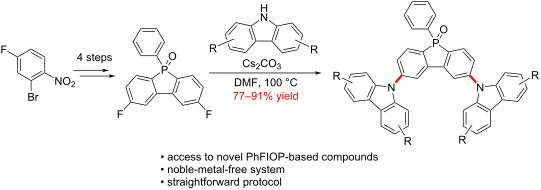
- ]. Compared to the traditional PO-containing moieties, PhFlOP possesses an enhanced rigid structure to reduce the possibility of nonradiative decay processes, which would improve optoelectronic properties [17][27]. Thermally activated delayed fluorescence (TADF) materials and devices have emerged rapidly in




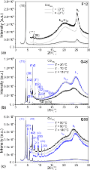
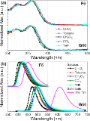
Efficient synthesis of fluorinated triphenylenes with enhanced arene–perfluoroarene interactions in columnar mesophases
Beilstein J. Org. Chem. 2024, 20, 3263–3273, doi:10.3762/bjoc.20.270
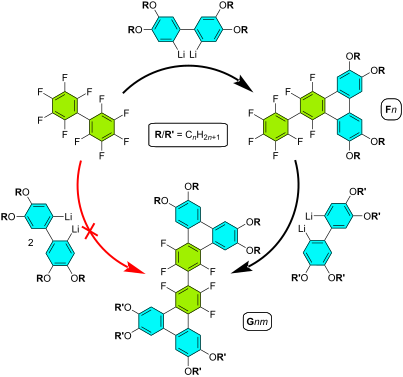
- fluorine atoms, inserted in the aromatic rings, which considerably modifies the dipole moment of the corresponding fluorinated aromatic rings with respect to their hydrogenated homologs, thus influencing their behavior, binding affinities, and optoelectronic properties. These interactions already represent



A new platform for the synthesis of diketopyrrolopyrrole derivatives via nucleophilic aromatic substitution reactions
Beilstein J. Org. Chem. 2024, 20, 1933–1939, doi:10.3762/bjoc.20.169
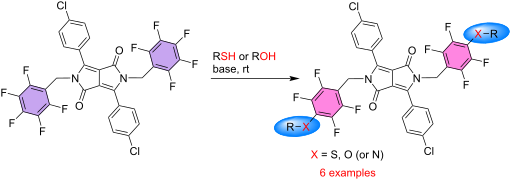
- Vitor A. S. Almodovar Augusto C. Tome LAQV-REQUIMTE, Department of Chemistry, University of Aveiro, 3810-193 Aveiro, Portugal 10.3762/bjoc.20.169 Abstract Diketopyrrolopyrroles (DPPs) are a versatile group of dyes and pigments with valuable optoelectronic properties. In this work we report the


Hetero-polycyclic aromatic systems: A data-driven investigation of structure–property relationships
Beilstein J. Org. Chem. 2024, 20, 1817–1830, doi:10.3762/bjoc.20.160
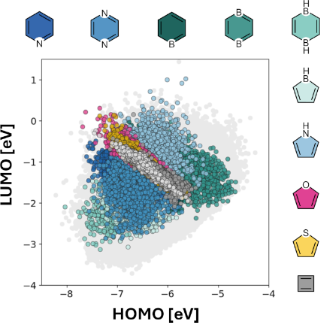
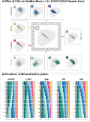
- heteroatoms boron, nitrogen, oxygen, and sulfur and ranging in size from four-membered to six-membered rings. Compared to the parent polycyclic aromatic hydrocarbons (PAHs), PASs containing heterocycles offer greater structural diversity as well as a much broader range of optoelectronic properties. Such



Structure–property relationships in dicyanopyrazinoquinoxalines and their hydrogen-bonding-capable dihydropyrazinoquinoxalinedione derivatives
Beilstein J. Org. Chem. 2024, 20, 1037–1052, doi:10.3762/bjoc.20.92
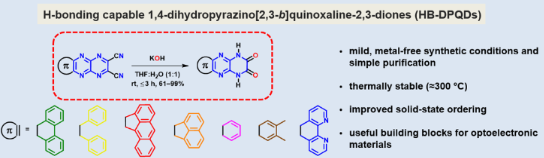
- molecules; N-heteroacenes; hydrogen bonding; optoelectronic properties; organic field-effect transistors; organic semiconductors; Introduction The role of weak intermolecular interactions in tuning the properties of organic semiconductors has garnered significant attention in the past two decades, owing to
- their profound implications on device performance [1]. Among these interactions, hydrogen bonding (H-bonding, HB) as a highly directional noncovalent interaction can influence the structural, electronic, and optoelectronic properties of bulk materials [2][3]. Hydrogen bonding plays a crucial role in
- phase within these systems [24]. These molecules are particularly intriguing as they bear resemblance to Głowacki’s compounds discussed above. Reported here is a robust structure–property relationship study of these types of molecules with a particular interest in their optoelectronic properties




Perspectives on push–pull chromophores derived from click-type [2 + 2] cycloaddition–retroelectrocyclization reactions of electron-rich alkynes and electron-deficient alkenes
Beilstein J. Org. Chem. 2024, 20, 125–154, doi:10.3762/bjoc.20.13
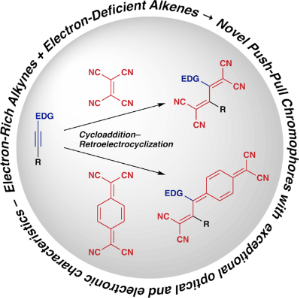
- of click-type [2 + 2] cycloaddition (CA)–retroelectrocyclization (RE) reactions, offering means for preparing these coveted push–pull chromophores [7]. A review conducted in 2023 comprehensively explored the optoelectronic properties of TCBDs along with their photovoltaic applications [8]. The


Biphenylene-containing polycyclic conjugated compounds
Beilstein J. Org. Chem. 2023, 19, 1895–1911, doi:10.3762/bjoc.19.141
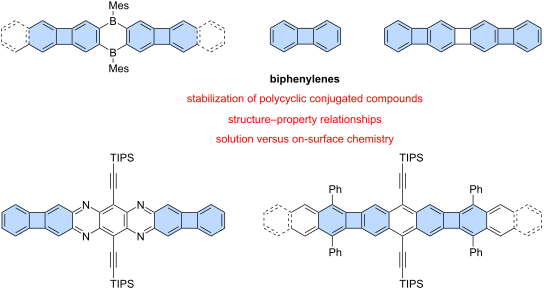
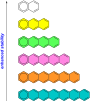
- for use in cutting-edge technologies. In particular, acenes, a subgroup of polycyclic aromatic compounds, are sought-after synthetic targets due to their remarkable optoelectronic properties which stem from their π-conjugation and planar structure. Despite all these promising characteristics, acenes
- antiaromatic four-membered ring. This review gives a brief overview of the methods used in the synthesis of biphenylenes and summarizes the recent studies on biphenylene-containing polycyclic conjugated compounds, elucidating their synthesis, and distinct optoelectronic properties. Keywords: acenes
- establish an alternative synthetic approach to the existing methods for biphenylene synthesis described in the literature, rather than focusing on the optoelectronic properties of the resulting compounds. Small quantities of the key starting material benzocyclobutene-1,2-dione (BBD, 13) were obtained



Quinoxaline derivatives as attractive electron-transporting materials
Beilstein J. Org. Chem. 2023, 19, 1694–1712, doi:10.3762/bjoc.19.124
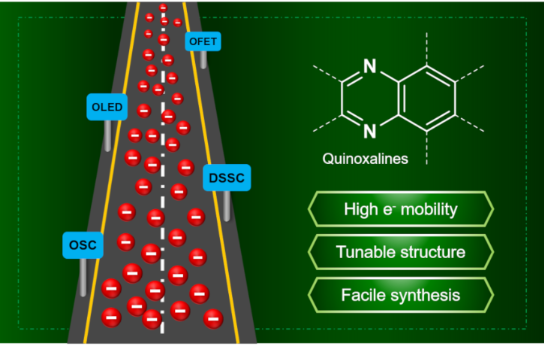
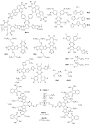
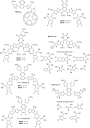
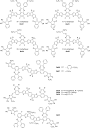
- chemistry offers a cost-effective and time-efficient means of screening and selecting promising candidates for experimental exploration. Bhattacharya et al. employed density functional theory (DFT) approach to explore structural modulation for tuning the optoelectronic properties of Qx13. Their designed
- their optoelectronic properties to highlight the potential of their experimental exploration [33]. The introduction of an electron-withdrawing group has been shown to be a key strategy for enhancing intermolecular interactions and improving the optical absorption, molecular packing, and charge transport
- absorption, improved carrier mobility, and reduced charge recombination of NFAs. Qx21, bearing chlorine atoms on the end groups as opposed to Qx20, showed superior optoelectronic properties and a PCE of 12.32% with PBDB-T as donor in OSC device [34]. The same group explored side-chain engineering and




A deep-red fluorophore based on naphthothiadiazole as emitter with hybridized local and charge transfer and ambipolar transporting properties for electroluminescent devices
Beilstein J. Org. Chem. 2023, 19, 1664–1676, doi:10.3762/bjoc.19.122
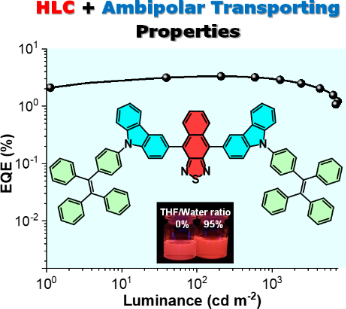
- without lengthy extension of their π-conjugation systems due to a broadening of both the valence and the conduction bands and a consequent narrowing of the energy gap [22][23][24][25]. The D–A characters also offer a tunability of optoelectronic properties such as energy levels, optical bandgap (Eg), and


A series of perylene diimide cathode interlayer materials for green solvent processing in conventional organic photovoltaics
Beilstein J. Org. Chem. 2023, 19, 1620–1629, doi:10.3762/bjoc.19.119
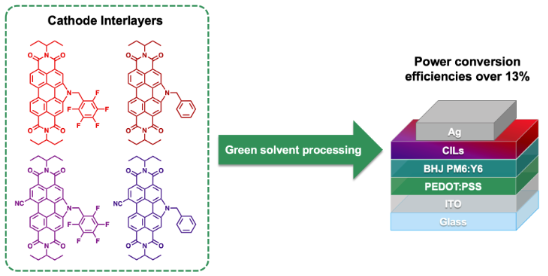
- films using ethyl acetate as the solvent. The optoelectronic properties were assessed for both solution and film, and the electrochemical properties were probed in solution. To validate the potential as electron transporting layers, each film was used in conventional OPVs as the CIL with processing from
- are reported for the design strategy used, their synthesis, optoelectronic properties, electrochemical properties, and processability from ethyl acetate for thin film formation. Lastly, each new CIL material was tested in conventional OPVs by processing with ethyl acetate, a green solvent [20][21][22


Construction of hexabenzocoronene-based chiral nanographenes
Beilstein J. Org. Chem. 2023, 19, 736–751, doi:10.3762/bjoc.19.54
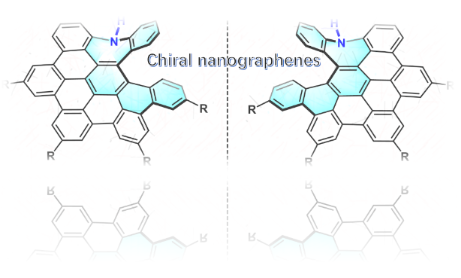
- derivatives have attracted increasing attention due to their specific optoelectronic properties [5][29]. HBC thus generally serves as a reference structure or building block to construct chiral NGs which are currently receiving a lot of interest in carbon-based materials science. This review will mainly focus




Post-synthesis from Lewis acid–base interaction: an alternative way to generate light and harvest triplet excitons
Beilstein J. Org. Chem. 2022, 18, 825–836, doi:10.3762/bjoc.18.83
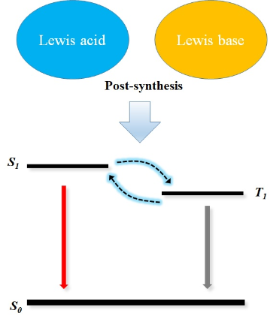
- coordination between Lewis acids and bases, which can finely adjust the optoelectronic properties of the fluorescent molecules, such as band gaps, peak wavelengths, and even frontier molecular orbitals if bound together [20]. The traditional way to manipulate the optoelectronic properties of the emitters
- optoelectronic properties of a fluorene-based copolymer with an sp2 nitrogen heteroatom via supramolecular coordination [33]. The PL emission in solution showed an obvious red-shifted profile. The polymer LED with different molar equivalents of Lewis acids was investigated. The EL peak wavelength was gradually
- with the Lewis acids discussed in this review and thus lead to a significant shift of their optoelectronic properties. It has been confirmed that organic molecules containing pyrimidine, pyrazine, and indole groups display similar interactions upon the addition of Lewis acids [40][41][42]. Lewis acid


Effect of a twin-emitter design strategy on a previously reported thermally activated delayed fluorescence organic light-emitting diode
Beilstein J. Org. Chem. 2021, 17, 2894–2905, doi:10.3762/bjoc.17.197
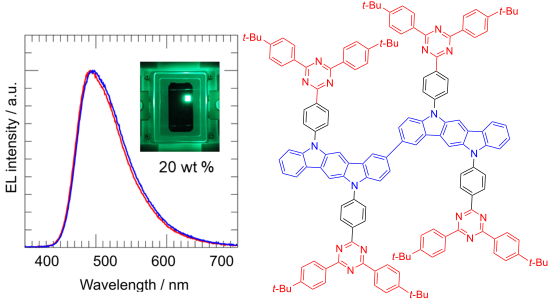
- electroluminescence, with λEL going from 449 nm for CzTRZ to 490 nm for 33TCzTTrz. In this work, we utilized a similar strategy to assess the change in optoelectronic properties and device performance of the compound DICzTRZ (Figure 2) compared to our recently reported ICzTRZ study [14]. We note that the effective
- eV for DICzTRZ vs −1.75 eV for ICzTRZ) since the electronic environment surrounding the t-Bu-triazine remains essentially unperturbed (Figure 3). Optoelectronic properties The electrochemical properties of the two materials were studied in degassed DCM with tetra-n-butylammonium hexafluorophosphate


Synthesis and investigation on optical and electrochemical properties of 2,4-diaryl-9-chloro-5,6,7,8-tetrahydroacridines
Beilstein J. Org. Chem. 2021, 17, 2450–2461, doi:10.3762/bjoc.17.162

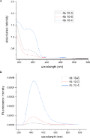
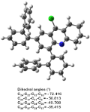
- optoelectronic properties [32][35][36][37]. Acridines, as aza-analogues of anthracene have obtained much attention in the field of organic light emitting diodes [38][39][40][41]. While considerable attention has been devoted to the photophysical properties of acridines, not much work has been reported related to
- their optoelectronic properties, the search for new candidates is of ongoing interest. Recently, considerable attention has been given to acridines in our laboratory and we developed new synthetic methods for dibenzoacridines and acridones based on Pd-catalyzed cross-coupling reactions [55][56]. More






Recent advances in the application of isoindigo derivatives in materials chemistry
Beilstein J. Org. Chem. 2021, 17, 1533–1564, doi:10.3762/bjoc.17.111
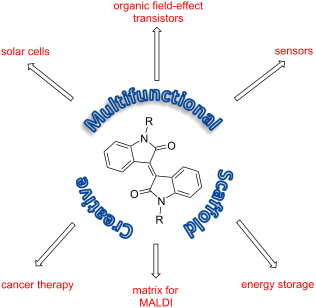
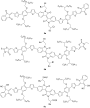
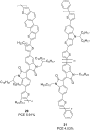
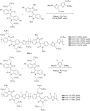
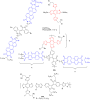
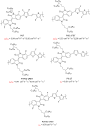
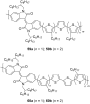
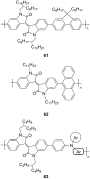
- possibility of varying optoelectronic properties, and good solubility in a wide range of solvents [59][60][61]. In this regard, the most studied and promising are π-conjugated polymer structures based on sulfur, oxygen, nitrogen, and selenium heterocyclic compounds [62][63]. One of the systems for creating














Design, synthesis and photophysical properties of novel star-shaped truxene-based heterocycles utilizing ring-closing metathesis, Clauson–Kaas, Van Leusen and Ullmann-type reactions as key tools
Beilstein J. Org. Chem. 2021, 17, 1374–1384, doi:10.3762/bjoc.17.96
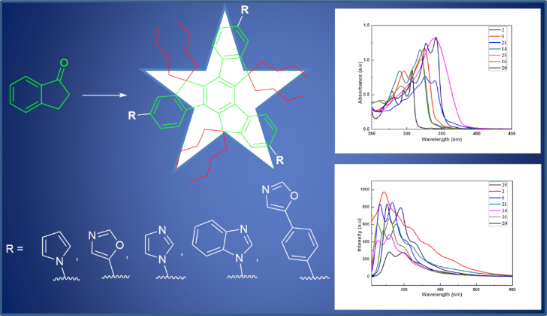
- interdisciplinary interest from both fundamental as well as applied viewpoint on account of their wonderful optoelectronic properties. The scientific interest in two-dimensional star-shaped PAHs particularly in truxene architectures arises because of their high thermal stability, exceptional solubility and ease


Exploring the possibility of using fluorine-involved non-conjugated electron-withdrawing groups for thermally activated delayed fluorescence emitters by TD-DFT calculation
Beilstein J. Org. Chem. 2021, 17, 210–223, doi:10.3762/bjoc.17.21
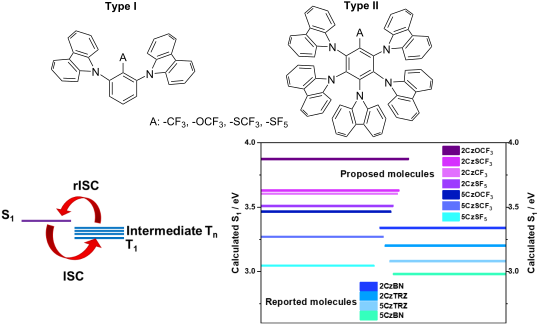
- explore their potential computationally within TADF emitter design. We cross-compare their optoelectronic properties with analog materials using well-studied conjugated electron-withdrawing groups (cyano, benzophenone, and triazine). We investigated two families of structures. The first family consists of


Synthesis, crystal structures and properties of carbazole-based [6]helicenes fused with an azine ring
Beilstein J. Org. Chem. 2021, 17, 11–21, doi:10.3762/bjoc.17.2
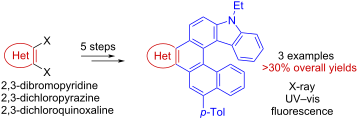
- polycyclic π-systems additionally contributes to altering electronic structure and helps to fine tune optoelectronic properties [1][2][3][4][5][6][7][8][9][10][11][20][35][36][37]. The last decades highlighted heterohelicenes, incorporating one or two carbazole fragments, as a very attractive class of