Search results
Search for "transition states" in Full Text gives 224 result(s) in Beilstein Journal of Organic Chemistry. Showing first 200.
Recent advances in copper-catalyzed direct hydroamination of alkenes with (hetero)aromatic amines
Beilstein J. Org. Chem. 2026, 22, 925–947, doi:10.3762/bjoc.22.73
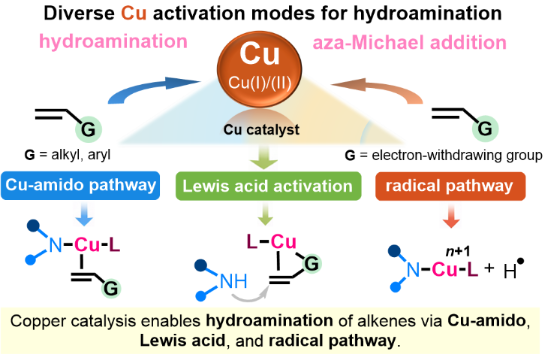
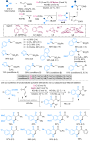
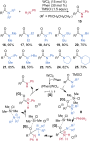
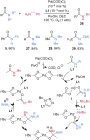
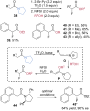
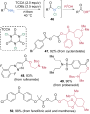
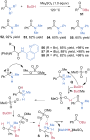
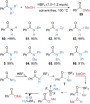
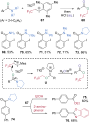
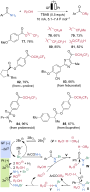
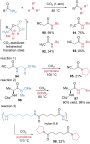
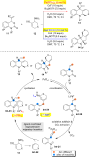
- that this key step could occur through either four- or six-membered cyclic transition states (III-a vs III-b), depending on the nature of the electron-withdrawing group on the olefin. Finally, proton transfer from the amine substrate released the hydroamination product and regenerated the active Cu







Rongalite addition to dienones: diastereoselectivity in cyclic sulfone synthesis; stereochemical rationalization and prospects as a general conjugate nucleophile
Beilstein J. Org. Chem. 2026, 22, 742–752, doi:10.3762/bjoc.22.56

- to resolve a stereochemical ambiguity, the modelling of transition states to explain the diastereoselectivity of the one-pot reaction, a full exploration of its scope and limitations and further mechanistic and competition experiments that place the nucleophilicity of Rongalite in context by
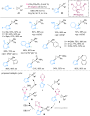
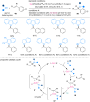
- work, by which we were able to locate transition states for reactions to give trans-12a and the unobserved cis-12b (Figure 4). The activation energy difference to reach TS-12a, leading to 12a and TS-12b, leading to 12b was found to be a significant 4.7 kcal/mol in favor of TS-12a (see Supporting
- , within the expected accuracy of the calculations (see also Supporting Information File 1) [30]. Similar transition states have been invoked for other cyclizations leading to 6-membered rings [31][32][33], but this is the first time that they have been computationally modeled for a sulfur nucleophile in a




Computational prediction of C–H hydricities and their use in predicting the regioselectivity of electron-rich C–H functionalisation reactions
Beilstein J. Org. Chem. 2026, 22, 603–610, doi:10.3762/bjoc.22.46
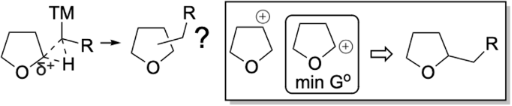
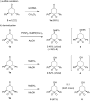
- ). Many of these transformations are not formal hydride transfers; however, they commonly involve buildup of positive charge (e.g., via metal–carbene/nitrene insertion transition states, radical cations, or polar hydrogen atom transfer). Hydricity could therefore serve here as an empirical reactivity


![[Graphic 6]](/bjoc/content/inline/1860-5397-22-46-i8.svg?max-width=637&scale=1.18182)


Experimental and DFT studies on the regioselective methanolysis of 5-azido-9-oxabicyclo[6.1.0]nonan-4-yl 4-nitrobenzoate isomers
Beilstein J. Org. Chem. 2026, 22, 547–556, doi:10.3762/bjoc.22.40
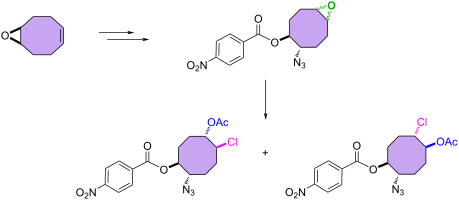
- (τ, °) in the optimized transition states. Supporting Information Supporting Information File 14: Experimental, 1H and 13C NMR spectra for all new compounds, as well as selected 2D NMR spectra and crystallographic data for compound 10 are provided. Optimized geometries of the transition states with


Electrosynthetic access to unsymmetrical oxaza[8]helicenes with high chiral stability and strong circularly polarized luminescence (CPL)
Beilstein J. Org. Chem. 2026, 22, 372–382, doi:10.3762/bjoc.22.25
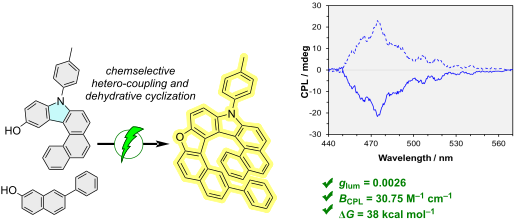
- [8]helicenes 5a and 5b, we performed DFT calculations to locate the transition states with the highest Gibbs free energies. In both cases, the transition states correspond to conformations in which the terminal rings adopt a face-to-face arrangement along the helical axis (Figure 3). The calculated




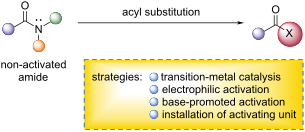
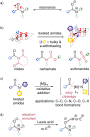
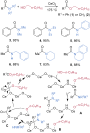
Recent advances in the cleavage of non-activated amides
Beilstein J. Org. Chem. 2026, 22, 352–369, doi:10.3762/bjoc.22.23
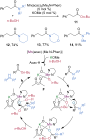
- good to high yields. The authors proposed that a manganese–potassium heterodinuclear alkoxylate complex F, formed from Mn(acac)2(Me2N-Phen), potassium methoxide, and n-butanol, serves as the key catalytic species. The dinuclear complex stabilizes the relevant transition states and intermediates










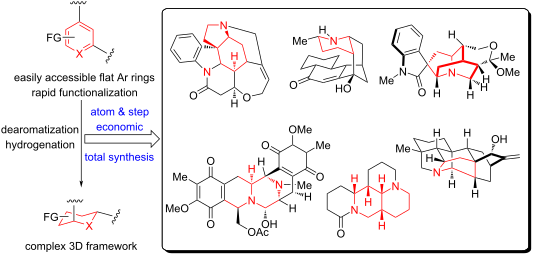
Total synthesis of natural products based on hydrogenation of aromatic rings
Beilstein J. Org. Chem. 2026, 22, 88–122, doi:10.3762/bjoc.22.4
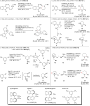
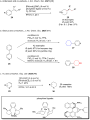
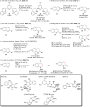
- transition states to give the intramolecular [5 + 2] products 111 and 112, respectively. While the desired cycloadduct 112 was formed as the minor constituent (112/111 = 1:3.6), the isomeric ratio was verified to be the result of thermodynamic selection. The cycloaddition process is reversible under the











Reactivity umpolung of the cycloheptatriene core in hexa(methoxycarbonyl)cycloheptatriene
Beilstein J. Org. Chem. 2026, 22, 64–70, doi:10.3762/bjoc.22.2
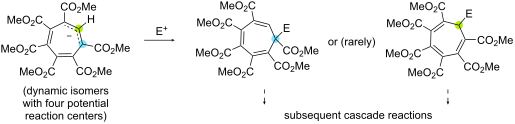
- transition states with an adjacent ester group, not to the stability of the main conformer. Conversely, the reactions with halogens and diazonium salts are immediate at room temperature and the α-selectivity, when observed, can be due to the stability of the main conformer. The transition from iodine to


Sustainable electrochemical synthesis of aliphatic nitro-NNO-azoxy compounds employing ammonium dinitramide and their in vitro evaluation as potential nitric oxide donors and fungicides
Beilstein J. Org. Chem. 2025, 21, 2739–2754, doi:10.3762/bjoc.21.211
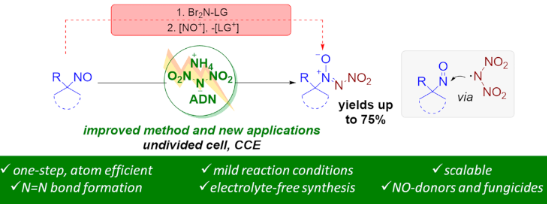
- length constraints were used for the generation of conformer ensembles of transition states in order to avoid optimization to starting reagent(s) or product(s). On the next step, most stable conformers were identified by re-optimization of generated conformers and vibrational analysis on ωB97X-3c [94





Mechanistic insights into hydroxy(tosyloxy)iodobenzene-mediated ditosyloxylation of chalcones: a DFT study
Beilstein J. Org. Chem. 2025, 21, 2703–2715, doi:10.3762/bjoc.21.208
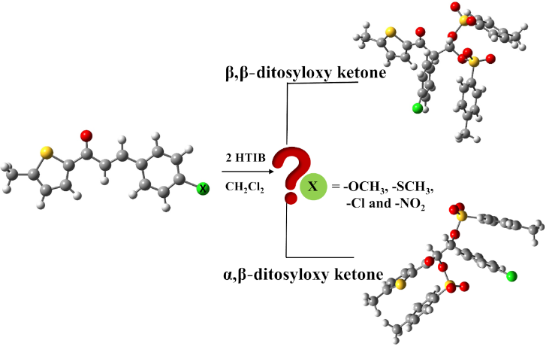
- . The solvent considered for the present study was dichloromethane (CH2Cl2). Frequency calculations were performed for all optimized structures to confirm the stationary point and transition state. Intrinsic reaction coordinate (IRC) calculations were carried out to validate the transition states. The
- corresponding reaction profile for X = -OCH3 has been discussed in our earlier study [34]. Figure 2 and Figure 3 present the free energy reaction profiles for chalcones with X = -Cl and X = -NO2, respectively. Table 1 lists the free energy and potential energy for various intermediates and transition states for
- product). These two pathways are further elaborated below and Table 3 lists the free energies and potential energies for various intermediates and transition states for chalcones with different X = -OCH3, -SCH3, -Cl, -NO2 for the reaction proceeding as per Scheme 4 leading to formation of α,β-ditosyloxy


Synthesis of the tetracyclic skeleton of Aspidosperma alkaloids via PET-initiated cationic radical-derived interrupted [2 + 2]/retro-Mannich reaction
Beilstein J. Org. Chem. 2025, 21, 2470–2478, doi:10.3762/bjoc.21.189
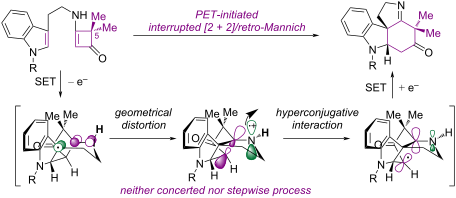
- order [34][35] analyses were performed to determine the hyperconjugative interactions in the intermediates, transition states, and transient structures along the IRC path (Figure 2c and 2d). In the early stage of this process (Figure 2f, IN2 → R-50 → R-24 → TS2), formation of the C19–C3 bond arises from


Pathway economy in cyclization of 1,n-enynes
Beilstein J. Org. Chem. 2025, 21, 2260–2282, doi:10.3762/bjoc.21.173
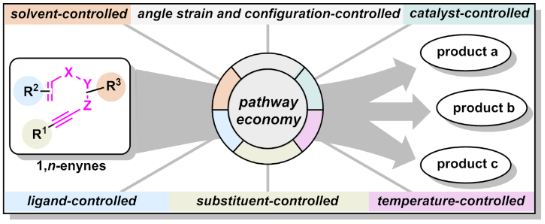
- transition states. This integrated control framework provides a rational basis for designing reaction conditions to optimize selectivity and efficiency in organic synthesis. In 2014, the Liu group developed an Au(I)-catalyzed cascade cyclization strategy for synthesizing polysubstituted naphthalenes using
- cyclization, yielding a six-membered ring product 72 (Scheme 15, path b). This observed selectivity arose from differential stabilization of transition states by ligands, thereby enabling the Au(I)-catalyzed cyclization to directly access bioactive heterocyclic frameworks commonly encountered in natural
- intermediates or transition states with reactants, thereby fundamentally altering the reaction pathway. Therefore, many research groups have made significant contributions to the divergent synthesis of small-molecule frameworks by modulating catalyst types to steer reaction pathways. In 2006, the Echavarren


Preparation of spirocyclic oxindoles by cyclisation of an oxime to a nitrone and dipolar cycloaddition
Beilstein J. Org. Chem. 2025, 21, 1890–1896, doi:10.3762/bjoc.21.146
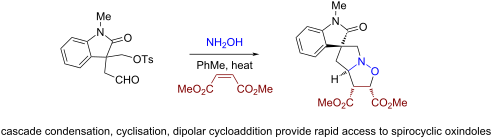
- same stereochemical outcome predominates. There are two possible exo transition states, both of which avoid steric (and electronic clash) of the dipolarophile carbonyls with the oxindole. Of these, the preference appears to be for the dipolarophile carbonyl groups, in this case for dimethyl maleate, to


Photoswitches beyond azobenzene: a beginner’s guide
Beilstein J. Org. Chem. 2025, 21, 1808–1853, doi:10.3762/bjoc.21.143
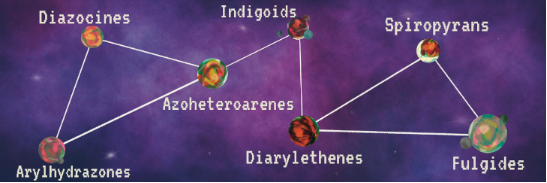
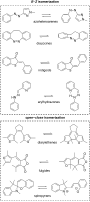
- ) single bond N–N. The hydrazone pathway in protic solvents could be ruled out in cases when the energy of the s-cis-hydrazone was superior to the energy of the other two transition states. For further substituent effects on azoheteroarenes, we refer the readers to the following reports by Venkataramani






Synthesis of chiral cyclohexane-linked bisimidazolines
Beilstein J. Org. Chem. 2025, 21, 1786–1790, doi:10.3762/bjoc.21.140
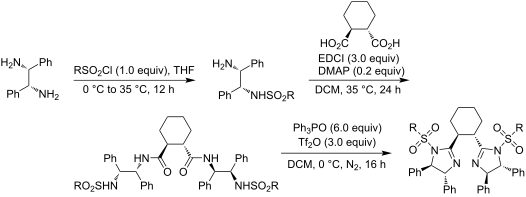
- bisoxazoline ligands, such as anthracene-1,8-linked bisoxazolines (AnBOX) [18][19][20] showed excellent enantioselectivities for certain substrates due to their ability to fix transition states in asymmetric reactions, realizing excellent stereoselectivities. However, they also presented some limitations to
- the substrate scope due to their complete rigidity. Cyclohexane-1,2-linked bisoxazolines (cHBOX) are a class of bisoxazoline ligands with the more flexible cyclohexane as linker [21][22]. Chiral cyclohexane-1,2-linked bisoxazolines fix transition states in catalytic asymmetric reactions, in whch the
- transition states can be regulated depending upon the structures of substrates, achieving excellent stereoselectivities among various substrates in the catalytic asymmetric aziridination of α,β-unsaturated ketones [21]. The steric effect of cHBOX ligands can be changed easily by the use of different chiral


Influence of the cation in hypophosphite-mediated catalyst-free reductive amination
Beilstein J. Org. Chem. 2025, 21, 1661–1670, doi:10.3762/bjoc.21.130

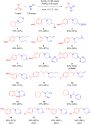
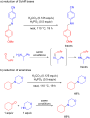
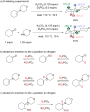
- ), K2CO3 (0.181 mmol, 0.125 equiv), H3PO2 (0.725 mmol, 0.5 equiv.), neat, 110 °C. Yield was determined by NMR, isolated yield in parentheses. a48 h. Reaction profile and DFT energies of intermediates and transition states. M062X functional with the basis set 6-311+G(d,p) on the model reaction between


Transition-state aromaticity and its relationship with reactivity in pericyclic reactions
Beilstein J. Org. Chem. 2025, 21, 1613–1626, doi:10.3762/bjoc.21.125

- aromatic character in their transition states, this increased aromaticity does not necessarily correlate with lower activation barriers. State-of-the-art computational methods on reactivity, such as the combined activation strain model (ASM)–energy decomposition analysis (EDA) method, reveal that factors
- been introduced [7][8][9][10][11]. The concept of aromaticity was also extended to the transition states (TSs) of concerted pericyclic reactions as early as 1938 when Evans and Warhurst [12] recognized the relationship between the six π-electrons of benzene and the six delocalized electrons in the
- rules [15]. In this regard, it has been suggested that thermally allowed pericyclic reactions take place preferentially through concerted aromatic transition states, which are favored energetically and therefore display faster rates (i.e., lower barriers) [16][17]. This is in line with the seminal


pH-Controlled isomerization kinetics of ortho-disubstituted benzamidines: E/Z isomerism and axial chirality
Beilstein J. Org. Chem. 2025, 21, 1568–1576, doi:10.3762/bjoc.21.120
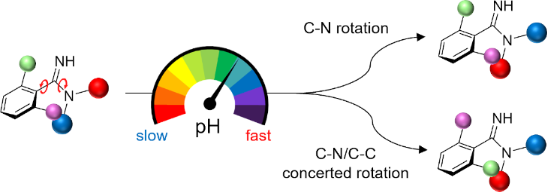
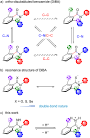
- hypothesis that the rotational barrier of the benzamidine changes upon protonation, density functional theory (DFT) calculations were performed for the C–N and C–N/C–C rotations of the molecular form and of the protonated 2-bromo-N,N,6-trimethylbenzimidamide as a model compound (Figure 2). Several transition
- states (TSs) were found depending on the configuration of the amidine N–H and the rotational direction. The C–N bond rotation of the molecular form of amidine was calculated to be 68 kJ·mol−1 for Z-amidine and 71 kJ·mol−1 for E-amidine. Protonation of the amidine moiety drastically increases the



Tautomerism and switching in 7-hydroxy-8-(azophenyl)quinoline and similar compounds
Beilstein J. Org. Chem. 2025, 21, 1404–1421, doi:10.3762/bjoc.21.105
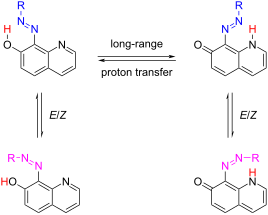
- surrounding transition states are approximately the same, which excludes changes in the stabilization going from toluene to acetonitrile. The results indicate that the excitation of KE leads preferably to return to the ground state via CI in the N=N bond isomerization region and, in a very limited extent, to
- solvation was described using the polarizable continuum model [94] (the integral equation formalism variant, IEFPCM, as implemented in Gaussian 16). The transition states were estimated using the STQN method [95] and again verified by performing frequency calculations in the corresponding environment. The
- characteristics of the ground-state tautomers of the studied compounds as well as relative energies of the transition states between them in toluene and in acetonitrile (in parentheses). Relative stability of the tautomers of compound 1 in toluene as a function of the substituents in Ph ring. Relative stability




Enhancing chemical synthesis planning: automated quantum mechanics-based regioselectivity prediction for C–H activation with directing groups
Beilstein J. Org. Chem. 2025, 21, 1171–1182, doi:10.3762/bjoc.21.94
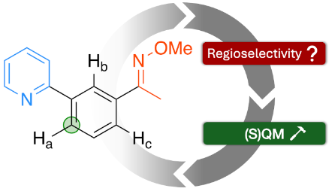
- . The wrong prediction here might indicate that the BEP relationship does not hold in this case and one would need to calculate the activation energy of the actual transition states. Molecule 3 from Jiang et al. [28] is another intramolecular cyclization reaction which was not labelled as such. For such


A multicomponent reaction-initiated synthesis of imidazopyridine-fused isoquinolinones
Beilstein J. Org. Chem. 2025, 21, 1161–1169, doi:10.3762/bjoc.21.92
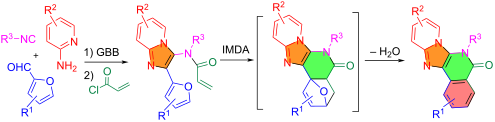
- thiophene to reduce the diene's reactivity or altering the electrophilicity of the dienophile. Based on the computational analysis of the transition states, reaction mechanisms for the IMDA and the dehydration re-aromatization process are proposed in Scheme 5. In the IMDA reaction for the preparation of




Recent advances in controllable/divergent synthesis
Beilstein J. Org. Chem. 2025, 21, 890–914, doi:10.3762/bjoc.21.73
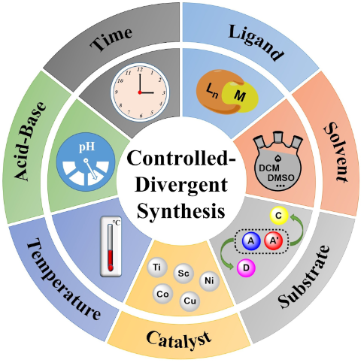
- profound influence through multifaceted solute–solvent interactions [5]. Solvent polarity, hydrogen-bonding propensity, and dielectric characteristics collectively orchestrate stereodivergent pathways through dynamic coordination effects and differential stabilization of transition states. Notably, these







Substituent effects in N-acetylated phenylazopyrazole photoswitches
Beilstein J. Org. Chem. 2025, 21, 830–838, doi:10.3762/bjoc.21.66
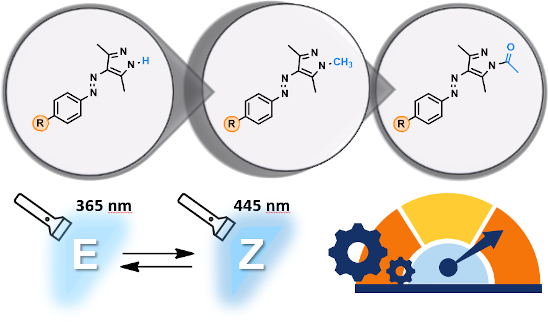
- dependency on the nature of the substituent. The observed trend behavior indicates an apparent change of mechanism for thermal relaxation to the E isomer. This was previously observed for NH-PAPs [32] N-PEG-PAPs [20], and for azopyrazolium salts [33]. To obtain a deeper understanding of the transition states
- in toluene to access higher temperatures (Table 6 and Supporting Information File 1, section 3.7). The Eyring plot for NAc-PAP-CN and NAc-PAP-OMe are depicted in Figure 4. Counterintuitively, the calculated thermodynamic data of the transition states show, within the error margin, similar values of


Recent advances in allylation of chiral secondary alkylcopper species
Beilstein J. Org. Chem. 2025, 21, 639–658, doi:10.3762/bjoc.21.51
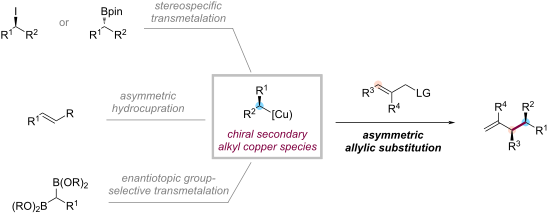
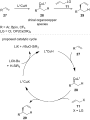
- transfer, X-ray crystallographic analysis of the (tert-butyl)(adamantyl)Bpin·Li(THF)2 complex revealed that the B–(adamantyl) bond is shorter than the B–(tert-butyl) bond (1.673 vs 1.692 Å). DFT calculations further illuminated the underlying mechanism by comparing two distinct transition states: TS1
- involving adamantyl transfer and TS2 involving tert-butyl transfer (Scheme 9). Analysis of these transition states revealed that both require significant pyramidalization of the transferring carbon center, with the barrier for adamantyl transfer (TS1) being 2.3 kcal/mol higher than that for tert-butyl
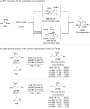
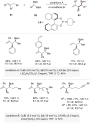
- the competing transition states showed that the chiral α-borylalkylcopper species 37 could approach the olefinic moiety of allylic electrophile 35 from either the re- or si-face. The re-face approach is energetically favored, minimizing steric interactions between the bulky aryl substituent of NHC





Beyond symmetric self-assembly and effective molarity: unlocking functional enzyme mimics with robust organic cages
Beilstein J. Org. Chem. 2025, 21, 421–443, doi:10.3762/bjoc.21.30
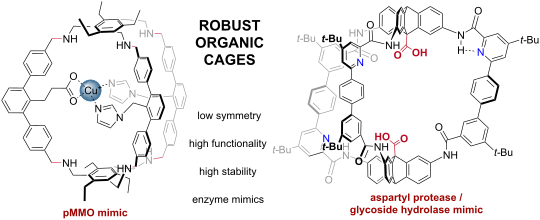
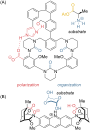
- catalysis has fared best using approaches such as destabilizing ground states by constrictive binding, guiding molecular collisions to reduce large entropic costs (e.g., pericyclic reactions), and broad, undirected coulombic stabilization of charged transition states [36], for example of cations by
- electrophile [175]. In terms of polarization, since cages are invariably charged [36], a few MOCs have demonstrated charge stabilization of transition states (Figure 5B). A key example uses the highly successful Raymond gallium-based cages, exploited by Raymond, Bergman and Toste [21][37][107][155][165][168
- preorganization to catalyze new reactions, better stabilize transition states, or provide new selectivities. The study of discrete, soluble cavities in solution before translation to lattice analogues might prove a fruitful avenue. Covalent organic cages Covalent organic cages [235] are any discrete assembly, at