Search results
Search for "X-ray" in Full Text gives 1345 result(s) in Beilstein Journal of Organic Chemistry. Showing first 200.
4,6-Diaryl-5,5-difluoro-1,3-dioxanes as chiral dopants for liquid crystal compositions
Beilstein J. Org. Chem. 2024, 20, 2940–2945, doi:10.3762/bjoc.20.246
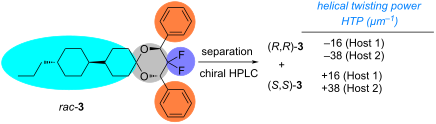
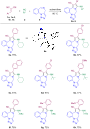
- enantiomers (R,R)-3/(S,S)-3, (R,R)-4/(S,S)-4 were obtained by slow evaporation from n-heptane solution and structures were determined by X-ray diffraction, which allowed the correlation of the chiroptical properties with the configuration (Figure 2 and Figure 3). The HTP of all enantiomers were measured with
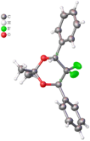
- polar mixture Host 2 it is twice as high as for less polar Host 1. Selected examples of chiral dopants with high HTPs in their nematic host LC mixture. Configuration of (R,R)-3 determined by X-ray crystallography. Configuration of (R,R)-4 determined by X-ray crystallography. Structure–property


Structure and thermal stability of phosphorus-iodonium ylids
Beilstein J. Org. Chem. 2024, 20, 2931–2939, doi:10.3762/bjoc.20.245
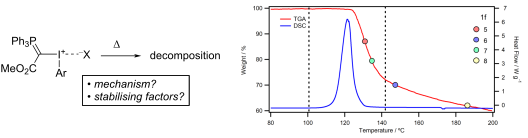
- functionalities they can transfer. In this study, a fundamental understanding of the thermal stability of phosphorus-iodonium ylids is obtained through X-ray diffraction, differential scanning calorimetry (DSC) and thermogravimetric analysis (TGA). Insights into the structural factors affecting thermal stability
- ][26][27] and the mechanisms by which they decompose when heated through a systematic investigation of structural data from X-ray diffraction (XRD) and thermal stability data from differential scanning calorimetry (DSC) and thermogravimetric analysis (TGA). The insights from this study will galvanise
- the rational design and synthesis of novel, unstabilised hypervalent iodine(III) compounds and expand the application of these powerful reagents in organic synthesis. Results and Discussion Structural data Twelve phosphorus-iodonium ylids were synthesised (Figure 2). X-ray diffraction data (XRD) of


The charge transport properties of dicyanomethylene-functionalised violanthrone derivatives
Beilstein J. Org. Chem. 2024, 20, 2921–2930, doi:10.3762/bjoc.20.244
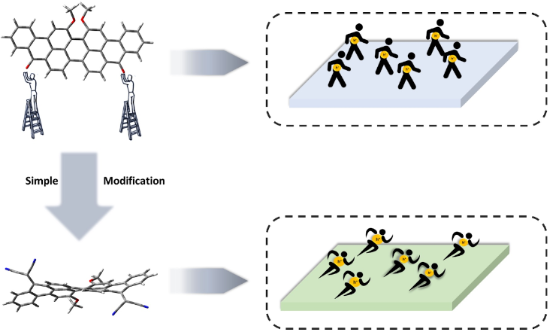
- single-crystal X-ray analysis were obtained by slow evaporation of a dichloromethane/isopropanol solution of 3b. The crystal structure of 3b, displayed in Figure 4, shows a very similar twisted conformation of the core of the molecule to that of the related methoxy-substituted structure obtained from
- otherwise. The absence of transition states was confirmed by the absence of imaginary frequencies in vibrational frequency calculations. The long side chains were replaced by methyl units to aid the convergence of the geometry optimisations. Crystallography Single crystal X-ray diffraction data for 3b were


Recent advances in transition-metal-free arylation reactions involving hypervalent iodine salts
Beilstein J. Org. Chem. 2024, 20, 2891–2920, doi:10.3762/bjoc.20.243

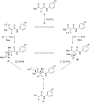
- aryl groups attached to an iodine atom and an associated "anion". X-ray studies revealed that these iodine(III) compounds typically have a T-type structure 1 (Figure 1). In solution, they dissociate into Ar2I+ and X− counterions 2, with the degree of dissociation influenced by the solvent and the




Synthesis of pyrrole-fused dibenzoxazepine/dibenzothiazepine/triazolobenzodiazepine derivatives via isocyanide-based multicomponent reactions
Beilstein J. Org. Chem. 2024, 20, 2870–2882, doi:10.3762/bjoc.20.241
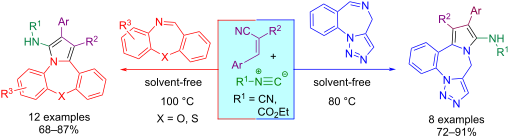
- studied by X-ray diffraction analysis, and the crystal structure is illustrated in Figure 2 (detailed information can be found in the Supporting Information File 1). The 1H NMR spectrum of product 6f obtained through the I-MCR was investigated and some unexpected chemical shifts were observed at room
- analysis, mass spectrum, and IR are consistent with the structure (for details see Supporting Information File 1). Finally, a single crystal X-ray analysis of compound 6a was performed, confirming the structure (Figure 4). The proposed mechanism for an isocyanide-based multicomponent domino reaction for





C–C Coupling in sterically demanding porphyrin environments
Beilstein J. Org. Chem. 2024, 20, 2784–2798, doi:10.3762/bjoc.20.234
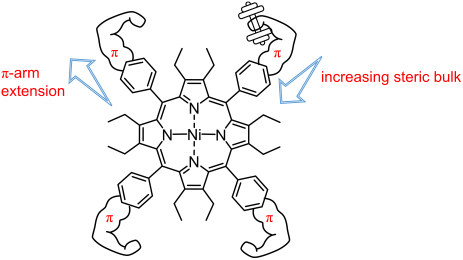
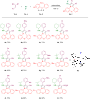
- , borylation of a dodecasubstituted porphyrin’s meso-phenyl position was explored and a subsequent C–C coupling showed the polarity of the reaction can be reversed resulting in higher yields. X-ray analysis of the target compounds revealed the formation of supramolecular assemblies, capable of accommodating
- reactivity, where not previously possible. X-ray crystal structure analysis Despite the many examples in literature of the crystal structure and packing of nonplanar porphyrins [3][6][8][13][52][53], few examples of crystal structure and packing analysis exist for arm-extended porphyrins. One of the few
- porphyrins appended with boronic ester groups to be structurally disseminated by X-ray crystallography [62][63]. Compound 46 was found to crystallize in a 1:1 ratio with bis(pinacolato)diboron, with a void size of 8–9 Å. The formation of channel-type lattice structures is thermodynamically unfavorable, when


Access to optically active tetrafluoroethylenated amines based on [1,3]-proton shift reaction
Beilstein J. Org. Chem. 2024, 20, 2776–2783, doi:10.3762/bjoc.20.233
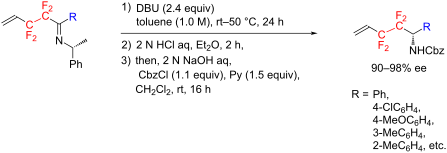
- transition state is not stabilized, leading to the increase of the activation energy of the reaction. As a result, the reaction does not proceed smoothly. The absolute configurations of product (S)-23c, (S)-23d, and (S)-23e were determined on the basis of their X-ray crystallographic analyses. The validity



Copper-catalyzed yne-allylic substitutions: concept and recent developments
Beilstein J. Org. Chem. 2024, 20, 2739–2775, doi:10.3762/bjoc.20.232
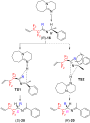
- stereocenter of the product is controlled by the catalyst. A single crystal of Cu(I) was investigated by X-ray and proved to be the dicopper complex, while the Cu(II) catalyst was revealed as mononuclear copper coordinated with two ligands. Further kinetic isotope experiments and nonlinear relationship studies
- radical-involved mechanism. In addition, a positive nonlinear relationship between the product and ligand indicated that the dinuclear copper is the active catalyst, which was also proved by single crystal X-ray analysis. However, kinetic experiments showed the reaction is first-order on copper, implying











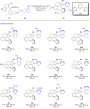


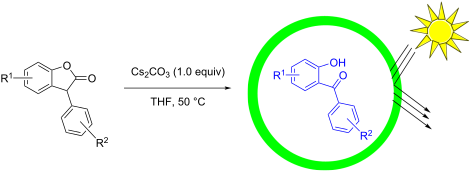
Transition-metal-free decarbonylation–oxidation of 3-arylbenzofuran-2(3H)-ones: access to 2-hydroxybenzophenones
Beilstein J. Org. Chem. 2024, 20, 2655–2667, doi:10.3762/bjoc.20.223
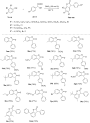
- over anhydrous Na2SO4. FTIR spectra were recorded as films with a Bruker Tensor II spectrophotometer. The 1H and 13C NMR spectra were recorded with a Varian 500 MHz NMR spectrometer, and were processed using Bruker TOPSPIN software. Melting points (mp) were measured on a Büchi B-540 apparatus. X-ray
- data were collected either on an Agilent Supernova system equipped with a microfocus Cu source (λ = 1.54184 Å) and a titan CCD detector, or on a XtaLAB Synergy, Dualflex, HyPix four-circle diffractometer with a micro-focus sealed X-ray tube using a mirror as monochromator and a HyPix detector. The
- -crystal XRD The data were collected using a similar method as reported by us earlier [23], using a XtaLAB Synergy, Dualflex, HyPix four-circle diffractometer, a micro-focus sealed X-ray tube and a HyPix detector. The data were corrected using SCALE3 ABSPACK and the structure were solved using SHELXT




Applications of microscopy and small angle scattering techniques for the characterisation of supramolecular gels
Beilstein J. Org. Chem. 2024, 20, 2608–2634, doi:10.3762/bjoc.20.220
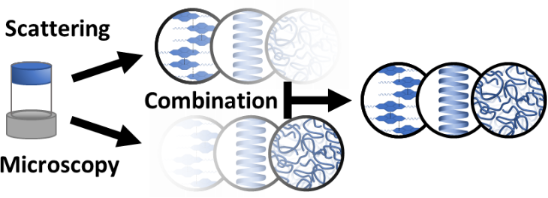
- increases, and techniques develop at a rapid pace [10][11][52][53]. SAS techniques include small angle X-ray scattering (SAXS), small angle neutron scattering (SANS), and their wide angle (WAXS) and ultra-small angle (USAXS and USANS, respectively) analogues have various advantages and drawbacks compared to
- solvents [60]. This is so that the solvent can be suitably removed from the scattering pattern and a model then be used to fit only the material of interest. For X-ray scattering, most solvents have a suitable difference in SLD and so can be used, but should be checked. However, in neutron scattering the
- , cells that allow for the coupling of SAS with non-X-ray techniques continue to be developed; these include spectroscopy, rheology, and electrochemistry [62][63][64]. Ascribing changes in properties of interest directly to changes in the structure further elucidates the interesting properties of self


Base-promoted cascade recyclization of allomaltol derivatives containing an amide fragment into substituted 3-(1-hydroxyethylidene)tetronic acids
Beilstein J. Org. Chem. 2024, 20, 2585–2591, doi:10.3762/bjoc.20.217
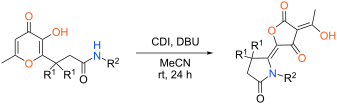
- purification. The synthetic utility of the prepared tetronic acids was demonstrated by further transformations at the hydroxyethylidene fragment. The structures of one obtained tetronic acid and one product of derivatization were confirmed by X-ray analysis. Keywords: allomaltol; base-promoted recyclization
- fragment in the region δ = 2.5–2.4 ppm and methylene unit at δ = 2.7–2.5 ppm. The remaining signals are also in good agreement with the presented structure. Besides that, compound 4 has been analyzed using X-ray diffraction (Figure 1). It is important to emphasize that based on X-ray data the structure of
- refluxing EtOH allowed us to obtain substituted enehydrazine 7 (Scheme 5a). The similar condensation with amine 8 led to enamine derivative 9 (Scheme 5b). Based on the data of X-ray analysis compound 7 has the same configuration of double and hydrogen bonds as in the case of starting tetronic acids 4


Anion-dependent ion-pairing assemblies of triazatriangulenium cation that interferes with stacking structures
Beilstein J. Org. Chem. 2024, 20, 2567–2576, doi:10.3762/bjoc.20.215
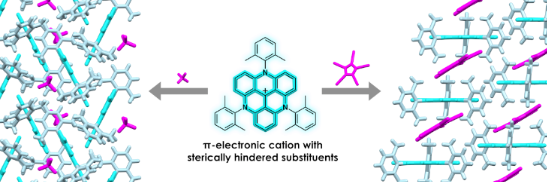
- synthesized to investigate the interactions for the bulky cation. Single-crystal X-ray analysis of the TATA+ ion pairs revealed solid-state ion-pairing assemblies without stacking at the cationic π-planes. The TATA+ cation showed counteranion-dependent assembly structures, with smaller counteranions located
- at the top of TATA+ and bulkier counteranions displaced from the TATA+ plane to interact with the surrounding TATA+. Keywords: charged π-electronic systems; ion pairs; single-crystal X-ray analysis; solid-state assemblies; triazatriangulenium cation; Introduction Triangulenium cations [1][2] have
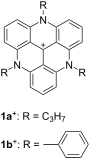
- orthogonal arrangement in comparison with the phenyl moieties in 1b+. Solid-state ion-pairing assemblies of the ion pairs 2+-X− (X− = Cl−, BF4−, PF6−, B(C6F5)4−, and PCCp−) were investigated by X-ray analysis of the orange rod-shaped single crystals, which were obtained by vapour diffusion using CHCl3/n



HFIP as a versatile solvent in resorcin[n]arene synthesis
Beilstein J. Org. Chem. 2024, 20, 2469–2475, doi:10.3762/bjoc.20.211
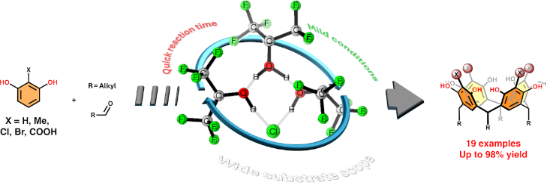
- compounds. Acknowledgements This research was supported through instrumentation made available through the Shared Instrumentation Authority at Rice University. We thank Dr. Christopher L. Pennington for assistance with HRMS data collection and Dr. Hong-Lei Xu for help with single-crystal X-ray diffraction


Synthesis and conformational analysis of pyran inter-halide analogues of ᴅ-talose
Beilstein J. Org. Chem. 2024, 20, 2442–2454, doi:10.3762/bjoc.20.208
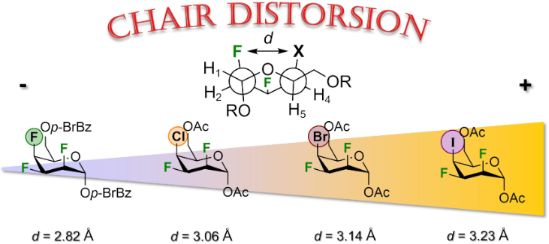
- allopyranoses; b) synthesis and conformational analysis of pyran inter-halide analogues of ᴅ-talose integrating the 2,3-cis, 3,4-cis relationship for the halogens (this work). Direct comparison of 19F resonances of halogenated talose analogues 12–15 (19F NMR; 470 MHz, CDCl3). X-ray analysis of compound 13–15


Facile preparation of fluorine-containing 2,3-epoxypropanoates and their epoxy ring-opening reactions with various nucleophiles
Beilstein J. Org. Chem. 2024, 20, 2421–2433, doi:10.3762/bjoc.20.206
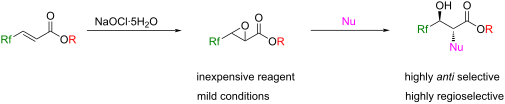
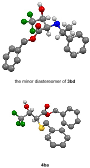
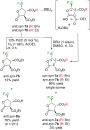
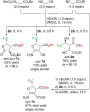
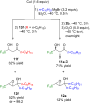
- –11). The stereostructure of the products was confirmed by X-ray crystallographic analysis using the minor diastereomer of 3bd, nicely separated from the major isomer by recrystallization, and the major product 4ba. As was our expectation, these compounds [49] possess the anti relationship between the
- was confirmed as 2,3-anti-3,4-syn by its X-ray crystallographic analysis [49] (Figure 2) whose construction could be readily understood as the result of a highly stereoselective SN2-type epoxy ring opening of 2a, followed by the intramolecular lactone formation with the pro-R ethoxycarbonyl group





Evaluating the halogen bonding strength of a iodoloisoxazolium(III) salt
Beilstein J. Org. Chem. 2024, 20, 2401–2407, doi:10.3762/bjoc.20.204
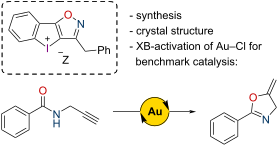
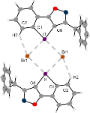
- donors in recent years. Herein, a new structural motif for this compound class was developed: iodoloisoxazolium salts, bearing a cyclic five-membered iodolium core fused with an isoxazole ring. A derivative of this class was synthesized and investigated in the solid state by X-ray crystallography




Synthesis, electrochemical properties, and antioxidant activity of sterically hindered catechols with 1,3,4-oxadiazole, 1,2,4-triazole, thiazole or pyridine fragments
Beilstein J. Org. Chem. 2024, 20, 2378–2391, doi:10.3762/bjoc.20.202
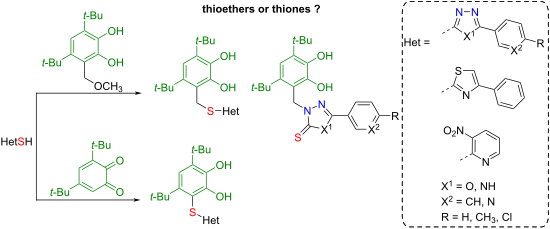
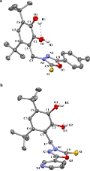
- corresponding thiones. The yield of reaction products ranges from 42 to 80%. The crystal structures of catechols with 3-nitropyridine or 1,3,4-oxadiazole-2(3H)-thione moieties were established by single-crystal X-ray analysis. The possibility of forming intra- and intermolecular hydrogen bonds has been
- ), HRMS, and elemental analysis. The molecular structures of compounds 5, 6 and 8 in crystal state were determined by single-crystal X-ray analysis. X-ray data The X-ray suitable crystals 5, 6·0.5CH3CN, and 8 were grown by slow recrystallization of the compounds from acetonitrile solutions. The unit cells
- of complexes 5 and 8 do not contain any solvent molecules, while the unit cell of crystals 6·0.5CH3CN contains one acetonitrile molecule per two catechol molecules. The nitro-substituted pyridine group in 5 is disordered in two positions. The X-ray structure of catechol 5 is shown in Figure 1, and




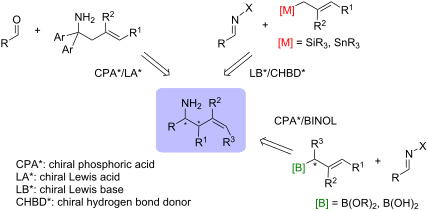
Asymmetric organocatalytic synthesis of chiral homoallylic amines
Beilstein J. Org. Chem. 2024, 20, 2349–2377, doi:10.3762/bjoc.20.201
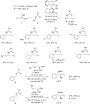
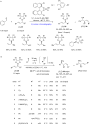
- enantioselectivities were in the range of 82–97% and were lowest for the prenylation, and highest for Z-geranylboronic acid. The absolute configurations of the products were established by X-ray crystallography of the hydrochloride salts of the corresponding bromoindole and bromodihydroisoquinoline derivatives 20 and








Tandem diazotization/cyclization approach for the synthesis of a fused 1,2,3-triazinone-furazan/furoxan heterocyclic system
Beilstein J. Org. Chem. 2024, 20, 2342–2348, doi:10.3762/bjoc.20.200
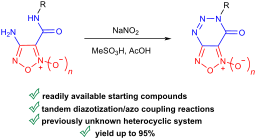
- additionally confirmed by X-ray diffraction (see Supporting Information File 1 for details) (Figure 2). To confirm the reaction mechanism, we performed diazotization followed by azo coupling of amide 2a using labeled Na15NO2 as the nitrosating reagent (Scheme 4). As a result, 15N-labeled triazinone 8 was
- physiological conditions. Moreover, the target bicyclic compounds were shown to be thermostable substances and could be used in various fields of materials science. Examples of bioactive compounds containing the 1,2,3-triazin-4-one core. The X-ray structure of compound 1b (CCDC 2363621) and 7h (CCDC 2363622
- . Supporting Information Supporting Information File 96: Experimental procedures, characterization data of all products, copies of 1H, 13C NMR, 15N spectra of new compounds, DSC curves,X-ray crystallographic data and copies of IR spectra. Acknowledgements The crystal structure determination was performed at


Stereoselective mechanochemical synthesis of thiomalonate Michael adducts via iminium catalysis by chiral primary amines
Beilstein J. Org. Chem. 2024, 20, 2313–2322, doi:10.3762/bjoc.20.198
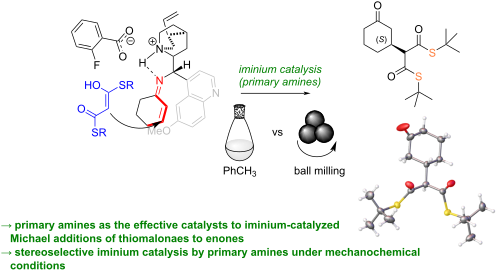
- proved by X-ray studies. Assuming the mechanism of addition is similar in the case of other nucleophiles, the configuration of others was assigned by analogy. More sterically demanding di-tert-butyl thiomalonate (2) reacted in a similar fashion as the dibenzyl thiomalonate (1), leading also to desired


Synthesis and reactivity of the di(9-anthryl)methyl radical
Beilstein J. Org. Chem. 2024, 20, 2254–2260, doi:10.3762/bjoc.20.193
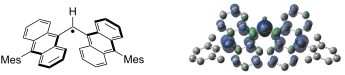
- , Supporting Information File 1). ESR and MS measurements as well as X-ray crystallography revealed that the radical species was assigned 10-mesityl-9-anthroyxyl radical (5), obtained in 47% yield (Figure 4c, Figure S8, Supporting Information File 1). Thus, two decomposition pathways were considered: a minor
- ) ESR spectrum of anthroxyl radical 5 (black line, Exp.) and its simulated pattern (red line, Sim.). (b) Hyperfine coupling constant of 5. (c) X-ray structure of 5. Hydrogen atoms are omitted for clarity. Cyclic voltammogram (CV) of DAntM cation. (a) CV measured with scan rate at 3.0 V s−1. (b) Scan
- . Decomposition pathway of the DAntM radical under air conditions. Supporting Information Supporting Information File 81: Synthetic procedure and compound characterization data (1H, 13C NMR, MS, melting point, X-ray crystallography) of new compounds. DFT calculation results and optimized structural Cartesian


Electrochemical allylations in a deep eutectic solvent
Beilstein J. Org. Chem. 2024, 20, 2217–2224, doi:10.3762/bjoc.20.189
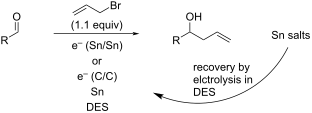
- end, the DES mixture from cycle 3 of Table 8 following product extraction was electrolyzed at 100 mA constant current using glassy carbon electrodes until 2 F/mol of current had passed. This deposited a metal clump on the electrode that was removed and then analyzed using X-ray fluorescent
- using a scoopula for further use and analysis using a Thermo Scientific Niton XL3t X-Ray Fluorescent Spectroscopy analyzer. Product characterization 1-(4-Methoxyphenyl)-3-buten-1-ol [39]: 1H NMR (300 MHz, CDCl3) 7.27 (d, J = 8.58, 2H), 6.86 (d, J = 5.82, 2H), 5.83–5.73 (m, 1H), 5.17–5.10 (m, 2H), 4.67

Heterocycle-guided synthesis of m-hetarylanilines via three-component benzannulation
Beilstein J. Org. Chem. 2024, 20, 2208–2216, doi:10.3762/bjoc.20.188
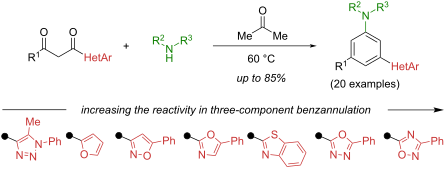
- reaction was expected, Figure 2) with morpholine under previously found conditions (Scheme 2). To our delight, the meta-1,2,4-oxadiazole aniline 3ab, formed by the sequence of aldol-type reactions, was isolated in 80% yield and its structure was confirmed by NMR and single crystal X-ray analysis (CCDC


Natural resorcylic lactones derived from alternariol
Beilstein J. Org. Chem. 2024, 20, 2171–2207, doi:10.3762/bjoc.20.187
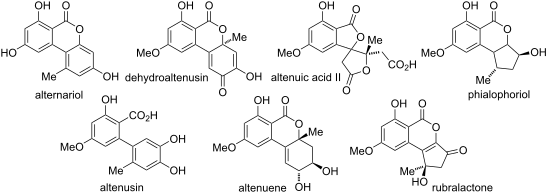
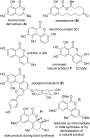
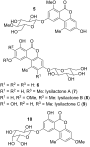
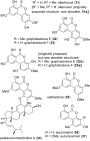
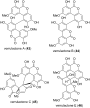
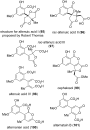
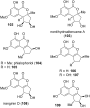
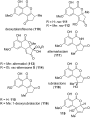
- substituted derivatives Alternariol: Alternariol (AOH, 1, Figure 4) was first isolated in the early 1950ies from Alternaria tenuis (synonymous with A. alternata). Its structure was elucidated with chemical analysis methods [33][54] and later unambiguously confirmed by X-ray crystallographic analyses [55][56
- an X-ray crystallographic analysis [108]. Further syntheses have been presented over the decades including a biomimetic synthesis [68] and a synthesis of deuterated AME [70]. It was isolated from numerous fungal sources, especially from Alternaria spp. (i.e., A. brassicae, capsici-anui, citri
- structure of verrulactone A was later unambiguously confirmed by X-ray crystallographic analysis [160]. Chirality and absolute configurations remained unresolved, where it should be noted that even verrulactones A and B are axially chiral with an assumed significant racemization barrier. At least it has










Computational toolbox for the analysis of protein–glycan interactions
Beilstein J. Org. Chem. 2024, 20, 2084–2107, doi:10.3762/bjoc.20.180
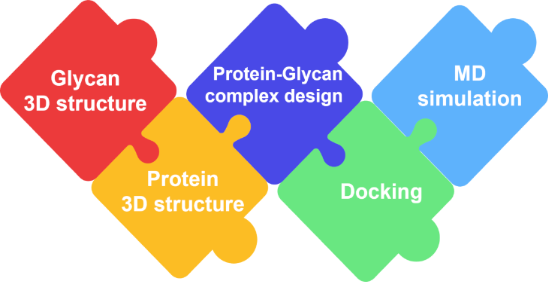
- needed to deeply investigate the multifaceted aspects of protein–glycan interactions. To date, advanced and versatile NMR, X-ray crystallography, and MS methods [36][37][38] above all, have been developed to reach extensive information on the structural and conformational features of glycans and proteins
- . Several experimental techniques, including NMR, X-ray crystallography and Cryo-EM, can provide critical information for the characterisation of protein structure and conformation. Their widespread and wisely use permitted to experimentally determine the structures of around 200,000 proteins [78], all