Search results
Search for "Diels–Alder" in Full Text gives 369 result(s) in Beilstein Journal of Organic Chemistry. Showing first 200.
Get a better glimpse on sequential photoreactions of trisnorbornadienes with 19F NMR spectroscopy
Beilstein J. Org. Chem. 2026, 22, 527–534, doi:10.3762/bjoc.22.38
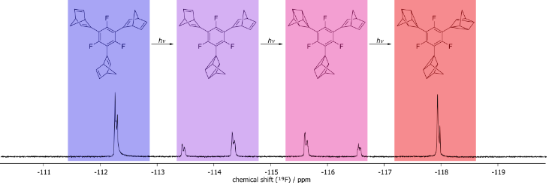
- . This observation likely indicates the thermally induced retro-Diels–Alder reaction of the initially formed norbornadiene units and presumably subsequent reactions of the primary intermediates under these conditions. This unfavorable property may also be caused by the ortho-fluoro substituents as it was
- not observed with the parent compound 1b. In fact, increased rates of retro-Diels–Alder reactions have been observed with acceptor-substituted substrates [56][57]. Although the course of the photoreaction of norbornadiene 1f can be visualized by in situ 1H NMR spectroscopy, significantly overlapping


Recent advances in the stereoselective synthesis of distal biaxially chiral molecules
Beilstein J. Org. Chem. 2026, 22, 461–479, doi:10.3762/bjoc.22.34
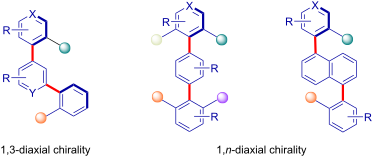
- ]. This method successfully employed a Ni(II)-catalyzed Diels-Alder reaction between 1,3-biaryl-isobenzofurans and α,β-unsaturated N-acyl pyrazoles, followed by a TfOH-promoted dehydration aromatization step. These atropisomeric compounds, which contain multiple stereogenic axes, show broad application


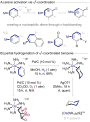
Arene activation via π-bond localization: concepts and opportunities
Beilstein J. Org. Chem. 2026, 22, 257–273, doi:10.3762/bjoc.22.19
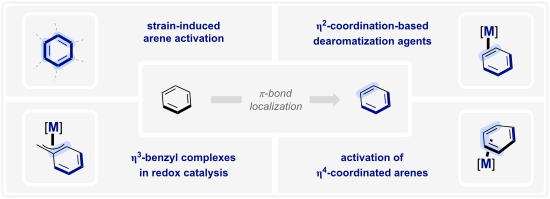
- –Alder reactions with several electron-deficient dienes, furnishing distinctive methano-bridged structures (Figure 3C) [32][33][34][35]. Similarly, small cyclophanes are known to act as reactive dienes in Diels–Alder chemistry [36][37]. More recently, Lu and co-workers reported the unusually facile
- biological relevance [63]. A final notable advance lies in the deployment of the W(0) dearomatization platform to mediate Diels–Alder reactions of η2-coordinated benzenes with alkynes, affording the corresponding η2-barrelene complexes under ambient conditions [64]. While Diels–Alder cycloadditions between
- the W(0) center was also found to promote the retro-Diels–Alder process, effecting the formal extrusion of acetylene and generating modified arenes. This transformation thus represents both a rare example of a Diels–Alder reaction of benzenes and a remarkable two-carbon molecular editing of the




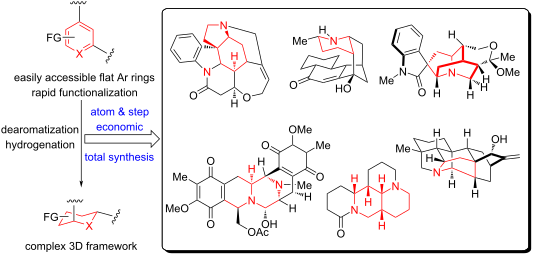
Total synthesis of natural products based on hydrogenation of aromatic rings
Beilstein J. Org. Chem. 2026, 22, 88–122, doi:10.3762/bjoc.22.4
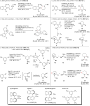
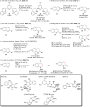
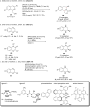
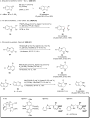
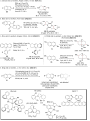
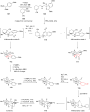
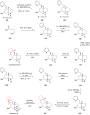
- tetrahydropyridine and completed the synthesis of (±)-LSD (Scheme 10) [74][75]. In the synthesis of (±)-dihydrolysergic acid, Boger and co-workers constructed the tetracyclic core via an inverse-electron demand Diels–Alder cycloaddition between an enamine derived from ketone 88 and triazine, giving pyridine 90 in 75
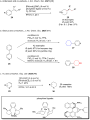
- -type alkaloids [98]. That same year, Sherburn and co-workers described a complementary synthesis employing an aza-Diels–Alder cycloaddition followed by olefin hydrogenation [99]. Starting from pyridine and glutaryl chloride, tetracyclic intermediate 192 was efficiently generated in a single step
- and co-workers reported the first asymmetric total synthesis of (−)-senepodine F, a tetracyclic Lycopodium alkaloid (Scheme 29) [100]. The synthesis commenced with a stereoselective Diels–Alder reaction between compounds 194 and 195 under asymmetric amine catalysis, directly affording the bicyclic











Recent advancements in the synthesis of Veratrum alkaloids
Beilstein J. Org. Chem. 2025, 21, 2657–2693, doi:10.3762/bjoc.21.206
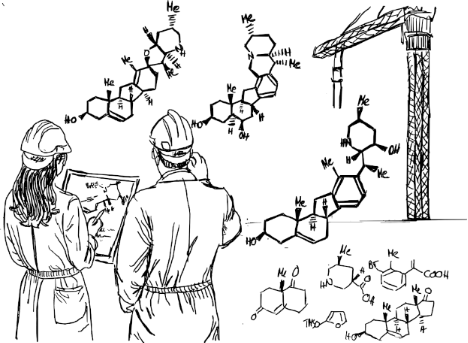
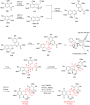
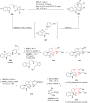
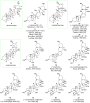
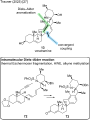
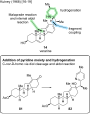
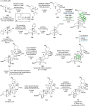
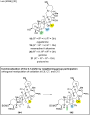
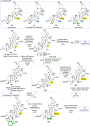
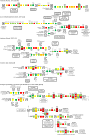
- synthesis by the Trauner group [27]. In comparison to the Liu/Qin group [26], it provides a total synthetic entry in 13 steps in the longest linear sequence and 19 steps in total. The key disconnection cuts across the D-ring through a Diels–Alder reaction and aromatization (Scheme 22). The coupling occurs
- material was concentrated and subjected to a Horner–Wadsworth–Emmons (HWE) reaction with phosphonate 77. In the same pot, the alkyne moiety was also methylated to furnish dienyne 72. Now, the key Diels–Alder step could be performed. Initial attempts failed, but a rhodium-catalyzed reaction in
- to abstract the chloride of the [Rh(cod)Cl]2 catalyst, forming a cationic rhodium complex in situ, while diethyl fumarate acted as a hydrogen acceptor. Double bond isomerization, ketone reduction and deprotection of 73 furnished veratramine (13). This Diels–Alder strategy concluded the synthesis of
















Chemoenzymatic synthesis of the cardenolide rhodexin A and its aglycone sarmentogenin
Beilstein J. Org. Chem. 2025, 21, 2637–2644, doi:10.3762/bjoc.21.204
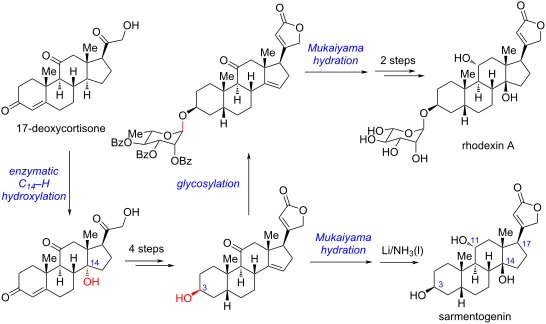
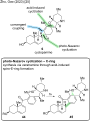
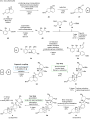
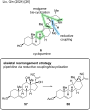
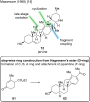
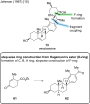
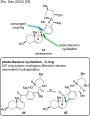
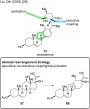
- -electron demand Diels–Alder (IEDDA) reaction was utilized to successfully construct the BCD tricyclic structure with the correct configuration of the four contiguous stereocenters in just one step. However, the requirement of a series of protecting group manipulations undermined the step-economy and



Visible-light-driven NHC and organophotoredox dual catalysis for the synthesis of carbonyl compounds
Beilstein J. Org. Chem. 2025, 21, 2584–2603, doi:10.3762/bjoc.21.200
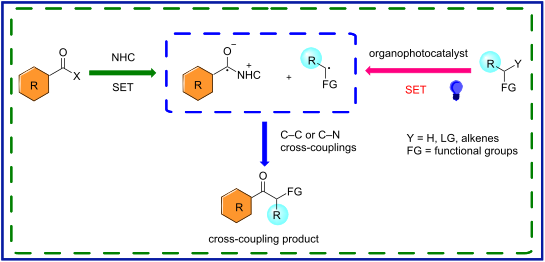
- , Michael additions, cycloadditions, domino reactions, cascade annulations, Diels–Alder reactions, and Michael–Stetter reactions, to name a few [31][32][33][34][35]. Notably, previous reports have demonstrated that the utility of chiral N-heterocyclic carbene (NHC) catalysts permits contracting asymmetric C




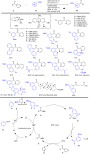

Recent advances in total synthesis of illisimonin A
Beilstein J. Org. Chem. 2025, 21, 2571–2583, doi:10.3762/bjoc.21.199
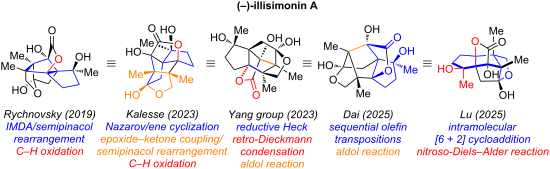
- directly, the team adopted a strategy involving rearrangement from the more accessible cis-pentalene isomer. They first assembled the cis-pentalene core through an elegant intramolecular Diels–Alder (IMDA) reaction. Subsequently, the conversion from cis to trans-pentalene was achieved via a semipinacol
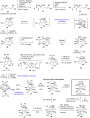
- , obtained as a 1.7:1 mixture of diastereomers after protection of one of the carbonyl groups in 19 as enol ether with BOMCl. A silyl-tethered intramolecular Diels–Alder reaction of the in situ generated 22 constructed the tricyclo[5.2.1.01,5]decane core bearing a cis-pentalene unit, yielding compound 23
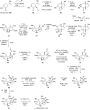
- starting materials [32]. This synthesis features a pentafulvene-based intramolecular [6 + 2] cycloaddition [41][42] and a nitroso-Diels–Alder reaction [43] as key steps. The route began with the esterification of pentafulvenol 82 to give β-ketoester 83, which was subsequently converted to the sterically






Total syntheses of highly oxidative Ryania diterpenoids facilitated by innovations in synthetic strategies
Beilstein J. Org. Chem. 2025, 21, 2553–2570, doi:10.3762/bjoc.21.198
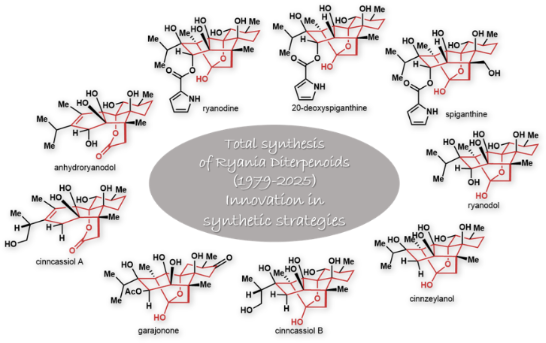
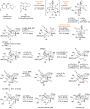
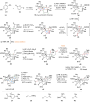
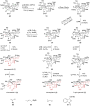
- of the non-naturally produced ryanodol (4) and its dehydrated derivative, anhydroryanodol (10) [30] (Scheme 2). Given the highly complex fused-ring system and the stereochemical challenges posed by multiple chiral centers, the author utilized the Diels–Alder reaction, a prominent representative of
- pericyclic reactions [31][32][33][34][35][36][37][38][39][40][41][42][43][44], to control the formation of the crucial C5 chiral center precisely. Subsequent oxidative cleavage of the carbon–carbon double bond introduced in the Diels–Alder reaction, followed by an intramolecular aldol reaction, efficiently







Ni-promoted reductive cyclization cascade enables a total synthesis of (+)-aglacin B
Beilstein J. Org. Chem. 2025, 21, 2548–2552, doi:10.3762/bjoc.21.197
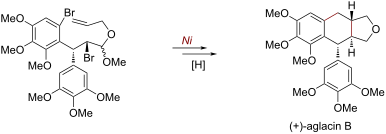
- synthesis of both enantiomers of aglacins A (1), B (2), and E (4) by asymmetric photoenolization/Diels–Alder reactions as the key steps for the construction of the C7–C8 and C7′–C8′ bonds [8]. During the past decade, we had developed nickel-catalyzed or -promoted reductive coupling/cyclization reactions for


Transformation of the cyclohexane ring to the cyclopentane fragment of biologically active compounds
Beilstein J. Org. Chem. 2025, 21, 2416–2446, doi:10.3762/bjoc.21.185
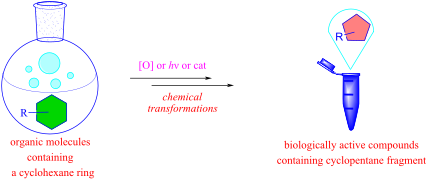
- interesting transformation of a cyclohexene fragment into the cyclopentane fragment in Diels–Alder adducts of levoglucosenone (LG) and 1,3-dienes is presented in [16]. Diels–Alder adducts of LG and 1,3-dienes, containing in their structure fragments of cyclohexene and a carbohydrate residue, are attractive
- explained to some extent by their structural diversity. Figure 1 shows the general formula of iridoids. The authors [16] have established regiocontrol of the effect of the 1,6-anhydro bridge on the Dieckmann condensation of dicarboxylic acid diester 16, obtained in four steps from 13, the Diels–Alder adduct
- method for the synthesis of cyclopentane derivatives through oxidative cleavage of the double bond in Diels–Alder adducts of LG with 1,3-butadiene and piperylene (3E-penta-1,3-diene), followed by an intramolecular aldol condensation of the resulting dialdehydes was described in [19]. The dicarbonyl


Comparative analysis of complanadine A total syntheses
Beilstein J. Org. Chem. 2025, 21, 2334–2344, doi:10.3762/bjoc.21.178
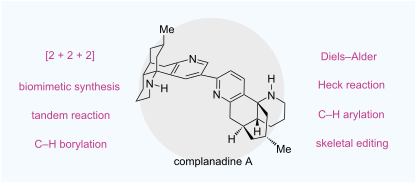
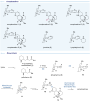
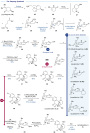
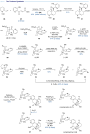
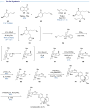
- diastereomers) via either a creative “degradation” of the piperidine ring or cross-coupling reactions at the pyridine C3 position [29]. The Tsukano total synthesis – 2013 In 2013, Tsukano and co-workers reported their total synthesis of complanadines A and B (Scheme 4). Their synthesis utilizes a Diels–Alder
- a thermal Diels–Alder cycloaddition, which afforded a mixture of stereo- (endo/exo) and regioisomers, among which the desired product 46 was obtained in 45% yield as a racemic mixture. After triflation of the free hydroxy group of 46 to provide 47, an intramolecular Heck reaction was employed to
- close the second six-membered carbocycle to deliver 48 in 73% yield. The Diels–Alder reaction and Heck reaction quickly set up the tetracyclic skeleton for subsequent peripheral modifications. First, the ketone functionality of 48 was reduced to a methylene group via a sequence of Luche reduction and



Pathway economy in cyclization of 1,n-enynes
Beilstein J. Org. Chem. 2025, 21, 2260–2282, doi:10.3762/bjoc.21.173
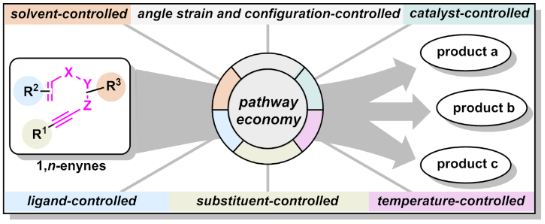
- distinct from those generated through thermal Diels–Alder cycloaddition of (Z)-100. However, when [ReCl(CO)5] was used as the catalyst, a regioselective C–H bond insertion pathway was observed for substrate (E)-100, leading to the formation of tricyclic products 104 and 105 (Scheme 21, path b). This
- strategy employed transition metal-catalyzed carbene intermediates to mediate stereoselective cyclization, affording bicyclo[4.3.0]nonane derivatives with configurations distinct from Diels–Alder adducts. In 2013, Alami and co-workers demonstrated catalyst-dependent cycloisomerization of aromatic enynes


C2 to C6 biobased carbonyl platforms for fine chemistry
Beilstein J. Org. Chem. 2025, 21, 2103–2172, doi:10.3762/bjoc.21.165
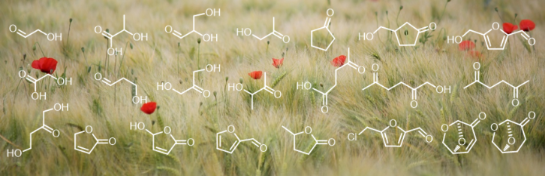
- bicyclic alkanes, used as fuel additives, by hydrodeoxygenation catalyzed by iridium/rhenium oxide supported on silica [182]. Conversion of furfural to amines: The synthesis of m-xylylenediamine from furfural and acrylonitrile through a Diels–Alder/aromatization sequence was developed by Wischet and Jérôme
- [183]. 2-(Furan-2-yl)-1,3-dioxolane with higher reactivity was generated through the acetalization of furfural with ethylene glycol, and converted to Diels–Alder cycloadducts in the presence of acrylonitrile at 60 °C. Treatment of the Diels–Alder adduct in basic conditions allowed the rearomatization


The application of desymmetric enantioselective reduction of cyclic 1,3-dicarbonyl compounds in the total synthesis of terpenoid and alkaloid natural products
Beilstein J. Org. Chem. 2025, 21, 2085–2102, doi:10.3762/bjoc.21.164
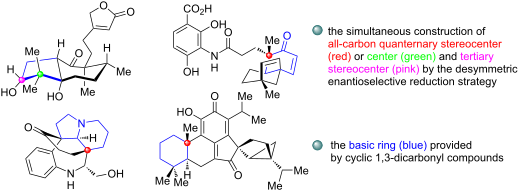
- -catalyzed intermolecular Diels–Alder reaction of 106 with methacrolein 107 afforded the common intermediate 108 in high yield. Sequential Grignard reagent addition and acid-promoted ethoxy elimination provided the separable planar diene 109 (dr = 1:1), which underwent a Mn-catalyzed HAT hydrogenation to
- intramolecular Diels–Alder reaction generated tricyclo[3.2.1.02,7]-octene 113. A two-step transformation including HAT hydrogenation and acetal C–H oxidation with RuCl3/NaIO4, 113 was converted into ketoester 114. The TFA-mediated C13–C15 bond cleavage of 114 proceed smoothly to give ring-opening products, which







Bioinspired total syntheses of natural products: a personal adventure
Beilstein J. Org. Chem. 2025, 21, 2048–2061, doi:10.3762/bjoc.21.160
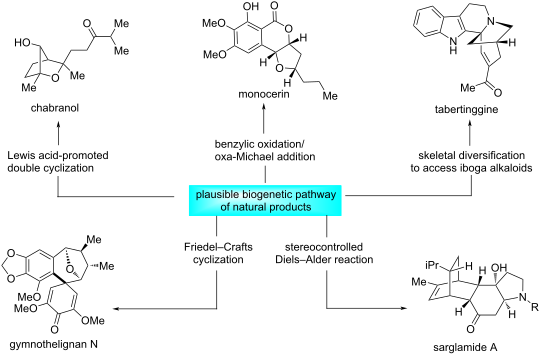
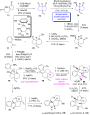
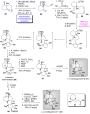
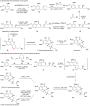
- (Scheme 7a). Biogenetically, sarglamides A–C are generated directly from α-phellandrene and toussaintine C through stereodivergent Diels–Alder reactions, since the indolidinoid natural product toussaintine C is known and symbiotic with sarglamides. More importantly, a solid evidence to support this
- proposal is that toussaintine C was isolated as a racemic mixture, and sarglamides A and B are derived from one enantiomer of toussaintine C while sarglamides C–E are derived from the other one. The Diels–Alder cycloadditions are basically proceeded through endo-selectivity. The isopropyl group in α
- bioinspired synthetic approach [44]. Initially, we prepared a bicyclic precursor similar with toussaintine C to react with α-phellandrene to mimic the bioinspired Diels–Alder reaction, which, however, showed no reactivity due to the strong steric hindrance. To decrease the steric effect, we finally used


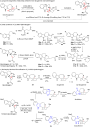
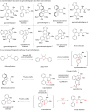

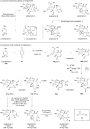
Photochemical reduction of acylimidazolium salts
Beilstein J. Org. Chem. 2025, 21, 1973–1983, doi:10.3762/bjoc.21.153
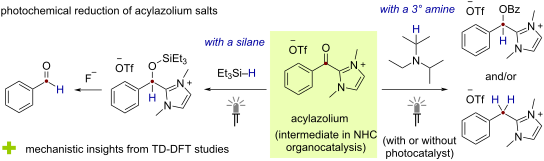
- catalytic photoenolization/Diels–Alder (PEDA) reaction [14][15]. In this process, the NHC fragment present in the acylazolium species influences the absorption wavelength and fundamental photochemical reactivity of the C=O bond, enabling a “ketone-like” photoreaction from otherwise unsuitable carboxylic


Enantioselective desymmetrization strategy of prochiral 1,3-diols in natural product synthesis
Beilstein J. Org. Chem. 2025, 21, 1932–1963, doi:10.3762/bjoc.21.151

- hetisine-type diterpenoids (+)-18-benzoyldavisinol and (+)-davisinol [82] (Scheme 34). Using diester 286 as a starting material, phenol 287 was prepared in six steps. Subsequent oxidative dearomatization-induced Diels–Alder cycloaddition with PhI(OAc)2, delivered endo-cycloadduct 288 with high












Preparation of a furfural-derived enantioenriched vinyloxazoline building block and exploring its reactivity
Beilstein J. Org. Chem. 2025, 21, 1737–1741, doi:10.3762/bjoc.21.136

- reactions. Out of these, the aza-Diels–Alder reaction with TsNCO was successful, leading to a highly diastereoselective formation of an oxazolo[3,2-c]pyrimidine derivative. Keywords: aza-Diels–Alder reaction; electrosynthesis; furfural; valinol; vinyloxazoline; Introduction The utilization of biomass as
- -6 is a good substrate for an aza-Diels–Alder reaction with tosylisocyanate (TsNCO) providing the oxazolo[3,2-c]pyrimidine derivative 7 as the only detectable diastereomer (Scheme 6) [22][23][24]. Oxazolo[3,2-c]pyrimidines are substructures in several pharmaceutically relevant compounds such as
- potent gonadotropin-releasing hormone receptor antagonists with potential application as anticancer drugs [25] and as nucleoside analogs with antiviral potency [26]. According to the reaction mechanism proposed by Elliott et al., the aza-Diels–Alder reaction of vinyloxazoline S-6 with TsNCO is a step


Transition-state aromaticity and its relationship with reactivity in pericyclic reactions
Beilstein J. Org. Chem. 2025, 21, 1613–1626, doi:10.3762/bjoc.21.125

- this end, selected representative examples ranging from fundamental processes such as Diels–Alder or Alder–ene reactions to double-group transfer reactions or 1,3-dipolar cycloadditions involving metal complexes are presented. It is found that while more synchronous processes tend to exhibit greater
- transition structure of the Diels–Alder cycloaddition reaction between butadiene and ethylene “…Very qualitatively, we may say that whereas in the initial state the mobile electrons are those characteristics of an ethylene and a butadiene structure, in the TS they simulate the behavior of a benzene molecule
- the aromaticity of the transition state and the activation barriers of different pericyclic reactions spanning from the parent Diels–Alder reactions to higher-order cycloadditions or even transition-metal-mediated transformations [22][23][24][25][26][27][28][29]. By selecting illustrative examples, in


Copper catalysis: a constantly evolving field
Beilstein J. Org. Chem. 2025, 21, 1477–1479, doi:10.3762/bjoc.21.109
- reactions, are separately debated. In addition, mechanistic insights into the reaction of heteropolycyclic systems, cycloadditions, and aza-Diels–Alder reactions are provided. This is important because multicomponent, one-pot reactions have gained interest as potentially more economic, efficient, and
High-pressure activation for the solvent- and catalyst-free syntheses of heterocycles, pharmaceuticals and esters
Beilstein J. Org. Chem. 2025, 21, 1374–1387, doi:10.3762/bjoc.21.102
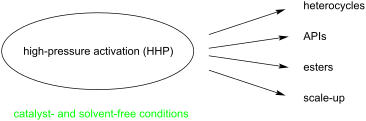
- Mannich reactions [20], lipase-catalyzed esterification [21], nitro-aldol [22], Michael [23], and aza-Michael reactions [24][25], Diels–Alder reactions [26][27] and Friedel–Crafts alkylation of indoles [28]. Many high pressure reactions were applied in natural product synthesis [29]. The high pressure


A multicomponent reaction-initiated synthesis of imidazopyridine-fused isoquinolinones
Beilstein J. Org. Chem. 2025, 21, 1161–1169, doi:10.3762/bjoc.21.92
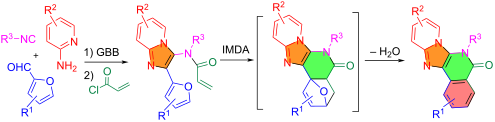
- Ashutosh Nath John Mark Awad Wei Zhang Department of Chemistry, University of Massachusetts Boston, 100 Morrissey Boulevard, Boston, MA 02125, USA 10.3762/bjoc.21.92 Abstract A new synthetic route initiated with Groebke–Blackburn–Bienaymé (GBB) followed by N-acylation, intramolecular Diels–Alder
- –Bienaymé (GBB); imidazopyridine; intramolecular Diels–Alder (IMDA); isoquinolinone; multicomponent reaction (MCR); re-aromatization; Introduction Multicomponent reactions (MCRs) have intrinsic green chemistry advantages of synthetic efficiency and operational simplicity. Performing post-condensational
- dienophile, characteristic of Diels–Alder processes. The incorporation of a bromine atom at the 5-position of the diene (+0.306, −0.041, 6j) complicates the situation. As an electronegative element, Br exerts an inductive electron-withdrawing influence to enhance the electron shortage of the diene. This




Synthesis and photoinduced switching properties of C7-heteroatom containing push–pull norbornadiene derivatives
Beilstein J. Org. Chem. 2025, 21, 807–816, doi:10.3762/bjoc.21.64
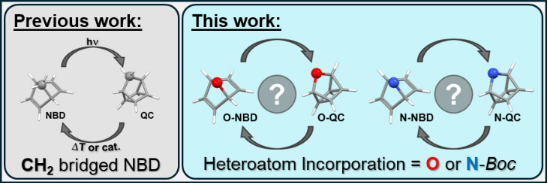
- . Starting with 1-((bromoethynyl)sulfonyl)-4-methylbenzene, which was previously prepared and characterized [40][41], Diels–Alder reaction with either cyclopentadiene, furan or Boc-protected pyrrol, resulted in the NBD precursors C-NBD1, O-NBD1 and N-NBD1, respectively [31][42]. With these precursors in hand
- were observed. However, purification was not possible. Furthermore, an alternative commonly used synthetic strategy involving the Diels–Alder reaction of a pre-functionalized push–pull acetylene with furan or pyrrol derivatives proved unsuccessful [4][43]. All synthesized NBD derivatives were


Synthesis of HBC fluorophores with an electrophilic handle for covalent attachment to Pepper RNA
Beilstein J. Org. Chem. 2025, 21, 727–735, doi:10.3762/bjoc.21.56
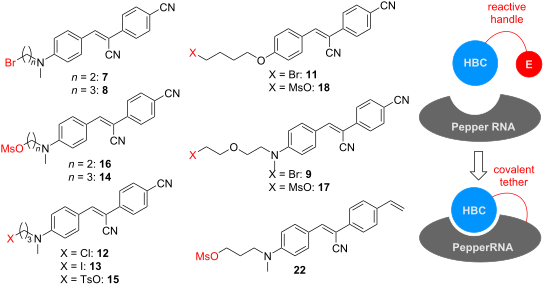
- intention was to provide an RNA pulldown tool where the RNA of interest tagged with the Pepper aptamer becomes covalently attached to the fluorophore, which in turn can be biotinylated via a catalyst-free inverse-electron-demand Diels–Alder reaction (IEDDA) [11]. Thereby, the entire process is easily