Search results
Search for "NMR analysis" in Full Text gives 430 result(s) in Beilstein Journal of Organic Chemistry. Showing first 200.
Recent advances in copper-catalyzed direct hydroamination of alkenes with (hetero)aromatic amines
Beilstein J. Org. Chem. 2026, 22, 925–947, doi:10.3762/bjoc.22.73
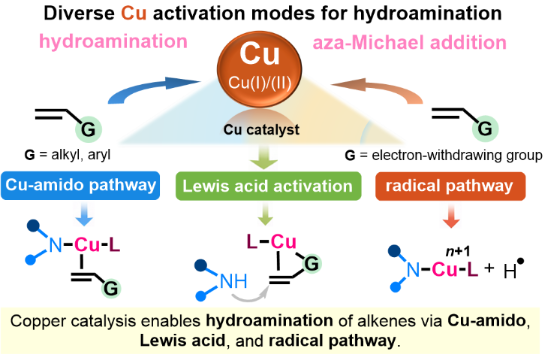
- ). In particular, NMR analysis indicated the formation of the organocopper species (IPr)Cu(N(Ph)CH2CH2CN) (VII), a key intermediate consistent with the nucleophilic addition mechanism. These early mechanistic studies established that copper-bound amido species act as key nucleophilic intermediates in







Synthesis and structural elucidation of a novel bis-spirooxindole from isatin and ethylenediamine
Beilstein J. Org. Chem. 2026, 22, 813–820, doi:10.3762/bjoc.22.63

- :1 isatin-to-diamine ratio provides the diiminoisatin, whereas a 1:2 ratio leads to the formation of a highly symmetric bis-spirooxindole scaffold. The new spirocyclic product was fully characterized by HRMS, IR and extensive 1D/2D NMR analysis, and its structure was unequivocally established by


Synthesis of depressin, cryptomeridiol and 4-epi-cryptomeridiol enabled by a terpenoid chiral pool-producing platform
Beilstein J. Org. Chem. 2026, 22, 683–690, doi:10.3762/bjoc.22.53
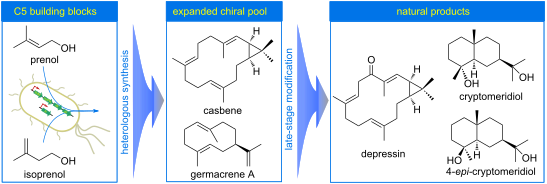
- conditions, affording 9-hydroxy-13-ketocasbene (10, 21%) and 5-hydroxy-13-ketocasbene (11, 20%), respectively, as single diastereomers. Although the orientation of the newly introduced hydroxy group could not be assigned solely based on NMR analysis, the 5-hydroxy group of 11 will be transformed into a


Harnessing light energy with molecules
Beilstein J. Org. Chem. 2026, 22, 680–682, doi:10.3762/bjoc.22.52
- trisNBD-benzene, overcoming the signal overlap that limits conventional 1H NMR analysis. Further, the consequences on the absorption properties, photoisomerization, and QC lifetime were studied. In another article by Krappmann and Hirsch [6], the implications of replacing the methylene bridge of the NBD
Synthesis of a HDAC inhibitor–nanogold probe for cryo-EM visualization in class I HDAC co-repressor complexes
Beilstein J. Org. Chem. 2026, 22, 480–485, doi:10.3762/bjoc.22.35
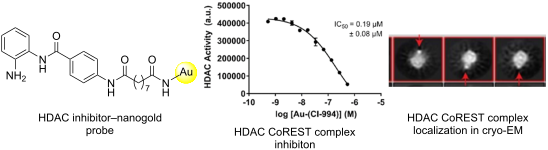
- for assistance and guidance in Cryo-EM experiments. We thank Dr. Vanessa M. Timmermann and Dr. Rebecca Hawker for assistance in NMR analysis and Dr. Sharad C. Mistry for assistance in mass spectrometry. Funding We thank the following funders: EPSRC (EP/S030492/1 to JTH; EP/W02151X/1 NMR facility); MRC



Cone p-aminocalix[4]arenes enriched with ‘clickable’ alkyne or azide functionalities
Beilstein J. Org. Chem. 2026, 22, 399–415, doi:10.3762/bjoc.22.28
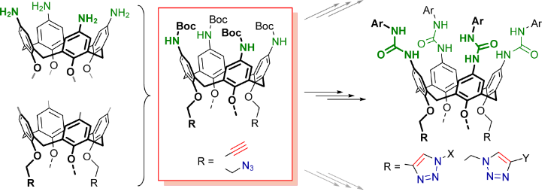
- concentrations of dissolved compounds was too low for NMR analysis. Thus, additional experiments need to be designed to reveal whether the triazolated tetraureacalix[4]arenes can be used to include pairs of triazole-bound cations into supramolecules via intermolecular hydrogen bonding between the urea groups


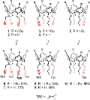


Spirobarbiturates with a pyrrolizidine moiety: synthesis, structure and biological evaluation
Beilstein J. Org. Chem. 2026, 22, 274–288, doi:10.3762/bjoc.22.20
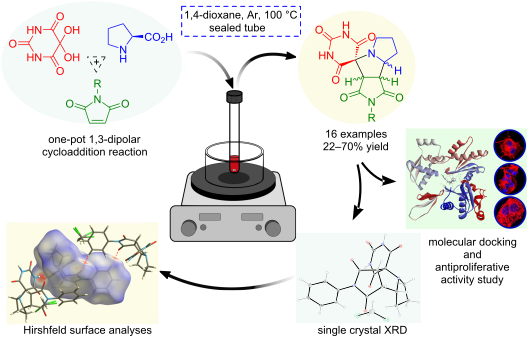
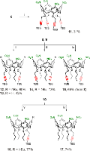
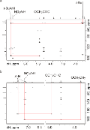
- for endo-4f–p could be unambiguously identified, as they remain virtually unchanged compared to those in the pure endo-isomers 4a–e. 19F NMR analysis of 4j revealed two fluorine signals (δF −114.3 ppm for exo, −114.4 ppm for endo), while the CF3 group in 4m showed analogous splitting (δF −61.2 ppm




Asymmetric Mannich reaction of aromatic imines with malonates in the presence of multifunctional catalysts
Beilstein J. Org. Chem. 2026, 22, 151–157, doi:10.3762/bjoc.22.8
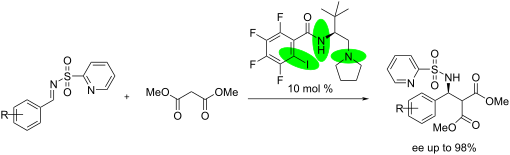
- monitored by 1H NMR analysis. After completion of the reaction, the product was isolated by direct precipitation from the crude reaction mixture by adding a mixture of petroleum ether/Et2O (4:1; 2 mL). The product was collected by filtration and washed with a mixture of petroleum ether/Et2O (4:1; 4 × 2 mL


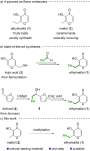
One-pot synthesis of ethylmaltol from maltol
Beilstein J. Org. Chem. 2025, 21, 2755–2760, doi:10.3762/bjoc.21.212

- opted for deprotonation with lithium reagents. Attempted double deprotonation with methyl lithium afforded a complex reaction mixture, from which ethylmaltol (1) was isolated in 11% together with an inseparable impurity tentatively assigned as 6 based on NMR analysis (Table 1, entry 2). Switching to the


Rapid access to the core of malayamycin A by intramolecular dipolar cycloaddition
Beilstein J. Org. Chem. 2025, 21, 2542–2547, doi:10.3762/bjoc.21.196
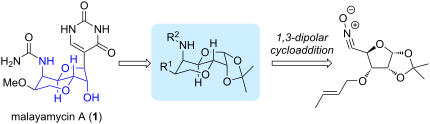
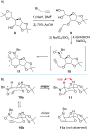
- smoothly to deliver the aldehyde which was immediately subjected to the condensation reaction with benzylhydroxylamine. The corresponding nitrone 10 then underwent an intramolecular cycloaddition. Adduct 11 was isolated as the major product in 42% yield for 2 steps. Comprehensive NMR analysis revealed the




The high potential of methyl laurate as a recyclable competitor to conventional toxic solvents in [3 + 2] cycloaddition reactions
Beilstein J. Org. Chem. 2025, 21, 2389–2415, doi:10.3762/bjoc.21.184
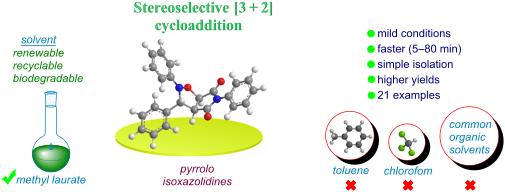
- of hexane and dried in open air. The resulting mixture of isomers was subjected to direct NMR analysis, without any additional purification or separation steps. Versatile compounds via cycloaddition reactions. a) Radar view of the physical properties of methyl laurate. b) Oral toxicity values of






Asymmetric total synthesis of tricyclic prostaglandin D2 metabolite methyl ester via oxidative radical cyclization
Beilstein J. Org. Chem. 2025, 21, 1964–1972, doi:10.3762/bjoc.21.152
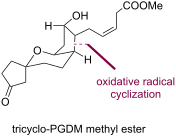
- an inseparable mixture of diastereomers at C-15 in a ratio of 1.0/1.1 (1H NMR analysis). Having established a route to the bicyclic hemiketal 21, we investigated the stereoselective introduction of an allyl moiety at C8 for the synthesis of compound 25 according to the strategy in Scheme 3. Treatment



[3 + 2] Cycloaddition of thioformylium methylide with various arylidene-azolones in the synthesis of 7-thia-3-azaspiro[4.4]nonan-4-ones
Beilstein J. Org. Chem. 2025, 21, 1791–1798, doi:10.3762/bjoc.21.141
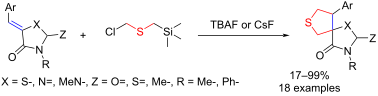
- were formed, and the transformation rate was extremely low. This outcome may be attributed to the electron-acceptor properties of the oxygen atom, which likely disrupt the cycloaddition process. NMR analysis confirmed that each heterocyclic ring formed products exclusively as a single diastereomer



Structural analysis of stereoselective galactose pyruvylation toward the synthesis of bacterial capsular polysaccharides
Beilstein J. Org. Chem. 2025, 21, 1671–1677, doi:10.3762/bjoc.21.131

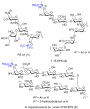
- 1H-13C HSQC NMR analysis was performed to further characterize the structure of 14 (see Supporting Information File 1). 1H NMR coupling constants revealed the presence of one α-glycosidic bond at C1′ (δ 5.49, J = 4.3 Hz) and two β-glycosidic bonds at C1 (δ 4.22, bs) and C1′′ (δ 5.56, J = 3.8 Hz). The


Microwave-enhanced additive-free C–H amination of benzoxazoles catalysed by supported copper
Beilstein J. Org. Chem. 2025, 21, 1462–1476, doi:10.3762/bjoc.21.108
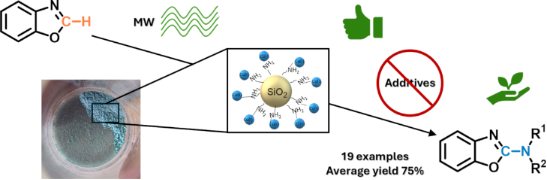
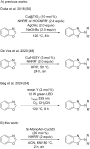
- in the presence of Si-MonoAm-Cu(I) 5 wt %. Under these conditions, the yield was quantitative, and NMR analysis confirmed the exclusive formation of the desired product. No improvements were observed when the catalyst was loaded at 3 or 9 wt % (Table 3, entries 7–10). For comparison, the reaction was



A multicomponent reaction-initiated synthesis of imidazopyridine-fused isoquinolinones
Beilstein J. Org. Chem. 2025, 21, 1161–1169, doi:10.3762/bjoc.21.92
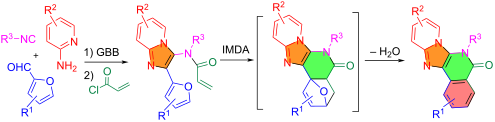
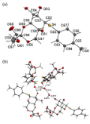
- chromatography with 30:70 EtOAc/hexanes. Product structures were confirmed by 1H and 13C NMR analysis and X-ray crystal structure analysis of 8a. Density functional theory (DFT) calculations DFT computations were conducted utilizing Gaussian 16W with the B3LYP functional and the 6-31G(d,p) basis set [21][22




A versatile route towards 6-arylpipecolic acids
Beilstein J. Org. Chem. 2025, 21, 1104–1115, doi:10.3762/bjoc.21.88
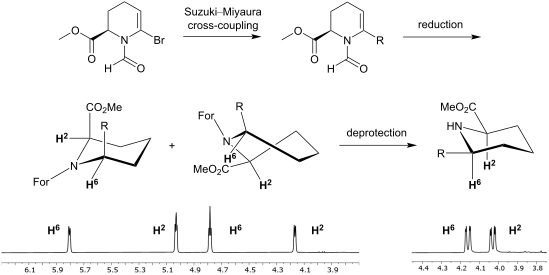
- aryl modifications in C6 position by utilising the chiral pool of a non-proteinogenic amino acid in combination with transition metal-catalysed cross-coupling reactions. Moreover, we present an in-depth NMR analysis of the key intermediate steps, which illustrates the conformational constraints in
- the Sonogashira–Hagihara cross-coupling products [35]. Furthermore, an in-depth NMR analysis was conducted on the resulting constraints leading to conformational structure predictions. ᴅ-2-Aminoadipic acid (1) [36], a side product formed in the pharmaceutical semisynthesis of 7-aminocephalosporanic
- )-9 are generated in a 1:1 ratio, while a hydrogenation of the N-formyl enamine with Pd/C and H2 favours the (2R,6S)-9 diastereomer. Moreover, an in-depth NMR analysis, focusing on coupling constants and subsequent dihedral angles of diastereomers (2R,6S)-9 and (2R,6R)-9, as well as selected


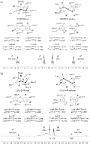


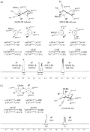

Harnessing tethered nitreniums for diastereoselective amino-sulfonoxylation of alkenes
Beilstein J. Org. Chem. 2025, 21, 947–954, doi:10.3762/bjoc.21.78

- synthesized in one pot with good yields and excellent diastereoselectivities (Table 4, entries 5 and 9). Surprisingly, carbamate substrates derived from di-substituted allylic alcohols (Figure 1) invariably failed to give the desired amino-sulfonoxylated products. With these substrates, 1H NMR analysis of the


Cu–Bpin-mediated dimerization of 4,4-dichloro-2-butenoic acid derivatives enables the synthesis of densely functionalized cyclopropanes
Beilstein J. Org. Chem. 2025, 21, 877–883, doi:10.3762/bjoc.21.71
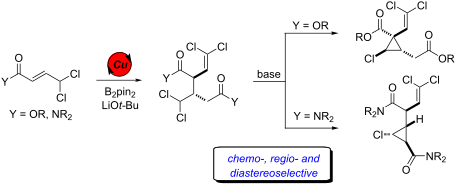
- cases, with SIPr providing the best result (Table 1, entry 11). Under these optimized conditions, product 2 was isolated in 60% yield as a single diastereomer. The relative configuration of 2 was determined by two-dimensional NMR analysis (see Supporting Information File 1 for details). This


Synthesis and photoinduced switching properties of C7-heteroatom containing push–pull norbornadiene derivatives
Beilstein J. Org. Chem. 2025, 21, 807–816, doi:10.3762/bjoc.21.64
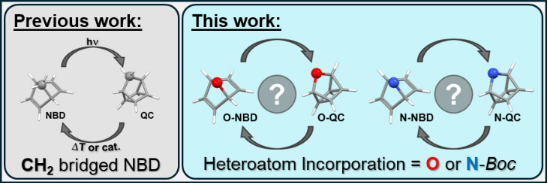
- described a variety of potential rearrangements for oxa-NBD and oxa-QC derivatives [32][34][36][37]. Therefore, in-depth 2D NMR analysis combined with mass spectrometry was attempted to elucidate the structure of O-UnS2. Notably, an additional singlet proton signal (integrated as 1 proton) corresponding to


Semisynthetic derivatives of massarilactone D with cytotoxic and nematicidal activities
Beilstein J. Org. Chem. 2025, 21, 607–615, doi:10.3762/bjoc.21.48
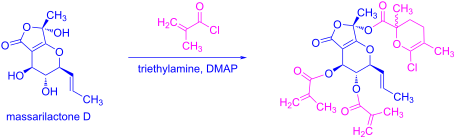
- % yield) obtained as a white powder. Its molecular formula C27H31ClO10 was deduced from the HRESIMS spectrum (Figure S2, Supporting Information File 1), which exhibited the sodium adduct at m/z 573.1495 (calcd. for C27H31ClO10Na+: 573.1498) and NMR analysis. In addition to resonances attributed to


Sequential two-step, one-pot microwave-assisted Urech synthesis of 5-monosubstituted hydantoins from L-amino acids in water
Beilstein J. Org. Chem. 2025, 21, 596–600, doi:10.3762/bjoc.21.46
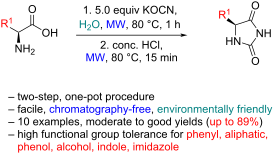
- ][15][16], but reaction times are significantly shorter. In addition, TLC analysis confirmed complete consumption of starting material, which was further confirmed by NMR analysis showing no detectable impurities or unreacted starting material. Variations in yields (34–89%) may be due to differences in


Deep-blue emitting 9,10-bis(perfluorobenzyl)anthracene
Beilstein J. Org. Chem. 2025, 21, 515–525, doi:10.3762/bjoc.21.39
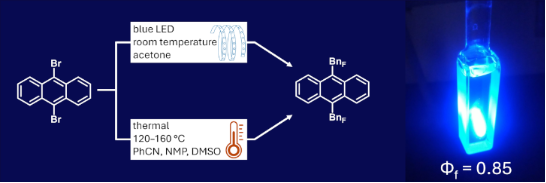
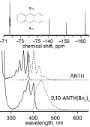
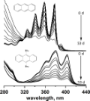
- Figures S1 and S2 in Supporting Information File 1). The 1H NMR analysis of the crude reaction mixture indicated 60% conversion of 9,10-ANTH(Br)2 and a 1:1 ratio of only two products, 9,10-ANTH(BnF)2 and 9-Br-10-BnF-ANTH. Even after only 2 h, it was possible to observe both products by 1H NMR, indicating





Organocatalytic kinetic resolution of 1,5-dicarbonyl compounds through a retro-Michael reaction
Beilstein J. Org. Chem. 2025, 21, 473–482, doi:10.3762/bjoc.21.34
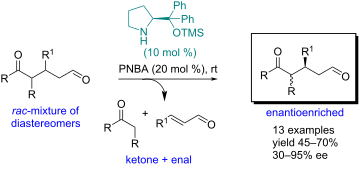
- ] using 20 mol % of catalyst A and 20 mol % of p-nitrobenzoic acid (PNBA) as co-catalyst in different solvents at room temperature. The results obtained are summarized in Scheme 3 and Table 1. The progress of the reaction was monitored using thin-layer chromatography (TLC) and 1H NMR analysis of the


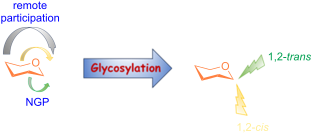
The effect of neighbouring group participation and possible long range remote group participation in O-glycosylation
Beilstein J. Org. Chem. 2025, 21, 369–406, doi:10.3762/bjoc.21.27
- corresponding orthophosphate intermediates. However, the NMR analysis showed the formation of covalent α-glycosyl triflates 72 as the intermediate indicating an SN2-like mechanistic pathway where the acceptor attacked from the opposite face of the α-triflate intermediates (path A, Scheme 13) which was triggered