Search results
Search for "DMF" in Full Text gives 1101 result(s) in Beilstein Journal of Organic Chemistry. Showing first 200.
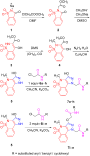
Formaldehyde surrogates in multicomponent reactions
Beilstein J. Org. Chem. 2025, 21, 564–595, doi:10.3762/bjoc.21.45
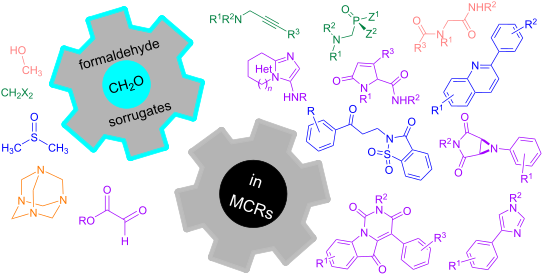
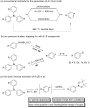
- only when aliphatic disulfides are used because of the higher Lewis basicity of the alkylated sulfur atom, which poisons the copper catalyst. When the reaction was carried out with paraformaldehyde and other solvents (such as DMF, 1,4- dioxane, toluene, and DCE) the yield was very low (between 0–34
- (DMF), dimethyl sulfoxide (DMSO), or dioxane to achieve high yields. The assumed mechanism is initiated by activation of the C–H bond of the terminal alkyne by a metal catalyst. The resulting metal acetylide reacts with the imine/enamine through a nucleophilic addition. Because imines/enamines are
- colorless crystals from the reaction between Et3N and CH2Cl2 at 100 °C in DMF. Subsequently, the corresponding α-aminophosphonate 35a was obtained by heating 36a with an equal amount of diethyl phosphite (Scheme 28b). Furthermore, when the reaction was carried out with CD2Cl2, the corresponding deuterated


Synthesis of electrophile-tethered preQ1 analogs for covalent attachment to preQ1 RNA
Beilstein J. Org. Chem. 2025, 21, 483–489, doi:10.3762/bjoc.21.35
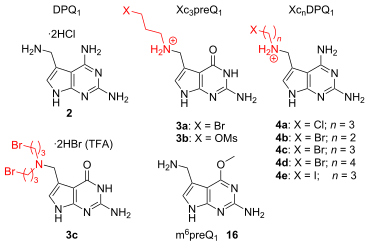
- subjected to Appel conditions in DMF, using elemental iodine as the halogen source. Notably, we were not able to efficiently generate the corresponding bromides with the same strategy. The preQ1 derivative 3a was synthesized in a 2-step reaction sequence analogous to the DPQ1 derivative 4b, while four steps


Photomechanochemistry: harnessing mechanical forces to enhance photochemical reactions
Beilstein J. Org. Chem. 2025, 21, 458–472, doi:10.3762/bjoc.21.33

- -assisted grinding (LAG). This minimizes waste production compared to conventional solution-based methods. This is particularly advantageous when high-boiling point (e.g., DMSO) or noxious solvents (e.g., DMF and halogenated ones) are required. It is worth noting, however, that in some cases the heat




Identification and removal of a cryptic impurity in pomalidomide-PEG based PROTAC
Beilstein J. Org. Chem. 2025, 21, 407–411, doi:10.3762/bjoc.21.28
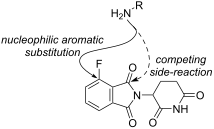
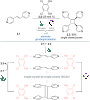
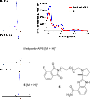
- formed due to the decomposition of DMF. Whereas switching the solvent could prevent its formation, the accumulation of 7 remained an issue, giving no substantial improvement in the yield of 3 in, for example, NMP. In MeCN, glutarimide displacement became a major reaction. Because NMP was significantly
- more difficult to remove after the reaction, and 4-(dimethylamino)thalidomide could be separated from 3 easily, we opted to keep DMF as the solvent. We only detected by LC–MS a trace amount of the secondary byproduct derived from SNAr of 6 or glutarimide displacement of 3 by 2. To understand the extent
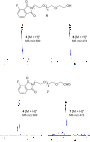
- develop a method to facilitate the elimination of this impurity. We first attempted scavenging 6 by solid-phase supported amines. Incubating a mixture of 3 and 6 with TentaGel S-NH2 in DMF led to a gradual decrease of 6 over four days. Whereas this method is applicable to removing 9 of different PEG-OH




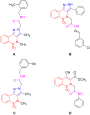
Synthesis, characterization, antimicrobial, cytotoxic and carbonic anhydrase inhibition activities of multifunctional pyrazolo-1,2-benzothiazine acetamides
Beilstein J. Org. Chem. 2025, 21, 348–357, doi:10.3762/bjoc.21.25
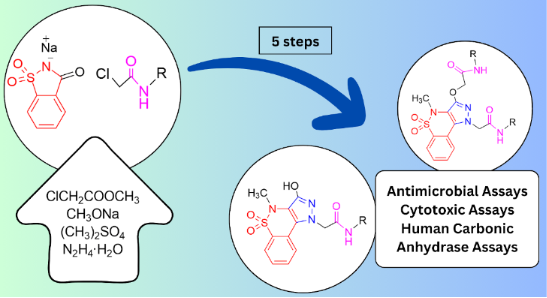
- dry DMF. The five-membered ring of this esterified benzisothiazole 2 was then expanded to form a six-membered cycle via a ring-expansion reaction in anhydrous conditions. In this reaction, the benzisothiazole scaffold was converted into a benzothiazine backbone 3 followed by N-methylation to obtain


Molecular diversity of the reactions of MBH carbonates of isatins and various nucleophiles
Beilstein J. Org. Chem. 2025, 21, 286–295, doi:10.3762/bjoc.21.21
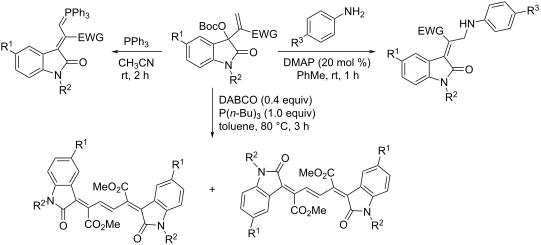
- was found that the reaction did not proceed in DMF as solvent (Table 1). When the reaction was carried out in dichloromethane, dichloroethane, acetonitrile, and toluene, the expected product 3a was produced in low yields (entries 2–5 in Table 1). The reaction in toluene at elevated temperature

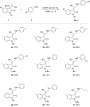


Synthesis and characterizations of highly luminescent 5-isopropoxybenzo[rst]pentaphene
Beilstein J. Org. Chem. 2025, 21, 270–276, doi:10.3762/bjoc.21.19
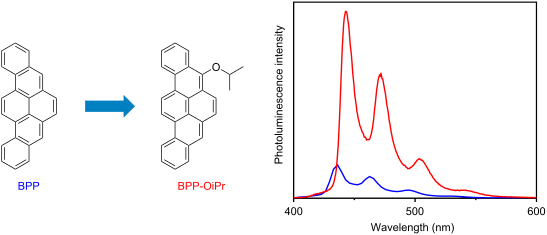
- (Figure 2c). In contrast, BPP-dione 4 displayed a considerable redshift of the emission maximum from 538 nm in toluene to 572 nm in dimethylformamide (DMF) along with disappearance of the shoulder peak with increasing solvent polarity (Figure 2d). The UV–vis absorption spectra of 4 in different solvents
- toluene, and BPP-t-Bu (excitation at 360 nm) [22], c) normalized PL spectra of BPP-OiPr 3 measured in hexane, toluene, tetrahydrofuran (THF), dichloromethane (CH2Cl2), and DMF, and d) normalized PL spectra of BPP-dione 4 measured in toluene, THF, CH2Cl2, and DMF. SEM images of BPP-OiPr showing: a) the




Synthesis of disulfides and 3-sulfenylchromones from sodium sulfinates catalyzed by TBAI
Beilstein J. Org. Chem. 2025, 21, 253–261, doi:10.3762/bjoc.21.17
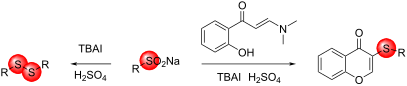
- been further decreased, in the end, 0.5 mL of DMF was used because of the solubility of the reagents. Increasing the amount of catalyst to 20 mol % resulted in a significant increase in the yield, but further increases did not significantly change the yield (Table 1, entries 14 and 15). A decrease in
- salts gave relatively lower yields (Table 1, entries 20 and 21). The replacement of the catalyst with tetrabutylammonium bromide (TBAB) gave no product (Table 1, entry 22). Finally, sulfuric acid as the acidifying agent, tetrabutylammonium iodide as the catalyst, DMF as the solvent and carrying out the
- -hydroxyacetophenone and N,N-dimethylformamide dimethyl acetal (DMF-DMA) were reacted at 120 °C to give compound 3a, and without further isolation and purification, 1a, H2SO4 and TBAI were added directly to the reaction solution and the reaction was continued at 120 °C for 12 hours. In this way, the product 4a could



Visible-light-promoted radical cyclisation of unactivated alkenes in benzimidazoles: synthesis of difluoromethyl- and aryldifluoromethyl-substituted polycyclic imidazoles
Beilstein J. Org. Chem. 2025, 21, 234–241, doi:10.3762/bjoc.21.15
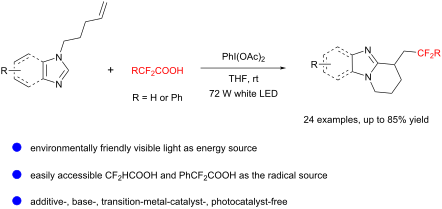
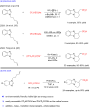
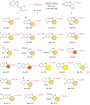
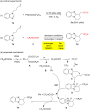
- transformation (Table 1, entries 2 and 3), and PIDA was the most efficient promoter. Changing THF to other solvents, such as DCM, EtOH, DMF, CH3CN, EtOAc, or DMSO, resulted in a lower yield (Table 1, entries 4–9). Furthermore, variations in the amounts of PIDA or CF2HCOOH led to diminished yields (Table 1


Heteroannulations of cyanoacetamide-based MCR scaffolds utilizing formamide
Beilstein J. Org. Chem. 2025, 21, 217–225, doi:10.3762/bjoc.21.13
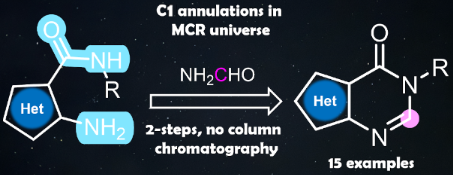
- determined that harsher reaction conditions than for the synthesis of 5 were required for the targeted adducts 6 to form. Additional treatment with DIPEA/DMF afforded the corresponding substituted quinolinopyrimidones 6a–e in 47–65% total yield (2 steps) within 12–16 h. Notably, the products carried a series




Nickel-catalyzed cross-coupling of 2-fluorobenzofurans with arylboronic acids via aromatic C–F bond activation
Beilstein J. Org. Chem. 2025, 21, 146–154, doi:10.3762/bjoc.21.8
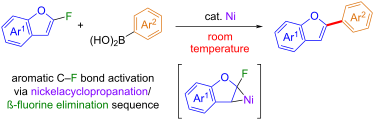
- JMS-T100GCV or a JEOL JMS-T200GC spectrometer. All the reactions were conducted under argon or nitrogen. Materials: Column chromatography was conducted on silica gel (Silica Gel 60 N, Kanto Chemical Co., Inc.). Toluene and N,N-dimethylformamide (DMF) were purified by a solvent-purification system



Hot shape transformation: the role of PSar dehydration in stomatocyte morphogenesis
Beilstein J. Org. Chem. 2025, 21, 47–54, doi:10.3762/bjoc.21.5
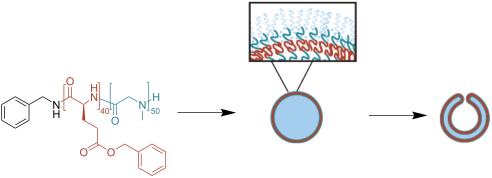
- the PSar-PBLG block copolymers was optimally achieved by dissolving the block copolymers in DMF followed by a solvent-exchange method. Here, Milli-Q water was gradually introduced to form monodisperse polymersomes (Figure 1i, and Supporting Information File 1, Figure S22). Hexafluoroisopropanol (HFIP
- ) emerged as another solvent yielding monodisperse assemblies. HFIP promotes formation of alpha helices in peptides and this property yielded vesicles with different morphologies [30]. The resulting vesicles looked darker compared to those formed in DMF, as observed through TEM (Supporting Information File
- 1, Figure S21). For the shape transformation experiments only the vesicles assembled in DMF were used. To validate the structure of the self-assembly, cryo-TEM was conducted, revealing that the obtained vesicles exhibited a wrinkled appearance, differing from the typically round vesicles observed in


Emerging trends in the optimization of organic synthesis through high-throughput tools and machine learning
Beilstein J. Org. Chem. 2025, 21, 10–38, doi:10.3762/bjoc.21.3
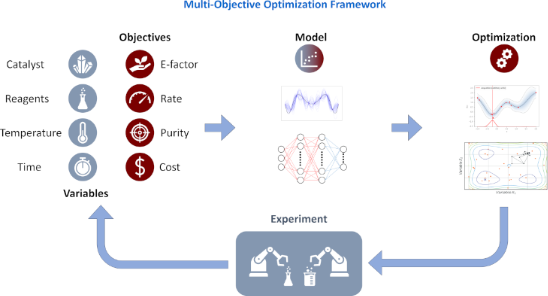
- with feedback DOE facilitated the rapid identification of appropriate solvents. Notably, the use of DMSO, DMF, and pyridine led to an enhanced yield of the monoalkylated product. An experimental setup was developed for single-droplet studies of visible-light photoredox catalysis using an oscillatory


Synthesis, characterization, and photophysical properties of novel 9‑phenyl-9-phosphafluorene oxide derivatives
Beilstein J. Org. Chem. 2024, 20, 3299–3305, doi:10.3762/bjoc.20.274
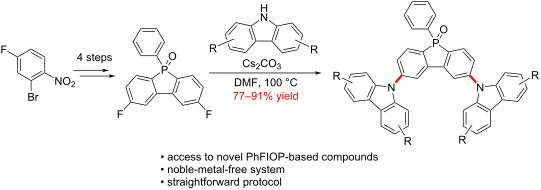
- delight, by treatment of 5 with substituted carbazoles 6 in the presence of Cs2CO3 (5.0 equiv) in DMF at 100 °C, seven 2,8-bis(9H-carbazol-9-yl)-5-phenylbenzo[b]phosphindole 5-oxide derivatives 7 were furnished in good to excellent yields (77–91%). The structural characterization of the obtained molecules




Reactivity of hypervalent iodine(III) reagents bearing a benzylamine with sulfenate salts
Beilstein J. Org. Chem. 2024, 20, 3281–3289, doi:10.3762/bjoc.20.272
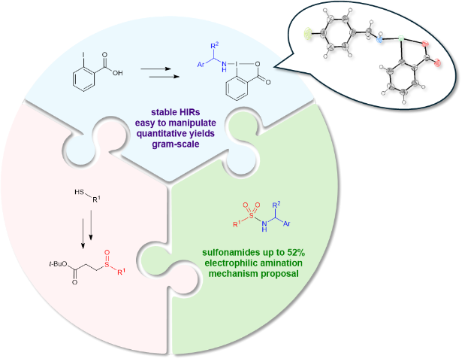
- 5aa (Table 1, entry 2) but with prior degassed solvent (DMF), to prevent potential oxidation of the sulfenate to sulfinate anions. Indeed, the oxidation of the unstable sulfenate intermediates has been previously reported by Waser when using EBX – an HIR applied in the transfer of alkynes to sulfenate
- – room temperature. Scope of the primary amine electrophilic reaction of sulfenate salts. Reaction conditions: 4 (2 equiv), NaH (2.4 equiv), 2, degassed DMF (0.055 M). Isolated yields. rt – room temperature; NO – not observed. Electrophilic amination reaction in the presence of TEMPO. Reaction conditions
- : 4a (2 equiv), NaH (2.4 equiv), 2a, TEMPO (10 mol %), degassed DMF (0.055 M). NO – not observed. Mechanism proposed for sulfonamide 5, β-sulfinyl ester 4, disulfide 7, and sulfide 3 formations. The ionic steps are illustrated in green, whereas the radical steps appear in purple [35]. Optimization of



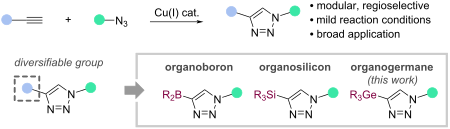
Germanyl triazoles as a platform for CuAAC diversification and chemoselective orthogonal cross-coupling
Beilstein J. Org. Chem. 2024, 20, 3198–3204, doi:10.3762/bjoc.20.265
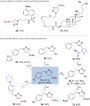
- ) Functionalisation of germylated triazoles. Isolated yields unless stated. (i) Pd(PPh3)4 (10 mol %), 2-bromothiazole (1.2 equiv), KCl (3.0 equiv), PhMe/EtOH 4:1, N2, 100 °C, 16 h. NMR yield in parentheses. (ii) Pd2(dba)3 (2.5 mol %), iodobenzene (1.5 equiv), AgBF4 (1.5 equiv), DMF, N2, 80 °C, 16 h. (iii) NBS (2.0
- equiv), DMF, air, rt, 2 h. (iv) Pd(dtbpf)Cl2 (10 mol %), 2-acetylthiophen-3-ylboronic acid (1.2 equiv), K3PO4 (2.0 equiv), iPrOH/H2O 3:4, N2, 85 °C, 16 h. (v) Pd(dtbpf)Cl2 (2.0 mol %), 1-naphthylzinc bromide (1.2 equiv), THF, N2, 45 °C, 16 h. (vi) Cu(OAc)2·H2O (30 mol %), B(OH)3 (2.0 equiv), DBU (2.0


Synthesis of 2H-azirine-2,2-dicarboxylic acids and their derivatives
Beilstein J. Org. Chem. 2024, 20, 3191–3197, doi:10.3762/bjoc.20.264
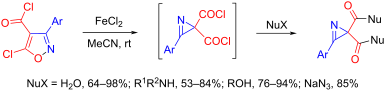
- derivatives, were synthesized using two reaction sequences (Table 1). The first sequence involved the chloroformylation of isoxazolones 3 to 5-chloroisoxazole-4-carbaldehydes 4 by POCl3/DMF [20][21][22][23], followed by radical chlorination of 4 with SO2Cl2/AIBN [24]. The alternative route to acid chlorides 1





Synthesis of extended fluorinated tripeptides based on the tetrahydropyridazine scaffold
Beilstein J. Org. Chem. 2024, 20, 3174–3181, doi:10.3762/bjoc.20.262
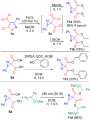
- on an intramolecular Michael addition carried out in DMF and catalyzed by 10% of potassium carbonate. As previously observed [37], under these conditions, the 5-endo-trig cyclization was selective and the lactam resulting from the 5-exo-trig cyclization was not observed. Furthermore, in the case of


Cyclodextrin-based rotaxanes for polymer materials: challenge on simultaneous realization of inexpensive production and defined structures
Beilstein J. Org. Chem. 2024, 20, 3026–3049, doi:10.3762/bjoc.20.252
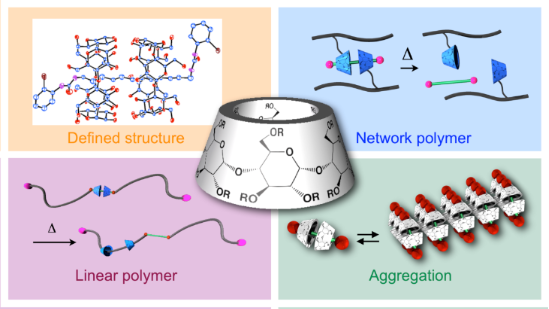
- molecule must be sufficiently long to penetrate the CD cavity and be available for the end-capping reactions, (3) the inclusion complex must dissolve appropriately, (4) the solvent must not decompose the inclusion complex (water or other polar organic solvents, such as dimethylformamide (DMF) and dimethyl
- polymer has been desired. To resolve this issue, utilizing a mixed solvent at the inclusion-formation step was considered an option. For the pseudopolyrotaxane comprising poly(caprolactone) and α-CD in a DMF/water mixed solvent, the increase in the DMF caused a decrease in the coverage ratio and product
- fluorescence (Figure 15C,D). Namely, the fluorescence of the initial RCP in DMF was observed as a blue emission by the naked eye, while according to the degradation, the dumbbell species spread throughout the solution and the [3]rotaxane structure disappeared, resulting in the light green color fluorescence of






Synthesis of pyrrole-fused dibenzoxazepine/dibenzothiazepine/triazolobenzodiazepine derivatives via isocyanide-based multicomponent reactions
Beilstein J. Org. Chem. 2024, 20, 2870–2882, doi:10.3762/bjoc.20.241
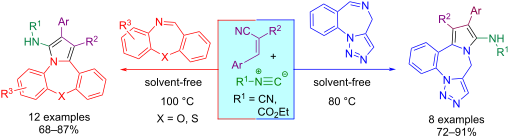
- , and DMF at different temperatures (Table 1, entries 3–9). The result obtained from the study of solvents showed that pyrrole-fused dibenzoxazepine 4a was obtained with a yield of 56% in ethanol as solvent at a temperature of 78 °C (Table 1, entry 4). To achieve a higher yield of product 4a, the


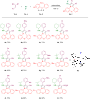
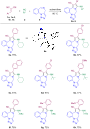

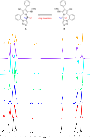


N-Glycosides of indigo, indirubin, and isoindigo: blue, red, and yellow sugars and their cancerostatic activity
Beilstein J. Org. Chem. 2024, 20, 2840–2869, doi:10.3762/bjoc.20.240
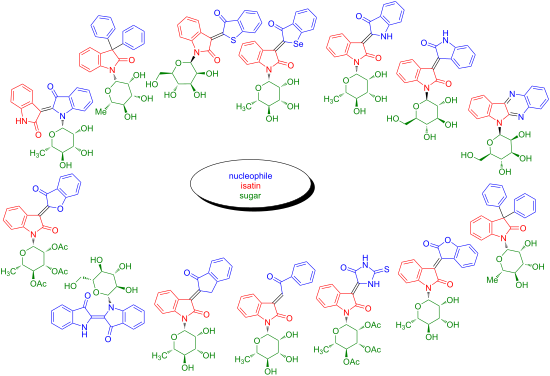
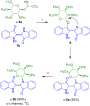
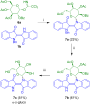
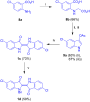
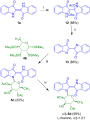
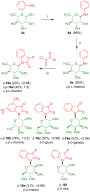
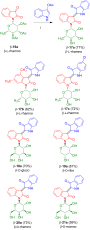
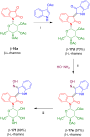
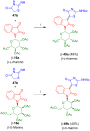
- ). Dehydrogenation of the latter with DDQ afforded the anomerically pure indol-N-glycoside β-26a which upon benzylation and methylation gave products β-27a and β-27b, respectively. Iodination gave products β-28a and β-28b, however, due to the basic reaction conditions (I2, NaOH, DMF), ether rather than ester











Multicomponent synthesis of α-branched amines using organozinc reagents generated from alkyl bromides
Beilstein J. Org. Chem. 2024, 20, 2834–2839, doi:10.3762/bjoc.20.239
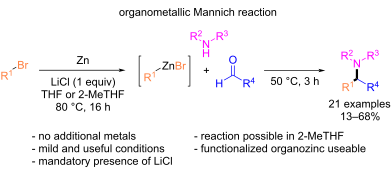
- presence of LiCl in THF for the metalation of alkyl bromides at room temperature [19]. Besides, Huo described the insertion of zinc dust into alkyl bromides at 80 °C in DMA or DMF [20]. Despite the high synthetic interest in mixed organozinc compounds, their use in the preparation of α-branched amines


Synthesis and antimycotic activity of new derivatives of imidazo[1,2-a]pyrimidines
Beilstein J. Org. Chem. 2024, 20, 2806–2817, doi:10.3762/bjoc.20.236
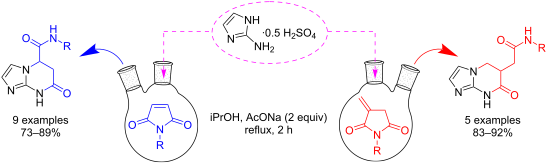
- on the analysis of existing data [28], taking into account experimentally obtained data on the solubility of the starting reagents. The tested solvents were dioxane, PhMe, MeOH, EtOH, iPrOH, MeCN, and DMF (dimethylformamide). Sodium acetate as an additive was necessary for converting 2-aminoimidazole
- conversion of the reagents was not achieved until after 12 h of boiling, and the yield of the product varied in the range of 25–35% (entries 1 and 2, Table 1). In the cases of DMF and MeCN, the formation of complex, inseparable mixtures of numerous intermediates and products of their subsequent
- acetate (0.82 g, 10 mmol), and iPrOH (10 mL) was boiled for 1 h. The resulting precipitate was filtered off, washed with water (2 × 5 mL) and recrystallized from a mixture of DMF/iPrOH 1:2. The title compounds were obtained as white (4a–e) or pink (4f–i) solids. General procedure for the synthesis of N


Synthesis and cytotoxicity studies of novel N-arylbenzo[h]quinazolin-2-amines
Beilstein J. Org. Chem. 2024, 20, 2592–2598, doi:10.3762/bjoc.20.218
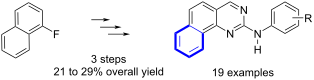
- should allow us to introduce the molecular diversity on the anilino moiety in the last step through a palladium-catalyzed reaction (Scheme 1). Therefore, we prepared first the core structure 3 in two steps from the commercially available fluoronaphthalene 1. Metallation, followed by trapping with DMF
- stirred at −78 °C for 2 h, and then dry DMF (3.3 mL, 0.041 mol) was added. After stirring for 2 h at −78 °C, the mixture was quenched with water and the crude product was extracted with ethyl acetate (30 mL × 3). The combined organic phase was dried over anhydrous Na2SO4, filtered and concentrated under


Transition-metal-free synthesis of arylboronates via thermal generation of aryl radicals from triarylbismuthines in air
Beilstein J. Org. Chem. 2024, 20, 2577–2584, doi:10.3762/bjoc.20.216
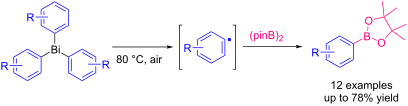
- quantitatively (Table 1, entry 8). Furthermore, instead of BTF, the reaction was carried out with similarly polar CHCl3, polar and aprotic CH3CN, DMF, DMSO, and protic EtOH, and it was found that BTF was the optimal solvent for the synthesis of 3a (Table 1, entry 2 vs entries 9–13). Based on the optimized