


Search results
Search for "probability" in Full Text gives 408 result(s) in Beilstein Journal of Organic Chemistry. Showing first 200.
Beyond symmetric self-assembly and effective molarity: unlocking functional enzyme mimics with robust organic cages
Beilstein J. Org. Chem. 2025, 21, 421–443, doi:10.3762/bjoc.21.30
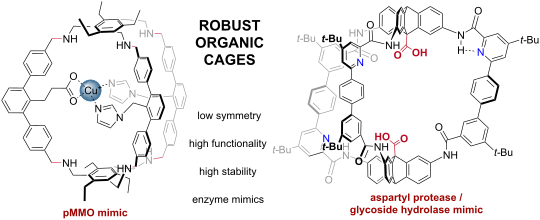
- catalysis, rather than the more rigidly preorganized functionality required for transition-state binding. If it is easier for a cage to flex [146] or disassemble than to withstand the strain of a transition barrier, the entropic probability of effective transition-state binding is reduced (one can imagine


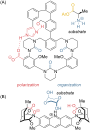


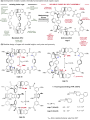
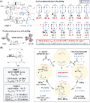
The effect of neighbouring group participation and possible long range remote group participation in O-glycosylation
Beilstein J. Org. Chem. 2025, 21, 369–406, doi:10.3762/bjoc.21.27
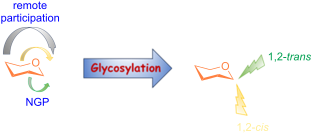
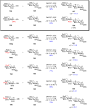
- protection: The pivaloyl (OPiv) ester is another such participating ester protection with decreased migratory properties. Moreover, the intrinsic neopentyl property of the ester significantly reduces the probability of nucleophilic attack at the oxocarbenium centre instead of the anomeric carbon, thereby




Synthesis and characterizations of highly luminescent 5-isopropoxybenzo[rst]pentaphene
Beilstein J. Org. Chem. 2025, 21, 270–276, doi:10.3762/bjoc.21.19
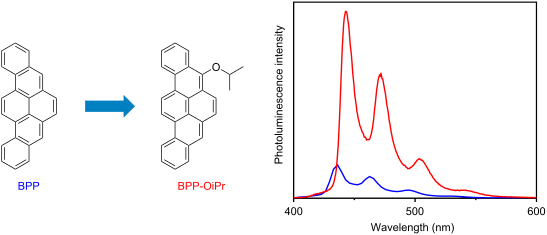
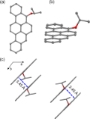
- BPP-OiPr 3: a) top view, b) side view (thermal ellipsoids shown at 50% probability), and c) molecular packing of 3 in a unit cell. All the hydrogen atoms are omitted for clarity. a) UV–vis absorption spectra of BPP 2, BPP-OiPr 3, and BPP-dione 4 measured in toluene. Inset: magnified spectra of 2 and 3




Hydrogen-bonded macrocycle-mediated dimerization for orthogonal supramolecular polymerization
Beilstein J. Org. Chem. 2025, 21, 179–188, doi:10.3762/bjoc.21.10
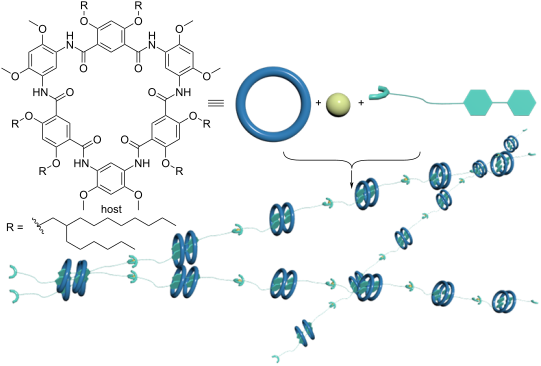
- the macrocycle marginally influenced the new set of signals, suggesting formation of an n:n complex of H1 and G2. Job plot experiments afforded a stoichiometry of n:n (Figure S10, Supporting Information File 3), purporting the probability of 2:2 complexation in solution. A strong indication of the



Synthesis, structure and π-expansion of tris(4,5-dehydro-2,3:6,7-dibenzotropone)
Beilstein J. Org. Chem. 2025, 21, 1–7, doi:10.3762/bjoc.21.1
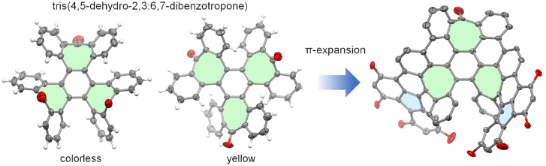
- crystallography. Structures of compounds 1–3 and the polycyclic skeleton of 1 as mapped on a carbon schwarzite unit cell. (a) Structures of 1 in the colorless crystal; (b) structures of (P,M,P)-1 in the yellow crystal. (Carbon atoms are shown as ellipsoids at 50% probability level, in and H atoms are removed for
- clarification). Structure of (M,P,M)-3 in the crystal of 3·CH2Cl2 (carbon and oxygen atoms are shown as grey and red ellipsoid at the level of 50% probability, and hexyl groups and hydrogen atoms are removed for clarity). UV–vis absorption spectrum (black line) and emission spectrum (blue line, excited at 400


Reactivity of hypervalent iodine(III) reagents bearing a benzylamine with sulfenate salts
Beilstein J. Org. Chem. 2024, 20, 3281–3289, doi:10.3762/bjoc.20.272
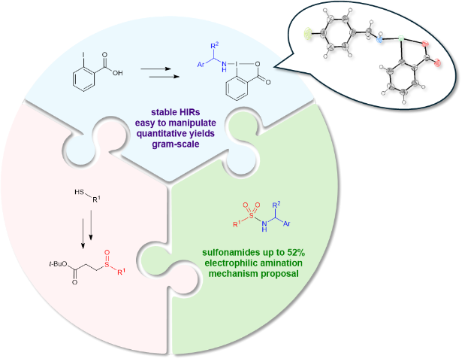
- )benziodoxolones (BBXs) 2 with ORTEP-3 diagram of compound 2d, using 50% probability level ellipsoids. One co-crystallized water molecule was omitted for clarity. CCDC 2368436 contains the supporting crystallographic data for this paper. Scope of the different β-sulfinyl esters 4 [32][33]. Isolated yields. rt



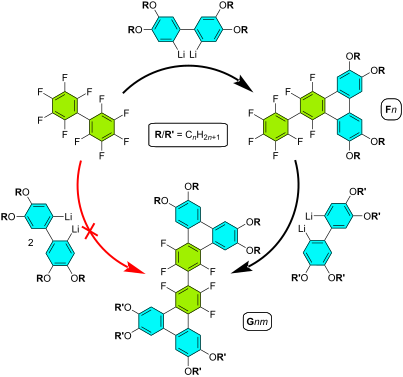
Efficient synthesis of fluorinated triphenylenes with enhanced arene–perfluoroarene interactions in columnar mesophases
Beilstein J. Org. Chem. 2024, 20, 3263–3273, doi:10.3762/bjoc.20.270
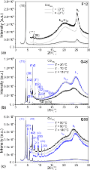
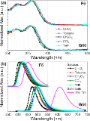
- along the main axes: ORTEP diagram showing 50% thermal ellipsoid probability: carbon (gray), fluorine (green), and hydrogen (white). POM textures, observed between crossed polarizers of Janus and dimer, F6, F12, G66, and G48, respectively, as representative examples. More images can be seen in



Controlled oligomerization of [1.1.1]propellane through radical polarity matching: selective synthesis of SF5- and CF3SF4-containing [2]staffanes
Beilstein J. Org. Chem. 2024, 20, 3134–3143, doi:10.3762/bjoc.20.259
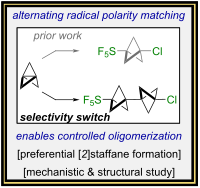
- moieties in the asymmetric axis viewed along the b-axis. (B) The asymmetric unit of 3 at 90 K viewed along the c-axis. Thermal displacement ellipsoids depicted at 50% probability. Effect of [1.1.1]propellane (1) equivalents relative to SF5Cl on selectivitya. Effect of [1.1.1]propellane (1) equivalents


The charge transport properties of dicyanomethylene-functionalised violanthrone derivatives
Beilstein J. Org. Chem. 2024, 20, 2921–2930, doi:10.3762/bjoc.20.244
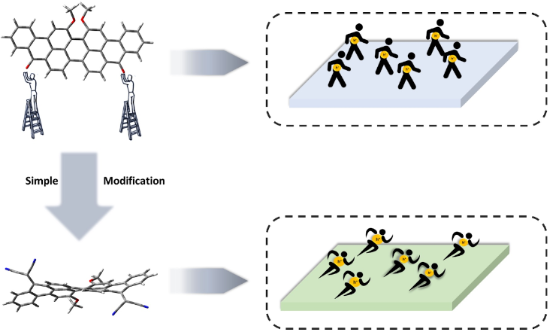
- dihydroxyviolanthrone. Chemical structures of 2b and 3b. Optimised ground state geometries of compounds 2 and 3 calculated using B3LYP/6-311G(d,p) in the gas phase. Views of the crystal structure of 3b (left, shows displacement ellipsoids drawn at 50% probability level, right showing the twisted conformation


C–C Coupling in sterically demanding porphyrin environments
Beilstein J. Org. Chem. 2024, 20, 2784–2798, doi:10.3762/bjoc.20.234
- (top right) with atomic displacements at 50% probability and hydrogen atoms omitted for clarity. Bottom left: Neoplastic representation of the molecular symmetry of compound 26. Bottom right: Neoplastic representation of the molecular symmetry of compound 27. Left: packing diagram of 27 viewed normal
- for clarity. Left: view of part 0 2 in the molecular structure of the α2β2-atropisomer, 11 in the crystal, hydrogen atoms omitted for clarity. Displacement parameters shown at 50% probability and heteroatoms labelled only. Right: view of part 0 1 of the molecular structure of the α2β2-atropisomer, 11
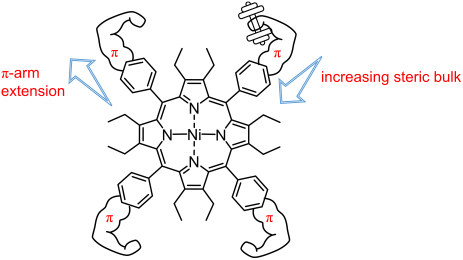
- in the crystal. Displacement parameters shown at 50% probability and heteroatoms labelled only. Schematic representation of porphyrin 37 showing a doubly intercalated structure. Reaction scheme for the synthesis of OET-xBrPPs and subsequent Ni(II) metalation. Scope of arm-extended dodecasubstituted


Machine learning-guided strategies for reaction conditions design and optimization
Beilstein J. Org. Chem. 2024, 20, 2476–2492, doi:10.3762/bjoc.20.212
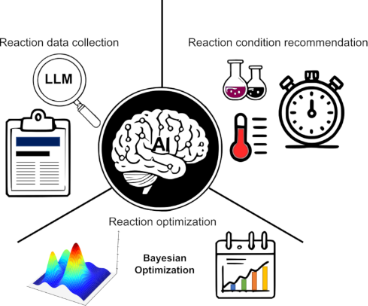
- density estimators to efficiently explore parameter space. This method updates prior probability distributions with new experimental results and optimizes the reaction conditions by focusing on regions of the parameter space predicted to improve objectives. The power of BO lies in its ability to balance


HFIP as a versatile solvent in resorcin[n]arene synthesis
Beilstein J. Org. Chem. 2024, 20, 2469–2475, doi:10.3762/bjoc.20.211
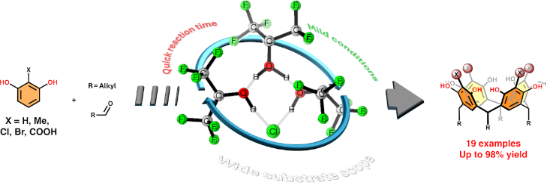
- set at 50% probability level. Resorcin[n]arene synthesis. Scope of resorcin[n]arene synthesis using HFIP. aAll reactions were performed with resorcinol (1.0 mmol), aldehyde (1.0 mmol), and HCl (30 mol %) in HFIP (5 mL) at room temperature, and the yields of the reactions are given as isolated yields


Synthesis and conformational analysis of pyran inter-halide analogues of ᴅ-talose
Beilstein J. Org. Chem. 2024, 20, 2442–2454, doi:10.3762/bjoc.20.208
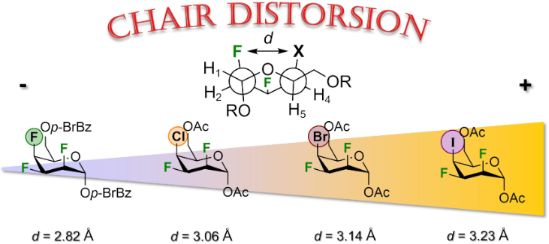
- , 17, and α-ᴅ-talose 18. ORTEP diagram showing 50% thermal ellipsoid probability (except for 18): carbon (gray), oxygen (red), fluorine (green), chlorine (orange), bromine (dark red), iodine (purple), and hydrogen (white). Packing arrangement of compound compound 15; a) View down the b axis; b
- ) proposed intermolecular interactions involving halogens. ORTEP diagram showing 50% thermal ellipsoid probability: carbon (gray), oxygen (red), fluorine (green), iodine (purple), and hydrogen (white). Synthesis of halogenated talopyranose analogues 13–15, and 17 that include a 2,3-cis, 3,4-cis relationship


Evaluating the halogen bonding strength of a iodoloisoxazolium(III) salt
Beilstein J. Org. Chem. 2024, 20, 2401–2407, doi:10.3762/bjoc.20.204
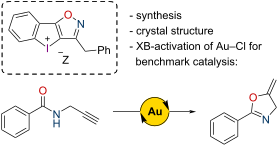
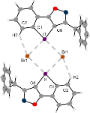
- ). Halogen bonding dimer found in the crystal structure of 7Br. Ellipsoids are shown at 50% probability (carbon: grey, nitrogen: blue, oxygen: red, bromine: orange, iodine: purple) and hydrogen atoms are shown in standard ball-and-stick model (white). Halogen and hydrogen bonding is indicated dashed. 1H NMR




Synthesis, electrochemical properties, and antioxidant activity of sterically hindered catechols with 1,3,4-oxadiazole, 1,2,4-triazole, thiazole or pyridine fragments
Beilstein J. Org. Chem. 2024, 20, 2378–2391, doi:10.3762/bjoc.20.202
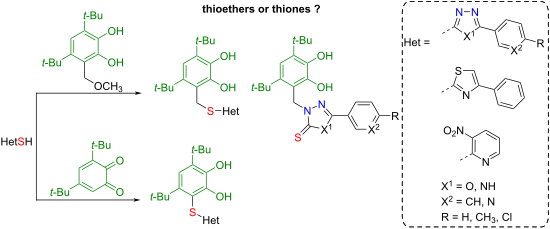
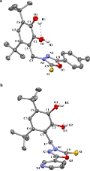
- ellipsoids of 50% probability). The hydrogen atoms except those of hydroxy groups are omitted. The X-ray structures of catechols 6 (a) and 8 (b) (the thermal ellipsoids of 50% probability). The hydrogen atoms except those of hydroxy groups are omitted. Fragment of the pack of catechol 5 in crystal (the H




O,S,Se-containing Biginelli products based on cyclic β-ketosulfone and their postfunctionalization
Beilstein J. Org. Chem. 2024, 20, 2143–2151, doi:10.3762/bjoc.20.184
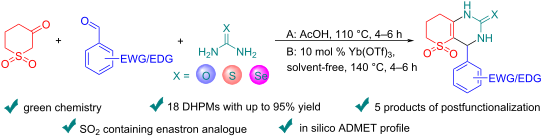
- of condensed thiazoles and tetrazoles. In silico assessment of ADMET parameters shows that most compounds meet the lead-likeness requirements. The biological profiles of new compounds demonstrate high probability levels of activity against the following pathogens/diseases: Candida albicans, Alphis
- biotargets (pathogens, species, diseases) for new synthesized compounds. If we focus on high levels of biological activity probability (80% and above), the following pathogens and diseases may be potential areas of interest: Alphis gossypii, Tripomastigote Chagas, Candida albicans, Tcruzi amastigota



Radical reactivity of antiaromatic Ni(II) norcorroles with azo radical initiators
Beilstein J. Org. Chem. 2024, 20, 1967–1972, doi:10.3762/bjoc.20.172
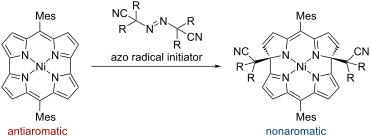
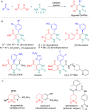
- governed the regioselectivity. Reactivities of norcorroles with various reagents. Top and side views of the X-ray structures of a) 2a and b) 1 [2]. Mesityl groups and hydrogen atoms were omitted for clarity. Thermal ellipsoids are drawn at 50% probability. UV–vis–NIR absorption spectra of 1 and 2a in


Ugi bisamides based on pyrrolyl-β-chlorovinylaldehyde and their unusual transformations
Beilstein J. Org. Chem. 2024, 20, 1773–1784, doi:10.3762/bjoc.20.156
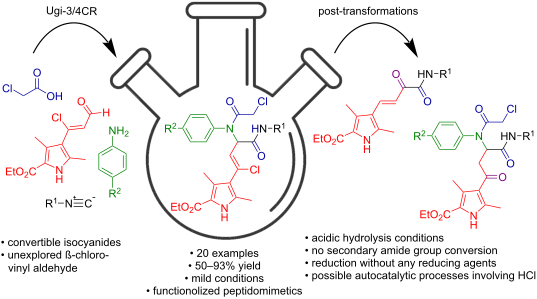
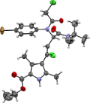
- . Molecular structure of ethyl (Z)-4-(3-(N-(4-bromophenyl)-2-chloroacetamido)-4-(tert-butylamino)-1-chloro-4-oxobut-1-en-1-yl)-3,5-dimethyl-1H-pyrrole-2-carboxylate (8c) according to the X-ray diffraction study. Non-hydrogen atoms are presented as thermal ellipsoids with 50% probability. Molecular structure
- of ethyl (E)-4-(4-(tert-butylamino)-3,4-dioxobut-1-en-1-yl)-3,5-dimethyl-1H-pyrrole-2-carboxylate (10d) according to X-ray diffraction data. Non-hydrogen atoms are presented as thermal ellipsoids with 50% probability. Molecular structure of ethyl 4-(3-(N-(4-bromophenyl)-2-chloroacetamido)-4-(tert
- -butylamino)-4-oxobutanoyl)-3,5-dimethyl-1H-pyrrole-2-carboxylate (12e) according to the X-ray diffraction data. Non-hydrogen atoms are presented as thermal ellipsoids with 50% probability. The use of α,β-unsaturated aldehydes in the Ugi reaction. Comparison of isocyanide conversion conditions. Hydrolysis of




Harnessing unprotected deactivated amines and arylglyoxals in the Ugi reaction for the synthesis of fused complex nitrogen heterocycles
Beilstein J. Org. Chem. 2024, 20, 1758–1766, doi:10.3762/bjoc.20.154
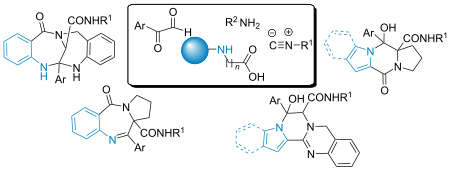
- (right). The thermal ellipsoid plot (Olex2) is at the 40% probability level. X-ray diffraction structure of dipyrrolopiperazinone 12c. The thermal ellipsoid plot (Olex2) is at the 40 % probability level. Synthesis of benzodiazepinones 5 from anthranilic acid derivatives. Diastereoselective one-pot


Oxidation of benzylic alcohols to carbonyls using N-heterocyclic stabilized λ3-iodanes
Beilstein J. Org. Chem. 2024, 20, 1677–1683, doi:10.3762/bjoc.20.149
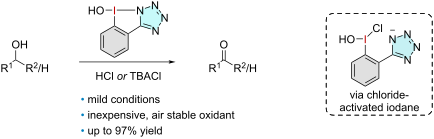
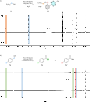
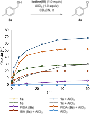
- coordination of the triflate to two positions of the iodane. Thermal ellipsoids are displayed with 50% probability. Selected bond lengths and angles: I1–N1: 2.44(4) Å; I1–O1: 1.94(9) Å; I1–O2: 3.04(1) Å; C1–I1–N1: 73.5(8)°; O1–I1–N1: 166.6(5)°; N1–I1–C1–O1: 177.8(3)°. 1H NMR spectra of the time-dependent




Generation of multimillion chemical space based on the parallel Groebke–Blackburn–Bienaymé reaction
Beilstein J. Org. Chem. 2024, 20, 1604–1613, doi:10.3762/bjoc.20.143

- the relatively high computational costs of this method, we randomly selected 50,000 compounds to represent each database. The dimension reduction algorithm uses molecular features as the starting inputs to generate a few coordinates (in this case, t-SNE1 and t-SNE2) reflecting the probability of the


Synthesis of substituted triazole–pyrazole hybrids using triazenylpyrazole precursors
Beilstein J. Org. Chem. 2024, 20, 1396–1404, doi:10.3762/bjoc.20.121
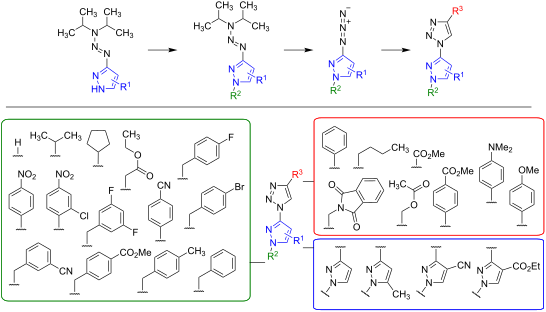
- ORTEP diagrams of triazole products 21sd and 21vg with the thermal ellipsoids shown at 50% probability. NaAsc = sodium ascorbate. One-pot synthesis of triazole–pyrazole hybrid 21gd. aOne-pot setup yielded 21gd with unknown impurities; bwith an additional evaporation step after the triazene cleavage, a




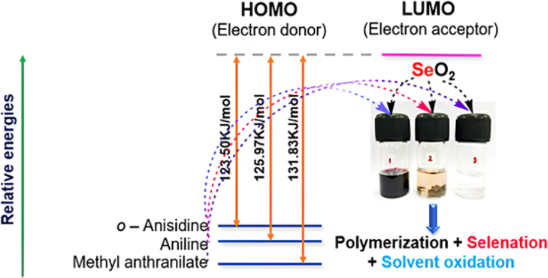
Competing electrophilic substitution and oxidative polymerization of arylamines with selenium dioxide
Beilstein J. Org. Chem. 2024, 20, 1221–1235, doi:10.3762/bjoc.20.105
- + Na]+ calcd for C54H48N6NaO18, 1091.2917; found, 1091.2885; FTIR (KBr) ν̃max: 3444, 3354, 1677, 1625, 1423, 1304, 1237, 820 cm−1. X-ray data Table 2 and Table 3 show single-crystal X-ray structure refinement data. Molecular structure of 3. Thermal ellipsoids drawn at 50% probability. Selected bond
- lengths (Å): O(1)–C(7) 1.2207 (16), N(1)–C(7) 1.3356 (17), N(1)–C(1) 1.4193 (16), N(1)–H(1) 0.8600. Molecular structure of 9. Thermal ellipsoids drawn at 50% probability. Selected bond lengths (Å): O(1)–C(7) 1.2192 (18), N(1)–C(7) 1.3396, N(1)–C(1) 1.4050 (19), N(1)–H(1) 0.8600, O(2)–C(2) 1.3674 (18), O(2
- )–C(8) 1.420 (2). Molecular structure of 13. Thermal ellipsoids drawn at 50% probability. Selected bond lengths (Å): O(3)–C(7) 1.2070 (16), O(1)–C(7) 1.3322 (16), N(1)–H(1) 0.8600, N(1)–C(6) 1.4044 (16), N(1)–C(9) 1.3440 (16), O(2)–C(9) 1.2160 (16). Molecular structure of 10. Thermal ellipsoids drawn


Two-fold addition reaction of silylene to C60: structural and electronic properties of a bis-adduct
Beilstein J. Org. Chem. 2024, 20, 1179–1188, doi:10.3762/bjoc.20.100
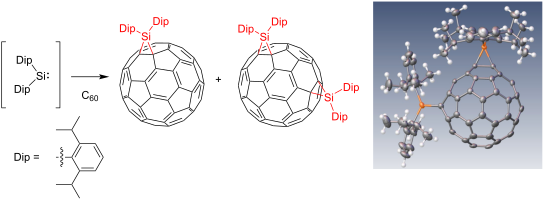
- C60 and quaternary carbons of the Dip groups are indicated by grey circles. ORTEP drawing of 3 showing thermal ellipsoids at the 50% probability level at 100 K. Hydrogen atoms are omitted for clarity. (a) Partial structures of isomers of Dip2SiC60. (b) Optimized structures of 2a and 2c. Hydrogen atoms


Mild and efficient synthesis and base-promoted rearrangement of novel isoxazolo[4,5-b]pyridines
Beilstein J. Org. Chem. 2024, 20, 1069–1075, doi:10.3762/bjoc.20.94
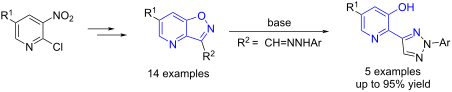
- molecule is not shown), 13c (top right), and 13d (bottom) with thermal ellipsoids set at a 50% probability level. Intermolecular hydrogen bonds are drawn with dashed lines. Methods for the synthesis of isoxazolo[4,5-b]pyridines: (A) annulation of an isoxazole fragment to a pyridine ring; (B) annulation of





