


Search results
Search for "C–H" in Full Text gives 776 result(s) in Beilstein Journal of Organic Chemistry. Showing first 200.
Synthesis of acenaphthylene-fused heteroarenes and polyoxygenated benzo[j]fluoranthenes via a Pd-catalyzed Suzuki–Miyaura/C–H arylation cascade
Beilstein J. Org. Chem. 2024, 20, 3290–3298, doi:10.3762/bjoc.20.273
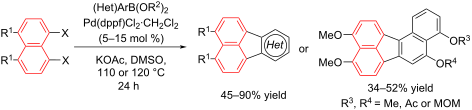
- %). This cascade involves an initial Suzuki–Miyaura cross-coupling reaction between 1,8-dihalonaphthalenes and heteroarylboronic acids or esters, followed by an intramolecular C–H arylation under the same conditions to yield the final heterocyclic fluoranthene analogues. The method was further employed to
- total synthesis of the fungal natural product bulgarein. Keywords: acenaphthylene-fused heteroarenes; benzo[j]fluoranthenes; C–H arylation; fluoranthenes; heterocycles; Introduction An important subclass of polycyclic aromatic hydrocarbons (PAHs) [1] is comprised of fluoranthenes, which have been the
- -based natural product, which was discovered to induce topoisomerase I-mediated DNA cleavage [16][17]. For the construction of the fluoranthene skeleton, a broad range of synthetic strategies including C–H arylation [18][19][20][21][22], Diels–Alder [7][8][23][24][25] and [2 + 2 + 2] cycloadditions [26




Intramolecular C–H arylation of pyridine derivatives with a palladium catalyst for the synthesis of multiply fused heteroaromatic compounds
Beilstein J. Org. Chem. 2024, 20, 3256–3262, doi:10.3762/bjoc.20.269
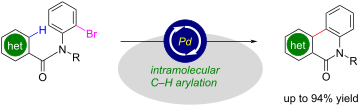
- Abstract The C–H arylation of 2-quinolinecarboxyamide bearing a C–Br bond at the N-aryl moiety is carried out with a palladium catalyst. The reaction proceeds at the C–H bond on the pyridine ring adjacent to the amide group in the presence of 10 mol % Pd(OAc)2 at 110 °C to afford the cyclized product in 42
- % yield, respectively. The related reaction is also carried out with amides of non-pyridine derivatives terephthal- and benzamides to afford multiply fused heterocyclic compounds in 81% and 89% yields, respectively. Keywords: intramolecular C–H arylation; multiply fused heterocycles; palladium acetate
- ; phosphine ligand; pyridine amides; Introduction Transition-metal-catalyzed synthetic reactions have recently attracted much attention in synthetic organic chemistry [1][2]. C–H Arylation reactions catalyzed by a transition metal are of particular interest because these reactions involve rather superior


Direct trifluoroethylation of carbonyl sulfoxonium ylides using hypervalent iodine compounds
Beilstein J. Org. Chem. 2024, 20, 3182–3190, doi:10.3762/bjoc.20.263
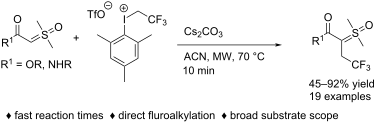
- ]. This synthetic potential has been demonstrated in a range of insertions into polar bonds [17][18][19][20], C−H activation transformations [21][22][23], and geminal difunctionalizations [24][25]. Within the literature, a broad array of classical methods describes the synthesis of sulfoxonium ylides [26


Multicomponent reactions driving the discovery and optimization of agents targeting central nervous system pathologies
Beilstein J. Org. Chem. 2024, 20, 3151–3173, doi:10.3762/bjoc.20.261

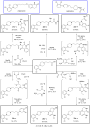
- a multicomponent reaction to obtain SIRT2 inhibitors (Scheme 12). The authors suggest a Knoevenagel condensation approach between isatin derivatives and ethyl cyanoacetate, followed by a Michael addition with C–H activated carbonyl compounds and intramolecular cyclization [50]. They synthesized 45




Advances in the use of metal-free tetrapyrrolic macrocycles as catalysts
Beilstein J. Org. Chem. 2024, 20, 3085–3112, doi:10.3762/bjoc.20.257
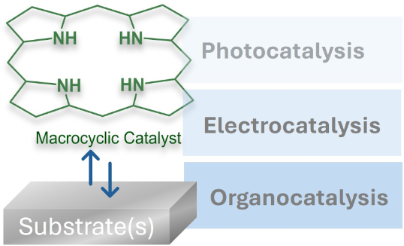
- metal-free macrocycles for the C–H arylation of five-membered heteroarenes using aryldiazonium salts, with porphyrin serving as the photoredox catalyst [92]. Control experiments indicated that H2TPP (18), when irradiated with light, gave 80% yield of the C–H arylated product 77 for the reaction of furan
- red light irradiation [97]. Firstly, they evaluated the photoreductant role of metal-free macrocycles, H2TPP (18) and PPIX 78, in the red light-induced C–H arylation of different substrates such as furan, coumarin, thiol, pivalamide, aryl thiaether and the selenium equivalents. Use of both macrocycles
- combining the organocatalytic and photocatalytic potential of porphyrin macrocycles [98]. In 2024, Gupta and colleagues expanded on the success of free base porphyrin macrocycles as photoredox catalysts by introducing meso-arylcorroles (types A3 and A2B) for C–H arylation and borylation reactions activated


Advances in radical peroxidation with hydroperoxides
Beilstein J. Org. Chem. 2024, 20, 2959–3006, doi:10.3762/bjoc.20.249
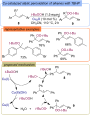
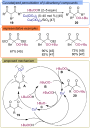
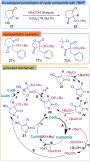
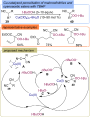
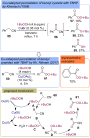
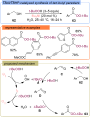
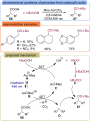
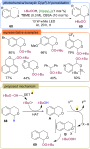
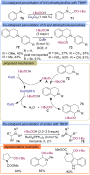
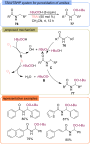
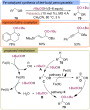
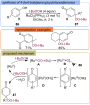
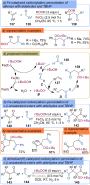
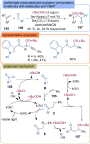
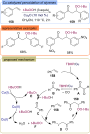
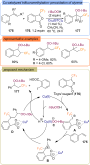
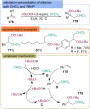
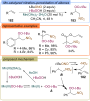
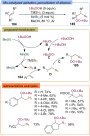
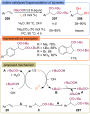
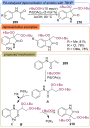
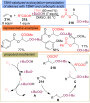
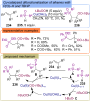
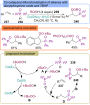
- . Keywords: C–H functionalization; oxidation; peroxidation; radical reactions; TBHP; Introduction Organic peroxides are used in many different areas of human activities. The traditional and most developed field is the use of peroxides as initiators in the polymerization process for the production of a wide
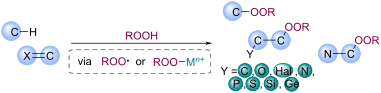
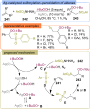
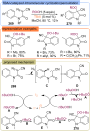
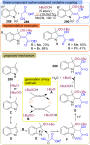
- broad, the present review mainly focused on radical and metal-catalyzed functionalization of C–H bonds or unsaturated bond with hydroperoxides (Scheme 2). The aim of this review is to cover recent studies in which alkylperoxy radicals have been used for the peroxidation of C(sp3) and C(sp2) sites
- ROOH, but most of them were published after 2010. Review C(sp3)–H peroxidation Allylic C(sp3)–H The pioneering work on C–H radical peroxidation with hydroperoxides was published by Kharasch in a series of articles entitled "The Chemistry of Hydroperoxides" in the 1950s [24][37][38]. Kharasch with





























Recent advances in transition-metal-free arylation reactions involving hypervalent iodine salts
Beilstein J. Org. Chem. 2024, 20, 2891–2920, doi:10.3762/bjoc.20.243

- easily recycled just by washing it with ethanol, retaining its catalytic activity for arylation up to three cycles without any compromise. Thus, this procedure could be considered economic as well as environment-friendly. In 2019, Kalek and co-workers reported the regioselective C–H arylation of 2
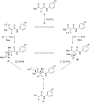
- –acceptor (EDA) complex. The complex is formed of triphenylphosphine, sodium iodide and N,N,N,N-tetramethylethylenediamine (TMEDA) with diaryliodonium reagents (DAIRs) [64]. This activates DAIRs 16 to generate an aryl radical which is utilized in the C–H arylation of various heterocycles 31 to yield the




C–H Trifluoromethylthiolation of aldehyde hydrazones
Beilstein J. Org. Chem. 2024, 20, 2883–2890, doi:10.3762/bjoc.20.242
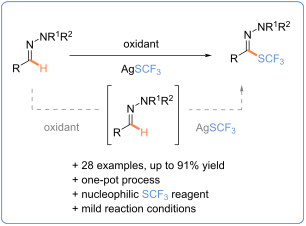
- /Education Center for Excellence in Molecular Sciences Institute of Chemistry, Chinese Academy of Sciences, Beijing 100190, China 10.3762/bjoc.20.242 Abstract The selective C–H trifluoromethylthiolation of aldehyde hydrazones afforded interesting fluorinated building blocks, which could be used as a
- ). Mechanistic investigations revealed that AgSCF3 was the active species in the transformation. Keywords: C–H bond functionalization; C–S bond formation; hydrazones; synthetic method; trifluoromethylthiolation; Introduction Fluorinated molecules are of paramount importance [1][2][3][4][5][6][7][8][9][10][11
- various transformations [54][55][56][57][58][59][60][61][62][63][64]. In consequence, a large number of transition-metal-catalyzed or radical-mediated processes for C–H functionalization of aldehyde hydrazones has flourished over the years. An ideal scenario for a direct and sustainable synthetic route



Interaction of a pyrene derivative with cationic [60]fullerene in phospholipid membranes and its effects on photodynamic actions
Beilstein J. Org. Chem. 2024, 20, 2732–2738, doi:10.3762/bjoc.20.231
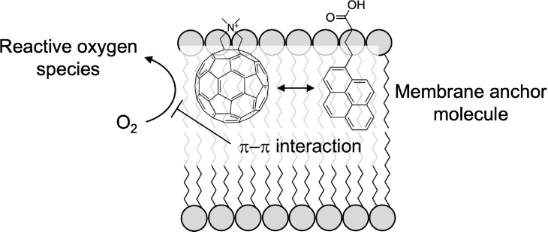
- ). Measurements were performed following equilibration at 10 °C at a scan rate of 180 °C/h. Measurements were also performed after mixing of 50, 100 or 500 µM PyBA (Sigma-Aldrich, St. Louis, MI, USA) and DMPC liposomes without catC60 or C60 followed by dialysis of the mixture against 3 L PBS for 2 h to remove


Transition-metal-free synthesis of arylboronates via thermal generation of aryl radicals from triarylbismuthines in air
Beilstein J. Org. Chem. 2024, 20, 2577–2584, doi:10.3762/bjoc.20.216
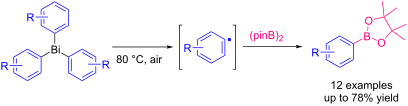
- with halogen or triflate groups. Recently, transition-metal-catalyzed direct borylation of arenes via C–H bond activation has been reported, although the design of the substrate and ligands is somewhat complicated [16][17][18][19][20][21][22]. Since the complete removal of catalyst-derived metal



Anion-dependent ion-pairing assemblies of triazatriangulenium cation that interferes with stacking structures
Beilstein J. Org. Chem. 2024, 20, 2567–2576, doi:10.3762/bjoc.20.215
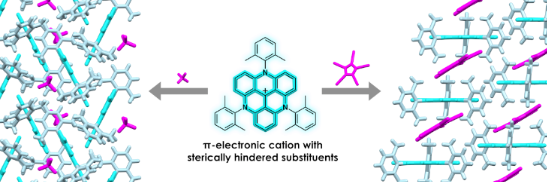
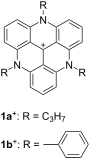
- intermolecular C–H···π interactions between the proximally located CH3 and TATA+ units, as obtained by the Hirshfeld surface analysis (Figure 4) [33][34][35][36]. The arrangement of the ion pairs depended on the counteranions, which formed different interactions. Smaller counteranions were located above the
- electron-deficient TATA+ core through the interactions of the methyl units. In fact, in 2+-Cl−, Cl− was located 3.43 Å above the TATA+ core and was interacted with the surrounding CH3 units, with C(–H)···Cl− distances of 3.74, 3.85, and 3.96 Å (Figure 3a, Figure 5a and Figure S17 in Supporting Information
- File 1). As a crystallization solvent, three CHCl3 molecules were located between the 2,6-dimethylphenyl units by forming hydrogen bonding with Cl− with C(–H)···Cl− distances of 3.36, 3.36, and 3.37 Å. A similar arrangement of the counteranions was observed for 2+-BF4− and 2+-PF6−, with the BF4− and



A review of recent advances in electrochemical and photoelectrochemical late-stage functionalization classified by anodic oxidation, cathodic reduction, and paired electrolysis
Beilstein J. Org. Chem. 2024, 20, 2500–2566, doi:10.3762/bjoc.20.214
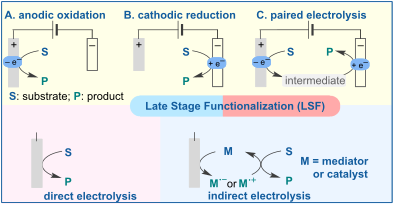
- been systematically summarized, classifying them by targeted C–H bond functionalization and the newly formed bonds [4][5]. In this review, we aim to provide a comprehensive classification and overview of the currently available electrochemical and photoelectrochemical methods for the LSF of
- industrial settings. An anodic oxidation is frequently employed for C–H functionalization, which can simplify late-stage functionalization strategies. Additionally, many of these synthetic methods do not require precious metals, enhancing their appeal in terms of sustainability and cost-effectiveness
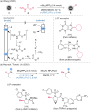
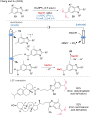
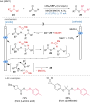
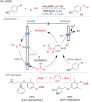
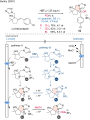
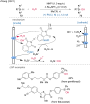
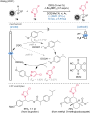
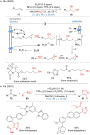
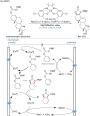
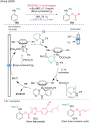
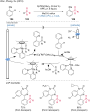
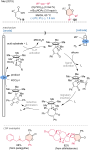
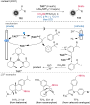
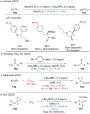
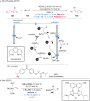
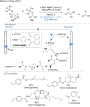
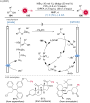
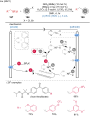
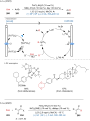
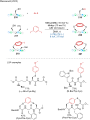
- in schemes as H2↑) in the cathodic half-reaction, which will however not be addressed in greater detail in this review. 1.1 Direct anodic oxidation of substrates 1.1.1 C–H bond functionalization. C–H bond carbofunctionalization: CF3 groups can be installed on heteroarenes at a late stage via a TM




























Hypervalent iodine-mediated cyclization of bishomoallylamides to prolinols
Beilstein J. Org. Chem. 2024, 20, 2455–2460, doi:10.3762/bjoc.20.209
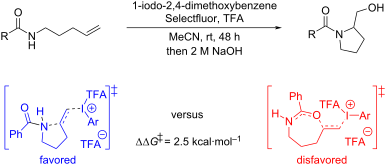
- provided slight improvements in yield (Table 1, entries 2–4). The more electron-rich 2-iodo-1,3-dimethoxybenzene led to a further increase in yield to 44% (Table 1, entry 5). 1,2-Diiodobenzene has been reported to be a superior precatalyst in intermolecular C–H aminations of arenes but only provided 40


Synthesis and conformational analysis of pyran inter-halide analogues of ᴅ-talose
Beilstein J. Org. Chem. 2024, 20, 2442–2454, doi:10.3762/bjoc.20.208
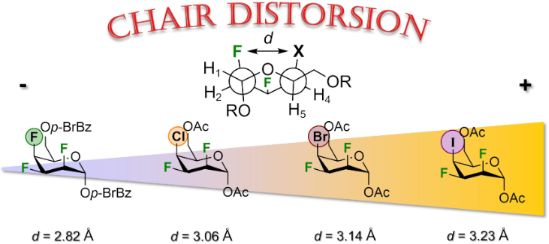
- exception being bromine). Dipole moments for the 4C1 structures are 2 Debye larger than for 1C4 structures, making them substantially more stable in chloroform. Both chair structures have multiple C–F bonds in gauche arrangements which are stable due to hyperconjugation: there is donation from C–H bonding
- NBO to an unoccupied NBO that would stabilize the system. The results are presented in Table 9. In both cases, there is also donation from the halogen lone pairs to C–H and C–C antibonding orbitals, but as these effects were near equivalent in both chair structures, they are omitted. Conclusion We


Synthesis, electrochemical properties, and antioxidant activity of sterically hindered catechols with 1,3,4-oxadiazole, 1,2,4-triazole, thiazole or pyridine fragments
Beilstein J. Org. Chem. 2024, 20, 2378–2391, doi:10.3762/bjoc.20.202
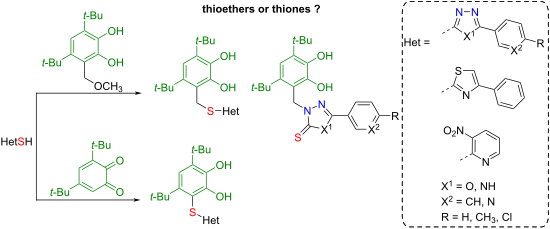
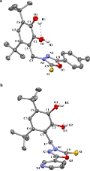
- ) Å, the angle O1–H1–O4 106°; O1–H1···O4A: the H1···O4 distance is 2.82(1) Å, the O1···O4 distance is 3.146(3) Å, the angle O1–H1–O4 101°, Figure 3). Additionally, the packing of these chains in the crystal is caused by the intermolecular C–H···O and N–O···π contact. Catechol 6 in crystal also forms




Hydrogen-bond activation enables aziridination of unactivated olefins with simple iminoiodinanes
Beilstein J. Org. Chem. 2024, 20, 2305–2312, doi:10.3762/bjoc.20.197
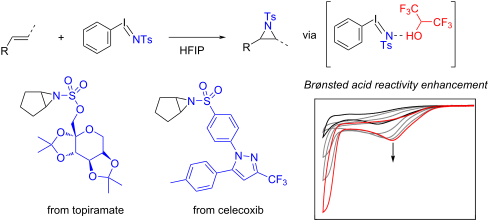
- ), Koser’s reagent (PhI(OH)OTs), Zhdankin’s reagent (C6H4(o-COO)IN3, ABX), and Dess–Martin periodinane (DMP) – and find application in an array of synthetically important transformations including olefin difunctionalization, carbonyl desaturation, alcohol oxidation, and C–H functionalization [3][4


Deuterated reagents in multicomponent reactions to afford deuterium-labeled products
Beilstein J. Org. Chem. 2024, 20, 2270–2279, doi:10.3762/bjoc.20.195
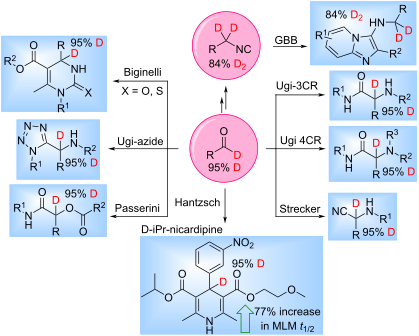
- [D3]-formamide. The ability to deuterate at benzylic positions is particularly relevant as benzylic C–H bonds are common in biologically relevant chemotypes and moreover appear in approximately 25% of the top selling 200 pharmaceuticals [23]. Benzyl cation stability is a driver of metabolism at these
- sites where benzylic C–H bonds readily undergo metabolism driven by cytochrome P450 oxidases via single-electron oxidation [24]. This metabolic lability may be tempered by hydrogen replacement with deuterium, an almost perfect bio-isosteric replacement (C–H to C–D) which maintains 3D surface, shape and
- flexibility [8]. Indeed, early incorporation of deuterium during hit generation may negate the need for late-stage C–H functionalization which often requires strong external oxidants or affords products with significantly lower biological activity [25][26][27]. Thus, eight MCRs were evaluated for D-reagent


Heterocycle-guided synthesis of m-hetarylanilines via three-component benzannulation
Beilstein J. Org. Chem. 2024, 20, 2208–2216, doi:10.3762/bjoc.20.188
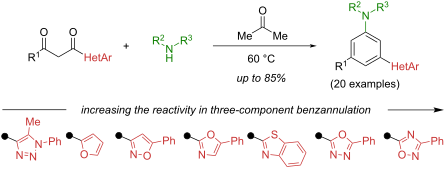
- mainly via metal-catalyzed C–N or C–C bond formation. Despite recent advances in the area of remote C–H functionalization, this strategy still requires some pre-functionalization of the starting material or the use of directing groups [28][29][30][31][32]. An alternative strategy is based on aromatic


From perfluoroalkyl aryl sulfoxides to ortho thioethers
Beilstein J. Org. Chem. 2024, 20, 2108–2113, doi:10.3762/bjoc.20.181
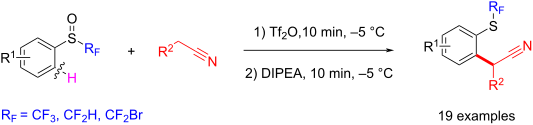
- study, many research groups described a strategy for ortho-C–H functionalization of aryl sulfoxides with various nucleophiles via a cascade reaction of interrupted Pummerer reaction/sigmatropic rearrangement (Scheme 1a) [6][7][8][9][10][11]. A large range of nucleophiles, such as phenols [12][13][14][15



Harnessing the versatility of hydrazones through electrosynthetic oxidative transformations
Beilstein J. Org. Chem. 2024, 20, 1988–2004, doi:10.3762/bjoc.20.175
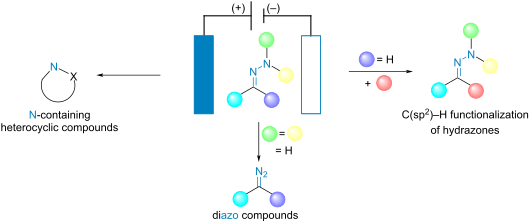
- access to diazo compounds as either synthetic intermediates or products. A special attention is paid to the reaction mechanism with the aim to encourage further development in this field. Keywords: C–H functionalization; diazo compound; electrosynthesis; hydrazone; nitrogen-containing heterocycle








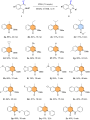
Solvent-dependent chemoselective synthesis of different isoquinolinones mediated by the hypervalent iodine(III) reagent PISA
Beilstein J. Org. Chem. 2024, 20, 1914–1921, doi:10.3762/bjoc.20.167
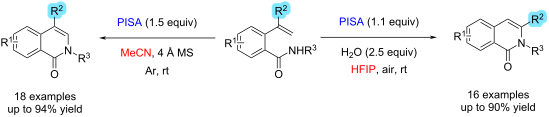
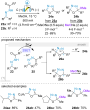
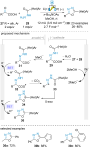
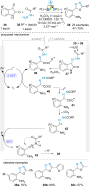
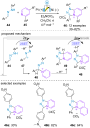
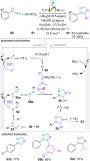
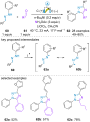
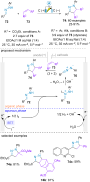
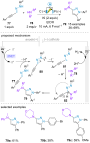
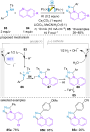
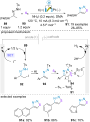
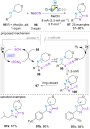
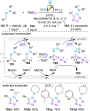
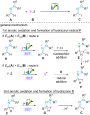
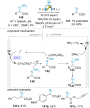
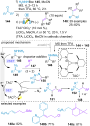
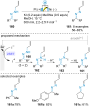
- isoquinolinone derivatives. The method provides highly chemoselective access to 3- or 4-substituted isoquinolinone derivatives by reacting o-alkenylbenzamide derivatives with PISA in either acetonitrile or wet hexafluoro-2-isopropanol. Keywords: annulation; C–H amination; hypervalent iodine reagent; iodine(III
- zwitterionic water-soluble hypervalent iodine reagent (phenyliodonio)sulfamate (PISA). In water, PISA is strongly acidic, and the pH value can reach 2.05 in a saturated aqueous solution. With PISA, various indoles have been synthesized via C–H amination of 2-alkenylanilines involving an aryl migration




Access to 2-oxoazetidine-3-carboxylic acid derivatives via thermal microwave-assisted Wolff rearrangement of 3-diazotetramic acids in the presence of nucleophiles
Beilstein J. Org. Chem. 2024, 20, 1894–1899, doi:10.3762/bjoc.20.164

- cyclization [15][16]. Additionally, the manganese(III)-promoted cyclization of N-alkenyl malonamides [17][18] and the Cu(I)-catalyzed reaction of propiolic acid derivatives with nitrones (Kinugasa reaction) [19][20][21] should also be mentioned, as well as intramolecular C–H insertion using


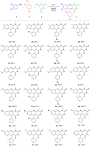
A facile three-component route to powerful 5-aryldeazaalloxazine photocatalysts
Beilstein J. Org. Chem. 2024, 20, 1831–1838, doi:10.3762/bjoc.20.161
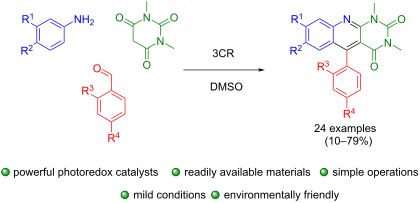
- (All) and also 5-deazaflavins (dFl) and 5-deazaalloxazines (dAll), where the N(5) atom of the isoalloxazine/alloxazine core is replaced by a C–H moiety (Figure 1A). In particular, 5-deazaflavins have generated considerable interest from scientists to study flavin-catalysed reactions in enzymatic and




Synthesis and characterization of 1,2,3,4-naphthalene and anthracene diimides
Beilstein J. Org. Chem. 2024, 20, 1767–1772, doi:10.3762/bjoc.20.155
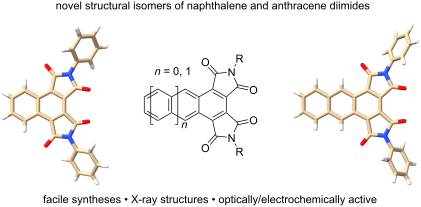
- steric demands of the N-phenyl groups, there are also C–H···π interactions between phenyl groups of adjacent π stacks, with the closest Ph centroid to H distance being 2.613 Å (Figure 2a). Additionally, the middle carbonyl oxygens are in short contact (2.376 Å) with the 7- and 8-H atoms of the
- from the title compounds. Despite this different packing mode within the stack, the interstack interactions exhibited by 8-Ph are similar to those found in 7-Ph. Although there are still observable C–H···π interactions and C=O···H–C interactions between stacks, they appear to be weaker, as evidenced by
- -Ph as determined by X-ray crystallography. Representative C=O···H–C and C–H···π interactions are indicated in teal and magenta, respectively. Top-down views of π-stacking modes in c) 7-Ph and d, e) 8-Ph. Hydrogen atoms have been removed for clarity in c–e. Atom color code: C = tan, H = white, Cl


Syntheses and medicinal chemistry of spiro heterocyclic steroids
Beilstein J. Org. Chem. 2024, 20, 1713–1745, doi:10.3762/bjoc.20.152
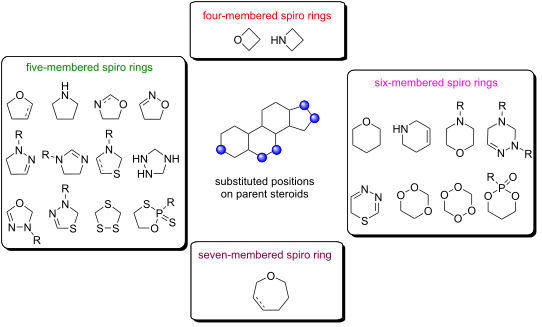
- -Methylene spirolactones at C-3 11a and 11b derived from dihydrocholesterol and stanolone were also obtained in 41% and 52% yields, respectively (dr > 20:1) (Scheme 3). More recently, a functionalized spiro-β-lactone was obtained via a metal-free procedure involving photoinduced carbene C–H insertion in a
- C–H insertion to produce the spiro-β-lactone was accomplished by simply exposing the diazo derivative to 440 nm blue LEDs (Kessil lamp) at 50 °C, that favored the formation of a singlet carbene that reacted selectively by insertion into the C(3)–H bond. Spiro-lactones 14 were obtained in 80% yield





