Search results
Search for "room temperature" in Full Text gives 2203 result(s) in Beilstein Journal of Organic Chemistry. Showing first 200.
Semisynthetic derivatives of massarilactone D with cytotoxic and nematicidal activities
Beilstein J. Org. Chem. 2025, 21, 607–615, doi:10.3762/bjoc.21.48
- ), solvent A: H2O + 0.1% formic acid; solvent B: acetonitrile (ACN) + 0.1% formic acid, gradient: 5% B for 0.5 min, increasing to 100% B in 20 min, maintaining isocratic conditions at 100% B for 10 min, flow = 0.6 mL/min, UV–vis detection 190–600 nm]. Preparative HPLC was achieved at room temperature on an
- mixture was stirred at room temperature overnight. The reaction mixture was suspended in water (25 mL) and extracted with CH2Cl2 (2 × 25 mL). The combined organic layer was evaporated to dryness to give a residue, which was dissolved in methanol (300 μL) and purified by preparative HPLC [ChemStation
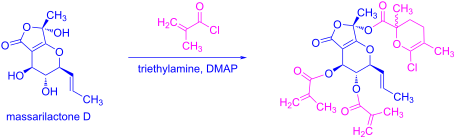
- , 0.062 mmol) was dissolved in CH2Cl2 (10 mL). Triethylamine (20 μL) and cinnamoyl chloride (50 mg, 0.30 mmol) were added to the solution. After adding a catalytic amount of 4-dimethylaminopyridine, the reaction mixture was stirred at room temperature overnight. The reaction mixture was suspended in water


Formaldehyde surrogates in multicomponent reactions
Beilstein J. Org. Chem. 2025, 21, 564–595, doi:10.3762/bjoc.21.45
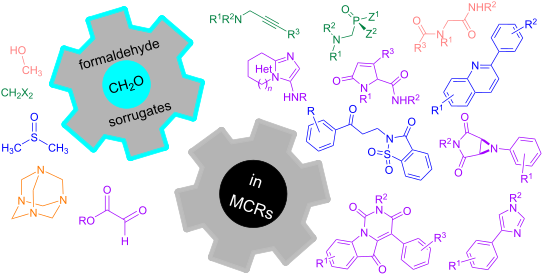
- occurred at room temperature. The mild reaction conditions for both strategies (“free” or immobilized glyoxylic acid) allows for a broad scope in terms of 2-aminoazines and isocyanide components (some examples are shown in Scheme 34). It is important to note that these imidazo heterocycles have been


Vinylogous functionalization of 4-alkylidene-5-aminopyrazoles with methyl trifluoropyruvates
Beilstein J. Org. Chem. 2025, 21, 533–540, doi:10.3762/bjoc.21.41
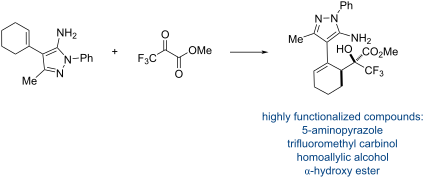
- (Table 1). First, we tried several solvents (dichloromethane, toluene and dichloroethane, entries 1–3 in Table 1) at room temperature, obtaining product 5aaa in yields around 50% with high diastereoselectivity (up to 6:1) after several days. Increasing the temperature to 50 °C (Table 1, entries 4 and 5



Deep-blue emitting 9,10-bis(perfluorobenzyl)anthracene
Beilstein J. Org. Chem. 2025, 21, 515–525, doi:10.3762/bjoc.21.39
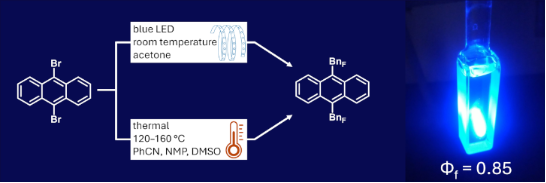
- Abstract A new deep-blue emitting and highly fluorescent anthracene (ANTH) derivative containing perfluorobenzyl (BnF) groups, 9,10-ANTH(BnF)2, was synthesized in a single step reaction of ANTH or ANTH(Br)2 with BnFI, using either a high-temperature Cu-/Na2S2O3-promoted reaction or via a room-temperature
- were shown to form from ANTH(RF)n derivatives within minutes at room temperature in the presence of oxygen when irradiated with a high pressure mercury lamp [32]. When 9,10-bis(perfluorooctyl)anthracene was dissolved in CHCl3 and irradiated for 350 minutes, photodecomposition was observed. However, the
- . The new compounds 9-ANTH(BnF) and 9,10-ANTH(BnF)2 were prepared in varying amounts using several synthetic procedures, including conventional high-temperature Cu-/Na2S2O3-promoted reactions and a room-temperature photochemical reaction. The former approach resulted in challenging work-ups, low yields





Unprecedented visible light-initiated topochemical [2 + 2] cycloaddition in a functionalized bimane dye
Beilstein J. Org. Chem. 2025, 21, 500–509, doi:10.3762/bjoc.21.37
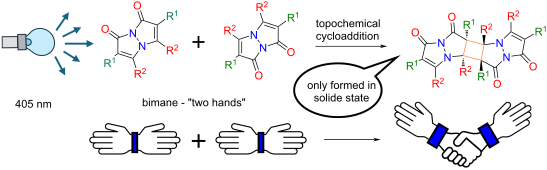
- included two additional bimane samples, Me2B and Me4B. These samples were crystallized from a MeOH–DCM 1:1 (v/v) mixture which was left to slowly evaporate over the course of several days at room temperature, followed by single-crystal X-ray diffraction to determine their structure (Figure 4) and crystal
- )bimane (DMOCDO10) and syn-(Me,Me)bimane (DXABIM10) [26], a room temperature structure of Me4B (TNZBCO10) [27], and a planar syn-(H,ethynyl)bimane (WAYHEJ) [28]. Optical properties The optical properties of the three bimanes were measured to investigate differences in their excited state properties, as
- 1:1 (v/v) solution which was left to evaporate at room temperature over the course of a few days. Photophysical properties Fluorescence spectra were measured on a Horiba FluoroMax Plus spectrofluorimeter. UV–vis spectra were measured on a Shimadzu UV-1900i UV–vis spectrophotometer. Absorption and


Synthesis of electrophile-tethered preQ1 analogs for covalent attachment to preQ1 RNA
Beilstein J. Org. Chem. 2025, 21, 483–489, doi:10.3762/bjoc.21.35
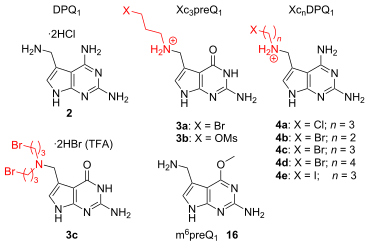
- methanol (1.3 mL). Anhydrous magnesium sulfate (340 mg, 2.82 mmol, 10 equiv) and the respective amino alcohol (2.82 mmol, 10 equiv) were added. The mixture was sonicated for 30 minutes and subsequently stirred at room temperature for 16 h. After cooling to 0 °C, sodium borohydride (96.1 mg, 2.54 mmol, 9
- equiv) was added in portions over the course of 1 h. The mixture was stirred for additional 2.5 h at room temperature. Afterwards, the volatiles were removed under reduced pressure and the residue was taken up in dilute aqueous acid (for composition see individual experiments in Supporting Information


Organocatalytic kinetic resolution of 1,5-dicarbonyl compounds through a retro-Michael reaction
Beilstein J. Org. Chem. 2025, 21, 473–482, doi:10.3762/bjoc.21.34
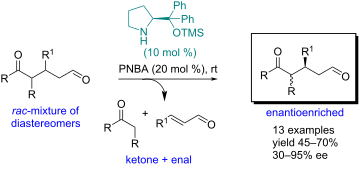
- low catalyst loadings and mild reaction conditions. This research focuses on the kinetic resolution of 1,5-dicarbonyl compounds using a retro-Michael reaction, co-catalyzed at room temperature with 20 mol % of the Jørgensen–Hayashi catalyst and PNBA. The study highlights the importance of conducting
- ] using 20 mol % of catalyst A and 20 mol % of p-nitrobenzoic acid (PNBA) as co-catalyst in different solvents at room temperature. The results obtained are summarized in Scheme 3 and Table 1. The progress of the reaction was monitored using thin-layer chromatography (TLC) and 1H NMR analysis of the
- excess reached is lower than at room temperature. Additionally, when the reaction mixture was stirred at −18 °C, no change was observed after 100 hours (entry 14, Table 2). These results led us to raise the reaction temperature to 31 °C (entries 17–20, Table 2). We observed that the retro-Michael


Photomechanochemistry: harnessing mechanical forces to enhance photochemical reactions
Beilstein J. Org. Chem. 2025, 21, 458–472, doi:10.3762/bjoc.21.33

- Na2CO3 was ground in a mortar at room temperature for 3–5 min. Second, the reaction mixture was transferred into a quartz tube, heated to 50 °C (heating mantle) for 18 h, while being irradiated with blue LEDs under air-equilibrated conditions. In these conditions, product 3.3 was isolated in excellent




Electrochemical synthesis of cyclic biaryl λ3-bromanes from 2,2’-dibromobiphenyls
Beilstein J. Org. Chem. 2025, 21, 451–457, doi:10.3762/bjoc.21.32
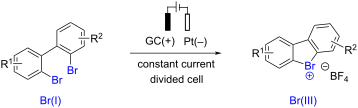
- required thermal decomposition of the diazonium salt to effect the cyclization. In the quest for mild (room temperature) and scalable conditions toward cyclic diaryl λ3-bromanes 1 we realized that bromanyl units possess leaving group abilities comparable to the diazonium moiety [1][15]. Hence, the


The effect of neighbouring group participation and possible long range remote group participation in O-glycosylation
Beilstein J. Org. Chem. 2025, 21, 369–406, doi:10.3762/bjoc.21.27
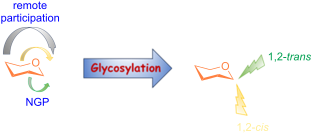
- room temperature was the only difference with the pivaloyl group. Protecting the C-2 hydroxy group as ADMB ester yielded 1,2-trans glycosides in high yields. However, its participating mechanism is still unclear. So, we reserve our views on placing the use of ADMB as potential neighbouring group




Synthesis, structure, ionochromic and cytotoxic properties of new 2-(indolin-2-yl)-1,3-tropolones
Beilstein J. Org. Chem. 2025, 21, 358–368, doi:10.3762/bjoc.21.26
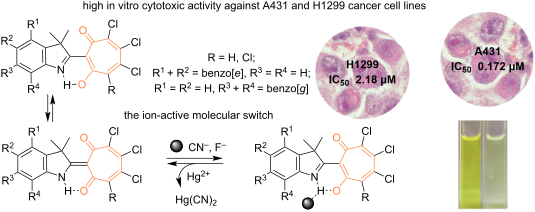
- corresponding solution (1 mL) and the tetra-n-butylammonium salt (1 mL) solution were mixed directly in the cell and thoroughly stirred. Hence, the working concentrations of compounds 7 or 8 and anions was 2.5 × 10⁻⁵ mol L−1 and 5.0 × 10⁻⁵ mol L−1, respectively. All spectral experiments were performed at room
- temperature (23 °C). Chromatography was carried out on columns filled with Al2O3 of II–III degree of activity according to Brockmann. Melting points were determined on a Fisher-Johns melting point apparatus. 1,1,2-Trimethyl-1H-benzo[e]indolenine (2a, 98%, Alfa Aesar), 2,3,3-trimethyl-3H-benzo[g]indolenine (2b




Synthesis of new condensed naphthoquinone, pyran and pyrimidine furancarboxylates
Beilstein J. Org. Chem. 2025, 21, 340–347, doi:10.3762/bjoc.21.24
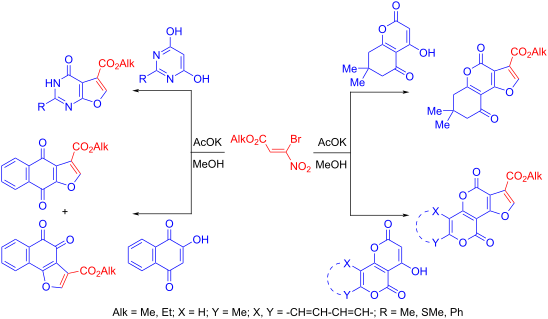
- -nitroacrylates 1a,b with 2-hydroxynaphthalene-1,4-dione (2a). The reaction proceeds successfully in a methanol solution in the presence of AcOK for 3 h at room temperature, resulting in the formation of a mixture of alkyl 4,9-dioxo-4,9-dihydronaphtho[2,3-b]furan-3-carboxylate 3a,b and alkyl 4,5-dioxo-4,5
- -c]chromene-3-carboxylates 5a,b with a yield of 84–85% were obtained under the same conditions as a result of the interaction of bromonitroacrylates 1a,b with 4-hydroxy-7,7-dimethyl-7,8-dihydro-2H-chromene-2,5(6H)-dione (2b) (ratio acrylate/CH-acid/AcOK = 1:1:1.5, room temperature, 1 h) (Scheme 5
- Shimadzu UV-2401 PC spectrometer for samples in DMSO solutions in fused quartz cuvettes (optical path length 1.01 mm). Luminescence excitation spectra and luminescence spectra were recorded on a Shimadzu SF-6000 spectrofluorimeter in a 1 cm thick quartz cuvette at room temperature in a DMSO solution (c


Antibiofilm and cytotoxic metabolites from the entomopathogenic fungus Samsoniella aurantia
Beilstein J. Org. Chem. 2025, 21, 327–339, doi:10.3762/bjoc.21.23
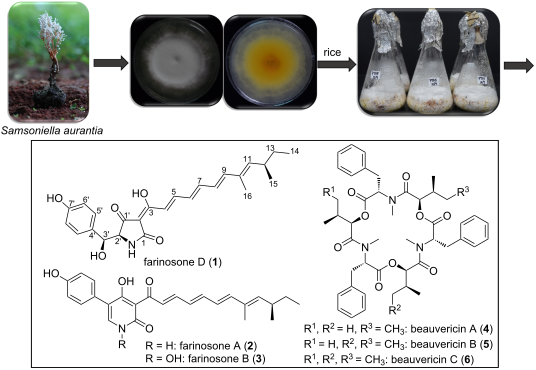
- mm, were inoculated with rice in 10 × 1 L Erlenmeyer flasks, each containing 180 g of rice and 180 mL of distilled water that were foremost autoclaved, and the mixture was incubated for 16 days under static conditions at room temperature until full mycelial growth was achieved. Upon reaching optimal


Molecular diversity of the reactions of MBH carbonates of isatins and various nucleophiles
Beilstein J. Org. Chem. 2025, 21, 286–295, doi:10.3762/bjoc.21.21
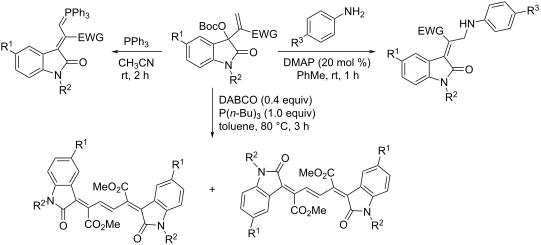
- resulted in a slight increase of the yield (entries 6 and 7 in Table 1). In the presence of 20 mol % of DMAP, the reaction in toluene at room temperature afforded the product 3a in 72% yield. However, increasing the amount of DMAP decreased the yield (entries 8–10 in Table 1). Additionally, stronger bases
- such as DABCO, DBU, triethylamine, and K2CO3 also resulted in the significant reduction of the yields. Therefore, the reaction of MBH nitrile of isatins and arylamines can be simply carried out in toluene at room temperature in the presence of a catalytic amount of DMAP. With the optimized reaction
- triphenylphosphine with MBH nitriles of isatins in acetonitrile at room temperature quickly gave red solid products 6a–d in high yields (Scheme 3). In this reaction, triphenylphosphine acted as a nucleophile to finish an allylic SN2 reaction. The obtained triphenylphosphaneylidenes are stable, which can be isolated



Oxidation of [3]naphthylenes to cations and dications converts local paratropicity into global diatropicity
Beilstein J. Org. Chem. 2025, 21, 277–285, doi:10.3762/bjoc.21.20
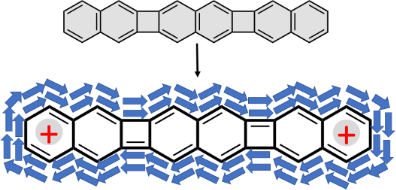
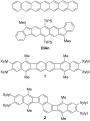
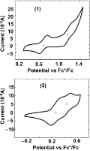
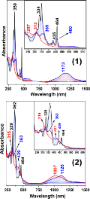
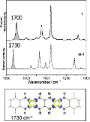
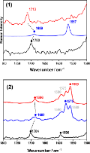
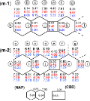
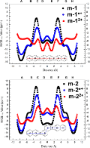
- , Me: methyl). Cyclic voltammograms of 1 and 2. UV–vis–NIR electronic absorption spectra of 1 (top) and 2 (bottom) during the electrochemical oxidation in 0.1 M n-Bu4N·PF6 in CH2Cl2 at room temperature. The traces are black lines for neutral, blue lines for radical cation, and red lines for dication


Three-component reactions of conjugated dienes, CH acids and formaldehyde under diffusion mixing conditions
Beilstein J. Org. Chem. 2025, 21, 262–269, doi:10.3762/bjoc.21.18
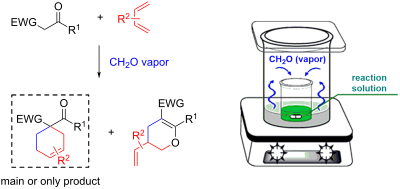
- generate crotonic condensation adducts of active methylene compounds and formaldehyde at room temperature in the absence of strong acids and bases. The formed adducts were highly reactive intermediates capable of reacting with dienes in a three-component reaction, leading to the formation of Diels–Alder
- –Alder products were isolated from the reaction mixtures. In the present study, we carried out similar three-component reactions under significantly milder conditions (room temperature), and the main or only [4 + 2]-cycloaddition products in most cases were carbocyclic ones. Results and Discussion
- in a high yield in the presence of ʟ-proline could be explained by the efficient crotonic condensation of formaldehyde and acetylacetone (1), followed by the addition of the second equivalent of diketone 1 to the highly reactive methylidene intermediate. The mild reaction conditions (room temperature


Effect of substitution position of aryl groups on the thermal back reactivity of aza-diarylethene photoswitches and prediction by density functional theory
Beilstein J. Org. Chem. 2025, 21, 242–252, doi:10.3762/bjoc.21.16
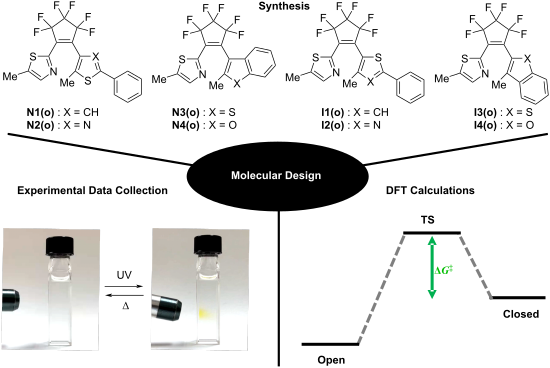
- which the photogenerated isomers are thermally unstable at room temperature and return to the initial isomers not only by photoreaction but also by the thermal back reaction, are utilized for eyeglass lenses [43], security inks [44], and real-time holograms [45]. Especially, it is important to control
- to N1(c)–N4(c), which is due to the localization of the π conjugation in the central part of the molecular skeleton as reported in inverse-type diarylethenes [64]. Figure 1c and the video (Supporting Information File 2) show the photochromic behavior of N4 at room temperature in n-hexane. It was
- -hexane at 253 K for N3 and 203 K for I3: open-ring isomer (black line) and under irradiation at 365 nm (yellow line). (c) Photochromic reaction of N4 in n-hexane at room temperature ([N4] = 7.0 × 10⁻⁴ M). Absorbance decay curves and first-order kinetics profiles for (a,b) N3 and (d,e) I3 in n-hexane at



Visible-light-promoted radical cyclisation of unactivated alkenes in benzimidazoles: synthesis of difluoromethyl- and aryldifluoromethyl-substituted polycyclic imidazoles
Beilstein J. Org. Chem. 2025, 21, 234–241, doi:10.3762/bjoc.21.15
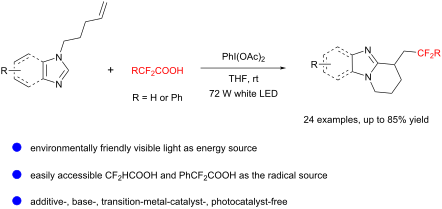
- reaction (Table 1). Employing PIDA as the promoter, THF as the solvent, and 72 W white LED as the light source, the desired product 3a formed in 85% isolated yield at room temperature (Table 1, entry 1). We found that the hypervalent iodine reagent was of significant importance for the present
- . Reaction conditions: 1 (0.2 mmol), 2 (1.4 mmol), and PIDA (0.8 mmol) in solvent (2 mL) irradiated with 72 W white LEDs at room temperature for 12 h under a N2 atmosphere. Yields refer to isolated yield. aα,α-Difluorobenzeneacetic acid (2 equiv) was used. Control experiments and plausible mechanism


Nickel-catalyzed cross-coupling of 2-fluorobenzofurans with arylboronic acids via aromatic C–F bond activation
Beilstein J. Org. Chem. 2025, 21, 146–154, doi:10.3762/bjoc.21.8
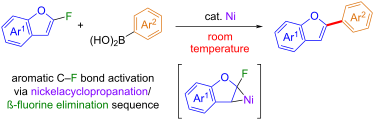
- catalyst, PCy3 (20 mol %) as a ligand, and K2CO3 (2.0 equiv) as a base, the desired arylated naphthofuran 3bb was obtained in 75% yield (Table 1, entry 1). Reducing the reaction temperature improved the yield of 3bb, reaching a quantitative yield when the reaction was performed at room temperature (Table 1
- , reductive elimination from G yields the coupling products 3. The following experiments were performed to elucidate the mechanism. Under the same conditions as the coupling reaction, stoichiometric amounts of Ni(cod)2, PCy3, and cod were treated with fluoronaphthofuran 1b at room temperature for 13 h
- mmol), and K2CO3 (50 mg, 0.36 mmol) were added toluene (3.0 mL) and H2O (0.6 mL). After stirring at room temperature for 13 h, the reaction mixture was diluted with H2O. Organic materials were extracted with diethyl ether three times. The combined extracts were washed with brine and dried over Na2SO4

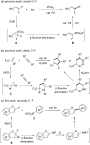
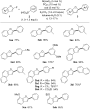


Cu(OTf)2-catalyzed multicomponent reactions
Beilstein J. Org. Chem. 2025, 21, 122–145, doi:10.3762/bjoc.21.7

- -workers in 2003 (Scheme 13) [28]. Working in acetonitrile at room temperature, very high yields were obtained with recycling of the catalyst with negligible loss of activity. The reaction is successful also by operating it in ethanol as a solvent under microwave irradiation [29]. More recently, the
- cascade reaction for the preparation of α-alkoxy-N-alkyltriazoles 44 that was developed starting from aliphatic aldehydes, alcohols, TMSN3 as azide source and alkynes (Scheme 33) [52]. The reaction occurs under mild conditions in acetonitrile at room temperature but is inhibited when using aromatic


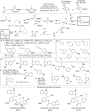
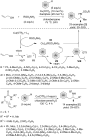








Hot shape transformation: the role of PSar dehydration in stomatocyte morphogenesis
Beilstein J. Org. Chem. 2025, 21, 47–54, doi:10.3762/bjoc.21.5
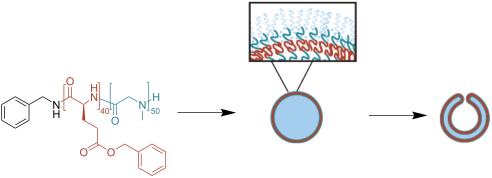
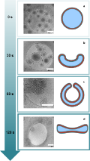
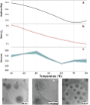
- room temperature with an organic solvent content of 33% The window for shape transformation seems to lie between 60 °C and 80 °C, with the best result being obtained at 70 °C (Figure 3). When the temperature is too low, the shape transformation cannot happen as the membrane is still too permeable


Facile one-pot reduction of β-nitrostyrenes to phenethylamines using sodium borohydride and copper(II) chloride
Beilstein J. Org. Chem. 2025, 21, 39–46, doi:10.3762/bjoc.21.4
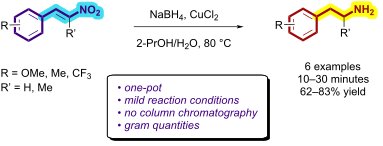
- structures both prior to and following the production of the target compounds. The application of mild heating is crucial to reach full conversion of the starting materials in the times indicated in Table 1. However, conversion to the desired products is also achievable at room temperature over 18 hour
- CuCl2 2 M solution were added dropwise but rapidly to the vessel. The reaction was monitored by TLC and refluxed at 80 °C in either oil bath or heating mantle for the time indicated in Table 1. General workup procedure of the amino products (1b–8b): Once cooled to room temperature, a 35% solution of
- ); 13C NMR (151 MHz, D2O) δ 122.41, 124.77, 129.01, 133.06; ESI-MS m/z: [M + 1]+ 171.0; found, 171.1; mp 190–191 °C. Benzyl alcohol (9b): The product formation was monitored by TLC using Hex/EtOAc (6:1). Once cooled to room temperature, the mixture was acidified with 20% HCl solution and extracted with


Synthesis, structure and π-expansion of tris(4,5-dehydro-2,3:6,7-dibenzotropone)
Beilstein J. Org. Chem. 2025, 21, 1–7, doi:10.3762/bjoc.21.1
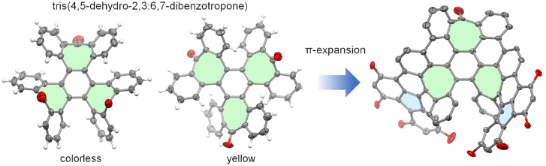
- room temperature yielded partially fused nanographene 3 (20%), with formation of six C–C bonds giving four six-membered rings and two five-membered rings. Performing this reaction at a higher temperature led to a lower yield of compound 3 and the formation of byproducts with lower Rf values on thin


Synthesis, characterization, and photophysical properties of novel 9‑phenyl-9-phosphafluorene oxide derivatives
Beilstein J. Org. Chem. 2024, 20, 3299–3305, doi:10.3762/bjoc.20.274
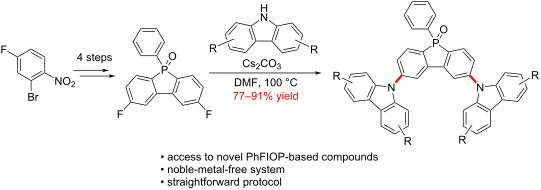
- were conducted. UV−vis absorption spectra of 7 in toluene solution at room temperature are shown in Figure 2, and the corresponding data are included in Table 2. The spectra in Figure 2a exhibit two major absorption bands at ≈290 nm and ≈340 nm. The band at around 290 nm might be induced by π→π
- has insignificant effect on the molecular ground state of 7-H. The PL spectra of the PhFlOP-based compounds 7 in toluene at room temperature are shown in Figure 3, and the λem values are included in Table 2. Different emission wavelengths are observed due to the various substituents present in the
- ORTEP drawing obtained using the X-ray crystallographic data of 7-H. (a) UV–vis absorption spectra of the PhFlOP-based emitters 7 measured at a concentration of ≈10−5 M in toluene at room temperature. (b) UV–vis absorption spectra of 7-H measured at a concentration of ≈10−4 M in different solvents at




Reactivity of hypervalent iodine(III) reagents bearing a benzylamine with sulfenate salts
Beilstein J. Org. Chem. 2024, 20, 3281–3289, doi:10.3762/bjoc.20.272
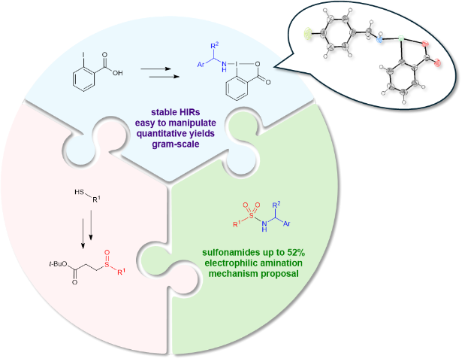
- conducted at room temperature for 20 hours, which resulted in a reduction of the yield for 5aa to 9% (Table 1, entry 5). This result might be due to the reactivity of this hypervalent iodine reagent. Indeed, we have previously observed that the transfer of the benzylamine moiety to carbon-based nucleophiles
- – room temperature. Scope of the primary amine electrophilic reaction of sulfenate salts. Reaction conditions: 4 (2 equiv), NaH (2.4 equiv), 2, degassed DMF (0.055 M). Isolated yields. rt – room temperature; NO – not observed. Electrophilic amination reaction in the presence of TEMPO. Reaction conditions